VP of Partnerships: Role, Responsibilities, and Bar

What is a VP of partnerships?
Short answer: A VP of partnerships is the executive who owns the partner channel as a revenue line, responsible for the strategy, the team, and the pipeline and revenue that partners source and influence. It is a revenue leadership role, not a relationship-management one, and the difference matters: a VP of partnerships is measured the way a sales VP is measured, on a number, not on how many partner logos they added or how good the relationships feel.
Many companies hire for the relationship version of this job and are surprised when the channel does not produce. They get a well-connected executive who builds goodwill and cannot point to pipeline.
The VP of partnerships who works owns partner-sourced revenue and runs the channel like the growth engine it is supposed to be.
Why the VP of partnerships role matters in 2026
Partnerships have moved from a nice-to-have to a board-level revenue channel, and that shift changed who should run them. When partnerships were about relationships and co-marketing, a connector could lead the function. Now that the function is measured on partner-sourced revenue, it needs an executive who can carry a number and build a team that produces one.
The stakes are visible in the market. The Chief Partner Officer and senior partnerships roles have been among the faster-growing executive titles, with growth cited in the mid-teens year over year, because companies are betting that a partner channel run by a real revenue leader outperforms one run as a networking function. In 2026, with direct acquisition costs climbing, that bet is getting more common, not less.
A VP of partnerships is also the person who makes the channel legible to the rest of the executive team. They translate partner activity into the language the CRO and CFO speak, pipeline, revenue, and cost, which is what earns the function budget and keeps it out of the first round of cuts.
How the VP of partnerships role actually works
The VP of partnerships role works as revenue leadership across five responsibilities: own the partner channel’s number, set the strategy for which partners produce it, build and lead the team that runs the motion, sell the function internally to the rest of the revenue org, and report partner-sourced revenue to the executive team in their language. Each responsibility ties back to production, and a VP who is strong on relationships but weak on the number is filling the role in title only. The parts below are what the role actually includes.
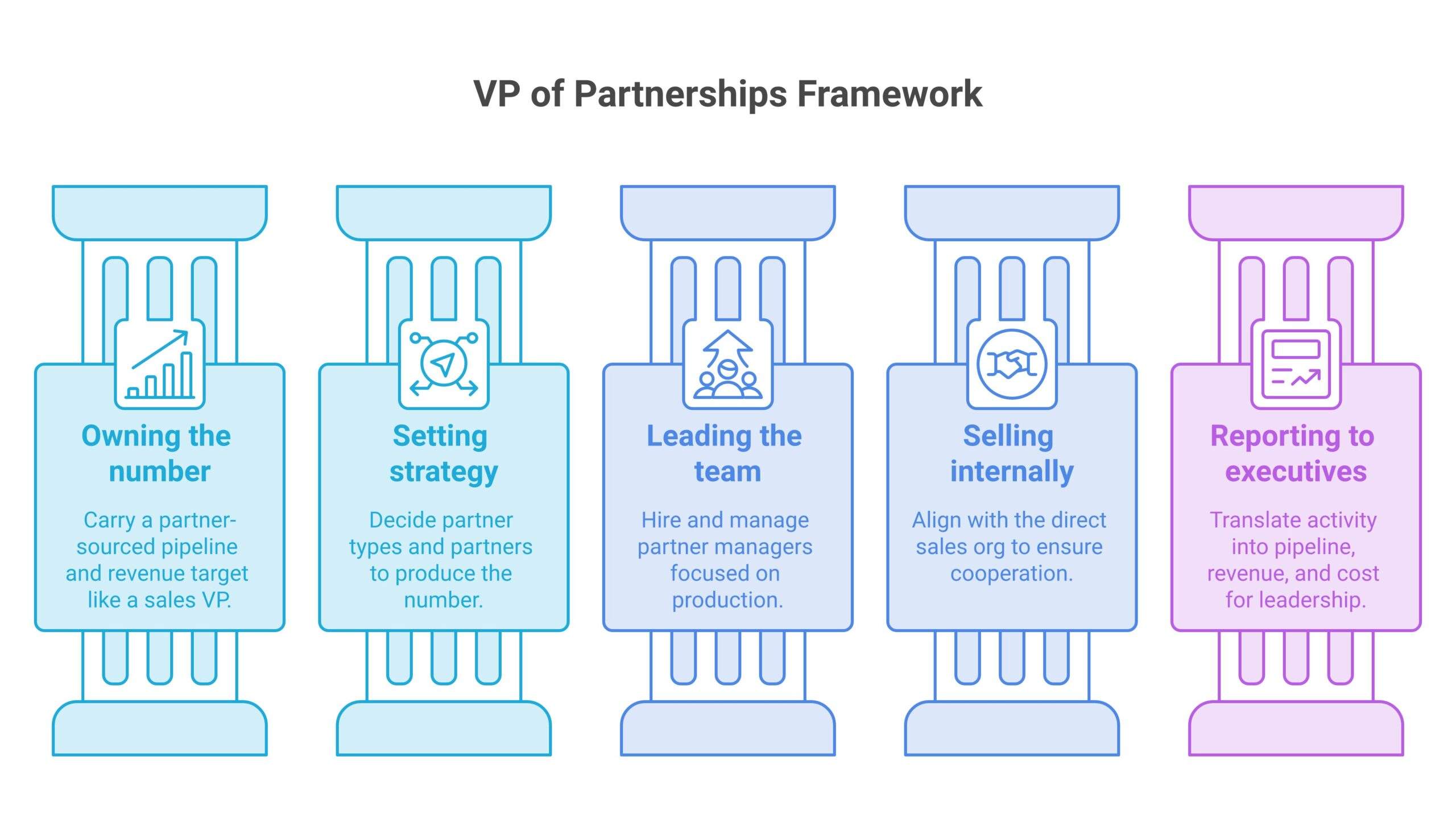
- Owning the number: Carry a partner-sourced pipeline and revenue target the way a sales VP carries quota. This is the responsibility that defines the role, and a VP of partnerships who cannot state their number and their progress against it is running a relationship function, not a revenue one.
- Setting strategy: Decide which partner types and which partners can produce the number, and build the program around them. Strategy is choosing where to concentrate the team’s finite attention, so it is deciding what not to do as much as what to do.
- Building and leading the team: Hire, develop, and manage partner managers who can execute the motion, and hold them to production, not activity. The VP’s leverage is the team, so the quality of the hiring and coaching determines the ceiling on what the channel produces.
- Selling internally: Win the alignment of the direct sales org, because co-sell only works when reps see partners as help rather than competition. This internal selling is often the hardest part of the job and the most overlooked in the hire.
- Reporting to the executive team: Translate partner activity into pipeline, revenue, and cost the CRO and CFO can act on. This is what turns the channel from a black box into a managed revenue line and secures its budget.
Common pitfalls in hiring a VP of partnerships
- Hiring for the network, not the number: A well-connected executive who cannot carry a target builds goodwill and no pipeline. Hire someone who has owned a partner-sourced revenue number before and can talk about it in specifics.
- Confusing the role with partner management: A VP of partnerships leads the function; they do not personally manage every partner relationship. A candidate who only describes relationship work is interviewing for the wrong level.
- No mandate for internal selling: If the VP cannot align the direct sales org, co-sell stalls no matter how good the partners are. The role needs the authority and the skill to sell partnerships inside the company.
- Measuring on activity: Judging the VP on partners signed, webinars run, or meetings held rewards motion over revenue. Measure them on partner-sourced pipeline, the same way you measure the rest of the revenue org.
- Hiring too senior too early: A pre-revenue program may need a hands-on builder before it needs a VP. Match the level of the hire to the stage of the program, or you buy strategy the program cannot yet use.
What this looks like in practice
A growth-stage company hired a VP of partnerships known for an enormous network and a warm reputation across the industry. A year in, the partner roster had grown, the relationships were genuinely good, and partner-sourced pipeline was a rounding error. The executive was excellent at the relationship version of the job and had never been asked to carry, or build a team around, a revenue number, so the channel produced connections instead of pipeline.
The company recut the role and hired against a different bar: a leader who had owned a partner-sourced revenue target, built a team of partner managers held to production, and knew how to align a skeptical direct sales org behind co-sell. The new VP set a number, focused the team on the partner types that could move it, and spent as much time selling partnerships internally as externally. Within a few quarters the channel was reporting real pipeline into the CRO’s forecast, and partnerships had a seat in the revenue review because it finally spoke the revenue org’s language. The lesson was that the role is a revenue job, and it has to be hired as one.
Forecastable’s POV on the VP of partnerships role
Our position is that a VP of partnerships is a revenue leader who happens to work through partners, and hiring them any other way is how the channel underperforms. The relationships matter, but they are the raw material, not the output. The output is partner-sourced pipeline, and a VP who cannot own and build a team around that number is filling a revenue seat with a relationship skill set.
The part of the role most companies underweight is internal selling. A VP of partnerships can have perfect partners and a sound strategy and still produce nothing if the direct sales org treats co-sell as a threat. Aligning sales behind partnerships is not a soft skill on the side of the job; it is often the job, and it is worth screening for as hard as external relationship-building.
Forecastable is a partnerships operating platform that connects partner conversations and actions to CRM pipeline and revenue, the flywheel of Conversations to Actions to Pipeline to Revenue. We work with revenue and partnerships leaders on running the channel as a measurable growth engine, and the VP of partnerships is the person who owns that engine, carries its number, and reports it in the language the rest of the executive team acts on.
Any third-party tools or firms referenced in this space are independent third-party products, and mentioning them is not an endorsement. Cited hiring and market figures belong to the third parties who published them. Define the role against your own program stage and revenue model before hiring for it.
Frequently asked questions
What does a VP of partnerships do? A VP of partnerships owns the partner channel as a revenue line, responsible for strategy, the team, internal alignment, and the pipeline and revenue partners source and influence. It is a revenue leadership role measured on a number, not on relationships.
How is a VP of partnerships different from a partner manager? A partner manager runs individual partner relationships and their deals. A VP of partnerships leads the whole function, sets strategy, builds the team, aligns the direct sales org, and owns the channel’s revenue target. It is a level of leadership above day-to-day partner management.
What should you measure a VP of partnerships on? On partner-sourced and partner-influenced pipeline and revenue tied to the CRM, the same way you measure a sales VP. Measuring on partners signed, webinars run, or meetings held rewards activity over the revenue the role exists to produce.
When should a company hire a VP of partnerships? When the partner channel is, or is ready to become, a real revenue line and needs an executive to carry its number and build a team. A pre-revenue program may need a hands-on builder first, so match the seniority of the hire to the stage of the program.
What is the most overlooked skill in a VP of partnerships? Internal selling. Co-sell stalls if the direct sales org sees partners as competition, so the VP has to align sales behind partnerships. Companies screen for external relationships and forget that aligning the internal org is often the harder half of the job.
Does a VP of partnerships need a sales background? Not necessarily a sales title, but they do need to have carried and delivered a revenue number and led a team against one. The role is revenue leadership, so the relevant experience is owning production, whatever function it came from.
Next step
If your partner channel has good relationships and flat pipeline, look at how the leadership role was defined and hired. A VP of partnerships is a revenue leader who owns partner-sourced pipeline, builds a team held to production, and aligns the sales org behind co-sell. Start your growth journey now to build a partner channel run as a revenue engine. The partner program hub frames how the role connects to the wider partnerships motion.
Uncover Your Growth Potential
Schedule a Discovery Call