B2B Partnerships Guide: How to Build a Program

What are B2B partnerships?
Short answer: B2B partnerships are formal relationships between two businesses that agree to work together to reach customers and produce revenue, spanning referral, reseller, technology, and strategic alliances. They are a go-to-market channel, not a networking exercise, and the ones that work are built backward from the revenue you want partners to help produce rather than forward from a signed agreement and a logo swap.
Most companies treat partnerships as relationship-building and hope revenue follows. It rarely does on its own.
The programs that produce start from a number, decide which partner types can move that number, and build everything else, enablement, co-sell, measurement, in service of it.
Why B2B partnerships matter in 2026
Buyers do not evaluate vendors in isolation. They buy inside an ecosystem of tools and advisors they already trust, and the partners sitting next to your product shape which vendor gets shortlisted. A partnership program is how you get into that trusted circle instead of shouting at it from outside.
The scale of the opportunity is hard to ignore. Omdia and Jay McBain have shown that 96% of the $5.3 trillion in tech-industry deals are partner-surrounded, meaning a partner is present in the buying motion whether or not you are organized to work through them. Partnership Leaders has found that partner-involved deals close 28% faster and run 13% larger. Those are the numbers a B2B partnerships program is built to capture.
In 2026, with direct acquisition costs rising and buyers more skeptical of vendor marketing, the reach and trust a good partner brings is one of the few durable advantages left. The catch is that it only shows up when the program is run as a revenue motion, not a relationship hobby.
How a B2B partnerships program actually works
A B2B partnerships program works as a revenue system built in sequence: define the revenue you want partners to produce, pick the partner types that can produce it, recruit against a clear profile, enable partners for the specific motion you expect them to run, co-sell deal by deal, and measure the whole thing against partner-sourced pipeline in the CRM. Each stage serves the number, and any stage built for its own sake becomes overhead. The parts below are what a working program includes.
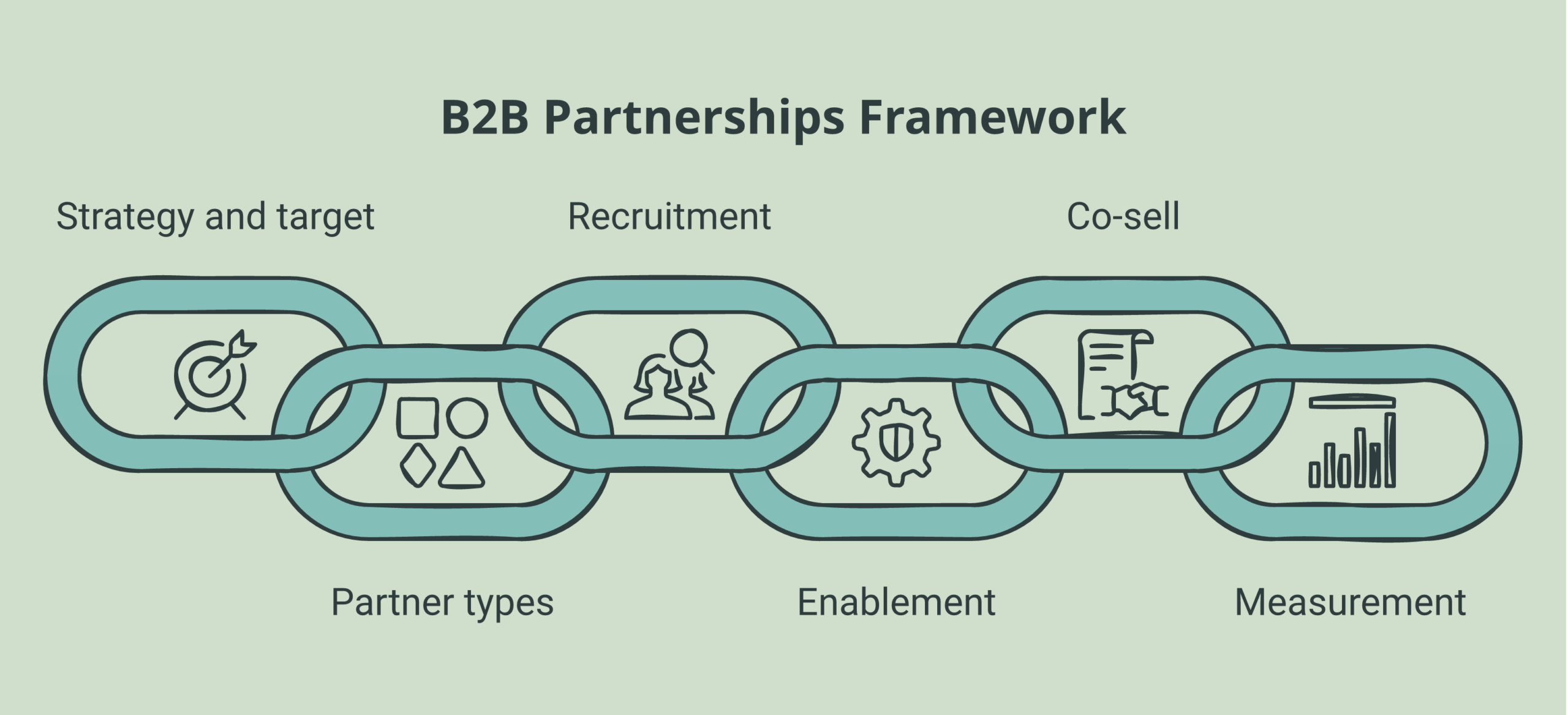
- Strategy and target: Start from the revenue you want partners to help produce and the customer segments you want them to reach. A program with a number to hit makes every later decision easier, because you can ask of any activity whether it moves that number.
- Partner types: Choose which kinds of partners fit your motion, referral partners who send leads, resellers who own the transaction, technology partners who integrate and co-market, and strategic partners who bring scale. Each behaves differently and needs different economics, so pick deliberately rather than signing whoever is willing.
- Recruitment: Recruit against a written ideal partner profile, targeting partners with real reach into your buyers and a reason to work with you. A smaller set of well-fit partners beats a large roster of convenient ones every time.
- Enablement: Arm partners with the assets, training, and co-sell support to actually sell your product, matched to the specific motion you expect them to run. Enablement is not a portal login, it is making the partner genuinely capable of producing.
- Co-sell: Put your sellers and the partner’s sellers in front of the same customer with a shared plan. Co-sell is where the program produces revenue, and it needs deal-level structure rather than a quarterly check-in.
- Measurement: Track the program by partner-sourced and partner-influenced pipeline tied to the CRM, not by signed logos or portal activity. Measurement is what turns the program from a cost center into a channel you can manage and grow.
Common pitfalls in B2B partnerships
- Signing partners before you have a strategy: A roster assembled from whoever was willing produces a program built for no one in particular. Decide what you want partners to produce first, then recruit for it.
- Counting logos as results: A partner count is activity, not revenue. Twenty partners producing pipeline beat two hundred who signed and went quiet, and celebrating roster size measures the wrong thing.
- Enablement that is just access: Handing partners a portal login and calling it enablement leaves them unable to sell. Real enablement makes a partner capable of producing, which takes assets, training, and support.
- No co-sell motion: A program that recruits and enables but never puts sellers in front of customers together stops short of the step that produces revenue. Co-sell is the point, not an afterthought.
- No line to CRM revenue: If you cannot see which partners source or influence pipeline, you can report program size but not manage a channel. Measurement is what makes the program defensible.
What this looks like in practice
A B2B software company spent a year building partnerships the way most do: it signed forty partners across every type it could find, stood up a portal, ran a quarterly partner webinar, and reported the growing roster to the board. Partner-sourced pipeline stayed near zero, because the program had a logo count and no motion. The partnerships were real relationships and produced no revenue.
The rebuild started from a number. Leadership set a partner-sourced pipeline target, decided that technology partners with overlapping customers were the type most likely to move it, and focused on the eight partners with genuine reach into their two core segments. They recruited to a written profile, enabled those eight for a specific co-sell motion, and ran shared account plans with pipeline tracked back to the CRM. Within two quarters a focused program of a dozen partners sourced more pipeline than the prior forty combined, and the board deck finally reported revenue instead of roster growth. The difference was not effort; it was building backward from the number.
Forecastable’s POV on B2B partnerships
Our position is that B2B partnerships should be built backward from revenue and run as a channel, not cultivated as relationships and hoped to pay off. The relationship matters, but it is the means, not the goal, and a program that optimizes for signed agreements instead of produced pipeline is measuring its own busyness. Start from the number you want partners to produce and let it govern every decision downstream.
That reframes what a partnership program is for. It is not a way to collect logos or fill a slide; it is a way to reach buyers you cannot reach directly, through partners they already trust, and to convert that reach into pipeline you can see. Everything, the partner types, the enablement, the co-sell, exists to make that conversion happen and to make it measurable.
Forecastable is a partnerships operating platform that connects partner conversations and actions to CRM pipeline and revenue, the flywheel of Conversations to Actions to Pipeline to Revenue. We are a category authority on running partner-led growth, not a PRM vendor, and we sit complementary to the PRM that administers your partners. Our job is to make it visible which partners actually produce, so a B2B partnerships program is measured by revenue rather than roster size.
Any third-party tools or firms referenced in this space are independent third-party products, and mentioning them is not an endorsement. Cited proof points belong to the third parties who published them. Design your partnerships program against your own market, motion, and CRM before committing to it.
Frequently asked questions
What are B2B partnerships? B2B partnerships are formal relationships between two businesses that work together to reach customers and produce revenue. They span referral, reseller, technology, and strategic alliances, and they function as a go-to-market channel rather than a networking exercise.
What are the main types of B2B partnerships? The main types are referral partners who send leads, resellers who own the transaction, technology or ISV partners who integrate and co-market, and strategic partners who bring scale or market access. Each needs its own economics, enablement, and co-sell support.
How do you measure B2B partnerships? By partner-sourced and partner-influenced pipeline and revenue tied to the CRM, not by signed logos or portal activity. If you cannot see which partners produce, you are reporting program size instead of managing a channel.
Where do most B2B partnership programs go wrong? They sign partners before deciding what they want partners to produce, count logos as results, and never build a co-sell motion. The fix is to build backward from a revenue target and focus on the few partners who can hit it.
Do B2B partnerships require a lot of partners to work? No. Most programs produce more with fewer, better-fit partners than with a large roster. A dozen partners you can genuinely enable and co-sell with beat a hundred who signed and went quiet.
How long does a B2B partnership program take to produce revenue? A focused program built backward from revenue can source meaningful pipeline within a couple of quarters. A roster-first program can run for a year and produce almost nothing, because it never built the motion that produces.
Next step
If your partnerships are real relationships that produce no revenue, the program was built forward from agreements instead of backward from a number. Set a partner-sourced pipeline target, focus on the partners who can hit it, and measure everything against CRM pipeline. Start your growth journey now to build a B2B partnerships program measured by revenue. The partner program hub frames how strategy connects to recruitment, enablement, co-selling, and measurement.
Uncover Your Growth Potential
Schedule a Discovery Call