OEM Alliance Partners: How the Model Actually Works

What are OEM alliance partners?
Short answer: OEM alliance partners are two companies where one embeds the other’s product inside its own offering and resells it under its own brand, with the underlying vendor paid through a license or revenue share. They are the deepest form of technology partnership because the embedded product becomes part of the reseller’s shipping offer, not a referral or a side integration. The relationship is a supply agreement and a go-to-market agreement at the same time.
OEM stands for original equipment manufacturer, a term borrowed from hardware, where one manufacturer’s parts ship inside another’s finished product. In software, the same idea holds. One company builds a capability, another embeds it into its platform, and the end customer buys a single product from the company whose logo is on it.
The distinguishing feature is that the customer usually does not know the embedded vendor exists. They buy one product, sign one contract, and get one bill. That single-vendor experience is the point, and it is what separates an OEM alliance from a reseller or referral arrangement.
Why OEM alliance partners matter in 2026
OEM alliances matter because they move real product, not leads. A signed OEM deal puts your capability into another company’s install base and revenue motion, which means their sales team sells your technology every day without you touching the deal. That is leverage a referral partnership rarely produces.
In 2026, more software is assembled from parts than built from scratch, and buyers increasingly want one platform instead of a stack they have to integrate themselves. That preference pushes vendors toward embedding proven capabilities rather than rebuilding them, and it makes OEM a faster path to a complete product than internal engineering. The partner ecosystem is large enough now that the build-versus-embed decision comes up in almost every roadmap review. Bridge Partners sizes the partnering technology market at $12B by 2028, and OEM alliances are one of the reasons that number keeps climbing.
The counterweight is that OEM deals are hard to unwind. You are baking another company’s product into your own, and their pricing, roadmap, and reliability become yours in the customer’s eyes. That is why the model rewards careful structuring far more than speed.
How OEM alliance partners actually work
OEM alliance partners work as a layered agreement: a technical embedding, a commercial model underneath it, a joint go-to-market on top, and a governance layer holding the whole thing together. Each layer has to be negotiated on its own terms, because a strong technical fit with weak economics fails just as surely as good economics with a broken integration. The components below are what a working OEM alliance includes.
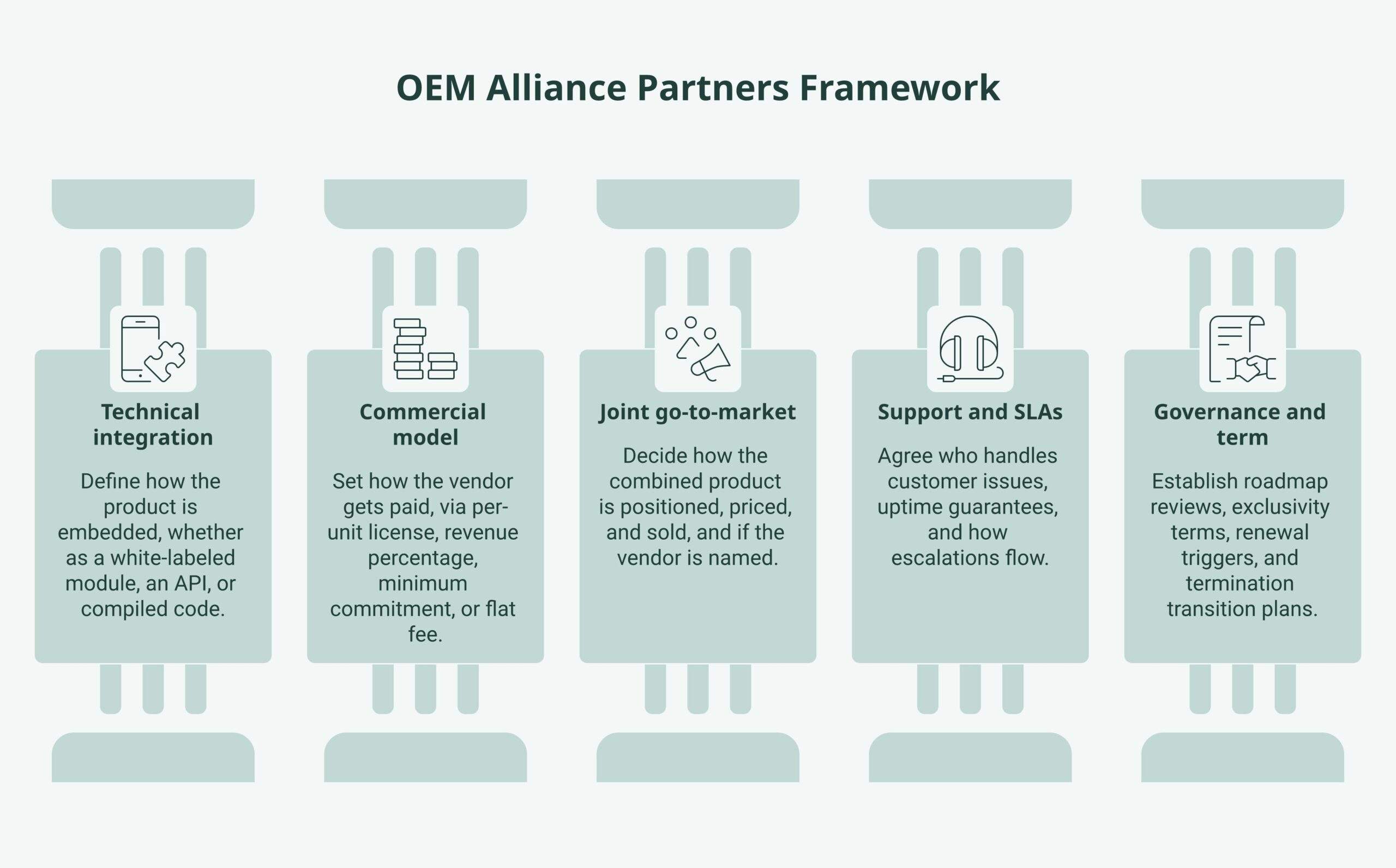
- The embedding and technical integration: Define exactly how the product is embedded, whether it ships as a white-labeled module, an API the platform calls, or code compiled into the offering. Nail down versioning, update cadence, data flows, and who owns the customer’s data, because these decide how tightly the two roadmaps are coupled.
- The commercial model and revenue share: Set how the embedded vendor gets paid, a per-unit license, a percentage of the reseller’s revenue, a minimum commitment, or a flat platform fee. Tie pricing to how the reseller monetizes so the economics survive their discounting, and put floors and volume tiers in writing.
- Joint go-to-market: Decide how the combined product is positioned, priced, and sold, and whether the embedded vendor is named or invisible. The reseller’s sales team carries the deal, so enablement, messaging, and competitive positioning have to be built for them, not for the embedding vendor’s own reps.
- Support, SLAs, and reliability: Agree who answers the customer when the embedded capability breaks, what uptime the vendor guarantees, and how escalations flow. The customer holds the reseller accountable, so the vendor’s SLA to the reseller has to be at least as strong as the reseller’s promise to the customer.
- Governance and term: Establish the joint roadmap review, the exclusivity or non-compete terms, the renewal and termination triggers, and the transition plan if the deal ends. Because the product is embedded, an exit is an engineering project, and the contract should say who does that work and who pays for it.
Common pitfalls with OEM alliance partners
- Economics that break under discounting: A revenue share looks fine at list price and collapses when the reseller discounts to win deals. Without floors and minimums, the embedded vendor funds the reseller’s price war.
- No SLA back-to-back with the customer promise: The reseller commits an uptime to the customer that the embedded vendor never guaranteed. When the capability fails, the reseller eats a penalty they cannot pass through.
- Roadmap coupling nobody planned for: The embedded product changes on the vendor’s schedule, not the reseller’s, and a breaking update ships into the reseller’s customers without warning. Version control and change notice have to be contractual, not a courtesy.
- Invisible until it is a problem: The embedded vendor is hidden by design, so their contribution goes unnoticed until an outage makes them the story. Neither side plans for how the vendor is credited or defended.
- An exit with no plan: The deal ends and the embedded capability is welded into the reseller’s product. Without a transition clause, both sides discover the cost of separation at the worst possible time.
What this looks like in practice
A workflow software company had built a strong document-automation capability and wanted more distribution than its own sales team could produce. It signed an OEM alliance with a larger platform that embedded the capability as a white-labeled module, sold under the platform’s brand to the platform’s install base. The first contract set a simple revenue share on list price and a basic uptime commitment. Within a year the platform was discounting the bundle aggressively to win competitive deals, and the revenue share on discounted seats barely covered the vendor’s hosting cost, while a support gap meant the vendor’s engineers were pulled into the platform’s customer escalations with no SLA governing the load. They renegotiated on the next term: a per-seat license floor independent of the platform’s discounting, a back-to-back SLA that matched the platform’s customer promise, and a quarterly roadmap review so version changes stopped surprising anyone. Revenue per embedded seat rose, escalations became predictable, and the platform kept selling because the module still made its product more complete. The lesson was that the technical fit was never the problem. The economics and the operating terms were, and those are the parts that get rushed.
Forecastable’s POV on OEM alliance partners
Our position is that OEM alliances are won or lost in the commercial and governance layers, not the demo. The integration is usually the easy part, because both sides are engineers who can make software talk to software. The economics, the SLAs, the version control, and the exit terms are where the value leaks, and those are exactly the parts that get compressed when both companies are excited to sign.
We also think an OEM alliance is only worth doing if you can see what it produces after signing. Embedded revenue is easy to lose track of precisely because the embedded vendor is invisible in the deal, so the partnership needs the same measurement discipline as any other revenue motion: which reseller sales motions actually move the embedded product, what the real revenue per unit is after discounting, and where the relationship is drifting from the terms you agreed to.
Forecastable is a partnerships operating platform that connects partner conversations and actions to CRM pipeline and revenue, the flow from Conversations to Actions to Pipeline to Revenue. We do not draft your OEM contract or build the integration. We make the alliance’s actual production visible, so the economics can be renegotiated against real outcomes rather than the assumptions in the original term sheet, and so an embedded partnership is managed by what it produces, not by the fact that it once got signed.
Forecastable is a partnerships operating platform and a category authority, not a PRM vendor. Any third-party tools or firms referenced in this space are independent third-party products, and mentioning them is not an endorsement. Evaluate any OEM approach against your own product, partner mix, and CRM.
Frequently asked questions
What are OEM alliance partners?
Two companies where one embeds the other’s product into its own offering and resells it under its own brand, with the underlying vendor paid through a license or revenue share, so the customer buys a single product.
What is the difference between an OEM partner and a reseller?
A reseller sells your product as your product under your brand, usually for a margin or commission. An OEM partner embeds your product inside their own offering and sells it under their brand, so the customer often does not know your product is in there at all.
How do OEM alliance partners make money?
Through the commercial model underneath the embedding, typically a per-unit license, a percentage of the reseller’s revenue, a minimum commitment, or a flat platform fee, and often a combination with floors and volume tiers.
Is an OEM alliance the same as white labeling?
White labeling is one form of OEM embedding, where the product ships fully rebranded with no trace of the vendor. Other OEM arrangements embed a named capability or an API the platform calls, so white labeling is a subset, not a synonym.
What should be in an OEM agreement?
The technical embedding and versioning terms, the revenue share or license model with pricing floors, joint go-to-market and enablement, back-to-back SLAs, and governance covering roadmap review, exclusivity, term, and a transition plan for exit.
Why do OEM alliances fail?
Usually because the economics break under the reseller’s discounting, the SLA does not match the customer promise, or roadmap changes ship without notice, not because the integration was technically weak.
How is an OEM alliance different from a technology integration?
A technology integration lets two products work together while each is sold separately. An OEM alliance makes one product part of the other’s shipping offer, sold as one thing, which is a far deeper commercial and operational commitment.
Next step
If you are weighing an OEM alliance, do the hard work in the commercial and governance layers before you celebrate the technical fit, and make sure you can measure what the embedded product actually produces once it ships. Structure the economics to survive discounting, put SLAs back-to-back with the customer promise, and track the alliance by its real production. Start your growth journey now to manage embedded revenue by what it produces, not by the fact that it signed. The partner program hub frames how OEM alliances sit alongside reseller, referral, and co-sell motions.
Uncover Your Growth Potential
Schedule a Discovery Call