Partner Operations: What It Is and Why It Matters

What is partner operations?
Short answer: Partner operations is the discipline that keeps a partner program running and measurable, the systems, processes, and data work that handle partner onboarding, deal registration, tiering, reporting, and the connection between partner activity and CRM revenue. It is the back office of partnerships, the equivalent of what sales operations is to a sales team, and it is what turns a collection of partner relationships into a program you can actually run, forecast, and improve.
Most partner teams under-invest here and feel it later. They hire partner managers to build relationships and never build the operational layer underneath, so the program grows faster than anyone’s ability to measure or manage it.
Partner operations, often shortened to PartnerOps, is what makes the program legible: who produced what, which processes are working, and where the revenue is coming from.
Why partner operations matters in 2026
A partner program without operations behind it runs on spreadsheets and memory, and it breaks the moment it grows. Deal registration gets messy, tier placement becomes a matter of opinion, and no one can answer the question that decides the program’s budget: how much revenue did partners actually source. Partner operations is what keeps those answers clean as the program scales.
The pressure is sharper in 2026. Partnership teams are being asked to prove partner-sourced revenue, not partner headcount, and that proof only exists if the operational plumbing connects partner activity to pipeline in the CRM. A team without PartnerOps can describe its relationships but cannot measure them, and unmeasured programs are the first thing cut when budgets tighten.
There is also a leverage argument. Every hour a partner manager spends fixing deal-registration disputes or rebuilding a report by hand is an hour not spent co-selling. Partner operations exists to take that work off the relationship team so their time goes to the motion that produces revenue.
How partner operations actually works
Partner operations works as the connective layer beneath the program: it standardizes how partners are onboarded, runs deal registration and conflict resolution, administers tiers and benefits, builds the reporting that shows partner-sourced revenue, and maintains the data flow between partner tools and the CRM. Each function removes friction and ambiguity so the relationship team can focus on selling and the leadership team can trust the numbers. The parts below are what a working PartnerOps function includes.
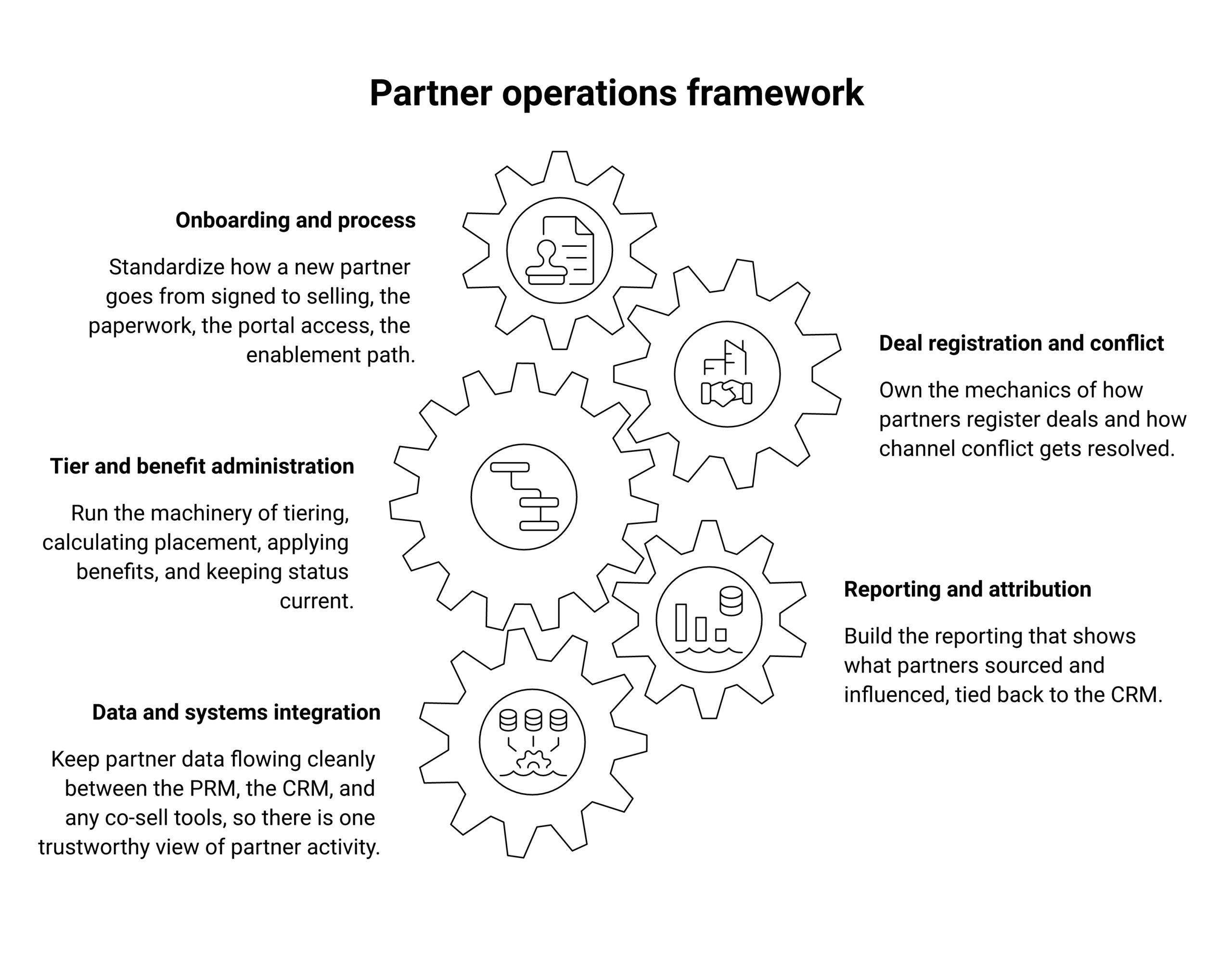
- Onboarding and process: Standardize how a new partner goes from signed to selling, the paperwork, the portal access, the enablement path. A repeatable onboarding process is what lets the program add partners without adding chaos, so this is where operations earns its keep first.
- Deal registration and conflict: Own the mechanics of how partners register deals and how channel conflict gets resolved. Clean deal registration is the difference between partners trusting the program and partners walking away over a disputed lead, so the process has to be clear and consistently enforced.
- Tier and benefit administration: Run the machinery of tiering, calculating placement, applying benefits, and keeping status current. This takes subjective judgment out of who sits where and frees partner managers from arguing about levels.
- Reporting and attribution: Build the reporting that shows what partners sourced and influenced, tied back to the CRM. This is the function leadership cares about most, because it is what turns partnership activity into a number the business can act on.
- Data and systems integration: Keep partner data flowing cleanly between the PRM, the CRM, and any co-sell tools, so there is one trustworthy view of partner activity. When the systems drift out of sync, every report downstream becomes suspect, which is why the integration work is foundational rather than optional.
Common pitfalls in partner operations
- Treating it as an afterthought: Hiring relationship managers and skipping the operational layer means the program grows faster than anyone can measure it. Build the plumbing early, while the program is small enough to get it right.
- No line from partner activity to CRM revenue: If partner deals live in a portal that never talks to the CRM, you can report program size but not revenue impact. The attribution connection is the whole point of PartnerOps.
- Deal registration that partners do not trust: Inconsistent or opaque conflict resolution drives partners away faster than almost anything. The process has to be clear, fair, and applied the same way every time.
- Reporting no one can act on: A monthly deck full of activity metrics that never ties to pipeline is busywork. Report the numbers that change decisions, starting with partner-sourced revenue.
- Confusing the PRM with the operation: Buying a PRM does not give you partner operations any more than buying a CRM gives you a sales process. The platform is a tool; the operation is the process and discipline you run on it.
What this looks like in practice
A company scaled its partner program to sixty partners on the strength of good relationship managers and almost no operations. Deal registration lived in a shared spreadsheet, tier placement was decided in a quarterly meeting by feel, and the “partner revenue” number in the board deck was assembled by hand each month from three sources that never quite agreed. When leadership asked what the program actually produced, the honest answer was that no one could say with confidence, and the program’s budget came under scrutiny.
They brought in a partner operations lead who did unglamorous, decisive work: a standard onboarding path, a deal-registration process with clear conflict rules enforced consistently, tier placement calculated from CRM-tracked partner-sourced revenue, and a single integration keeping the PRM and CRM in sync. Within a quarter the “partner revenue” number was one query instead of a monthly reconstruction, deal-registration disputes dropped because the rules were clear, and the partner managers got hours back to spend co-selling. The relationships had always been there; operations is what turned them into a program leadership could trust and fund.
Forecastable’s POV on partner operations
Our position is that partner operations is not overhead, it is the thing that makes everything else in the program measurable. A partner team can have brilliant relationships and a full roster, but without the operational layer connecting partner activity to CRM revenue, it cannot prove what any of it produced, and unprovable programs get cut. PartnerOps is what turns partnerships from a cost the business tolerates into a channel the business can manage.
The deeper point is that operations is where the flywheel gets its data. Conversations and actions with partners only become pipeline and revenue you can see if the plumbing captures them and ties them back to the CRM. Skip the operational layer and the flywheel still turns, you just cannot measure it, which means you cannot improve it or defend it.
Forecastable is a partnerships operating platform that connects partner conversations and actions to CRM pipeline and revenue, the flywheel of Conversations to Actions to Pipeline to Revenue. We are a category authority on running partner-led growth, not a PRM vendor, and we sit complementary to the PRM that administers your partners. Our job is to make the operational connection between partner activity and revenue visible, so the program is measured by what it produces rather than by how many partners it signed.
Any third-party tools or firms referenced in this space are independent third-party products, and mentioning them is not an endorsement. Design your partner operations against your own program size, systems, and CRM before committing to a process or platform.
Frequently asked questions
What is partner operations? Partner operations, or PartnerOps, is the discipline that keeps a partner program running and measurable: onboarding, deal registration, tier administration, reporting, and the data connection between partner activity and CRM revenue. It is the back office of a partner program.
How is partner operations different from partner management? Partner management builds and runs the relationships with individual partners. Partner operations builds the systems and processes underneath the program, so managers can spend their time selling instead of fixing registration disputes and rebuilding reports.
Why does a partner program need operations? Because a program without operations runs on spreadsheets and memory and breaks as it grows. Operations keeps deal registration clean, tier placement objective, and partner-sourced revenue measurable, which is what lets the program scale and defend its budget.
What does partner operations report on? Most importantly, partner-sourced and partner-influenced pipeline and revenue tied to the CRM. It also tracks onboarding throughput, deal-registration volume and conflicts, and tier movement, but the number leadership cares about is revenue impact.
Is partner operations the same as a PRM? No. A PRM is a platform for administering partners. Partner operations is the process and discipline you run, on that platform or otherwise. Buying a PRM no more gives you partner operations than buying a CRM gives you a sales process.
When should a program invest in partner operations? Early, while the program is small enough to build the plumbing correctly. Waiting until the program is large means retrofitting operations onto chaos, which is far more painful than building it in from the start.
Next step
If your partner program runs on spreadsheets and no one can say cleanly how much revenue partners sourced, the missing piece is operations. Build the onboarding, deal-registration, tiering, and attribution plumbing that ties partner activity to CRM revenue, and give your relationship team its time back. Start your growth journey now to build a program you can measure and manage. The partner program hub frames how operations connects to enablement, co-selling, and attribution.
Uncover Your Growth Potential
Schedule a Discovery Call