Skip to content
Logo — It’s All AboutThe Team
  • Home
  • Who We Serve
    • By Category
      • SaaS
      • Professional Services
      • Platforms (Large Ecosystems)
      • Private Equity
    • By Role
      • Chief Revenue Officers (CRO)
      • Chief Financial Officers (CFO)
      • Chief Marketing Officers (CMO)
      • Chief Executive Officers (CEO)
      • Sales Leaders
      • Partnership Professionals
  • Solutions
    • By Partner Program Maturity
      • Partnerships Foundation
      • Partnerships Acceleration
      • Ecosystem-Wide Orchestration
    • Specialized Solutions
      • Net-New Named Account Development
      • Large Ecosystems
      • M&A: Post-Acquisition Internal Cross-Selling
  • Education
  • Company
    • Our History
    • Security
  • Login
Logo — It’s All AboutThe Team
  • Home
  • Who We Serve
    • By Category
      • SaaS
      • Professional Services
      • Platforms (Large Ecosystems)
      • Private Equity
    • By Role
      • Chief Revenue Officers (CRO)
      • Chief Financial Officers (CFO)
      • Chief Marketing Officers (CMO)
      • Chief Executive Officers (CEO)
      • Sales Leaders
      • Partnership Professionals
  • Solutions
    • By Partner Program Maturity
      • Partnerships Foundation
      • Partnerships Acceleration
      • Ecosystem-Wide Orchestration
    • Specialized Solutions
      • Net-New Named Account Development
      • Large Ecosystems
      • M&A: Post-Acquisition Internal Cross-Selling
  • Education
  • Company
    • Our History
    • Security
  • Login
  • Home
  • Who We Serve
    • By Category
      • SaaS
      • Professional Services
      • Platforms (Large Ecosystems)
      • Private Equity
    • By Role
      • Chief Revenue Officers (CRO)
      • Chief Financial Officers (CFO)
      • Chief Marketing Officers (CMO)
      • Chief Executive Officers (CEO)
      • Sales Leaders
      • Partnership Professionals
  • Solutions
    • By Partner Program Maturity
      • Partnerships Foundation
      • Partnerships Acceleration
      • Ecosystem-Wide Orchestration
    • Specialized Solutions
      • Net-New Named Account Development
      • Large Ecosystems
      • M&A: Post-Acquisition Internal Cross-Selling
  • Education
  • Company
    • Our History
    • Security
  • Login
Back to all blogs
  • Partnerships Strategy & Leadership
Alex Buckles

SaaS Channel Partner Strategy: What Works

A SaaS partnerships leader and a partner's account manager reviewing recurring revenue and retention on a dashboard, a co-selling motion mapped on a whiteboard beside them, deep navy and warm amber palette

What is a SaaS channel partner strategy?

Short answer: A SaaS channel partner strategy is a plan for growing recurring revenue through partners whose economics reward retention and expansion, not one-time resale margin. It recognizes that a SaaS deal is the start of a relationship, so partners must be chosen and paid for the whole lifecycle. Copying a hardware channel playbook into SaaS is why many programs stall.

The strategy differs from a traditional resale plan because the money is not in the first sale. It is in renewal and expansion, and the partner motion has to be built for that.

Why a SaaS channel partner strategy matters in 2026

A SaaS channel partner strategy matters because SaaS revenue compounds over years, and a partner who influences retention and expansion is worth far more than one who books a first-year deal and disappears. Getting the partner economics and motion right early determines whether the channel becomes an asset or a churn problem. The wrong partners sell fast and leave you with accounts that do not renew.

In 2026, with net revenue retention driving SaaS valuations, a channel that sources logos but does not support them is a liability. Buyers of SaaS expect ongoing service, and the partner is often the one who provides it. A SaaS channel partner strategy that aligns partners to retention protects the revenue you already have while it grows new pipeline.

The strategy also decides which partner types you build around. In SaaS, services firms, agencies, and platforms that embed your product behave very differently from pure resellers. Choosing the right mix, and paying each for the outcomes SaaS actually rewards, is the difference between a channel that renews and one that leaks.

How a SaaS channel partner strategy actually works

A SaaS channel partner strategy works by aligning partner selection, incentives, and motion to recurring revenue across the lifecycle. The components below are what the strategy contains.
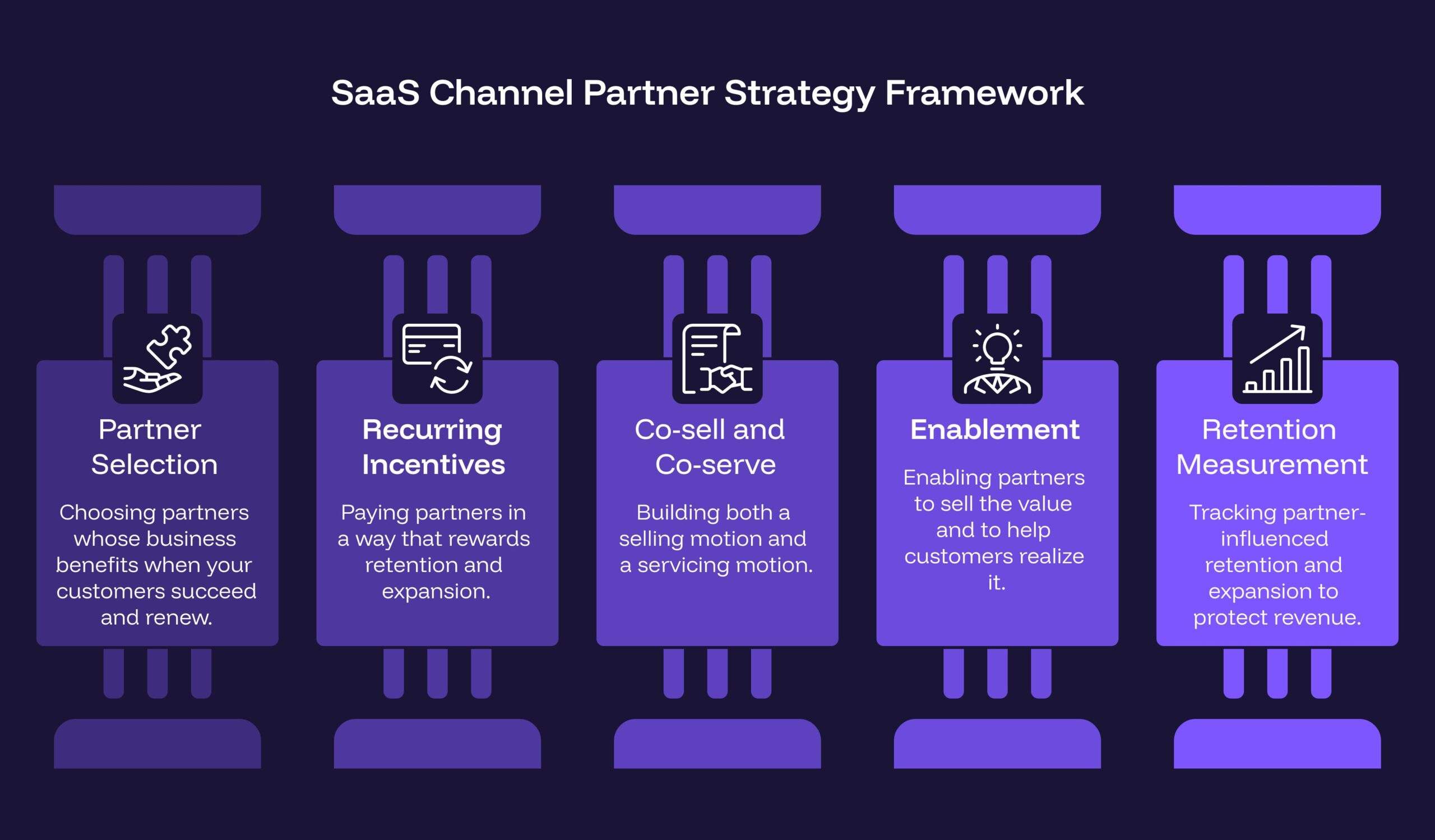
SaaS channel partner strategy framework diagram showing lifecycle-aligned partner selection, recurring incentives, co-sell and co-serve motion, and retention measurement components

  1. Lifecycle-aligned partner selection: Choosing partners whose business benefits when your customers succeed and renew, not just partners who can push a first sale.
  2. Recurring incentives: Paying partners in a way that rewards retention and expansion, so their interest stays aligned with the customer past the initial deal.
  3. Co-sell and co-serve motion: Building both a selling motion and a servicing motion, because in SaaS the partner often delivers the ongoing value that keeps the account.
  4. Enablement for the product and the outcome: Enabling partners to sell the value and to help customers realize it, since adoption is what drives renewal.
  5. Retention measurement: Tracking not just partner-sourced bookings but partner-influenced retention and expansion, so you know which partners actually protect revenue.

Common pitfalls in a SaaS channel partner strategy

  • Rewarding the sale, ignoring the renewal: Paying partners only on first-year bookings recruits partners who churn accounts. Tie incentives to retention and expansion.
  • Recruiting resale volume over fit: Chasing partners who can move volume without regard for whether their customers succeed fills the funnel with accounts that will not renew.
  • No co-serve motion: Treating SaaS partners like resellers who disappear after the sale leaves customers unsupported and revenue at risk. Build the servicing side.
  • Enabling on features, not adoption: Teaching partners to sell the product but not to drive its use ignores that adoption, not the signature, is what renews.
  • Measuring bookings only: Judging the channel on new logos while ignoring partner-influenced retention hides the partners quietly protecting or destroying revenue.

What this looks like in practice

A worked example: a SaaS company built its channel on a resale model borrowed from its founders’ hardware backgrounds, paying partners a healthy first-year margin and little else. Partners sold hard, logos rolled in, and a year later those cohorts churned well above the direct book. The accounts had been sold, never adopted. The company rebuilt the strategy for SaaS: it recruited services-capable partners whose business grew when customers succeeded, shifted incentives toward multi-year retention and expansion, and enabled partners to drive adoption, not just close. It also started measuring partner-influenced retention alongside bookings. The next cohorts renewed at rates close to direct, and the channel became a source of durable revenue. The lesson was that a SaaS channel partner strategy has to be built for the recurring model, because a resale mindset recruits partners who sell the first year and cost you the rest.

Forecastable’s POV on a SaaS channel partner strategy

Our position is that SaaS punishes channel strategies borrowed from resale, and most struggling SaaS channels are running a hardware playbook without realizing it. The tell is incentives and metrics anchored to first-year bookings. Fix the economics so partners win when customers renew, and the rest of the strategy, selection and motion, tends to follow the money into the right place.

We also believe SaaS channels should measure partner influence on retention, not just on sourcing, and almost none do. The partner who quietly keeps a customer adopting and expanding is protecting more value than the one who sourced a logo that churns, yet the second partner usually gets all the credit. A strategy that sees partner-influenced retention can invest in the partners who actually protect the recurring revenue, which is the whole game in SaaS.

Forecastable is a partnerships operating platform focused on connecting partner conversations and actions to CRM pipeline and revenue. We do not set your incentive model; we make partner-sourced and partner-influenced revenue visible across the lifecycle, so you can see which partners drive retention and expansion, not just first deals. A SaaS strategy aligns partners to recurring revenue; visibility is how you prove which ones deliver it.

Forecastable is a partnerships operating platform and a category authority, not a PRM vendor. Any third-party tools or firms referenced in this space are independent third-party products, and mentioning them is not an endorsement. Evaluate any strategy against your own partner mix, motion, and CRM.

Frequently asked questions

What is a SaaS channel partner strategy?
It is a plan for growing recurring revenue through partners whose economics reward retention and expansion, aligning partner selection, incentives, and motion to the SaaS lifecycle rather than one-time resale margin.

How is a SaaS channel different from a resale channel?
In resale the value is in the first sale; in SaaS it is in renewal and expansion. That changes which partners you recruit, how you pay them, and whether you build a servicing motion.

What partner types work best for SaaS?
Services firms, agencies, and platforms that benefit when your customers succeed and renew tend to fit SaaS better than pure resellers, though the right mix depends on your product.

How should you incentivize SaaS partners?
In a way that rewards retention and expansion, not only first-year bookings, so the partner’s interest stays aligned with the customer over the lifecycle.

How do you measure a SaaS channel?
By partner-sourced bookings plus partner-influenced retention and expansion, so you can see which partners protect recurring revenue, not just source it.

Why do SaaS channels churn accounts?
Usually because the strategy rewards the sale and ignores adoption. Partners who are paid only to close will close accounts that never adopt and therefore never renew.

Next step

If your channel books logos that churn, you are running a resale playbook in a recurring business. Recruit for fit, pay for retention, build a co-serve motion, and measure partner-influenced renewal. Start your growth journey now to make partner-influenced revenue visible across the lifecycle. The partner program hub frames how a SaaS channel partner strategy connects to enablement, roles, and attribution.

Uncover Your Growth Potential

Whether starting with a single sales team or a single partner, any co-sell motion can be live within 30 days.

Schedule a Discovery Call
Latest Insights
Two alliance leaders from partner companies shaking hands over a joint business plan at a conference table in a modern office, a printed mutual value map on the table, deep navy and warm amber palette
  • Partnerships Strategy & Leadership
Alex Buckles

Strategic Alliances: What They Are and How to Run Them

What are strategic alliances? Short answer: Strategic alliances are formal, long-term partnerships between two companies that agree to pursue shared goals while staying independent. They span joint go-to-market, technology integrations, reseller arrangements, and co-development, and they exist because each company can reach or build something faster together than alone. The alliance is a bet that […]

Read Article
A channel chief and a regional partner manager running a quarterly partner review, walking a tier-and-pipeline board on a wall monitor with a printed partner scorecard on the table, deep navy and warm amber palette
  • Partnerships Strategy & Leadership
Alex Buckles

Channel Management: What It Is and How It Works

What is channel management? Short answer: Channel management is how a vendor recruits, enables, and runs the partners who sell or influence deals on its behalf, so that partner-sourced revenue is predictable rather than accidental. It is the operating discipline that sits between signing a partner and getting paid through one. Done well, it turns […]

Read Article
A partnerships leader and a CRO reviewing a channel partner strategy plan on a whiteboard, target partner segments and revenue goals mapped in columns, a printed one-page plan on the table, deep navy and warm amber palette
  • Partnerships Strategy & Leadership
Alex Buckles

Channel Partner Strategy Plan: How to Build One

What is a channel partner strategy plan? Short answer: A channel partner strategy plan is a written statement of which partners you will invest in, why they will sell you, and what revenue that will produce, with the motions and metrics to get there. It is the difference between a partner wish list and a […]

Read Article
Three businessmen seated at a wooden table review a document during a meeting in a modern office, with graphs displayed on a monitor in the background.
  • Partnerships Strategy & Leadership
Alex Buckles

MEDDIC Partnerships: Qualifying Co-Sell Deals That Close

What is MEDDIC for partnerships? Short answer: MEDDIC partnerships is the application of the classic sales qualification frame (Metrics, Economic buyer, Decision criteria, Decision process, Identify pain, Champion) to co-sell and partner-sourced deals, with a partner-side mirror on every letter so the host AE and the partner counterpart qualify the same opportunity on the same […]

Read Article
Logo — It’s All AboutThe Team

Quick Links

  • Who We Serve
  • Solutions
  • Resources
  • Pricing
  • Our History

Social Media

  • Linkedin

Legal

  • Privacy Policy
  • Terms of Service
Quick Links
  • Who We Serve
  • Solutions
  • Resources
  • Pricing
  • Our History
Social Media
  • Linkedin
Legal
  • Privacy Policy
  • Terms of Service

Stay ahead on ecosystem-led growth

Logo — It’s All AboutThe Team
© 2025 Forecastable. All rights reserved.
Book Your Strategy Call
Request Enrollment Details

[contact-form-7 id=”dfbeed3″ title=”Request Enrollment Details”]

Mollie Bodensteiner

Revops Advisory
  Mollie Bodensteiner is an experienced operations professional with a demonstrated track record of utilizing technology to support operational processes that drive performance and innovation. She currently is the Vice President of Operations at Sound and owns go-to-market agency, MB Solutions. Mollie has previously held operations leadership roles at Deel, Syncari, Corteva and Marketo. She has over 14 years of experience in both B2C and B2B operations and technology. When she is not working, Mollie enjoys spending time with her husband, three small children, and two large dogs. Childhood Career/Dream: Growing up in the age of Disney and Nick@Nite I always wanted to be a child actor (good thing that never was actually pursued 🙂 Favorite Win: I am not sure I have a specific “win” but I think I get the most joy and excitement from coaching others and watching them hit major milestones in their career. The first time you get to promote someone on your team or watch them lead a major project – are always career highlights! Personal Fun Facts: Favorite Song: If it’s love, Train Favorite Movie: Good Will Hunting Favorite Meme: Disaster Girl
Forecastable resources: Co-Sell Orchestration Platform · All Use Cases · Live in 30 Days · Co-Sell Playbook

Kelsey Buckles

Director of Operations


My journey from Education to Operations has equipped me with a unique perspective and skill set that perfectly aligns with Forecastable’s mission to help businesses improve sales collaboration through partner co-selling strategies.

At Forecastable, I am passionate about empowering teams and organizations to unlock the full potential of strategic partnerships. By leveraging my expertise in communication, leadership, and operational efficiency, I contribute to creating seamless co-selling processes that align with business goals and deliver exceptional results.

The intersection of my educational foundation and operational experience fuels my dedication to fostering alignment, building trust, and enhancing collaboration between partners. I am driven by the opportunity to contribute to a platform that not only optimizes sales strategies but also strengthens relationships that lead to long-term growth.

Paul Jonhson

Chief Technology Officer (Co-founder)


Paul Johnson has 20+ years of software development and consulting experience for a variety of organizations, ranging from startups to large-enterprise organization with highly-complex needs.

Mr. Johnson has a long track record of successful technology deployments.
This, combined with his deep passion for machine learning and exceptional user experience design, allows him to lead our technical direction from the front with confidence.

Alex Buckles

Product, Partnerships, and Value Engineering (Co-founder)


After serving in The United States Marine Corps, Alex Buckles spent the next two decades as a student of revenue production and an advocate for innovation.

Along the way, he has helped numerous companies achieve double and triple-digit growth by crafting and executing high-performing go-to-market strategies, with co-selling at the center of each.

As a once-advanced technical marketer, an expert sales & partner professional, and a strong customer success advocate, Mr. Buckles understands the impact of these functions aligning not only on revenue production, but on the day-to-day execution of the go-to-market strategy. This concept of revenue-team alignment is what quickly became the foundation of Forecastable back in January of 2018.

In his free time, you’ll find him spending quality time with his children, one of whom is on the autism spectrum. 1 in 36 children in the U.S. are on the spectrum and boys are four times more likely to be diagnosed than girls.

With that in mind, Mr. Buckles plans on dedicating the rest of his life serving those living with autism, through his organization Pathways for Autism. From his perspective, there must be a scalable and financially self-sustaining infrastructure established to put as many individuals with autism as possible on a path towards complete independence as adults.