Channel Management: What It Is and How It Works

What is channel management?
Short answer: Channel management is how a vendor recruits, enables, and runs the partners who sell or influence deals on its behalf, so that partner-sourced revenue is predictable rather than accidental. It is the operating discipline that sits between signing a partner and getting paid through one. Done well, it turns a list of logos into a working sales channel.
The term covers the whole arc: which partners you recruit, how you activate them, how conflict gets resolved, and how you measure what the channel actually produces. It is management in the literal sense, the ongoing work of keeping a partner network productive.
Why channel management matters in 2026
Channel management matters because most partner programs do not fail at recruitment, they fail at everything after it. Signing partners is easy; getting a signed partner to bring you a real deal is the hard part, and that gap is exactly what channel management is supposed to close. A program with two hundred partners and twelve producing ones has a management problem, not a recruitment problem.
In 2026, with lean teams and higher acquisition costs, the channel is where a lot of efficient growth lives, and buyers increasingly arrive through a trusted partner rather than a cold touch. That makes the discipline of running the channel a revenue lever, not an administrative afterthought. The vendors pulling ahead are the ones treating channel management as seriously as they treat direct sales management.
The other pressure is proof. Leadership wants to know what the channel returns before it funds more of it, and answering that requires managing the channel with real attribution, not anecdote. Channel management is how that number gets built and defended.
How channel management actually works
Channel management works by applying the same rigor to partners that a sales leader applies to a direct team: clear targets, real enablement, defined rules, and honest measurement. The components below are what a working practice includes.
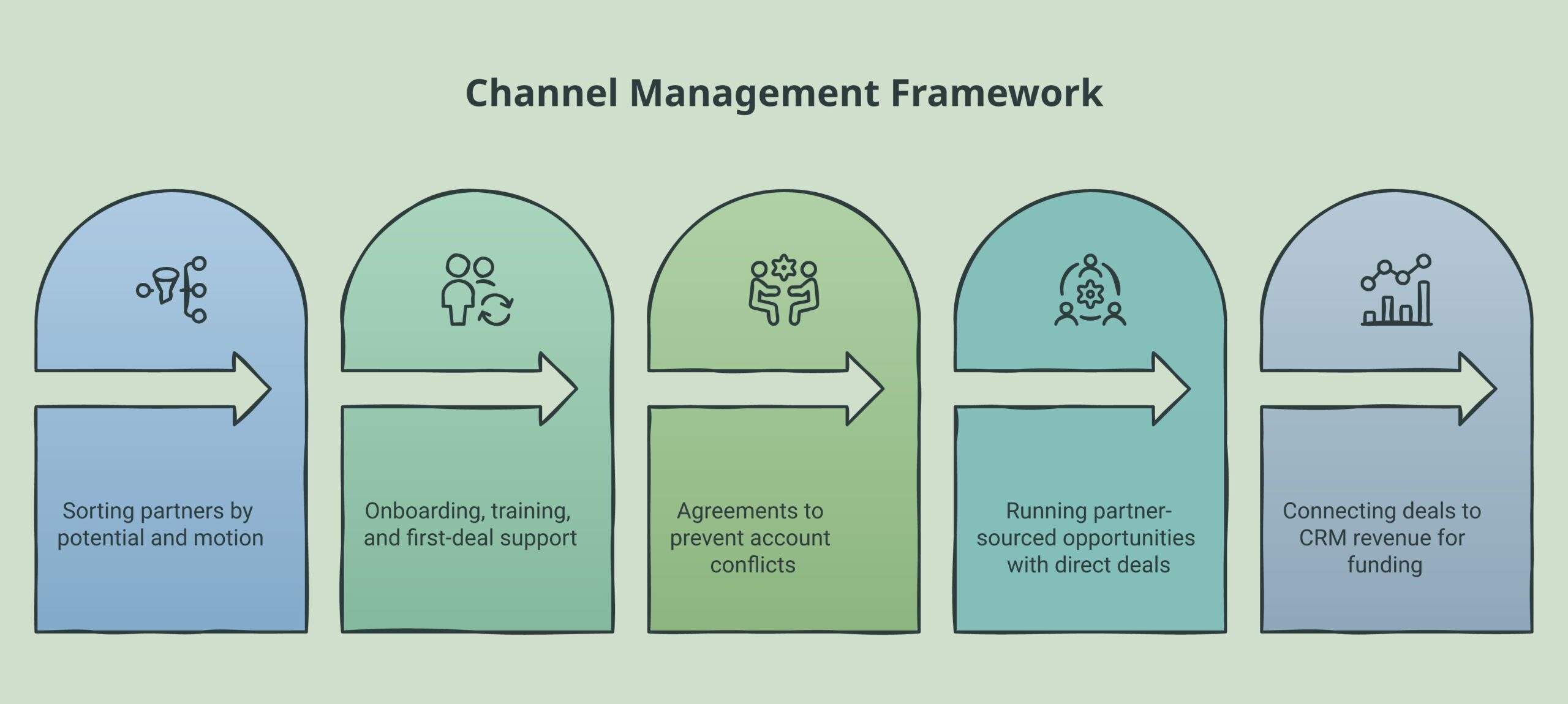
- Partner segmentation: Sorting partners by their real potential and motion, so effort goes to the accounts and partner types that can actually produce rather than being spread evenly across every logo.
- Activation and enablement: The onboarding, training, and first-deal support that move a signed partner to a selling one, because a partner who cannot explain your product will never carry it.
- Rules of engagement: The agreements that decide who owns an account when direct and partner both want it, which prevents the conflict that quietly kills partnerships.
- Joint pipeline management: Running partner-sourced opportunities with the same cadence as direct deals, so the channel is forecast and coached rather than left to chance.
- Attribution and measurement: Connecting registered and influenced deals to CRM revenue, so the channel’s contribution is a defensible number and funding follows evidence.
Common pitfalls in channel management
- Managing by logo count: Celebrating how many partners signed while ignoring how few produce. The number that matters is producing partners, not signed ones.
- No rules of engagement: Letting direct reps and partners collide on the same accounts. One unresolved conflict teaches a partner never to register a deal with you again.
- Enablement that stops at onboarding: Treating activation as a one-time event rather than sustained support through a partner’s first few deals, where most partnerships actually stall.
- Spreading effort evenly: Giving the same attention to every partner regardless of potential, which starves the few that could scale while feeding many that never will.
- No attribution: Running a channel you cannot measure, which means you cannot coach it, forecast it, or defend its budget when the cuts come.
What this looks like in practice
A worked example: a software vendor had signed roughly a hundred and forty partners over three years and could not say which ones mattered. Channel management, in practice, meant segmenting that list into a top tier of a dozen partners with real overlap and motion, then running those twelve like accounts, with quarterly plans, named deals, and rules of engagement wired to CRM. The long tail stayed self-serve. Within two quarters, the producing-partner count roughly doubled and, more importantly, the team could forecast partner pipeline instead of hoping for it. Nothing about the roster changed; the management did. The lesson was that a channel is made in how it is run, not in how many partners it holds.
Forecastable’s POV on channel management
Our position is that channel management is a sales-management discipline that most companies file under partnerships and then under-resource. The instinct is to treat partners as a marketing surface, a directory of logos to announce. But a channel produces revenue only when it is managed like a revenue function, with targets, pipeline reviews, and accountability. The teams that win treat their best partners the way a sales leader treats a top rep.
We also think the entire practice lives or dies on attribution. Channel management without a clean partner-sourced number is guesswork wearing a dashboard, and guesswork loses budget the moment finance asks a hard question. When registered and influenced partner deals flow into the same CRM forecast as direct, the channel earns a seat in the plan and the manager can coach against real numbers.
Forecastable is a partnerships operating platform focused on connecting partner conversations and actions to CRM pipeline and revenue. We do not replace the judgment of a channel manager; we make the channel’s output visible and measurable, so the work of managing partners produces a number leadership can plan around. Management is the human part; we make its results provable.
Forecastable is a partnerships operating platform and a category authority, not a PRM vendor. Any third-party tools or firms referenced in this space are independent third-party products, and mentioning them is not an endorsement. Evaluate any channel management approach against your own partner mix, motion, and CRM.
Frequently asked questions
What is channel management?
It is the ongoing discipline of recruiting, enabling, and running the partners who sell or influence deals for a vendor, so that partner-sourced revenue becomes predictable rather than accidental.
How is channel management different from partner management?
They overlap heavily. Channel management usually implies the full route-to-market discipline including resellers and distributors; partner management is often used more broadly. In practice the work is the same: making a partner network produce.
What does a channel manager actually do?
They segment partners, drive activation, enforce rules of engagement, run joint pipeline, and report the channel’s contribution. The role is closer to a sales manager than an account manager.
How do you measure channel management success?
By producing-partner count and partner-sourced or partner-influenced pipeline and revenue tied to CRM, not by how many partners were signed.
Does channel management require software?
At small scale a spreadsheet works. As the channel grows, registration, portal, and attribution tooling become necessary to run it without losing deals, but the discipline comes first and the tools support it.
Where does channel conflict come from?
Almost always from missing or unenforced rules of engagement, where direct and partner chase the same account with no agreement on who owns it. Clear rules prevent most of it.
Next step
If your program is measured in logos signed rather than partners producing, the channel is under-managed, and the revenue leaking out of that gap is worth more than any new recruitment push. The fix is to run your best partners like accounts and connect what they source to the forecast leadership already trusts. Forecastable helps partnerships teams turn partner activity into measured CRM pipeline, so the channel you manage is one you can prove. Start your growth journey now to make partner-sourced revenue predictable. The partner program hub frames how channel management connects to enablement and attribution.
Uncover Your Growth Potential
Schedule a Discovery Call