Forecastability: What It Is and Why It Matters

What is forecastability?
Short answer: Forecastability is how reliably you can predict an outcome before it happens, which in partnerships means how confidently you can call partner-sourced revenue a quarter out and be right. It is a property of your data and process, not a property of optimism, and it is what separates a forecast from a wish.
A number you cannot defend is not a forecast. Forecastability is the degree to which your prediction rests on signals that actually precede revenue, rather than on hope dressed up as a pipeline stage.
Why forecastability matters in 2026
Forecastability matters because partner revenue is now in the company plan, and a number in the plan has to be defensible. When partnerships was a side bet, a soft forecast was tolerable; now that the channel is expected to carry a share of the target, leadership needs to know the partner number is real before they build the year on it. Low forecastability is not just a partnerships problem at that point, it is a planning risk for the whole business.
In 2026 the data to be forecastable finally exists, which raises the bar. Partner activity, registrations, co-sell touches, and overlap signals are all capturable, so a vague partner forecast is no longer excused by a lack of information. The teams that connect those signals to outcomes can predict with confidence bands; the teams that still forecast on gut are visibly behind, and the gap shows up the first time a partner number misses by half.
There is also a compounding effect. Forecastability builds trust, and trust buys investment. A partner leader who calls the number and hits it earns the right to ask for more resources; one who misses unpredictably spends the next quarter explaining rather than building. Over time, the predictability of your forecast determines how much the rest of the company is willing to bet on the channel.
How forecastability actually works
Forecastability is built from a few properties of your pipeline data and process. The components below are what make a prediction reliable rather than hopeful.
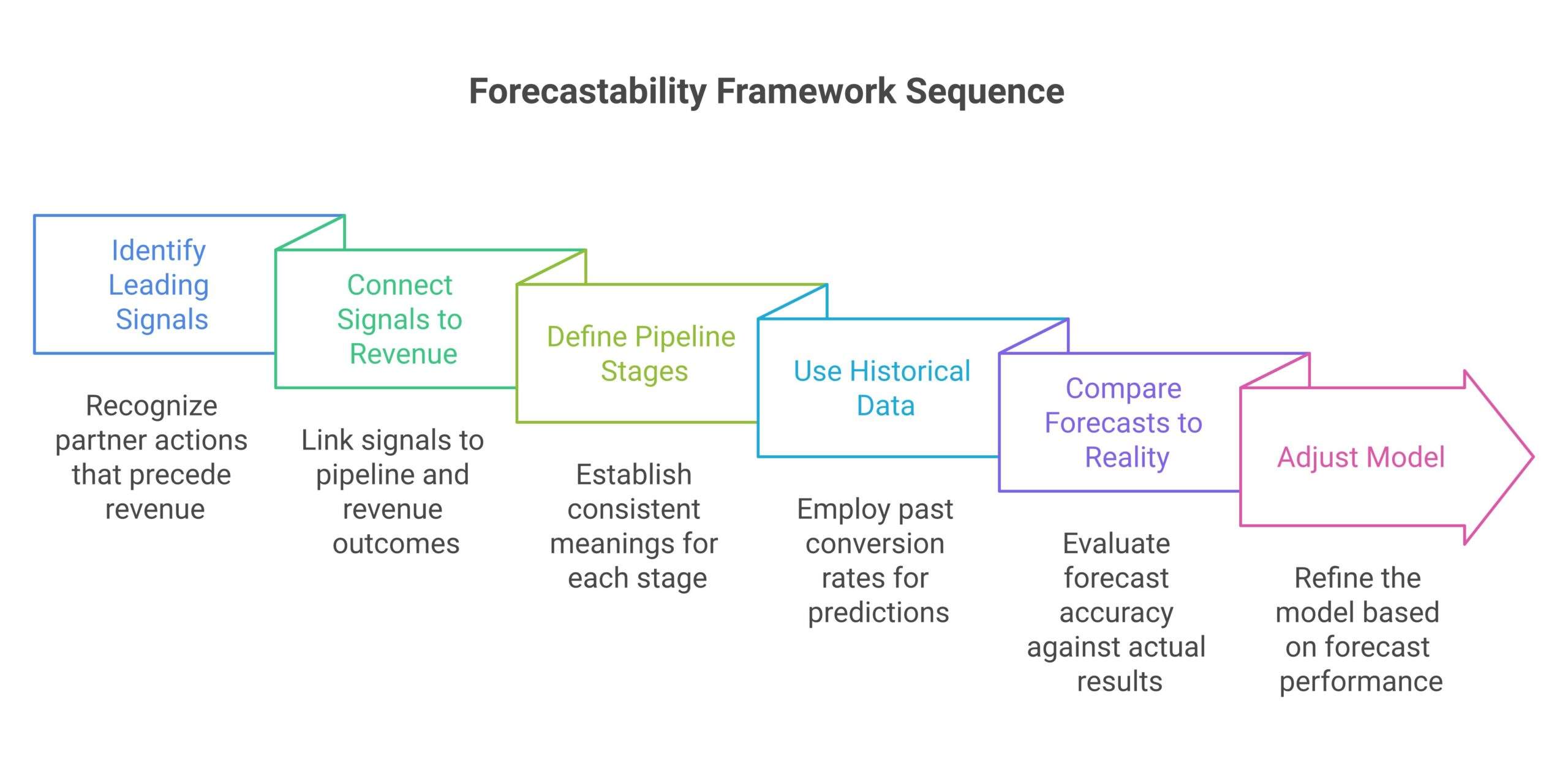
- Leading signals: Identify the partner actions that reliably precede revenue, such as a registered deal, a joint call, or an overlap-confirmed opportunity. A forecast built on lagging indicators predicts the past.
- Clean attribution: Connect each signal to the pipeline and revenue it produced so you know which actions actually move the number. Without attribution you cannot tell a predictive signal from a coincidental one.
- Stage discipline: Define what each pipeline stage means and enforce it, so a deal at a given stage carries a consistent probability. Inconsistent stages make every weighted forecast a guess.
- History and base rates: Use past conversion rates by partner type, motion, and stage as the anchor for prediction. Forecasts that ignore base rates over-trust the current quarter’s optimism.
- Feedback and calibration: Compare each forecast to what actually closed and adjust the model, because forecastability improves only when you learn from your misses. A forecast you never check never gets more reliable.
Common pitfalls that lower forecastability
- Forecasting on lagging indicators: Predicting revenue from things that happen near the close, like a verbal commit, gives you almost no lead time. The signals worth forecasting on are the ones that appear early.
- Stages that mean nothing: If two reps put deals at the same stage with wildly different real odds, your weighted pipeline is noise. Undefined stages destroy forecastability quietly.
- Ignoring base rates: A forecast that assumes this quarter will convert better than every prior one, with no reason, is optimism, not prediction. History is the anchor.
- No attribution: Without connecting partner actions to outcomes, you cannot know which signals predict revenue, so your forecast leans on whichever activity is easiest to count.
- Never checking the forecast against reality: A forecast you do not reconcile with what closed cannot improve. Forecastability is earned by calibration, and skipping it freezes you at your current accuracy.
What this looks like in practice
A partner team forecast by asking each manager for a gut number, then summing them. The numbers swung wildly quarter to quarter, missed by large margins, and could not be explained, so leadership stopped trusting the partner line and planned around it conservatively, starving the channel of investment it had actually earned. The problem was not effort; it was that nothing in the forecast rested on a signal that precedes revenue.
The rebuild started with leading signals. Registered deals, joint calls, and overlap-confirmed opportunities were captured from CRM and the partner platform, whether Introw, Euler, or the team’s own workflow, and each was tied to the pipeline it produced. Stages were given clear definitions and historical conversion rates by motion. The forecast became a weighted model with confidence bands instead of a sum of guesses, and within two quarters it was landing close enough that leadership funded the channel on it. Forecastability, once built, paid for itself in trust.
Forecastable’s POV on forecastability
Our position, and the reason the company carries the name, is that forecastability is the discipline that turns partnerships from a hopeful function into an accountable one. A channel you cannot forecast is a channel leadership cannot plan around, and that single fact caps how much the business will ever invest in it. Predictability is not a reporting nicety; it is the precondition for being taken seriously.
We also think forecastability is a property you build, not a talent you have. It comes from capturing the partner actions that precede revenue, attributing them to outcomes, and calibrating against what actually closes. Any team willing to do that work can forecast with confidence bands; any team that skips it is guessing no matter how experienced the guesser. The good news is that the inputs are now capturable, so the gap between a forecastable program and an unforecastable one is method, not luck.
Finally, forecastability compounds. Each accurate call earns trust, trust earns investment, and investment earns the resources to capture even better signals, which makes the next forecast more accurate still. The teams that start the loop, even roughly, pull away from the teams still forecasting on gut, because predictability is the thing the rest of the company decides to bet on.
Forecastable is a partnerships operating platform. Any third-party tools named here are independent third-party products, and naming them is not an endorsement of one over another. Decide how to build forecastability into your own pipeline, partners, and motion.
Frequently asked questions
What is forecastability?
It is how reliably you can predict an outcome before it happens. In partnerships it means how confidently you can call partner-sourced revenue ahead of time and be right, which depends on your data and process rather than on optimism.
What makes partner revenue forecastable?
Leading signals that precede revenue, clean attribution connecting those signals to outcomes, consistent pipeline stages, historical base rates, and regular calibration against what actually closed. Together these turn a guess into a defensible prediction.
Why is forecastability important for partnerships?
Because partner revenue is now in the company plan and a planned number has to be defensible. A channel leadership cannot forecast is one they cannot plan around, which limits how much they will invest in it.
How do you improve forecastability?
Capture the partner actions that reliably precede revenue, attribute them to pipeline outcomes, enforce stage discipline, anchor on historical conversion rates, and reconcile each forecast against actuals so the model learns from its misses.
What lowers forecastability the most?
Forecasting on lagging indicators and using pipeline stages that mean different things to different people. Both remove the predictive signal from your forecast and leave you weighting noise.
Is forecastability a skill or a system?
It is mostly a system. Experienced forecasters help, but reliable prediction comes from capturing the right signals and calibrating against reality, which any disciplined team can build regardless of individual intuition.
Next step
If your partner forecast swings unpredictably and leadership has stopped trusting it, the fix is to anchor the number to signals that actually precede revenue. Forecastable helps partnerships teams capture partner actions, attribute them to CRM pipeline, and forecast with confidence instead of gut. Start your growth journey now to make your partner number one leadership can plan around. The forecastability hub goes deeper on building a predictable channel.
Uncover Your Growth Potential
Schedule a Discovery Call