Skip to content
Logo — It’s All AboutThe Team
  • Home
  • Who We Serve
    • By Category
      • SaaS
      • Professional Services
      • Platforms (Large Ecosystems)
      • Private Equity
    • By Role
      • Chief Revenue Officers (CRO)
      • Chief Financial Officers (CFO)
      • Chief Marketing Officers (CMO)
      • Chief Executive Officers (CEO)
      • Sales Leaders
      • Partnership Professionals
  • Solutions
    • By Partner Program Maturity
      • Partnerships Foundation
      • Partnerships Acceleration
      • Ecosystem-Wide Orchestration
    • Specialized Solutions
      • Net-New Named Account Development
      • Large Ecosystems
      • M&A: Post-Acquisition Internal Cross-Selling
  • Education
  • Company
    • Our History
    • Security
  • Login
Logo — It’s All AboutThe Team
  • Home
  • Who We Serve
    • By Category
      • SaaS
      • Professional Services
      • Platforms (Large Ecosystems)
      • Private Equity
    • By Role
      • Chief Revenue Officers (CRO)
      • Chief Financial Officers (CFO)
      • Chief Marketing Officers (CMO)
      • Chief Executive Officers (CEO)
      • Sales Leaders
      • Partnership Professionals
  • Solutions
    • By Partner Program Maturity
      • Partnerships Foundation
      • Partnerships Acceleration
      • Ecosystem-Wide Orchestration
    • Specialized Solutions
      • Net-New Named Account Development
      • Large Ecosystems
      • M&A: Post-Acquisition Internal Cross-Selling
  • Education
  • Company
    • Our History
    • Security
  • Login
  • Home
  • Who We Serve
    • By Category
      • SaaS
      • Professional Services
      • Platforms (Large Ecosystems)
      • Private Equity
    • By Role
      • Chief Revenue Officers (CRO)
      • Chief Financial Officers (CFO)
      • Chief Marketing Officers (CMO)
      • Chief Executive Officers (CEO)
      • Sales Leaders
      • Partnership Professionals
  • Solutions
    • By Partner Program Maturity
      • Partnerships Foundation
      • Partnerships Acceleration
      • Ecosystem-Wide Orchestration
    • Specialized Solutions
      • Net-New Named Account Development
      • Large Ecosystems
      • M&A: Post-Acquisition Internal Cross-Selling
  • Education
  • Company
    • Our History
    • Security
  • Login
Back to all blogs
  • Partnerships Forecasting
Alex Buckles

Professional Services in SaaS: A 2026 Playbook

A SaaS services lead and a delivery partner reviewing an implementation plan on a shared screen, an onboarding and adoption timeline taped to the wall with a renewal milestone marked, deep navy and warm amber palette

What are professional services in SaaS?

Short answer: Professional services in SaaS are the implementation, configuration, training, and advisory work that helps a customer actually adopt and get value from the software they bought. They turn a signed subscription into a used one, and whether they are delivered by the vendor or by partners, they are the bridge between purchase and outcome.

The work spans onboarding, integration, customization, and ongoing enablement. In a subscription business, where revenue depends on renewal rather than the initial sale, that bridge is not a side activity, it is part of how the core revenue actually holds.

Why professional services in SaaS matter in 2026

Professional services in SaaS matter because in a subscription model the sale is the beginning, not the end. A customer who buys but never adopts will churn, taking the recurring revenue with them, and adoption rarely happens on its own for anything beyond the simplest product. Services are what get the customer to value fast enough that they renew, which makes them directly tied to the revenue that defines a SaaS business.

In 2026 they matter more because products have grown more capable and more configurable, which means more value to unlock and more ways for a customer to stall before they reach it. The gap between what a product can do and what a given customer actually uses has widened, and services are how that gap closes. A powerful product with no adoption support produces customers who paid for capability they never touched and quietly leave at renewal.

There is also a partner dimension that makes this a forecastability question, not just a delivery one. Much SaaS services work is delivered by system integrators and consulting partners rather than the vendor, and that partner-delivered adoption is a major driver of whether customers renew and expand. A vendor that cannot see partner delivery cannot forecast the renewal and expansion that depend on it, which is why services capacity, vendor or partner, belongs in the revenue picture rather than off to the side.

How professional services in SaaS actually work

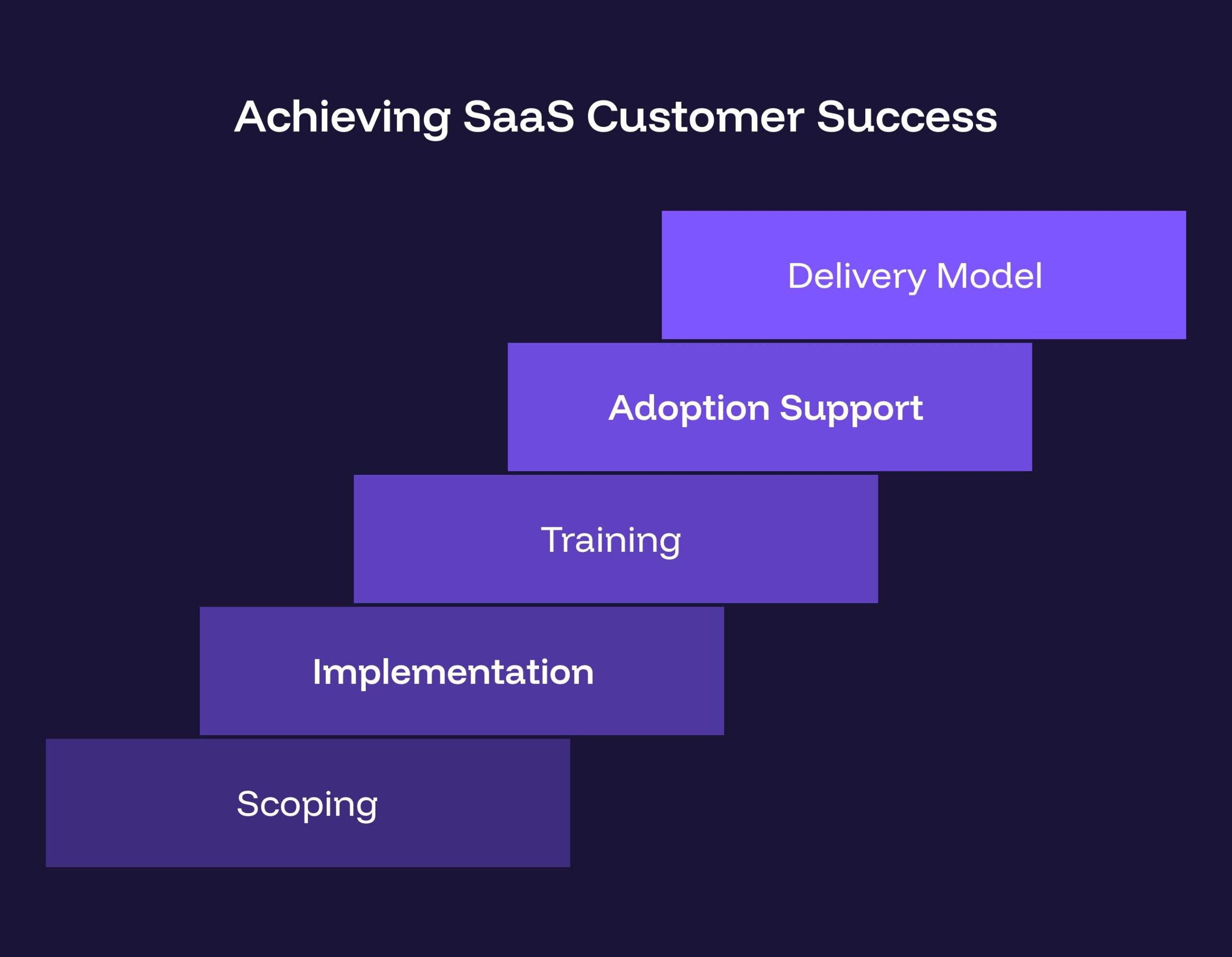
Professional services in SaaS run through a sequence that moves a customer from signed to successful. The components below are the work that converts a subscription into adoption and, ultimately, renewal.
Professional services in SaaS flow showing onboard, implement, train, adopt, and renew stages from sale to recurring revenue

  1. Scoping: Defining what success looks like for this customer and what it will take to get there. Services that start without a clear definition of the outcome tend to deliver activity rather than adoption.
  2. Implementation and integration: Getting the product configured, connected to the customer’s other systems, and ready for real use. This is the technical heart of services and where many adoptions stall when it is underestimated.
  3. Training and enablement: Teaching the customer’s people to actually use the product in their workflow. A perfectly implemented product that no one knows how to use produces no value and no renewal.
  4. Adoption support: Helping the customer move from initial use to embedded habit, which is the point where value becomes real and churn risk drops. Adoption is a phase, not a moment, and services carry the customer through it.
  5. Delivery model and capacity: Deciding what the vendor delivers directly and what partners deliver, and making sure there is enough capacity, of either kind, to serve the customers being sold. A sales motion that outruns services capacity creates a backlog of customers who bought and cannot adopt.

Common pitfalls in professional services in SaaS

  • Treating services as a cost to minimize: When services are seen purely as a margin drag rather than a renewal driver, they get under-resourced, customers stall on adoption, and the churn shows up later as lost recurring revenue. The saving is an illusion.
  • Selling faster than you can deliver: When the sales motion outpaces services capacity, customers sit in a backlog, unadopted and frustrated, before they ever reach value. Capacity, whether vendor or partner, has to keep pace with sales.
  • No clear outcome definition: Services that start without defining what success means for the customer deliver tasks instead of adoption. Activity is not the goal; a customer getting value is.
  • Ignoring partner-delivered services: When much delivery happens through partners and the vendor has no visibility into it, the vendor cannot tell which customers are being adopted well and which are at risk. Partner delivery is invisible churn risk if unmeasured.
  • Stopping at go-live: Treating implementation as the finish line leaves the customer at the start of adoption, not the end. The renewal depends on embedded use, which comes after go-live, not at it.

What this looks like in practice

A SaaS company sold aggressively and treated services as a necessary expense to keep as small as possible. The sales team closed faster than the small services function could deliver, so new customers waited weeks to be onboarded, then received a rushed implementation and minimal training. Go-live was declared, and the customer was left to adopt on their own. The numbers looked fine for a year, then the renewals came in soft, and churn analysis traced most of it back to customers who had never really adopted.

The company changed how it treated the work. Services were reframed as a renewal driver rather than a cost, capacity was expanded partly by building a network of delivery partners, and every engagement started with a defined outcome rather than a task list. Critically, partner-delivered work was made visible, so the company could see which customers were being adopted well regardless of who delivered the service. Renewal rates recovered as adoption improved, and the company could finally forecast renewal and expansion because it could see the delivery that drove them. Services stopped being a line item to shrink and became part of the revenue engine.

Forecastable’s POV on professional services in SaaS

Our position is that services in SaaS are a revenue function disguised as a cost function, and treating them as the latter is one of the quietest, most expensive mistakes a subscription business makes. The recurring revenue model means the renewal is where the money is, and the renewal depends on adoption, and adoption depends on services. Underinvesting in services to protect margin trades a small visible saving for a large invisible churn, and the bill arrives a year later when it is hard to trace.

We also believe partner-delivered services are a forecastability problem most vendors have not solved. A large share of SaaS adoption work runs through system integrators and consulting partners, and when the vendor cannot see that delivery, it cannot see the leading indicator of renewal and expansion. You end up forecasting recurring revenue while blind to the adoption work that determines it. Making partner delivery visible, and connecting it to the customer’s renewal trajectory, is what turns services from a blind spot into a forecasting input.

Finally, we think the discipline is to define the outcome and then resource to it. Services that start from a clear definition of what value means for the customer deliver adoption; services that start from a task list deliver activity. And capacity, vendor or partner, has to be planned against the sales motion, because selling faster than you can deliver simply manufactures unadopted customers. Get the outcome definition and the capacity right, make partner delivery visible, and services become the thing that makes recurring revenue actually recur.

Forecastable is a partnerships operating platform. Any third-party tools or methods named here are independent third-party products, and naming them is not an endorsement. Decide how professional services in SaaS should fit your own product, delivery model, and partners.

Frequently asked questions

What are professional services in SaaS?
They are the implementation, configuration, training, and advisory work that helps a customer adopt and get value from software they bought. They turn a signed subscription into a used one, delivered by the vendor, by partners, or both.

Why do professional services matter in a SaaS business?
Because subscription revenue depends on renewal, and renewal depends on adoption, which rarely happens on its own. Services are the bridge from purchase to value, which makes them directly tied to the recurring revenue that defines SaaS.

Should SaaS professional services be a profit center or a cost center?
The more useful framing is that they are a renewal driver. Whether or not the services line itself runs at a profit, under-resourcing it to protect margin tends to cost far more in churn than it saves.

Who delivers professional services in SaaS?
The vendor, partners such as system integrators and consultancies, or a mix. Much adoption work runs through partners, which is why visibility into partner-delivered services matters for forecasting renewal and expansion.

How do professional services affect SaaS churn?
Customers who adopt renew; customers who never adopt churn. Since services drive adoption, weak or rushed services are a leading cause of churn that often surfaces only at renewal, long after the gap was created.

How do partner-delivered services affect forecasting?
They are a leading indicator of renewal and expansion. A vendor that cannot see partner delivery cannot see whether customers are being adopted well, which leaves a blind spot in any recurring-revenue forecast.

Next step

If your renewals are softer than your sales suggest, the cause is often adoption that services, vendor or partner, never fully delivered. Forecastable helps SaaS and partnerships teams make partner-delivered services visible and connect adoption to renewal and expansion, so recurring revenue becomes something you can forecast rather than hope for. Start your growth journey now to bring services into the revenue picture. The forecastability hub frames how partner activity connects to predictable revenue, and the partner program hub covers building the delivery network behind it.

Uncover Your Growth Potential

Whether starting with a single sales team or a single partner, any co-sell motion can be live within 30 days.

Schedule a Discovery Call
Latest Insights
A revenue operations lead and a partner manager evaluating a forecast collaboration solution on a shared screen, the display showing reconciled partner and internal deals in one pipeline view, a finance lead nodding at the committed number, deep navy and warm amber palette
  • Partnerships Forecasting
Alex Buckles

Forecast Collaboration Solution: What to Look For

What is a forecast collaboration solution? Short answer: A forecast collaboration solution is the combination of shared data, agreed process, and the capability to reconcile estimates that lets a company and its partners produce one revenue forecast instead of two conflicting ones. It is less a single product than a set of capabilities, a shared […]

Read Article
Two professionals discuss a whiteboard diagram titled 'Partner Forecast Strategy' in a bright office as a colleague reads a document at the table.
  • Partnerships Forecasting
Alex Buckles

Forecast Collaboration Strategy: A Practical Guide

What is a forecast collaboration strategy? Short answer: A forecast collaboration strategy is the deliberate plan for how a company and its partners build one revenue forecast together, defining who is involved, what data they share, how often they reconcile, and how the joint number reaches the planning model. It turns ad hoc forecast conversations […]

Read Article
A partnerships lead and a partner rep building a shared forecast on a wall monitor, both pointing at the same deal list with overlapping accounts highlighted, a finance partner taking notes beside them, deep navy and warm amber palette
  • Partnerships Forecasting
Alex Buckles

What Is Forecast Collaboration? A Clear Definition

What is forecast collaboration? Short answer: Forecast collaboration is the practice of building a single revenue forecast jointly across the parties who influence it, internal sales, finance, and the partners co-selling the deals, working from shared data instead of separate, conflicting guesses. It replaces the situation where a company forecasts its own pipeline and its […]

Read Article
A partner manager and a finance lead listing the elements for forecast collaboration on a glass board, a shared joint deal view open on a laptop beside them, an internal AE adding a close date to the same list, deep navy and warm amber palette
  • Partnerships Forecasting
Alex Buckles

Elements for Forecast Collaboration: The Core 5

What are the elements for forecast collaboration? Short answer: The elements for forecast collaboration are the five parts that have to be present for a company and its partners to build one revenue forecast together: a shared view of the joint deals, a defined set of participants, aligned definitions of stage and timing, a recurring […]

Read Article
Logo — It’s All AboutThe Team

Quick Links

  • Who We Serve
  • Solutions
  • Resources
  • Pricing
  • Our History

Social Media

  • Linkedin

Legal

  • Privacy Policy
  • Terms of Service
Quick Links
  • Who We Serve
  • Solutions
  • Resources
  • Pricing
  • Our History
Social Media
  • Linkedin
Legal
  • Privacy Policy
  • Terms of Service

Stay ahead on ecosystem-led growth

Logo — It’s All AboutThe Team
© 2025 Forecastable. All rights reserved.
Book Your Strategy Call
Request Enrollment Details

[contact-form-7 id=”dfbeed3″ title=”Request Enrollment Details”]

Mollie Bodensteiner

Revops Advisory
  Mollie Bodensteiner is an experienced operations professional with a demonstrated track record of utilizing technology to support operational processes that drive performance and innovation. She currently is the Vice President of Operations at Sound and owns go-to-market agency, MB Solutions. Mollie has previously held operations leadership roles at Deel, Syncari, Corteva and Marketo. She has over 14 years of experience in both B2C and B2B operations and technology. When she is not working, Mollie enjoys spending time with her husband, three small children, and two large dogs. Childhood Career/Dream: Growing up in the age of Disney and Nick@Nite I always wanted to be a child actor (good thing that never was actually pursued 🙂 Favorite Win: I am not sure I have a specific “win” but I think I get the most joy and excitement from coaching others and watching them hit major milestones in their career. The first time you get to promote someone on your team or watch them lead a major project – are always career highlights! Personal Fun Facts: Favorite Song: If it’s love, Train Favorite Movie: Good Will Hunting Favorite Meme: Disaster Girl
Forecastable resources: Co-Sell Orchestration Platform · All Use Cases · Live in 30 Days · Co-Sell Playbook

Kelsey Buckles

Director of Operations


My journey from Education to Operations has equipped me with a unique perspective and skill set that perfectly aligns with Forecastable’s mission to help businesses improve sales collaboration through partner co-selling strategies.

At Forecastable, I am passionate about empowering teams and organizations to unlock the full potential of strategic partnerships. By leveraging my expertise in communication, leadership, and operational efficiency, I contribute to creating seamless co-selling processes that align with business goals and deliver exceptional results.

The intersection of my educational foundation and operational experience fuels my dedication to fostering alignment, building trust, and enhancing collaboration between partners. I am driven by the opportunity to contribute to a platform that not only optimizes sales strategies but also strengthens relationships that lead to long-term growth.

Paul Jonhson

Chief Technology Officer (Co-founder)


Paul Johnson has 20+ years of software development and consulting experience for a variety of organizations, ranging from startups to large-enterprise organization with highly-complex needs.

Mr. Johnson has a long track record of successful technology deployments.
This, combined with his deep passion for machine learning and exceptional user experience design, allows him to lead our technical direction from the front with confidence.

Alex Buckles

Product, Partnerships, and Value Engineering (Co-founder)


After serving in The United States Marine Corps, Alex Buckles spent the next two decades as a student of revenue production and an advocate for innovation.

Along the way, he has helped numerous companies achieve double and triple-digit growth by crafting and executing high-performing go-to-market strategies, with co-selling at the center of each.

As a once-advanced technical marketer, an expert sales & partner professional, and a strong customer success advocate, Mr. Buckles understands the impact of these functions aligning not only on revenue production, but on the day-to-day execution of the go-to-market strategy. This concept of revenue-team alignment is what quickly became the foundation of Forecastable back in January of 2018.

In his free time, you’ll find him spending quality time with his children, one of whom is on the autism spectrum. 1 in 36 children in the U.S. are on the spectrum and boys are four times more likely to be diagnosed than girls.

With that in mind, Mr. Buckles plans on dedicating the rest of his life serving those living with autism, through his organization Pathways for Autism. From his perspective, there must be a scalable and financially self-sustaining infrastructure established to put as many individuals with autism as possible on a path towards complete independence as adults.