What Is a Close Plan? Definition and Example

What is a close plan?
Short answer: A close plan is the dated, mutually agreed list of steps a buyer and a seller will take to move a deal from its current stage to a signed contract, with an owner and a due date on each step. It answers the question of what specifically has to happen, by whom, and by when, for a deal to close on its target date.
To put the definition plainly: a close plan is the deal’s route to signature, written down and dated. It is not a forecast of when the deal will close; it is the sequence of steps that makes that close date achievable.
Why understanding what a close plan is matters in 2026
Understanding what a close plan is matters because the term is often used loosely to mean any note about a deal, and the loose version does not work. A close plan is specifically dated, owned, and agreed with the buyer; a list of things the seller hopes will happen is none of those. Knowing the difference is what separates a plan that holds a forecast from a document that decorates a pipeline review.
In 2026 it matters more because buying committees and approval chains have grown, so the gap between a verbal yes and a signature is wider and fuller of steps. A clear understanding of what a close plan is, and what it is not, is the difference between surfacing those steps early and discovering them in the last week of the quarter.
How a close plan actually works
A close plan works by being built backward from the target close date and run forward as a shared checklist, where each step carries an owner and a date. Understanding the parts is the fastest way to understand the definition.
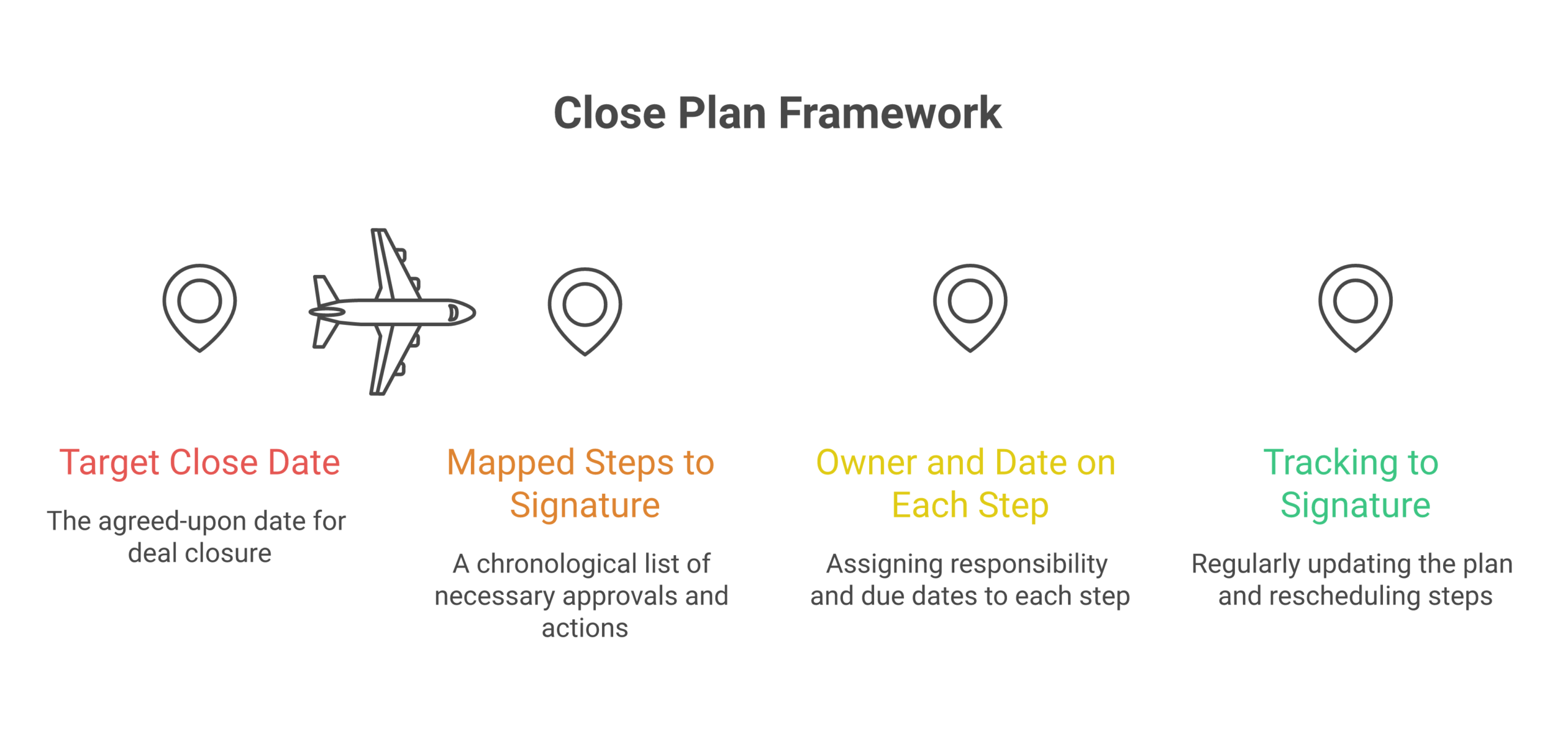
- A target close date: The date the deal is meant to close, agreed with the buyer, that every step is scheduled against.
- The mapped steps to signature: Every approval and action that has to clear before signing, technical validation, security, legal, budget, procurement, listed in order from the close date back to today.
- An owner and date on each step: A named person on both the buyer and seller side responsible for each step, with a due date, so the plan shows who does what by when.
- Tracking to signature: The plan is kept current as steps complete and slip, with dependent steps rescheduled so the close date stays honest.
A close plan is working when both sides see the same dated steps and a slip in one visibly moves the others, and failing when it is a static note that names a date with no steps behind it.
Common pitfalls in understanding what a close plan is
- Confusing it with a forecast: A forecast says when a deal will close; a close plan shows the steps that make that date achievable. They are different artifacts that serve different purposes.
- Thinking it is the seller’s document: A close plan is agreed with the buyer, who owns most of the internal approvals. A seller-only version maps the wrong half of the deal.
- Treating it as static: A close plan that names steps but is never updated is a snapshot, not a plan. The definition includes keeping it current as the deal moves.
- Reducing it to a date: A close date with no mapped steps is a guess, not a close plan. The steps, owners, and dates are what make it one.
What this looks like in practice
A simple example shows the definition at work. A seller targets a close date of the last day of the quarter. Working backward, signature requires legal sign-off, which requires a completed security review, which requires the buyer’s IT team to schedule it, which has to start six weeks before the close date. The close plan lays this out: each step, its owner on the buyer or seller side, and its due date. When the seller and buyer agree it, the six-week-out security start is visible immediately, so it gets scheduled on time instead of surfacing in the final week. That dated, owned, agreed sequence is a close plan; a sticky note saying close by quarter end is not.
Forecastable’s POV on what a close plan is
Our position is that the word agreed is doing most of the work in the definition. A close plan a seller writes alone is a forecast with extra steps, because the buyer owns the approvals that actually decide the date. What makes the artifact a close plan rather than a wish list is that the buyer has agreed to the steps and dates, which turns it into both a map and a mutual commitment. Strip out the agreement and you are left with a document that predicts the deal rather than driving it.
The second conviction is that a close plan is the bridge between selling and forecasting. People treat the two as separate, the rep sells and then reports a forecast, but the close plan is where they are the same thing. The dated, owned steps that move the deal are exactly the evidence that makes the forecasted close date defensible. Understanding what a close plan is means understanding that running the deal well and forecasting it accurately are the same activity, recorded in one artifact.
Forecastable is a partnerships operating platform; any third-party tools or methods referenced here are independent and naming them is not an endorsement of one approach over another. Define and build the close plan around your own deal, buying committee, and timeline.
Frequently asked questions
What is a close plan?
The dated, mutually agreed list of steps a buyer and seller take to move a deal to a signed contract, with an owner and a due date on each step.
What is the difference between a close plan and a forecast?
A forecast states when a deal will close; a close plan shows the specific steps that make that date achievable. The plan is the evidence behind the forecasted date.
What are the parts of a close plan?
A target close date, the mapped steps to signature, an owner and date on each step, and ongoing tracking that keeps the plan current as steps complete and slip.
Is a close plan the seller’s document or the buyer’s?
Both. It is agreed with the buyer, who owns most of the internal approvals, so a version the seller writes alone maps only half the deal.
When should a close plan be built?
As early as the deal is genuinely real, so slow steps like security review and procurement surface while there is still time to work them.
Next step
If close plan means only a date in your pipeline today, tightening the definition is the fastest way to make your forecast hold. Forecastable helps revenue and partnerships teams keep the agreed steps to signature visible, so a close date is grounded in a plan. Start your growth journey now to make your close dates defensible. The co-sell hub frames how joint deals reach signature, and the related close plan covers how to build one step by step.
Uncover Your Growth Potential
Schedule a Discovery Call