AE Accountability in Partner Engagement: A Field Guide

What is AE accountability?
Short answer: AE accountability is the practice of making individual account executives responsible for engaging partners and producing partner-sourced pipeline, with that responsibility tracked the same way quota is. It turns partner engagement from a nice-to-have into a measured part of the rep’s job.
Most partnership programs ask reps to work with partners and then never check whether they did. That is not accountability; it is a suggestion. Real accountability means the engagement is visible, owned, and reviewed.
When AE accountability is in place, a sales leader can look at any rep and see which partners they touched, what came of it, and whether the partner motion is actually moving deals. Without it, partner engagement happens for the reps who already believe in it and nowhere else.
Why AE accountability matters in 2026
Partner-sourced revenue has become a number leadership plans around, and in 2026 AE accountability is the difference between a partner motion that produces and one that lives entirely on the partnerships team’s shoulders. Reps decide where their selling time goes, so a motion they are not accountable for is a motion they deprioritize the first busy week.
The second reason is forecastability. A partner program where engagement depends on individual goodwill produces unpredictable results, because the people doing the work change every quarter. Tie engagement to named reps and the pipeline becomes something you can model rather than hope for.
The third reason is that the partnerships team cannot carry the whole motion alone. Partner managers can source overlap, run enablement, and open doors, but they do not own the customer relationship. The account executive does, and a partner deal that the AE will not engage on does not close regardless of how good the partner data is.
How AE accountability actually works
AE accountability works through a small set of mechanisms that make partner engagement visible and owned, so the motion stops depending on which reps happen to like partnering.
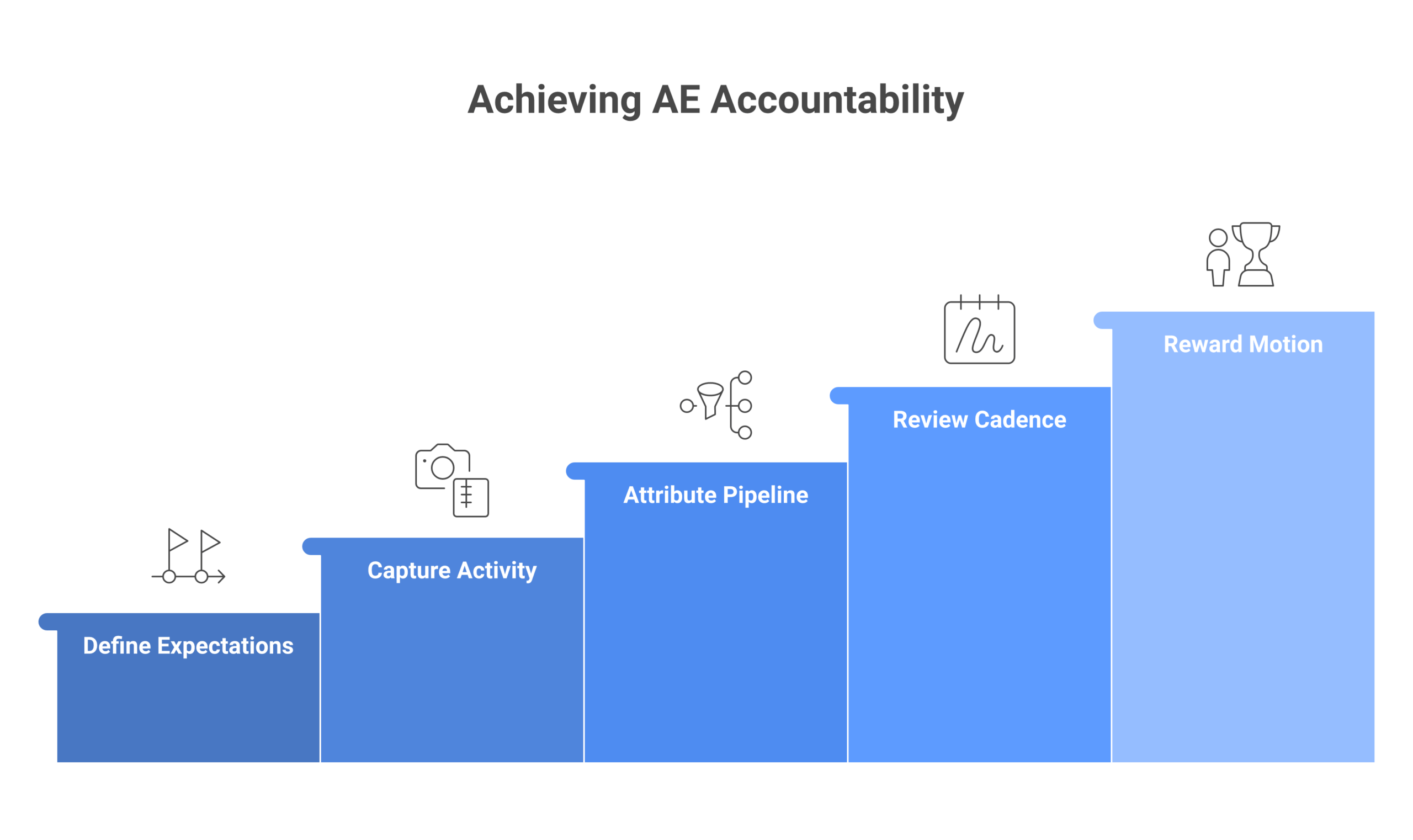
- A defined engagement expectation per rep: Accountability starts with stating what engagement actually means, a set number of partner touches, joint calls, or co-sell opportunities per quarter, so the rep knows the bar. A vague “work with partners” expectation produces nothing measurable.
- Partner activity captured in the CRM: When partner touches and partner-sourced opportunities live in the same system as the rest of the funnel, the engagement becomes visible to managers and reviewable in pipeline meetings. Activity that is not logged cannot be held to account.
- Partner-sourced pipeline attributed to the rep: The rep needs to see partner deals show up in their own numbers, not in a separate partnerships report nobody reads. Attribution that lands on the rep’s pipeline makes the engagement matter to the person doing it.
- A standing review in the existing sales cadence: Partner engagement belongs in the same one-on-ones and pipeline reviews where quota is discussed, not in a separate partnerships meeting reps skip. Reviewing it where the rest of the number is reviewed is what makes it real.
- Incentives that reward the partner motion: When working a partner deal pays the same as or better than going it alone, reps engage. When it costs them credit or speed, they route around it. Aligned incentives are what keep accountability from becoming resentment.
AE accountability is working when a sales manager can name which reps are engaging partners and what it produced, and it is failing when partner engagement is invisible until the partnerships team chases it down rep by rep.
Common pitfalls in AE accountability
- Accountability with no defined expectation: Telling reps to “engage partners” without a concrete bar gives everyone permission to do nothing and call it engagement. Without a number or a named motion, there is no standard to hold anyone to.
- Tracking engagement outside the CRM: When partner activity lives in a spreadsheet the sales team never opens, it is invisible where decisions get made. Engagement that is not in the pipeline system is engagement that does not count in practice.
- Reviewing partners in a separate meeting: A standalone partnerships review that reps treat as optional cannot enforce accountability. The motion has to be inspected in the same cadence as quota, or it loses every contest for attention.
- Crediting partner deals to the partnerships team only: When partner-sourced revenue shows up only in a partnerships dashboard and never on the rep’s number, the rep has no reason to care. Misplaced attribution quietly tells reps the motion is not theirs.
- Holding reps accountable with no support: Accountability without enablement, partner intros, overlap data, and a defined motion, is just pressure. Reps engage when the program makes engagement easy, not when it only makes them responsible for the outcome.
What this looks like in practice
A company had a partner program producing decent overlap data and almost no closed revenue, and the partnerships lead assumed the partners were the problem. A look at the sales side told the real story. Reps were never expected to do anything specific with partners, partner activity was tracked in a partnerships spreadsheet no AE ever opened, and partner deals were credited to the partnerships team rather than the rep who would have to close them. Engagement was nobody’s job. The fix had nothing to do with the partners. The team set a concrete expectation, two partner-sourced opportunities per AE per quarter, logged partner activity in the CRM where managers already lived, attributed partner pipeline to the individual rep, and moved the partner review into the weekly pipeline meeting. Within a quarter, engagement stopped being something the partnerships team begged for and became something managers inspected, and partner-sourced pipeline started showing up where leadership could forecast against it.
Forecastable’s POV on AE accountability
The position we hold is that partner programs fail on the sales side far more often than on the partner side, and AE accountability is the most underused lever in partnerships. Teams pour energy into recruiting partners and building overlap data, then hand it to reps who were never made responsible for using it. The data is fine; the accountability is missing.
The second conviction is that accountability has to live inside the existing sales system, not beside it. The moment partner engagement becomes a separate report, a separate meeting, a separate dashboard, it becomes optional, and optional partner work is the work that does not happen. Put it in the CRM, the pipeline review, and the rep’s number, and it becomes part of the job.
The honest caveat is that accountability without support backfires. If you make reps responsible for partner engagement but give them no warm intros, no overlap data, and no defined motion, you get compliance theater and quiet resentment. Accountability and enablement are two halves of the same lever, and pulling one without the other does not work.
Forecastable is a partnerships operating platform; any third-party tools or platforms referenced here are independent third-party products, and naming them is not an endorsement of one deployment over another. Evaluate each against your own motion.
Frequently asked questions
What does AE accountability mean in a partner program? It means individual account executives are responsible for engaging partners and producing partner-sourced pipeline, and that responsibility is tracked like quota. Engagement becomes a measured part of the rep’s job rather than an optional activity for the reps who already like partnering.
Why do partner programs fail without AE accountability? Because reps control where their selling time goes, and a motion they are not accountable for gets deprioritized the first busy week. Without accountability, partner engagement happens only for the few reps who believe in it and nowhere else, so the program cannot produce reliably.
Where should partner engagement be tracked? In the CRM, alongside the rest of the funnel, not in a separate partnerships spreadsheet. Activity that is not visible where pipeline decisions are made cannot be reviewed or enforced, so off-system tracking quietly removes the accountability.
How do you hold an AE accountable without demotivating them? Pair the expectation with support and aligned incentives. Give reps warm intros, overlap data, and a defined motion so engagement is easy, and make sure partner deals pay at least as well as solo deals. Accountability with enablement motivates; accountability alone just pressures.
Who owns partner-sourced pipeline, the rep or the partnerships team? The rep owns closing it; the partnerships team owns sourcing and supporting it. Attribution should land on the rep’s own pipeline so the motion matters to the person who has to execute it, while the partnerships team is measured on what it sources and influences.
How often should partner engagement be reviewed? In the same cadence as quota, typically the weekly or biweekly pipeline review and the rep’s regular one-on-one. Reviewing it in a separate partnerships meeting reps treat as optional is what lets accountability erode.
Next step
If your partner data is good but the revenue is not, the move this quarter is to put partner engagement on the reps, set a concrete expectation, track it in the CRM, attribute partner pipeline to the individual, and review it where you review quota.
Start your growth journey now to make partner engagement an owned part of the sales motion, or see the orientation on forecastable partnerships for how accountability feeds a predictable number.
Uncover Your Growth Potential
Schedule a Discovery Call