Why Does Co-Selling Fail? The Human Reasons It Breaks

What does why does co-selling fail mean?
Short answer: Why does co-selling fail is, at the level reps actually experience, a question about the human moments between two sellers, the slow handoff, the unbuilt trust, the credit that never gets shared, where joint deals quietly break even when the program looks well-designed on paper. It points to the execution failures that happen between people, not the architecture failures that happen in a planning doc.
A program can have a defined motion, a named owner, and clean attribution and still watch deals die, because co-selling ultimately happens between two individuals trying to win a customer together. When those individuals do not trust each other or do not follow through, the best structure in the world does not save the deal.
Asking why does co-selling fail at this level means looking at the texture of how sellers actually work together: whether they respond to each other, whether they make each other look good in front of the customer, and whether the relationship survives the first deal.
Why understanding why does co-selling fail matters in 2026
Co-selling depends on two sales teams that do not report to each other choosing to cooperate, and in 2026 the programs that produce are the ones that manage the human dynamics, not just the structure. Understanding why does co-selling fail at the execution level matters because a perfectly designed program still fails one rep relationship at a time when those dynamics go unmanaged.
The second reason is that the human failures are invisible in a dashboard. A flat partner number tells you something is wrong but not that the real cause is a partner rep who got burned on the first deal and stopped picking up the phone. Diagnosing why does co-selling fail at the seller level is the only way to see and fix those breakdowns.
The third reason is that trust between sellers compounds or decays. A first co-sell deal that goes well makes the next one easy; one that goes badly poisons the relationship for quarters. Knowing why co-selling fails between people lets you protect the early deals that set the tone for everything after.
How co-selling fails actually works
Co-selling fails at the human level through a sequence of small breakdowns between two sellers, each of which erodes the cooperation the deal depends on.
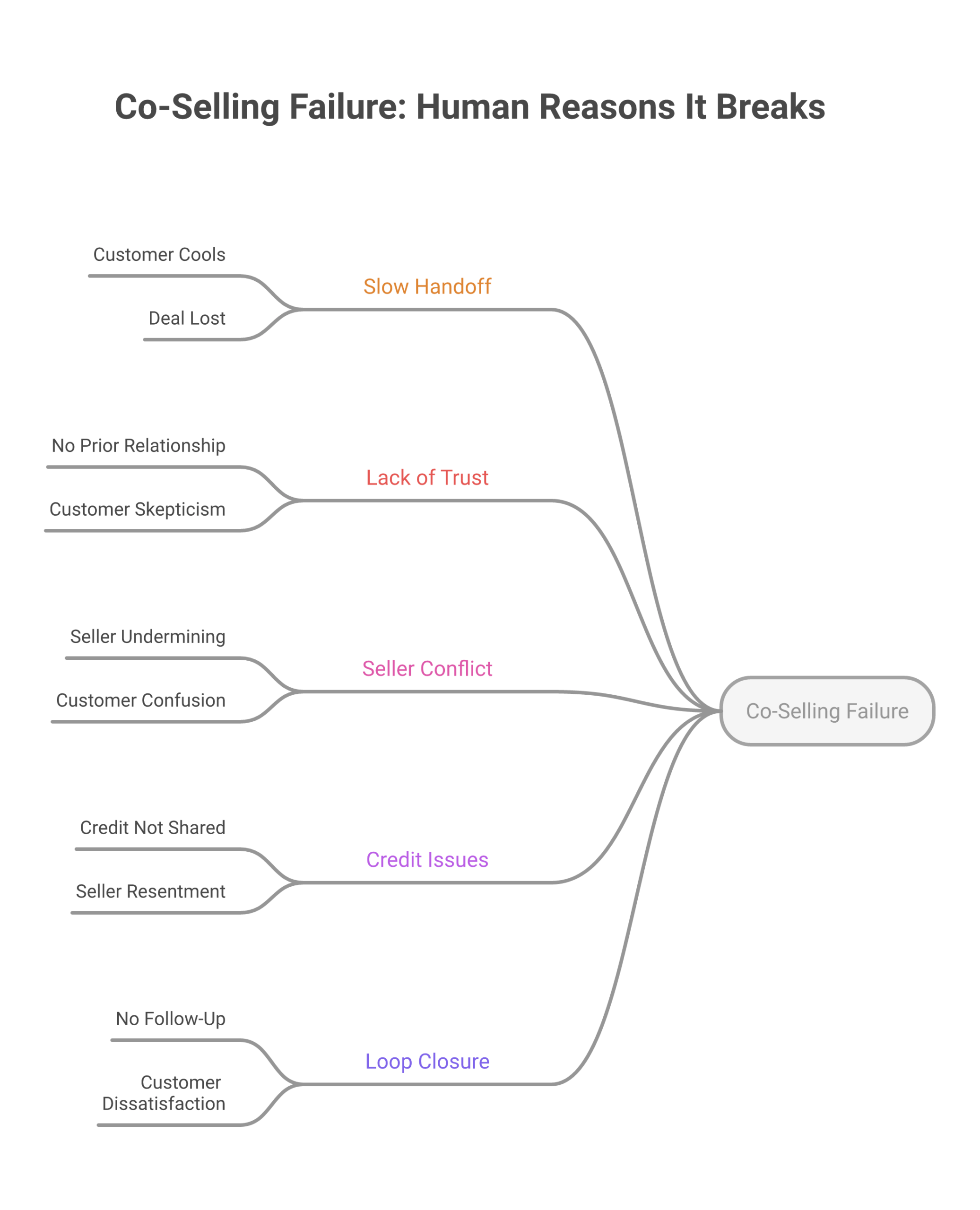
- The handoff is slow, so the customer cools: When one seller loops the other in and the response is slow, the customer loses momentum and the deal cools. Speed at the handoff is what keeps a joint deal alive, and a lagging response is where many co-sell deals quietly die.
- Trust was never built before the deal: When two sellers meet for the first time on a live deal, they have no basis to coordinate and default to protecting their own interest. Trust built before the pressure is what lets them work as one in front of the customer rather than as two competitors.
- One seller makes the other look bad to the customer: When a co-seller fumbles, oversells, or contradicts the other in front of the buyer, the relationship breaks and the deal suffers. Making your co-seller look good to the customer is the unwritten rule, and breaking it ends future cooperation.
- Credit is taken, not shared: When one side claims the win and the other feels used, the burned seller stops engaging. Sharing credit visibly is what makes a seller bring you the next deal, and hoarding it guarantees there is no next deal.
- No one closes the loop after the deal: When a seller brings a partner in and then hears nothing about the outcome, they learn the cooperation was one-way. Closing the loop, the result, the credit, the thanks, is what turns a single co-sell into a habit.
Co-selling is failing at the human level when partner reps stop initiating and only engage when chased, and it recovers when the early deals go well enough that sellers want to work together again.
Common reasons why co-selling fails between sellers
- The handoff drags and the customer loses momentum: A joint deal lives on timing, and a slow response when one seller loops the other in lets the customer cool. Many co-sell deals do not fail dramatically; they fade because the handoff took too long and the moment passed.
- The two sellers never built trust: Reps meeting for the first time on a live deal have no foundation to coordinate, so they protect their own interest instead of the deal. Without trust built before the pressure, co-selling defaults to two people guarding turf in front of one customer.
- One seller burned the other on the first deal: A co-seller who oversold, went silent, or grabbed the credit poisons the relationship, and the burned seller stops engaging. The first deal sets the tone, and a bad one costs you every deal that would have followed.
- Credit gets hoarded instead of shared: When one side claims the win and the other feels used, future cooperation ends. Sellers bring deals to people who make them look good and share the credit, and avoid the ones who do not.
- No one follows up after the deal closes: A seller who hands you an opportunity and hears nothing about how it went learns the relationship is one-way. Silence after the close is one of the quietest and most common reasons co-selling stops happening.
What this looks like in practice
A company had a co-sell program that looked healthy on paper, defined motion, named owner, clean attribution, and yet the partner reps had gone quiet. The dashboard showed a flat number but not the reason. When the partner manager actually talked to the partner’s sellers, the human story came out. The first co-sell deal six months earlier had gone badly: the company’s rep had been slow to respond on the handoff, then taken full credit for the win in front of both managers. The partner’s seller had looked bad to his own customer and felt used afterward, so he simply stopped bringing deals. No structural fix would have surfaced that. The partner manager rebuilt the relationship at the human level, apologized for the handoff, set a same-day response commitment, made sure the next win was credited visibly to the partner rep, and closed the loop personally on every deal. The partner reps started engaging again within a quarter, because the reason co-selling had failed was never the structure, it was the trust.
Forecastable’s POV on why does co-selling fail
The conviction we hold is that co-selling is ultimately a human motion, and a lot of programs fail at the seller level even after the structure is sound. You can define the motion, name the owner, and instrument attribution perfectly and still watch deals die because two sellers who do not trust each other will not coordinate under pressure. The structure makes co-selling possible; the human dynamics decide whether it actually happens.
The second conviction is that the first deal matters out of all proportion. A first co-sell that goes well, fast handoff, shared credit, a co-seller who looked good to the customer, makes every subsequent deal easier, and a first one that goes badly can poison a partner relationship for quarters. Protecting and over-investing in those early deals is some of the highest-leverage work in co-sell.
The honest caveat is that you cannot fully systematize trust between people who do not report to you. You can create the conditions, fast responses, shared credit, real follow-through, but the cooperation itself is chosen by sellers you do not control. When a partner’s reps simply do not want to work with yours despite good conditions, the honest read is sometimes that the human fit is not there, and the time is better spent where it is.
Forecastable is a partnerships operating platform; any third-party tools or platforms referenced here are independent third-party products, and naming them is not an endorsement of one deployment over another. Evaluate each against your own motion.
Frequently asked questions
Why does co-selling fail even when the program is well-designed? Because co-selling happens between two individual sellers, and good structure cannot force cooperation. Slow handoffs, unbuilt trust, and hoarded credit kill joint deals regardless of how clean the motion, ownership, and attribution look on paper.
What human moment kills co-sell deals most often? The handoff. When one seller loops the other in and the response is slow, the customer loses momentum and the deal cools. Many co-sell deals fade quietly at the handoff rather than failing for any structural reason.
How does the first co-sell deal affect the relationship? Out of all proportion. A first deal that goes well makes the next one easy; one that goes badly can poison the seller relationship for quarters. Protecting the early deals is some of the highest-leverage work in co-sell because they set the tone.
Why do partner reps stop bringing deals? Usually because they were burned, a slow response, a credit grab, or silence after a deal they handed over. Sellers bring deals to people who make them look good and share the win, and stop bringing them to people who do not.
Can you fix co-selling that fails at the human level? Often, yes, by repairing the conditions, fast responses, visible shared credit, and real follow-through on every deal. What you cannot do is force trust between sellers you do not control, so the fix is creating the conditions and protecting the early deals, not mandating cooperation.
How is why does co-selling fail different from why co-sell fails structurally? Structural failure happens in the program design, no motion, no owner, no attribution. Human failure happens between two sellers even when the design is sound. A program needs both the structure and the seller-level dynamics to work; fixing one while ignoring the other still leaves co-selling broken.
Next step
If your co-sell program looks well-built but the partner reps have gone quiet, the move this quarter is to talk to the actual sellers, find the deal that went badly, repair the trust with fast handoffs and shared credit, and protect the next first deal as if the relationship depends on it, because it does.
Start your growth journey now to make co-selling work at the human level where deals are won, or see the orientation on co-sell for how the motion fits together.
Uncover Your Growth Potential
Schedule a Discovery Call