Why Co-Sell Fails: The Structural Reasons It Stalls

What is meant by why co-sell fails?
Short answer: Why co-sell fails is a question about structure more than effort, because most co-sell programs stall on design flaws, no defined motion, no clear ownership, no attribution, rather than on people not trying hard enough. It points to the systemic reasons a joint-selling program produces meetings and goodwill but not revenue.
Teams tend to blame co-sell failure on the partner, the reps, or bad luck. Those explanations feel satisfying and are usually wrong. A program built on a broken structure fails no matter how committed everyone is.
Understanding why co-sell fails means looking at the program’s architecture: whether the motion is defined, whether anyone owns the number, whether the revenue is attributable, and whether the incentives point the right way. Fix the structure and the effort starts producing.
Why understanding why co-sell fails matters in 2026
Co-sell has become a core growth motion, and in 2026 the cost of a failing co-sell program is no longer a missed experiment, it is a missed number that leadership was counting on. Knowing why co-sell fails matters because the failure modes are predictable and preventable, and a program designed against them produces where an undesigned one stalls.
The second reason is resource defense. A co-sell program that fails quietly loses its budget and its credibility, and the partnerships function spends the next planning cycle explaining the flat number. Diagnosing the structural causes lets you fix them before the program is written off.
The third reason is that the same flaws recur across companies. Why co-sell fails is rarely a novel problem; it is the same handful of design gaps showing up again. A team that knows the pattern can build around it from the start rather than rediscovering it the expensive way.
How co-sell fails actually works
Co-sell fails through a small set of structural gaps, each of which produces activity without revenue, and each of which is fixable by design.
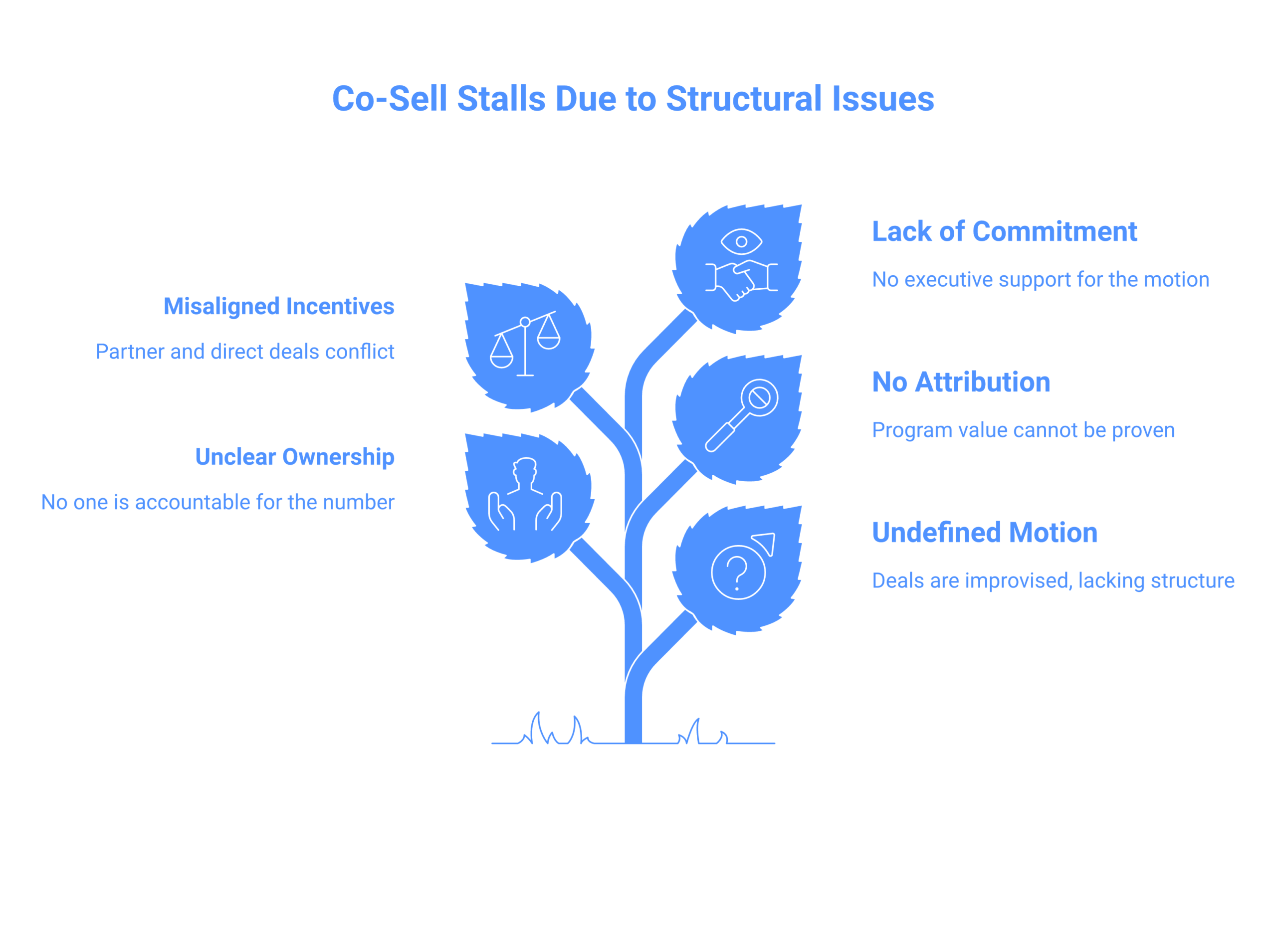
- No defined motion, so every deal is improvised: When there is no documented play for how partners and reps sell together, each co-sell deal is a one-off, and improvisation does not scale. The fix is a defined motion, who fronts the customer, how the deal runs, that any rep can execute.
- No clear ownership of the number: When co-sell revenue is everyone’s job and no one’s quota, it gets the attention an unowned goal always gets, which is none under pressure. The fix is a named owner accountable for partner-sourced revenue.
- No attribution, so the program cannot prove value: When partner involvement is not captured, the program cannot show what it produced, and an unprovable program loses its resources. The fix is capturing partner-sourced and influenced revenue where the rest of the funnel is tracked.
- Misaligned incentives between partner and direct deals: When co-sell deals contest credit with direct deals, reps avoid the friction and the program starves. The fix is settling credit rules before the quarter so co-sell is not a fight reps would rather skip.
- No executive commitment behind the motion: When leadership likes co-sell in principle but commits no resources, the program cannot secure the sales attention or budget it needs. The fix is a resourced executive commitment, not just enthusiasm.
Co-sell is failing structurally when the program is busy, meetings, enablement, decks, but partner revenue stays flat, and it recovers when each structural gap is closed so effort finally lands on a working architecture.
Common reasons why co-sell fails
- The motion was never defined: A program that never wrote down how partners and reps actually sell together leaves every deal to improvisation. Improvised co-sell works occasionally and scales never, so the program produces sporadic wins and no reliable revenue.
- No one owns the co-sell number: When partner revenue belongs to everyone, it belongs to no one when priorities compete. Without a named owner accountable for the outcome, co-sell loses every contest for attention against quota-carrying direct work.
- The program cannot prove what it produced: A co-sell program with no attribution cannot show its contribution, and an invisible contribution gets cut. Many co-sell programs fail not because they produced nothing but because they could not prove they produced anything.
- Credit rules pit co-sell against direct deals: When involving a partner means fighting a direct rep for the same credit, reps quietly avoid co-sell. Unsettled attribution turns a growth motion into an internal dispute that sellers route around.
- Executives endorsed but never committed: Leadership enthusiasm with no resources behind it leaves the program unable to secure sales time or budget. Co-sell that has a sponsor in name but not in committed resources stalls the first time it needs something.
What this looks like in practice
A company ran a co-sell program for a year and had almost nothing to show for it, and the leadership’s instinct was that the partners were weak. A short diagnosis told a different story. The partners were fine; the structure was broken in three places. There was no defined motion, so reps improvised every partner deal and most fizzled. No one owned the co-sell number, so it lost every priority contest to direct quota. And nothing was attributed, so even the deals that closed could not be credited to the program. None of that was an effort problem. The team fixed the architecture rather than replacing the partners. They documented the motion, named an owner accountable for partner revenue, and instrumented attribution in the CRM. Within two quarters the same partners that had looked weak were producing forecastable pipeline, because the program finally had a structure for their effort to land on.
Forecastable’s POV on why co-sell fails
The position we hold is that co-sell almost never fails for lack of effort, and teams waste months treating a structural problem as a motivation problem. They push reps harder, swap partners, and run more enablement, when the real issue is that the program has no defined motion, no owner, or no attribution. Effort poured onto a broken structure produces exhaustion, not revenue.
The second conviction is that the failure modes are boringly predictable, which is good news. Why co-sell fails is rarely a mystery unique to your company; it is the same handful of design gaps that stall programs everywhere. That means you can design against them from the start instead of discovering them one painful quarter at a time.
The honest caveat is that not every co-sell failure is worth fixing in place. Sometimes the structural diagnosis reveals that the underlying partnership has no real overlap or mutual value, and no amount of motion design will save it. The discipline is to separate a structurally broken program around a good partnership, which is fixable, from a sound structure around a partnership that was never going to produce, which is not.
Forecastable is a partnerships operating platform; any third-party tools or platforms referenced here are independent third-party products, and naming them is not an endorsement of one deployment over another. Evaluate each against your own motion.
Frequently asked questions
What is the most common reason co-sell fails? No defined motion. When there is no documented play for how partners and reps sell together, every deal is improvised, and improvisation does not scale. Most co-sell programs that stall do so because the motion was never actually designed.
Is co-sell failure usually a people problem or a structure problem? Almost always structure. Teams blame partners or reps, but the recurring causes are design flaws, no motion, no ownership, no attribution. Effort cannot compensate for a broken architecture, which is why pushing harder rarely fixes a failing co-sell program.
Why does a co-sell program lose its budget even when deals close? Because without attribution it cannot prove what it produced. A program that captures no partner involvement cannot credit the revenue it generated, and an unprovable contribution gets cut regardless of whether it was real.
How does misaligned credit cause co-sell to fail? When co-sell deals contest the same credit as direct deals, reps avoid the friction and route around the partner motion. Unsettled attribution turns co-sell into an internal dispute, and sellers will not fight that battle when a cleaner direct deal is available.
Can executive support fix a failing co-sell program? Only if the support is resourced. Enthusiasm with no committed people or budget cannot secure the sales attention the motion needs. Real executive commitment helps; symbolic endorsement does not, and many programs fail with a sponsor who never committed anything concrete.
How do I know whether to fix or abandon a failing co-sell program? Diagnose the structure first. If the motion, ownership, and attribution are broken around a partnership with real overlap and mutual value, fix the structure. If the structure is sound but the partnership has no genuine overlap, the honest move is to stop rather than redesign.
Next step
If your co-sell program is busy but the partner number is flat, the move this quarter is to diagnose the structure rather than the people, check whether the motion is defined, the number is owned, and the revenue is attributed, then close whichever gap is starving the program.
Start your growth journey now to fix the structure that makes co-sell produce, or see the orientation on co-sell for how the pieces fit together.
Uncover Your Growth Potential
Schedule a Discovery Call