Predictable Partner Pipeline: How to Build One

What is a predictable partner pipeline?
Short answer: A predictable partner pipeline is partner-sourced and partner-influenced opportunity that you can forecast with the same confidence as direct pipeline, because it flows from a repeatable motion rather than a lucky quarter. It depends on consistent partner inputs and clean stage data, which is exactly why most partner pipeline stays unpredictable and gets treated as upside rather than plan.
Predictability is not about volume. A program can source a lot of deals and still have a pipeline no one can forecast, because the deals arrive in bursts with no understood pattern. The opposite, a steadier and smaller flow you can model, is far more valuable to a revenue leader.
The distinction that matters is between pipeline you hope for and pipeline you can plan around. The first is a surprise each quarter; the second has a known rhythm, known conversion rates, and a known relationship between partner activity and deals.
Why a predictable partner pipeline matters in 2026
Partner revenue is increasingly part of the committed forecast, not just the upside, and in 2026 a CRO who has to plan around partner pipeline needs it to behave predictably or they cannot count it. Unpredictable partner pipeline gets discounted in the forecast, which means the program gets less credit and less investment than its volume deserves.
The second reason is that predictability is what earns the program a seat at the revenue table. A partner pipeline that swings wildly looks like noise to a sales leader; one that converts at a known rate from a known set of inputs looks like a forecastable engine worth planning around and funding.
The third reason is operational. A predictable pipeline lets you spot problems early, when partner inputs dip you can see the deals that will not arrive two quarters out, while an unpredictable one only reveals the shortfall when the quarter is already lost. Predictability buys you time to react.
How a predictable partner pipeline actually works
The pipeline becomes predictable when partner inputs are consistent, stages and conversion are measured cleanly, and you model deals from leading indicators rather than waiting for them to appear.
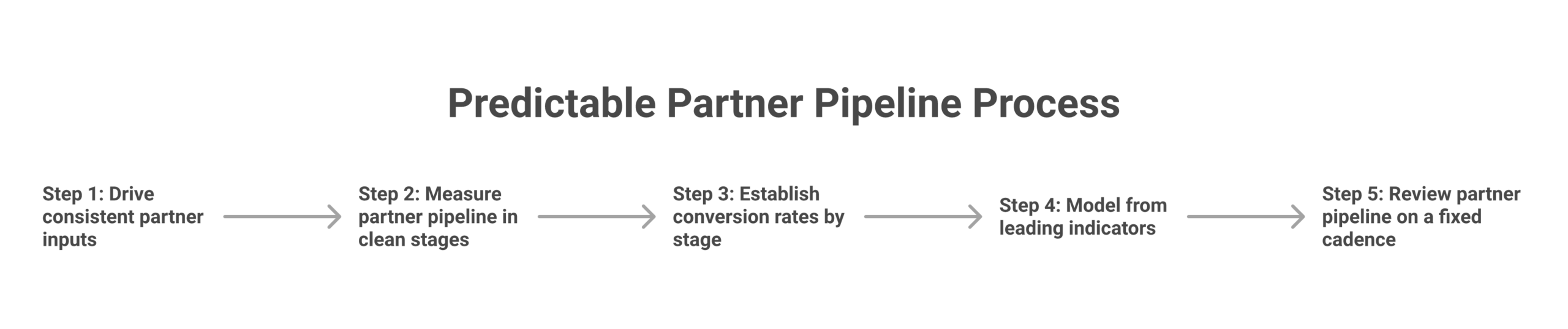
- Drive consistent partner inputs: Keep the upstream activity steady, partners activated, deals registered, co-sells in motion, because pipeline can only be as predictable as the inputs that feed it. Bursty activity produces bursty pipeline.
- Measure partner pipeline in clean stages: Track partner deals through defined stages with honest data, separating sourced from influenced, so you can see where deals sit and how they move rather than guessing. A pipeline you cannot see clearly you cannot forecast.
- Establish conversion rates by stage: Learn how partner deals actually convert from stage to stage over time, since known conversion rates are what turn a list of opportunities into a forecast. Without them, pipeline is just a hopeful total.
- Model from leading indicators: Forecast future pipeline from upstream partner signals, activation, registered deals, co-sell starts, rather than waiting for opportunities to surface, so you see the shortfall coming while there is still time to act.
- Review partner pipeline on a fixed cadence: Run a regular partner pipeline review with the same rigor as direct pipeline, so the data stays clean, the forecast stays current, and the program is held to a predictable rhythm rather than a quarterly scramble.
The pipeline is read against whether your partner forecast holds up quarter to quarter, which is the only real test of whether you have built predictability or just a busier version of hope.
Common pitfalls with a predictable partner pipeline
- Confusing volume with predictability: A program can source many deals and still have an unforecastable pipeline if they arrive in unpredictable bursts. The goal is a known rhythm, not just a big number, and chasing volume alone never produces it.
- Dirty or merged stage data: When sourced and influenced deals are mixed and stages are tracked loosely, the pipeline cannot be modeled because no one trusts what the numbers mean. Clean, separated stage data is the foundation predictability is built on.
- Forecasting from lagging signals: Waiting until opportunities appear to forecast means you only learn about a shortfall once it is too late to fix. Predictability comes from modeling leading indicators, not from counting deals already in the pipeline.
- Letting partner inputs run bursty: Inconsistent upstream activity, activation in waves, deal registration in spurts, produces inconsistent pipeline by definition. Steady inputs are the price of a steady pipeline, and most programs never pay it.
- Reviewing partner pipeline less rigorously than direct: Treating partner pipeline as upside that gets a casual glance keeps the data dirty and the forecast unreliable. Predictability requires the same review discipline applied to direct pipeline.
What this looks like in practice
A program was sourcing real partner revenue, but it landed unpredictably, a strong quarter followed by a weak one with no understood reason, so the CRO treated all of it as upside and counted none of it in the plan. The partnerships leader set out to make the pipeline forecastable. They cleaned up the stage data, separating sourced from influenced, established how partner deals actually converted from stage to stage, and started modeling future pipeline from upstream signals like activation and registered deals rather than waiting for opportunities to appear. They ran a partner pipeline review on the same cadence as the direct one. Within two quarters the partner forecast started holding, the swings turned out to be driven by bursty activation that they then smoothed, and the CRO began counting partner pipeline in the committed plan. The volume had not changed much; the predictability had, and that was what earned the program its seat in the forecast.
Forecastable’s POV on a predictable partner pipeline
Predictability beats volume, and most programs have the priority backwards. They chase more sourced deals and celebrate the big quarters, but a pipeline that swings unpredictably gets discounted by the revenue leader no matter how large it is, because a number you cannot count on is not a number you can plan around. A smaller pipeline you can forecast is worth more to the business than a larger one you cannot, and programs that optimize for predictability earn credit and investment that pure-volume programs never do.
The second conviction is that predictability is built upstream, not in the forecast. You cannot model your way to a reliable pipeline if the partner inputs are bursty and the stage data is dirty; the forecast only reflects the consistency of what feeds it. The real work is steadying activation, deal registration, and co-sell starts, and cleaning the stage data, so that there is a stable signal to forecast from in the first place.
The candid limit is that no partner pipeline is as predictable as a mature direct one, and pretending otherwise sets the program up to miss. Partner deals depend on another company’s behavior, which adds variance you do not fully control. The goal is a pipeline predictable enough to count in the plan with an honest confidence interval, not a perfectly smooth forecast, and a leader who promises the latter will lose credibility the first time a partner quarter slips.
Forecastable is a partnerships operating platform built around forecastability; any third-party tools or platforms referenced here are independent third-party products, and naming them is not an endorsement of one deployment over another. Evaluate each against your own motion.
Frequently asked questions
What makes a partner pipeline predictable?
Consistent partner inputs, clean stage data that separates sourced from influenced, known stage-to-stage conversion rates, and forecasting from leading indicators rather than lagging ones. Predictability is a property of the motion feeding the pipeline, not of the pipeline total.
Why is partner pipeline usually unpredictable?
Because the upstream activity is bursty and the stage data is dirty, so deals arrive in unexplained waves and no one trusts the numbers enough to forecast them. The unpredictability is upstream, in the inputs, not in the pipeline itself.
How do you forecast partner pipeline?
Model it from leading indicators, partner activation, registered deals, co-sell starts, using established conversion rates, rather than waiting for opportunities to appear. That lets you see a shortfall while there is still time to act on it.
Should partner pipeline be reviewed like direct pipeline?
Yes. Treating partner pipeline as casual upside keeps the data dirty and the forecast unreliable. Reviewing it on a fixed cadence with the same rigor as direct pipeline is what keeps it clean enough to count.
Is a predictable pipeline better than a large one?
For a revenue leader, usually yes. A pipeline you can forecast gets counted in the plan and earns investment; a large but unpredictable one gets discounted as upside. Predictability turns partner revenue into something the business can plan around.
Can partner pipeline ever be fully predictable?
Not fully, because partner deals depend on another company’s behavior, which adds variance. The realistic goal is predictable enough to count in the plan with an honest confidence range, not a perfectly smooth forecast.
Next step
If your partner revenue is real but lands in unpredictable bursts, the move this quarter is to clean your partner stage data, establish your stage-to-stage conversion rates, and start forecasting from upstream signals so the CRO can count the pipeline instead of discounting it.
Start your growth journey now to build a partner pipeline your revenue team can actually forecast, or read the orientation on forecastability for the broader operating model behind a predictable program.
Uncover Your Growth Potential
Schedule a Discovery Call