Partner Pipeline Forecasting: A Practical Model

What is partner pipeline forecasting?
Short answer: Partner pipeline forecasting is the practice of predicting how much partner-sourced and partner-influenced revenue will close in a future period, using stage conversion rates, deal age, and partner-specific signals rather than a partner manager’s gut feel. It turns the partner pipeline from a hopeful list into a number leadership can plan around.
Most partner pipelines are not forecast; they are described. A partner manager looks at the open deals, picks the ones that feel close, and offers a guess. That guess is usually optimistic, rarely consistent, and impossible to plan against, which is why finance treats partner numbers as the soft part of the forecast. Forecasting replaces the gut feel with a method that produces the same answer regardless of who runs it.
The clearest way to frame it is borrowing the discipline the direct-sales team already uses and adapting it to the seams of a partner motion. Direct teams forecast on stage conversion and deal age because those signals predict outcomes. Partner pipeline can be forecast the same way, once you account for the fact that the deal lives across two organizations and the data is split between them.
Why partner pipeline forecasting matters in 2026
Partner revenue has grown large enough that leadership has to plan around it, and you cannot plan around a number you cannot predict. When partner-sourced revenue was a rounding error, a rough guess was fine. Now that it is a meaningful share of the total, an unforecastable partner pipeline is a hole in the company’s plan, and finance notices the hole.
The second force is the credibility of the partnerships function. A team whose forecast is consistently wrong, usually too optimistic, loses the trust that earns budget and headcount. A team that forecasts partner revenue within a tight band, quarter after quarter, becomes a reliable part of the plan, which is worth more politically than a bigger pipeline that no one believes. Forecast accuracy is how partnerships earns a seat at the planning table.
The third force is the data finally existing. Partner pipeline forecasting used to be impossible because the deal data was scattered across spreadsheets and two separate systems. The platforms partner teams now run capture stage, age, and partner attribution in a way that makes real forecasting feasible for the first time. The inputs are available; the programs that still forecast on gut feel are choosing not to use them.
How partner pipeline forecasting actually works
A working forecast is built from a small set of inputs combined in a repeatable model. Each input addresses a specific reason partner pipelines are usually mis-forecast.
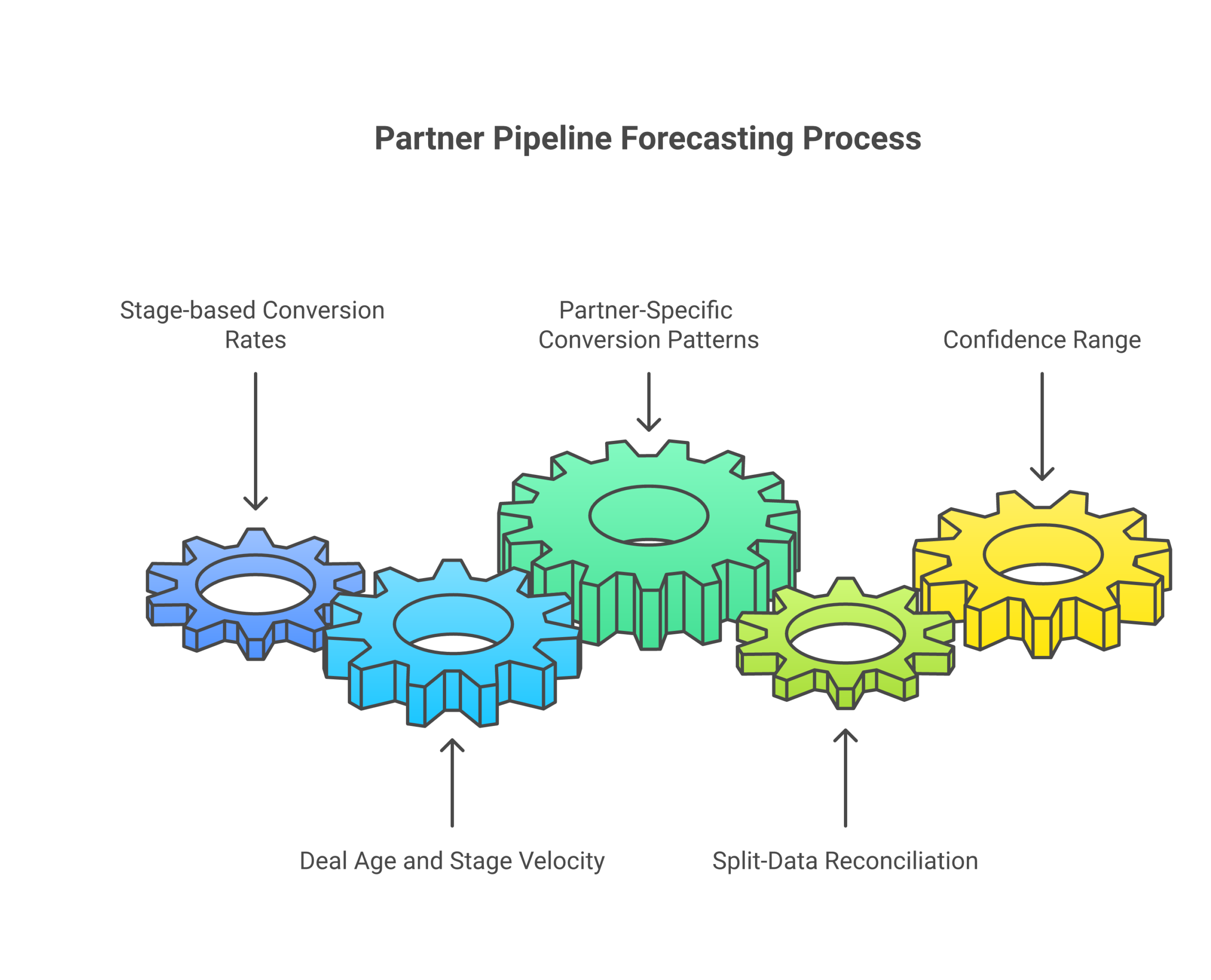
- Stage-based conversion rates from history: The model starts with the rate at which partner deals convert from each stage to closed, measured from your own historical data rather than assumed. A deal in late-stage validation has a known probability of closing; applying that rate across the pipeline produces a weighted number far more reliable than a manager’s pick.
- Deal age and stage velocity: A deal that has sat in the same stage for twice the normal time is not as likely to close as its stage implies, so the model adjusts for age. Stage velocity catches the stalled deals that a static stage view counts as healthy, which is one of the largest sources of partner-forecast error.
- Partner-specific conversion patterns: Different partners convert at different rates, and a good forecast weights by the partner, not just the stage. A deal sourced by a partner with a strong close history is worth more than the same-stage deal from a partner who rarely closes, so partner-level rates sharpen the projection.
- The split-data reconciliation: Because a co-sell deal lives in two systems, the forecast has to reconcile the two views into one stage of record, so a deal is not counted at two different stages. Resolving the split data into a single source of truth is the step that pure direct-sales forecasting never has to do.
- A confidence range, not a point: The output is a projected number with an honest band around it, grounded in how tightly the model has predicted in past periods. A range lets leadership plan for the realistic spread rather than bet on a single optimistic figure, which is what makes the forecast usable.
The model is rerun every period against fresh data, and its accuracy is tracked over time, so the conversion rates improve as the program accumulates history and the band tightens.
Common pitfalls in partner pipeline forecasting
- Forecasting on the manager’s gut: A partner manager picking the deals that feel close produces an optimistic, inconsistent number that cannot be planned against. The whole point of a model is to remove the person from the prediction. Replace the pick with stage conversion rates from real history.
- Ignoring deal age: A static stage view counts a deal that has been stuck for months as healthy because it is in a late stage. Stalled deals are a major source of over-forecasting, so a model that does not adjust for age and velocity will consistently project too high.
- Treating all partners as the same: Applying one blended conversion rate across all partners ignores that partners close at very different rates. A forecast that does not weight by partner over-counts the weak partners’ pipeline and under-counts the strong ones. Partner-level rates fix this.
- Counting the split data twice: A co-sell deal that appears in both organizations’ systems at different stages can be counted twice or at the wrong stage if the two views are not reconciled. The split-data reconciliation is unique to partner forecasting, and skipping it corrupts the number.
- Reporting a point instead of a range: A single projected figure invites the question “is that the floor or the ceiling,” and the honest answer is neither. A forecast without a confidence band over-promises and gets discredited the first time reality lands outside it. Report the range and the assumptions behind it.
What this looks like in practice
A partnerships team forecast its quarter by having each manager flag the deals they thought would close, and missed the number three quarters running, always high. They rebuilt the forecast as a model. They pulled two years of partner deals to derive stage conversion rates, added a velocity adjustment that down-weighted deals stalled past the normal stage duration, and computed partner-level conversion rates so strong and weak partners were weighted differently. They reconciled co-sell deals that appeared in both the partner platform and the core system into a single stage of record. The output was a weighted projection with a confidence band. The first quarter on the model, the actual close landed inside the band, and within three quarters the band had tightened enough that finance folded partner revenue into the company forecast without a discount. The pipeline had not grown; it had become predictable.
Forecastable’s POV on partner pipeline forecasting
Forecasting is where a partner program either earns or loses its credibility, and most programs lose it by forecasting on optimism. The instinct is to report the hopeful number, and the hopeful number is wrong in a predictable direction, too high, often enough that finance learns to discount everything the partner team says. A program that forecasts conservatively and lands inside its band builds a kind of trust that a bigger, looser pipeline never can. Accuracy compounds into influence.
The technical heart of the matter is the split data, and it is what makes partner forecasting genuinely harder than direct forecasting. A co-sell deal lives in two organizations with two views, two stages, two next steps, and any forecast that does not reconcile those views into one stage of record is building on a contradiction. The programs that forecast partner pipeline well are the ones that solved the reconciliation problem first; the ones that skip it produce a number that cannot be right because the inputs disagree with each other.
The honest limit is that a forecast is only as good as the history behind it, and a young program does not have much history. The first few quarters of partner forecasting will have wide bands and rough rates, and that is correct, not a failure. The discipline is to run the model anyway, track its accuracy, and let the bands tighten as the data accumulates, rather than wait for perfect history that never arrives or fall back on the gut feel that was never reliable in the first place.
Forecastable is a partnerships operating platform; any third-party tools or platforms referenced here are independent third-party products, and naming them is not an endorsement of one deployment over another. Evaluate each against your own motion.
Frequently asked questions
How is partner pipeline forecasting different from direct-sales forecasting?
The model is similar, stage conversion and deal age, but partner forecasting has to reconcile a deal that lives in two organizations’ systems into one stage of record. That split-data reconciliation is the step direct forecasting never has to perform.
What data do you need to forecast partner pipeline?
Historical partner deals to derive stage conversion rates, deal age and stage timestamps for velocity, partner identity for partner-level rates, and a way to reconcile co-sell deals that appear in two systems. Most of this lives in a partner platform and the core revenue system.
Why are partner forecasts usually too high?
Because they are built on a manager’s optimistic pick and ignore stalled deals. A deal stuck in a late stage for months looks healthy in a static view but rarely closes, so a model without an age adjustment systematically over-projects.
Can a young program forecast its partner pipeline?
Yes, but with wide confidence bands at first. The model runs on whatever history exists and tightens as more deals close, which is better than gut feel from day one even when the early bands are rough.
Should the forecast be a single number or a range?
A range. A confidence band grounded in past accuracy lets leadership plan for the realistic spread, while a single point over-promises and loses credibility the first time the actual lands outside it.
Do you need a platform to forecast partner pipeline?
A platform makes the inputs, stage, age, partner identity, far easier to assemble, but the model itself can run on exported data. The discipline of the model matters more than the specific tool, though scale eventually requires one.
Next step
If your partner forecast is a manager’s pick that lands high every quarter, the move this period is to pull your historical partner deals, derive stage conversion rates, and produce a weighted projection with a confidence band instead of a gut number.
Start your growth journey now to build a real partner pipeline forecast model, or read the orientation on forecastability for the broader operating model.
Uncover Your Growth Potential
Schedule a Discovery Call