Forecastable Company: What We Build and Why

What is Forecastable?
Short answer: Forecastable is a partnerships operating platform that turns scattered partner activity into a revenue forecast a CFO will fund. It exists because the gap between what partnerships teams report and what finance trusts has become the single largest obstacle to partner-program investment in B2B SaaS.
The product helps partner teams instrument their motion: tier the portfolio, register and review co-sell deals, attribute pipeline cleanly between sourced and influenced, and produce a joint number two CROs and a CFO will sign. It pairs the software with an opinionated operating model, because tools without cadence are dashboards nobody runs.
This post is a working description of what Forecastable does, who it is for, and the problem it was built to solve.
Why a forecastable partnership matters in 2026
The reason a forecastable partnership matters in 2026 is that finance has stopped funding partner programs it cannot predict. After two years of soft attribution claims and partner-sourced numbers that drift each quarter, CFOs have moved partnerships into the same scrutiny tier as digital marketing: show me the pipeline, the conversion rates, the commit, and the upside, in a model I trust.
Most partnerships teams cannot. The pipeline they report is partner-self-reported, lagged, and counted differently each quarter. The sourced and influenced split changes definitions when convenient. The forecast is a percentage of last quarter plus a hand wave. Finance sees this and either flatlines the partner budget or asks for the head of partnerships to defend the number in person.
A forecastable partnership solves that conversation. The motion runs on a cadence finance can audit. The attribution sits on a definition finance has signed. The forecast comes out of the same data, the same way, every month, with a confidence interval finance can interrogate. The partnership goes from a budget line that has to be defended every quarter to a revenue motion that gets funded.
How Forecastable actually works
Forecastable runs on four linked layers. Each one solves a problem the next one depends on.
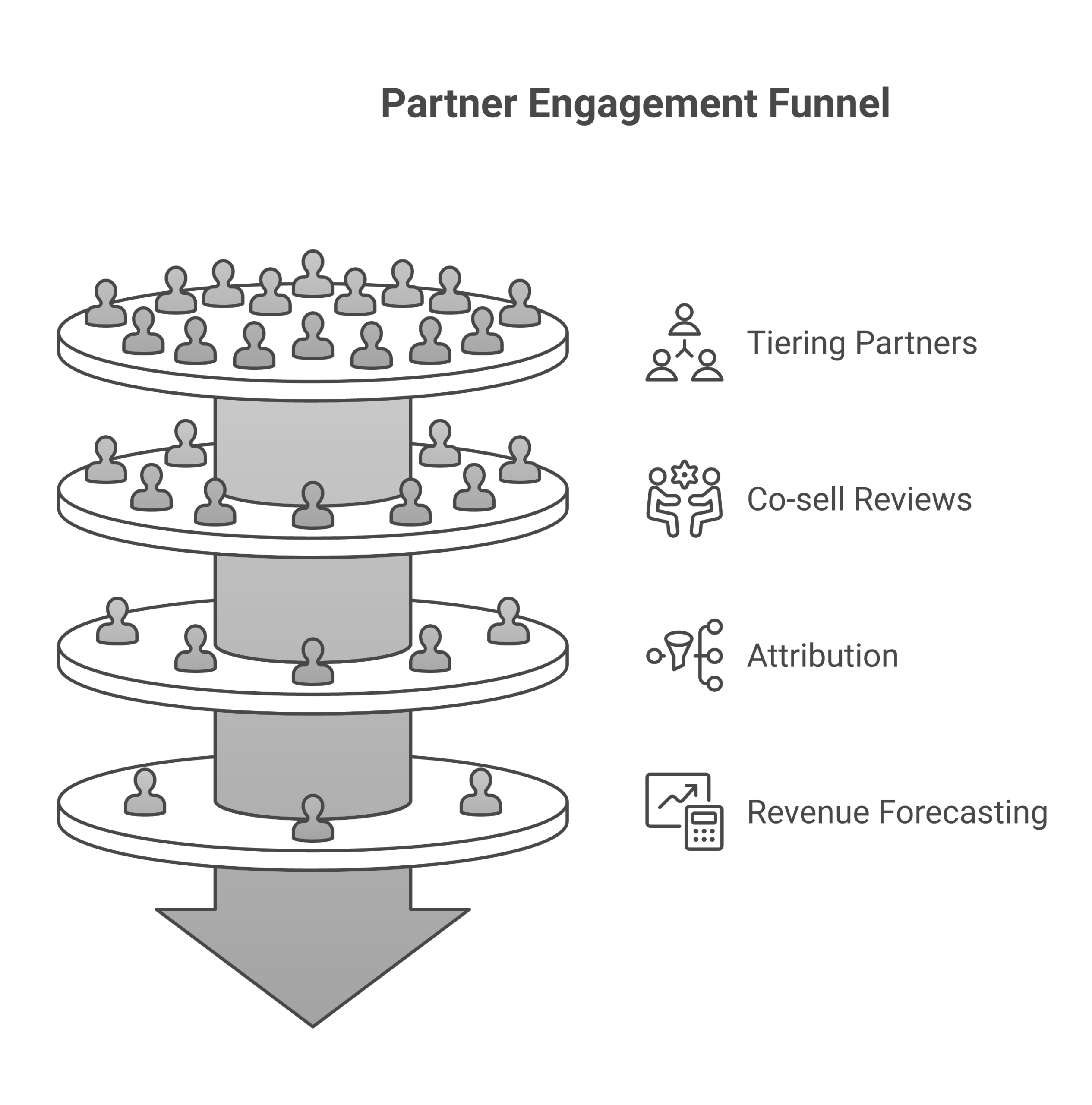
- Partner portfolio tiering: Forecastable starts by tiering the partner list into the four to six Tier 1 partners that get weekly attention and the rest that get a quarterly pulse. Without tiering, the rest of the platform has no concentration to work against.
- A co-sell deal review with named owners: A standing weekly review template runs against the joint pipeline, with a named partner manager and a named AE per deal on each side. Deals that have not moved get flagged automatically. This is where the motion actually moves.
- Partner-sourced and influenced attribution: Forecastable maintains a clean split between sourced and influenced pipeline, with a written definition the partnership and finance both sign once. Deals are tagged at registration, not retrofitted at the end of the quarter.
- A joint revenue forecast with commit, upside, and stretch: The forecast rolls up from the same deal data the partner manager already reviewed weekly. Two CROs sign it, the CFO signs the definition, and the forecast survives a quarterly audit because the inputs are clean by the time they reach the rollup.
The pattern is consistent. The cadence produces the data; the data produces the forecast; the forecast earns the budget. Skip a layer and the next one fails.
Common pitfalls a forecastable approach avoids
The patterns below are what Forecastable was built to replace. They are the failure modes most partnerships teams default to.
- Reporting activity instead of pipeline: Counting introductions, webinar attendees, or partner meetings while ignoring sourced and influenced pipeline. Activity numbers do not survive a budget review.
- Sourced and influenced as moving targets: Each quarter, the definition shifts to make the number look better. Finance notices the second time and the credibility never returns.
- Forecasts as a percentage of last quarter: Last quarter plus ten percent is not a forecast; it is hope, formatted as a number. A real forecast comes out of the deal-level data.
- Partner attention without tiering: Twenty partners on the books, the same cadence on each, the same thin result. Tiering forces the harder decision and the higher-leverage motion.
- Tools without cadence: A PRM, an overlap tool, and a marketplace ops tool, all installed, none of them connected to a recurring meeting. The software does nothing without the calendar.
Tools and the broader category
Forecastable sits inside a partnerships tech stack that varies by company. A short view of the layers and the names that show up alongside us.
| Layer | What it handles | Examples |
|---|---|---|
| Ecosystem data | Account overlap, ecosystem signals | Crossbeam |
| Partner program operations | Deal registration, partner profiles, enablement tracking | Impartner, PartnerStack, Channelscaler, Introw, Euler |
| Marketplace co-sell ops | Hyperscaler attribution | Tackle, Labra, Suger, Clazar |
| Partnership forecasting | Tiering, deal review, attribution, forecast | Forecastable |
A worked example. A mid-market data platform installed Forecastable in 2026 Q1, tiered twenty-three partners to five Tier 1, ran the weekly deal review starting Q1, and signed the attribution definition with the CFO in Q2. By Q3, partner-sourced pipeline was sixty-three percent of total partner pipeline, the forecast passed finance audit on the first try, and the company funded two new partner manager hires off the back of the credibility.
The contrast is a partnerships org that had every adjacent tool installed and no operating cadence on top. Two years of dashboards and unfunded headcount asks.
Forecastable’s POV
The interesting argument in partnerships in 2026 is whether forecasting is a tooling problem or an operating problem. Our answer is that it is both, and the operating side is the harder of the two.
The tooling exists. Account overlap, deal registration, marketplace attribution, and pipeline rollup are all solved categories with multiple credible vendors. What is not solved at most companies is the cadence that turns those tools into a clean number. Forecastable is opinionated about the cadence because the cadence is where the failure usually is.
There is a secondary belief that drives the product. The partnerships function should not be the only function whose budget is debated every quarter. Sales, marketing, and customer success defend their numbers once a year and then run the motion that produces them. Partnerships should be on the same footing. The path there is a forecast finance trusts, produced from a cadence finance can audit, on a definition finance has signed. The product is the path.
The third belief is that this is not a vendor fight. The right answer for most companies is to pair a few independent third-party tools and to install a clear operating model on top. Forecastable is the operating model and the forecast; the rest of the stack is a choice each company makes for itself.
Vendors named above are listed as independent third-party providers Forecastable has worked alongside. Forecastable does not endorse a single tool category leader and recommends independent third-party evaluation against your own ecosystem before any purchase.
Frequently asked questions
What does Forecastable do in one sentence?
Forecastable turns partnership activity into a revenue forecast a CFO will fund, by installing the tiering, the co-sell cadence, the attribution, and the rollup that produce a number finance can audit.
Who is Forecastable built for?
B2B SaaS partnership teams of five to fifty, usually with four to twenty active partnerships and a CRO asking for a defensible joint pipeline number.
How does Forecastable compare to a PRM?
A PRM stores partner records, deal registrations, and enablement content. Forecastable consumes those records and produces the cadence, the attribution, and the forecast. The two work alongside each other, not against each other.
What kinds of partnerships does Forecastable support?
Co-sell partnerships, tech partnerships with a joint motion, channel and reseller partnerships with deal registration, and marketplace co-sell through the hyperscalers.
Is there an implementation period?
A typical install runs ninety days to first forecast. The first thirty days are tiering and cadence; the next thirty are attribution; the last thirty are the forecast rollup and the first signed number.
Does Forecastable replace our existing partner data tools?
No. Forecastable connects to the data sources you already have, including the account-overlap tool and the PRM, and turns them into the cadence and the forecast.
What does success look like at month six?
A signed joint pipeline number with commit, upside, and stretch, a weekly co-sell deal review running on calendar, and a quarterly executive readout that has produced a documented decision in the room.
Next step
If finance has stopped trusting the partnership number, the problem is rarely the partnership and almost always the forecast. The cadence, the attribution, and the rollup are install-able in a quarter.
Start your growth journey with a working session on what your current forecast lacks and what would take to get finance to sign. For more on the forecasting model behind a producing partnership, see the Forecastability pillar.
Uncover Your Growth Potential
Schedule a Discovery Call