Forecastable Pricing: How to Think About It in 2026

What is the right way to think about Forecastable pricing?
Short answer: Forecastable pricing is structured around the size and shape of the partnership motion you are trying to forecast, not around seats or storage. Most buyers should size the investment against the partner-sourced and influenced pipeline they expect to clean up, not against the headcount on the partnership team. The right framing is a percentage of the joint revenue Forecastable is being asked to make defensible.
Buyers who anchor on a seat-based comparison miss the point. The product is replacing a spreadsheet workflow, a fragmented cadence, and a forecast finance does not trust. The investment is a fraction of the partner-revenue defensibility it produces.
This buyer’s guide lays out what drives the number, the questions to ask in a working session, and the ROI math most partnerships teams run before they buy.
Why pricing structure matters in 2026
Pricing structure in partnerships software has moved away from per-seat in 2026 for the same reason CFO scrutiny has moved into partnerships: the value is not in who logs in, it is in what the system makes defensible. Three pressures shape how buyers approach the number.
First, partnerships teams are small relative to the revenue they touch. A team of six can run a motion influencing fifty million in pipeline, and per-seat pricing massively underweights the value. Buyers and vendors alike are moving toward platform fees tied to the program scope.
Second, finance is involved in the buy. The CFO or VP of Finance is reading the proposal alongside the head of partnerships. Per-seat sounds simple but does not survive a finance read; a platform fee tied to the partnership motion does, because it can be defended as a percentage of the revenue it makes accountable.
Third, the buy is rarely point-product anymore. Buyers want a forecast they can sign, not a feature set. Pricing reflects that the deliverable is an operating model and a number, not a SaaS subscription per user.
How Forecastable pricing actually works
Pricing is structured around three drivers, applied in working-session conversation rather than published as a per-seat table.
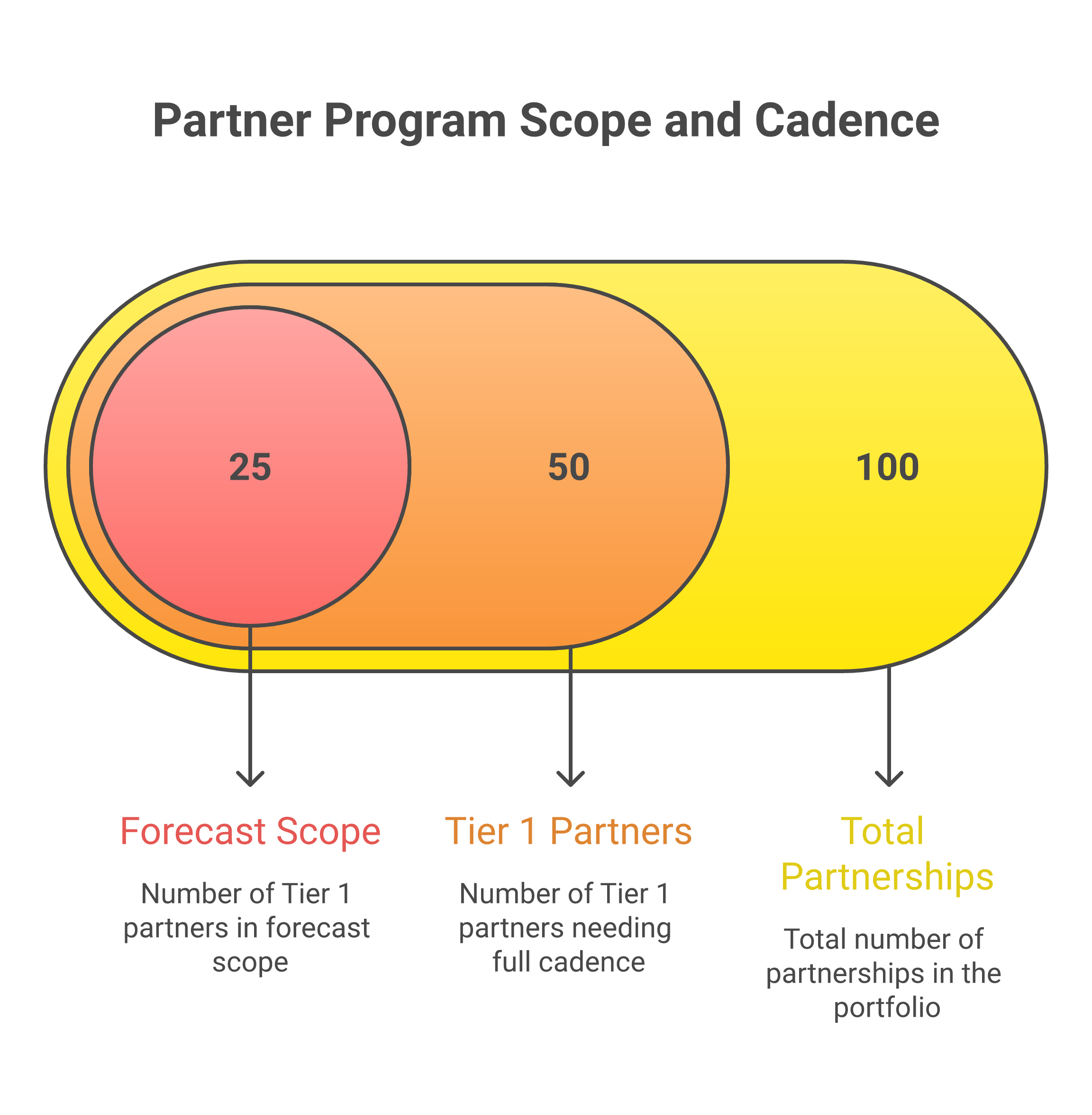
- Program scope and partner count: The number of Tier 1 partners that need the full cadence and the number of total partnerships in the portfolio. A four-partner Tier 1 with a quarterly pulse on twelve more sizes differently from a fifteen-partner Tier 1 with a fifty-partner long tail.
- Operating model installation: Whether the buyer wants the platform alone, or wants the platform with the cadence install: weekly deal review template, monthly PBR template, quarterly executive readout, attribution definition workshop with finance. The installation portion is usually a fixed-fee engagement that runs alongside the first ninety days.
- Forecast scope and signoff cadence: Whether the forecast is a joint pipeline number with a single partner, a portfolio rollup across Tier 1, or both, and whether finance is in the monthly review or only the quarterly readout. The scope of what the forecast has to defend shapes the work the platform does.
- An ROI sizing case against partner-revenue defensibility: A short ROI model that sizes the investment against the partner-influenced revenue the platform will make defensible. Most buyers size at one to three percent of the influenced revenue, which is a fraction of the budget the same revenue defensibility unlocks.
The conversation produces a proposal that finance and the head of partnerships can read together. No surprise renewals tied to seat growth; the renewal is tied to whether the forecast got signed.
Common pitfalls in pricing partnerships software
Buyers fall into a few predictable patterns when sizing the partnerships software stack. The patterns are easier to avoid if you know them.
- Anchoring on seat price: A per-seat anchor produces an apples-and-oranges comparison and obscures what the platform actually does. Anchor on partner-revenue defensibility instead.
- Buying tools without the operating model: A platform with no cadence install produces dashboards nobody runs. The cadence is the value; the platform is the artifact.
- Underweighting the finance buy-in: A proposal the head of partnerships loves and finance has not read sits in legal for a quarter. Bring finance into the second meeting.
- Negotiating on price before scope: A discount on a wrong-sized scope is still wrong-sized. Get the scope right first, then talk about the number.
- Forgetting the cost of the spreadsheet stack: The current state has a real cost: partner ops hours, deal slippage from bad data, the headcount finance will not fund because the forecast is not trusted. The right comparison is investment versus the current cost, not investment versus zero.
Tools and the ROI sizing case
The ROI math runs the same way across buyers. The drivers are listed below alongside the comparison stack a buyer might evaluate.
| Layer | What the buyer evaluates | Examples |
|---|---|---|
| Ecosystem data | Account overlap and ecosystem signal capacity | Crossbeam |
| Partner program operations | Deal registration, partner profiles, enablement | Impartner, PartnerStack, Channelscaler, Introw, Euler |
| Marketplace co-sell ops | Hyperscaler attribution and ops | Tackle, Labra, Suger, Clazar |
| Partnership Orchestration | Tiering, cadence, attribution, forecast rollup | Forecastable |
A worked ROI example. A mid-market platform vendor sized the investment in 2026 Q1 against forty million in expected partner-influenced pipeline. The platform fee plus the cadence install came to roughly one and a half percent of the influenced revenue it was being asked to make defensible. Finance signed because that fraction was easy to defend against the unlocked budget cycle. By Q3, partner-sourced pipeline had risen from thirty-seven percent to sixty-one percent of total partner pipeline, the forecast passed finance audit on the first try, and the company funded two new partner manager hires the prior year’s budget had blocked.
The contrast is a buyer who anchored on a per-seat comparison, picked the lowest-cost option, and inherited a tool with no cadence install. Twelve months later the team had dashboards, no signed forecast, and the same defensive budget conversation.
Forecastable’s POV
Pricing in partnerships software in 2026 should follow the value, not the seat count. We are opinionated about this because the seat-based model misframes the conversation, and a misframed conversation produces a worse outcome for both sides.
The proposal we put in front of a buyer has three sections. What the platform will make defensible, what the cadence install will look like in the first ninety days, and what the investment is as a percentage of the revenue under discussion. The number lands inside a finance-readable frame, which is the only frame that survives the second meeting.
There is a softer belief inside the pricing model. We do not want a buyer who cannot defend the investment to the CFO, because the buyer needs the CFO to fund the broader partnership motion the platform is supposed to instrument. A buyer who has to fight finance for the platform fee will not be able to fight finance for the partnership budget. Pricing structured around defensibility filters for the buyers most likely to succeed, which is a feature, not a friction.
The renewal logic is the same. The platform earns the renewal by producing a forecast finance signed, not by accumulating seats. If the forecast did not get signed, the platform did not do the job.
Vendors named above are listed as independent third-party providers Forecastable has worked alongside. Forecastable does not endorse a single tool category leader and recommends independent third-party evaluation against your own ecosystem before any purchase.
Frequently asked questions
Is there a published price list?
No, because the platform fee tracks the scope of the partnership motion, not a seat count. Buyers get a proposal after a working session on scope.
What does a working session cover?
Tier 1 partner count, total portfolio size, operating model needs, forecast scope, and the finance signoff cadence. About sixty minutes; we can run it with the head of partnerships and a finance partner together.
How do I size the ROI case internally?
Most buyers anchor the investment at roughly one to three percent of the partner-influenced revenue the platform will make defensible. That fraction is straightforward to defend against the unlocked budget cycle.
Is the operating model install required?
Most buyers take it. The platform without the cadence install produces dashboards; the install is what turns the data into a signed forecast.
Does pricing change with partner count growth?
The proposal sizes against the expected Tier 1 portfolio for the year. Tiering changes inside the year are usually accommodated; structural changes are revisited at renewal.
How does pricing compare to a PRM?
A PRM is priced on partner records and seats; the platform is priced on the forecast it makes defensible. The two solve different problems and most buyers run both.
Who from the buyer side should be in the pricing conversation?
The head of partnerships and a finance partner at minimum. The CRO joins the second meeting once the scope is clear.
Next step
If you are sizing a partnerships software investment in 2026, the framing that survives the finance read is investment as a percentage of partner-revenue defensibility. We can walk that math with you in a working session, against your real numbers, in about an hour.
Start your growth journey with a working session on scope and a proposal sized to your motion.
Uncover Your Growth Potential
Schedule a Discovery Call