Partner Pricing: A 2026 Buyer’s Guide for Programs

What is partner pricing?
Short answer: partner pricing is the deliberate set of discount tiers, deal-registration rules, margin protection mechanisms, and incentive structures that govern what a partner pays, earns, and protects on every transaction. It is the operating economics of a partner program, not the headline discount alone. In 2026, programs that publish a coherent four-component model produce predictable partner-sourced margin; programs that publish only the rate run on exception culture.
The partner program hub holds the broader operating context. A working partner pricing model has three properties. It is complete: all four components (tiers, registration, protection, incentives) are designed together, not bolted on quarter by quarter. It is published: partners can predict the outcome of a given deal shape without negotiation. And it is defensible: the rules survive contact with the field, and the exception count is the exception, not the routine.
Three adjacent terms get conflated. Channel pricing is broader and includes multi-tier distributor rollups that partner pricing usually does not touch. Customer discounting is downstream; the customer invoice reflects partner pricing but is not the same artifact. Co-sell economics is upstream and covers how the deal is shared, sourced, and credited, separate from what each side pays or earns on the line.
Why partner pricing matters in 2026
Partner pricing is the most material lever in a partner program’s economics and the lever most often built without explicit design. Get it right and the program produces predictable partner-sourced revenue at predictable margin. Get it wrong and the program produces channel conflict, exception sprawl, and margin erosion that compounds quarter over quarter.
Three forces sharpened the question in 2026. First, finance leadership now demands the partner number be forecastable with the same rigor as direct; an ad-hoc partner pricing model breaks that demand on contact. Second, partners are increasingly comparing programs side by side; partners walk from programs where the rules feel arbitrary even when the headline rate is competitive. Third, ecosystem-data platforms have made partner attribution measurable in ways that surface inconsistent pricing decisions inside two quarters, where five years ago the inconsistency was invisible.
The operating case has three layers. Partners commit headcount and marketing dollars to programs whose pricing they can predict; partners disengage from programs where the answer depends on which rep or which quarter. A well-designed model gives the direct sales team a mechanical answer when a partner shows up on a deal, which removes the political adjudication that costs sales leadership time. And a published, defensible model lets finance forecast partner-driven margin with the same rigor it forecasts direct margin.
How partner pricing actually works
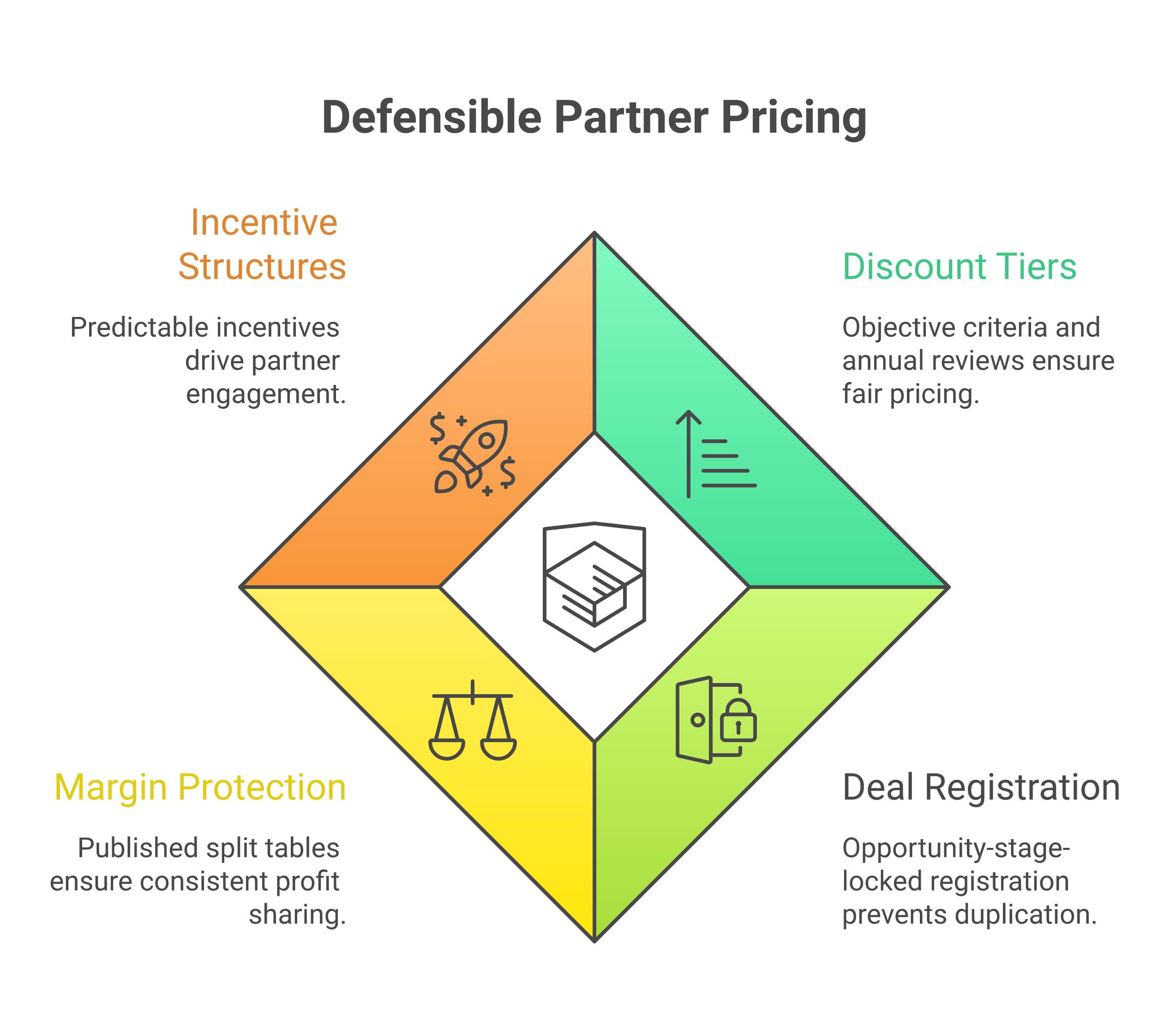
Four components compound into a defensible partner pricing model. The order matters: the tiers set the ladder, registration determines who gets which tier discount on a specific deal, protection determines what happens when a registered deal is touched by a second party, and incentives layer specific motions on top. Skip a component and the model produces exception sprawl.
- Discount tiers: a clear ladder of partner discounts tied to objective tier criteria, typically certified headcount, prior-year revenue, or a defined commitment. Tiers should be few (three or four is typical), publicly documented, and reviewed annually. Too many tiers with overlapping criteria make the ladder negotiable rather than defensible.
- Deal registration: the rule that determines who gets the protected partner price on a specific deal. A clean rule is opportunity-stage-locked (valid through stage X within Y days), deduplicated (only one partner registers a given account), and tied to a written approval. Without this, partner pricing becomes “whoever asks first.”
- Margin protection: the rule that fires when a registered deal is touched by a second party, another partner, the direct rep, or a distributor in a multi-tier model. The clean form is a published split table; the broken form is case-by-case adjudication. Margin protection failures are the largest single source of partner-program churn.
- Incentive structures: the bonuses layered on top of base discount, MDF for marketing, rebates for volume, SPIFFs for specific motions. These should be predictable, time-bound, and forecastable by the partner. Using SPIFFs to paper over a weak base discount signals instability, and partners discount the SPIFF in their planning.
The four components have to be designed in concert and reviewed on a cadence. Most programs run an annual partner kickoff, redesign the discount tiers, and leave the other three components untouched. That produces a coherent ladder layered on incoherent registration, protection, and incentive rules, and the partners feel the inconsistency immediately.
Common pitfalls
Five repeating failures show up across attempts to operate a partner pricing model. All five are recognizable from how the field talks about the rules.
- Headline discount, broken plumbing: the partner discount looks competitive in isolation but registration, protection, and incentive rules undercut it in practice. Partners do the math after their first deal and disengage.
- Exception culture as the operating model: pricing exceptions become the routine path rather than the edge case. Partners learn the rules are negotiable, and the program loses pricing discipline within four quarters.
- Tier sprawl: five or more tiers with overlapping criteria, named after metals or gem stones, that no one inside or outside the company can explain quickly. Partners cannot tell which tier they are in or why their tier matters.
- Registration without protection: a clean deal-registration rule with no defined margin-protection table. Partners register, get the discount, then watch the direct rep or another partner come in on the same deal with no consequence.
- Incentive theater: heavy SPIFFs and short-term rebates layered on top of a weak base discount. Partners read this as instability and discount it in their planning; the program pays the cost without buying the commitment.
The fix for most of these is the same: redesign the four components together, publish the rules, and run a recurring partner-pricing review that explicitly tests whether the published rules match the actual outcomes.
What this looks like in practice
Partner pricing operates across three tooling layers. The right stack is a function of program maturity, not vendor preference.
a mid-stage SaaS company runs four tiers (Authorized, Silver, Gold, Strategic), opportunity-stage-locked deal registration through PRM, a published margin protection table for two-partner and three-partner deals, and a quarterly MDF program tied to tier. Partners predict the outcome of any deal shape inside five minutes. Finance forecasts partner margin within three points. The exception rate runs under 8% of partner-touched deals. The program produces partner-sourced pipeline that compounds, and at renewal partners point to the predictability rather than the headline rate as the reason they re-up.
Forecastable’s POV
The honest test for partner pricing is whether the published rules match the field outcomes. A program is operating cleanly when partners can predict the answer to a given deal shape without negotiation, when finance can forecast partner margin within a few points, and when the exception count stays low quarter over quarter. Until those three hold, the program is running on exception culture regardless of how the slide describes the rate.
The most common failure I see is the inverse, programs that invest disproportionate energy in designing the headline partner discount and almost none on the four-component system that determines whether the discount actually produces the right partner behavior. The headline rate looks reasonable on paper. The footnotes look manageable. The program goes live, partners discover the edge cases, and the model starts producing the wrong behaviors, channel conflict, exception sprawl, and a flood of approval requests no one wants to own.
The fix is structural. Publish the rules, then defend them. The instinct in most programs is to keep the partner pricing model semi-public, semi-negotiable, and informally tunable, on the argument that flexibility wins partners. The actual effect is the program runs on relationships rather than rules, and the relationship economy cannot scale past the first few partners. Publishing the four-component model and defending it through one full annual cycle is the work that turns a partner program into a partner business.
The second move is to stop competing on headline discount. Programs that race to the steepest rate end up in a discount war that erodes the economics of every party. Programs that compete on registration clarity, margin protection, and incentive predictability win partners who care about the durability of the model, which are exactly the partners worth winning. The headline rate is the easy half. The plumbing is the half that decides whether the program produces a partner business or a sequence of one-off relationships.
Forecastable is an independent third-party professional services company. Our evaluations of partner pricing design are based on publicly-available information as of May 2026 and our own client experience.
Frequently asked questions
What is the typical partner discount in B2B software? Partner discounts in B2B software typically range from 15% to 35% off list, with reseller tiers commonly at 20% to 30% and strategic OEM-style relationships running higher. The number varies by category, deal size, and tier; the four-component structure matters more than the rate itself.
What is the difference between partner pricing and channel pricing? Partner pricing covers a single partner’s economics, what the partner pays, earns, and protects. Channel pricing is broader and covers multi-tier distributor and reseller arrangements, including margin rollups across the tiers.
How often should we review partner pricing? An annual full review of all four components (tiers, registration, protection, incentives) is the standard rhythm, with a quarterly review of exception rates and margin against forecast. Quarterly catches drift; annual catches design issues.
Should we publish our partner pricing externally? Publish the structure (the four components and the tier criteria); negotiate the rates inside the contracts. Programs that publish the structure earn partner trust; programs that publish the rates lose pricing flexibility.
How do we handle deal-registration conflicts between partners? A published margin-protection table with defined splits for two-partner and three-partner deals, applied mechanically. Case-by-case adjudication by sales leadership scales badly and rewards whoever yells loudest.
Do SPIFFs help or hurt partner pricing discipline? SPIFFs help when they reinforce a strong base discount and a clear program direction. They hurt when they substitute for a weak base discount; partners read short-term incentives as instability and discount them in their planning.
Next step
Audit the four components of your partner pricing model against the deals you closed last quarter. Did the registration rule hold? Did the protection table fire as published? Did partners get the tier discount they earned? If two of the four answers are no, the model is running on exception culture and the fix is structural, not numeric.
Talk to our team about designing a partner pricing model the field actually follows →
The partner program hub holds the broader context on where partner pricing fits inside program design.
Uncover Your Growth Potential
Schedule a Discovery Call