Partner Sales Execution: From Plan to Closed Deals

What is partner sales execution?
Short answer: partner sales execution is the deal-stage discipline that converts a partner plan into closed revenue, the joint pursuit work, deal-registration motion, and weekly forecast inspection that move named opportunities through stages. In 2026, it is the layer where most partner programs leak: the plan looks right and the pipeline shows numbers, but the deal-stage work never gets the operating rigor that direct sales gets.
The partner activation work decides which partners are ready to execute, and partner pipeline holds the deals that execution moves. Execution is the connective work that turns activated partners and recruited deals into closed-won revenue.
A working execution discipline has three traits. It is named: every executing opportunity has a partner-side AE and a company-side AE tagged to it. It is staged: the deal moves through the same CRM stages as direct, with the same exit criteria. And it is inspected: weekly, on the same cadence as direct deals.
Why partner sales execution matters in 2026
Partner programs that fail to produce do not usually fail at recruitment or planning; they fail at execution. The recruitment funnel is full, the joint plans are written, the partner roster is impressive, and the partner-sourced number is still flat. That gap is execution.
Three forces sharpened this. First, partner-driven revenue is now a board number, and the board does not accept “we have great plans” as a substitute for closed-won deals. Second, AE/sales-team time is the constraint in most revenue orgs, and AEs only invest in partner deals that show stage progress. Third, the operating discipline that used to be reserved for direct sales, weekly forecast review, structured inspection, named-account focus, has to extend to partner deals or the partner pipeline drifts.
The mechanical case is simple. A team with executive discipline reports partner-sourced revenue with the same conviction as direct revenue. A team without it reports partner pipeline and then debates with finance about which deals count, which is how partner numbers get discounted.
This is also a partner-side issue. The strongest partners want to work with companies that execute. A program with weak execution loses partner mindshare to competitors whose AEs return calls, register deals, and show up at the deal-stage moments that matter.
How partner sales execution actually works
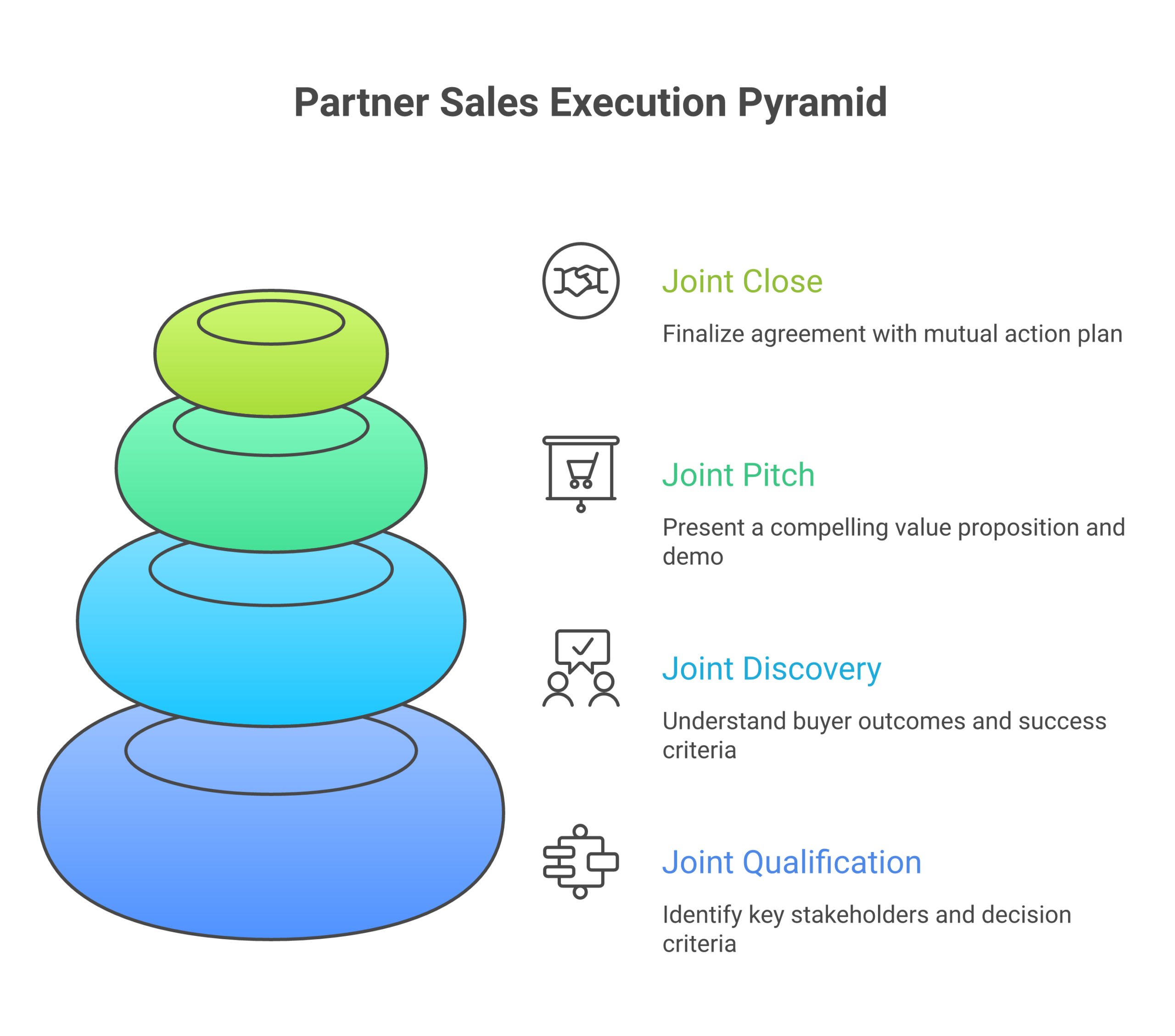
Five mechanics turn a partner plan into closed revenue. The order matters: pair the AEs, register the deal, run the inspection, run the forecast, and protect the discipline.
- Pair a partner AE with a company AE on every executing deal: the deal needs two named sellers, the partner’s AE and the company’s AE, both tagged on the CRM opportunity. Pairing is the precondition for everything else.
- Register the deal before it advances: use deal registration to timestamp the partner’s involvement before the deal is contested. Registration is what makes the partner sourced; without it, the partner number stays a memory.
- Run a weekly partner-deal inspection on every commit deal: the same inspection used for direct deals, applied to partner deals, champion, economic buyer, decision criteria, paper process, close plan. The partner deals get the same rigor or they get discounted by default.
- Roll partner pipeline into the same forecast review as direct: a separate partner forecast is invisible to the CRO and the AEs. The partner deals belong in the main forecast, math-led, defended in the same review.
- Protect the execution discipline against story-led drift: in a quarter that is going sideways, the temptation is to call partner deals more aggressively than direct deals. Resist. Apply the same conversion math, the same inspection, the same close-plan rigor, or the partner number’s credibility collapses the first time a CFO catches one inflated call.
Programs that run all five execute partner deals like first-class deals. Programs that skip the pairing step, the most common omission, end up with partner deals nobody owns, which is how plans become pipeline that never closes.
Common pitfalls
Four repeating failures account for most partner-execution gaps. All four are recognizable inside the first quarter of execution attempts.
- Unpaired deals: a partner deal without a named company AE attached drifts. The partnerships team cannot close deals alone; the AE has to be in the room or on the call.
- Inspection at quarter-end, not weekly: a partner deal first inspected in week 12 of the quarter is a deal nobody could save. The inspection has to happen weekly from the moment the deal becomes a commit, the same as direct.
- Soft commit math on partner deals: applying easier conversion math to partner deals because they are “newer” or “harder to predict” produces a partner number the CFO learns to discount. Use the same math, even when it produces lower commits early on.
- Execution that lives only in the partnerships team: a partner deal worked entirely by a partner manager without sales involvement signals to the AE that partner deals are someone else’s problem. AEs co-execute or the motion does not scale.
What this looks like in practice
Partner sales execution runs on the same operating layers as direct sales, plus the partner-specific layer for overlap and registration.
a mid-stage SaaS company has 12 active partner deals in its commit category. Each deal is paired with a company AE and a partner AE in the CRM. Each carries a deal-registration timestamp. The deals are inspected in the same weekly forecast review as direct deals, with the same five-question structure and the same stage-by-stage conversion math. By the end of the quarter, partner-sourced closed-won lands within 5% of the commit call. The CFO funds the program the following quarter.
Forecastable’s POV
The hardest part of partner sales execution is cultural, not mechanical. The mechanics are not complicated: pair the AEs, register the deal, inspect weekly, forecast with the same math. What stops most programs is the cultural assumption that partner deals are softer than direct deals, that they will “develop differently,” that “the relationship will carry it,” that “we should give them another quarter.” Every one of those phrases is a softer version of “I do not want to apply the same rigor to this deal.” Apply the rigor. The partner deals that survive it are real; the partner deals that do not survive it were never going to close anyway, and pretending otherwise burned manager time that should have gone to the deals that could.
The most common failure I see in execution is unpaired deals: a partner-side AE working a deal that no company-side AE has tagged or accepted. The partnerships team thinks the deal is being co-executed; the company AE has never heard of it. The deal sits in pipeline for two quarters and then dies quietly. The fix is mechanical, require AE pairing on every partner opportunity that enters commit, and the resistance to it is almost always cultural. AEs do not want to be on the hook for deals they did not originate; partner managers do not want to share credit. Push through both. A paired deal closes. An unpaired one rarely does.
The second move is to roll partner deals into the same weekly forecast review as direct deals, math-first. Separate partner reviews feel respectful and produce nothing, the partner deals get less scrutiny, less coaching, and less forecast rigor, and they fall through the cracks. Same review, same math, same exit criteria, same inspection questions. The partner pipeline gets first-class treatment or it gets discounted.
The third move is to be honest about the program’s true execution capacity. A partnerships team can run rigorous execution on a finite number of commit deals per week. Beyond that capacity, deals get cursory attention and the partner number suffers. The fix is to concentrate execution on the deals that will actually close this quarter, not to spread inspection across every deal in pipeline. The deals you cannot inspect this quarter are deals you should not have called commit; surface them honestly and re-stage.
Forecastable is an independent third-party professional services company. Our evaluations of partner-execution and CRM platforms are based on publicly-available information as of May 2026 and our own client experience.
Frequently asked questions
What does partner sales execution include? The deal-stage work that moves partner-sourced and partner-influenced opportunities to closed-won, AE pairing, deal registration, weekly inspection, forecast discipline against the same math as direct, and close-plan coordination between the partner AE and the company AE.
How is partner sales execution different from partner enablement? Enablement is the capability the partner has; execution is the deal-stage work the partner does on a specific opportunity. Enablement gets the partner ready; execution closes the deal.
Who owns partner sales execution inside a company? The partnerships team designs and runs the operating discipline, but execution itself is co-owned with sales. A program where partner deals are worked only by partner managers does not scale.
Why do most partner deals fail to close? Most often because the deal was not paired with a company-side AE, or because the deal was not inspected with the same rigor as direct deals. Both failures are upstream of the deal-stage work, they are design choices that the team can fix.
Should partner pipeline have its own forecast review? No. Partner pipeline belongs in the same forecast review as direct, math-led, with the same exit criteria. A separate partner forecast review under-scrutinizes the deals and undercuts their credibility.
How do you measure partner sales execution? Stage advancement of named partner deals week-over-week, partner-sourced commit accuracy at quarter-end, and the conversion math of partner deals versus direct deals. If the partner conversion math is consistently softer than direct, the execution discipline is uneven.
What is the most important habit for strong partner execution? Weekly deal inspection on every commit partner deal, using the same structured questions as direct deals. Inspection is the prerequisite for every other execution skill.
Next step
Pull your list of partner-sourced commit deals and check two things: is each one paired with a named company AE, and did each one get inspected with the same rigor as a direct deal last week? If either answer is no on more than one or two deals, the execution discipline is the first fix.
The partner program hub holds the broader context on where execution fits inside the program design.
Uncover Your Growth Potential
Schedule a Discovery Call