Partner Account Planning and Always-On Partner Comms

Short answer: Always-on partner communications keep partners aware of you. On their own, they do not generate pipeline. The pipeline comes from partner account planning: dedicated, recurring account-planning sessions built on completed account mapping. Always-on comms are the wiring between those sessions, not a substitute for them. Crossbeam network data puts the average win-rate lift at 11.7% when partners join a deal, and partner-informed deals can close up to 46% faster, but only once the right accounts are on the table. Here is the rhythm that gets them there.
Why always-on comms stall when they run alone
Most partnerships teams reach the same point. First they stand up an always-on communication program, then they send a steady stream of messages to partner reps, and then they wait for replies that mostly never come. The instinct kicks in: fix the message. Rewrite the subject line. Add an asset. Trim it down.
But here is a different way to look at it. The message is rarely the bottleneck. In fact, in our work with partnerships teams, the notes that get ignored are the ones with nothing underneath them. A partner rep can tell when a message is a broadcast dressed up as a personal touch. So they treat it like one. And a “checking in, anything for me?” note is worse, because it asks the rep to do the research, connect the dots, and surface the opportunity. After all, that is the partnerships team’s job, not the rep’s.
Still, none of this means always-on comms are a waste. They do real work. Good comms keep your brand top of mind, they make partners feel looked after, and over time they produce referrals. But awareness is not pipeline. Comms compound only when something underneath them is already producing. And that something is partner account planning.
The rhythm: map, pull, plan, sustain
Partner account planning is not a single meeting. Instead, it is a rhythm with four parts, and each part depends on the one before it.
First, you map. Account mapping surfaces the accounts where a partner can actually help. Second, you pull. Then a centralized ecosystem operations team pulls those accounts onto session agendas before anyone walks into the room. Third, you plan. Partner managers and account owners run dedicated account-planning sessions against the accounts on the agenda. Finally, you sustain. Meanwhile, always-on communications run in the gaps between sessions, holding mindshare so the next session starts warm instead of cold.
Then it repeats. When new overlap data surfaces new accounts, those accounts land on the next agenda, and the cycle turns again.
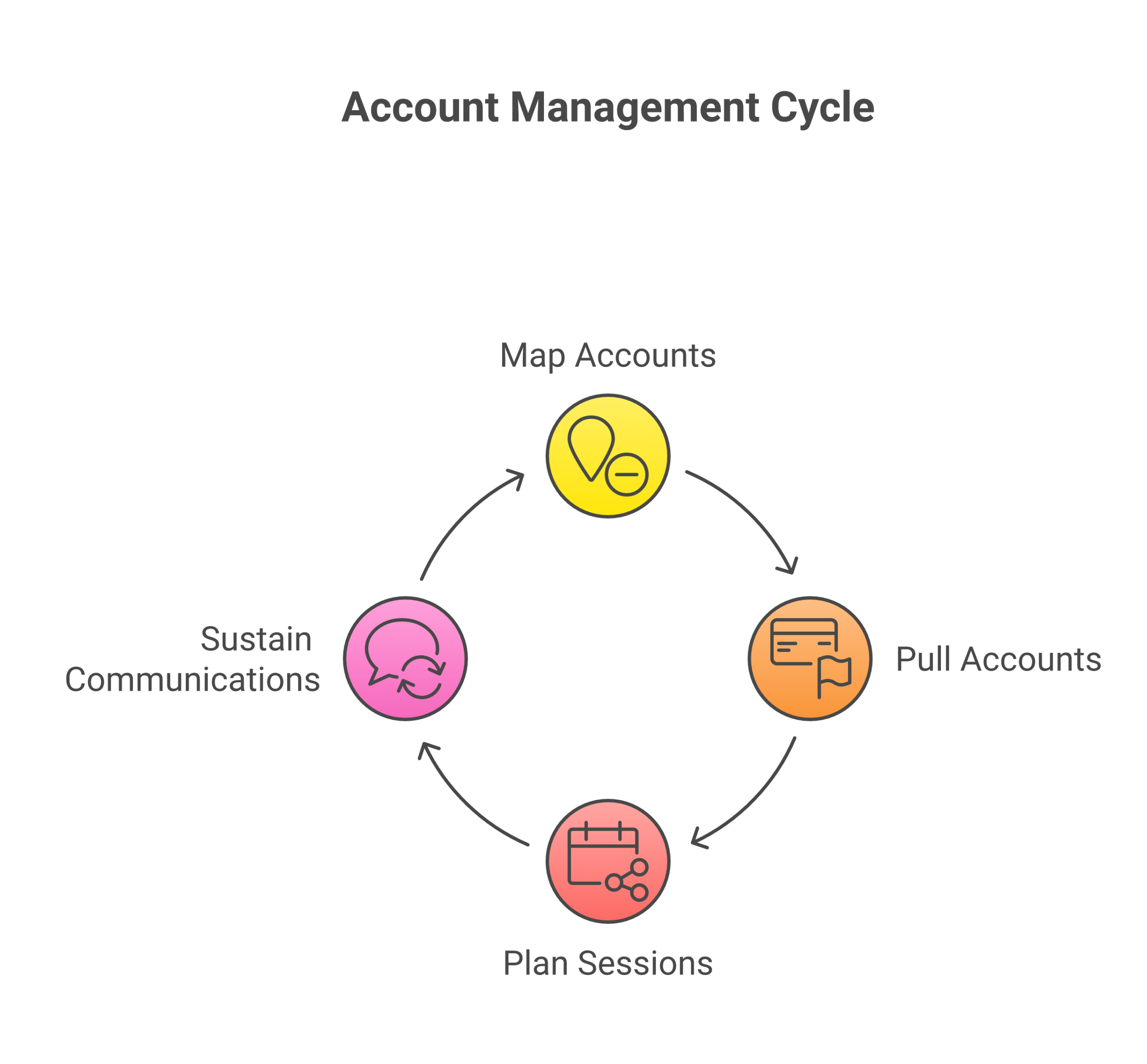
So why treat this as a rhythm and not a checklist? Because the parts are load-bearing. Skip the mapping and your sessions have no agenda. Without the prep, the session becomes a scramble. And skip the sessions, and your comms have nothing to sustain. Still, most teams have some version of all four, running ad hoc and disconnected. The real work is connecting them.
Start with account mapping
Account mapping is the practice of comparing your customer and prospect lists against a partner’s to find where they overlap. Specifically, the overlap data tells you which of your prospects are already a partner’s happy customers, which of your customers a partner is trying to win, and where you and a partner are working the same open deal. Tools like Crossbeam sit at this data layer and make the comparison continuous instead of a one-time spreadsheet exercise.
Account planning sits on top of account mapping. After all, you cannot plan against an account you have not surfaced. So the mapping has to be done, and kept current, before the planning is worth scheduling. And this is why teams that jump straight to “let’s do account planning” stall: they end up planning against memory and guesswork instead of data.
If you are choosing where to put a partner data tool, that is a separate decision worth its own research. Our take on the two main options lives in our account mapping comparison. But for the rhythm described here, the point is simpler. The mapping is the foundation. So everything above it is only as good as the data underneath.
What partner account planning actually is
Partner account planning is a dedicated meeting, set in advance, about specific named accounts and the specific actions that will drive pipeline for both sides. That definition has three load-bearing words: dedicated, named, and both.
Dedicated means the session is its own meeting. It is not five minutes at the end of a monthly partner touchpoint. By then it always gets rushed, because the first fifty minutes ran long. Still, a real session can be short. For example, thirty minutes is plenty if it stays focused on three accounts and ends with introductions. But what it cannot be is borrowed time.
Named means you are talking about real accounts, by name, pulled from the overlap data. Not “let’s find some overlap.” When the meeting starts, the accounts are already on the agenda.
Both means the value moves in more than one direction. A session is not a request line. Instead, it is a working meeting where each side leaves with something to act on.
The three directions of value in a session
Every account on the agenda fits one of three motions, and naming the motion keeps the session honest.
Sometimes the customer gives an account to the partner: you see a prospect the partner is better positioned to open, and you hand it over. Sometimes the customer asks the partner for an account: you need a warm path into a company the partner already serves. And sometimes it is a joint opportunity: you are both already in the deal, so the session is about sequencing who does what.
The give matters more than teams expect. In fact, in our work with partnerships teams, a useful pattern shows up again and again: any time you make a genuine give, you tend to get it back several times over. Because a partner rep who receives a real introduction remembers it. But a rep who only ever gets asked starts screening your calls.
Who runs the sessions, and how often
Account-planning sessions come in three shapes. First, they can be recurring sessions between two partner managers, yours and the partner’s. Second, they can be recurring sessions with the partner’s own partner managers, who then carry the accounts to their reps. Or third, they can be one-to-one sessions with the account owners themselves, whether those owners are account executives, account managers, or customer success managers.
Cadence is one cut. But trigger is another. A session can fire on a planned recurring schedule, like a standing monthly with a partner manager. It can also fire reactively, on a single high-value overlap that just surfaced. A fifteen-minute working session on one account, nothing more. And it can fire when overlaps with a particular partner accumulate to the point that a forty-five-minute session covering three to five accounts is the right shape. In fact, two of those three are easy to miss because they do not sit on the calendar in advance. The ecosystem operations team is the one that watches for the second and third.
Cadence is where most teams ask the wrong question. So the question is not “how many sessions per month.” Instead, it is “how many accounts have we planned against.” Because partners saturate. After you have worked through the meaningful overlap with a given partner, another session that month produces nothing. While a large partner with hundreds of overlapping accounts can absorb a steady cadence, a small partner with a handful of overlaps cannot. So measure accounts planned against, and let the cadence follow the data instead of the calendar.
The ecosystem operations team pulls the accounts
The single highest-impact change most teams can make is to stop asking partner managers to do their own prep.
The working contract is simple. First, the partner manager gives the instructions: which partner, which criteria, which cadence, what the message should sound like. The operations team executes: builds the lists, monitors the overlap data, sends the pre-reads, drafts the comms for review. So the partner manager stays in the relationship, greenlights what goes out, and never has to be in the list-building business.
A centralized ecosystem operations team should own the pull. Ahead of every planned session, ideally within three business days of it, the operations team pulls the overlap data, picks the accounts worth discussing, and puts them on the agenda. Then the partner manager and the account owner walk into a session that is already loaded. Consider what that buys them: they spend their thirty minutes deciding and committing, not searching.
This does two things. First, it removes an administrative burden from the people whose time is best spent in relationships. Second, it makes the sessions consistent. When prep is centralized, every session has the same shape: real accounts, real overlap data, a real agenda. But when prep is left to each partner manager, half the sessions are sharp and half are improvised.
The operations team also runs the monitoring. Because new overlaps surface continuously, they should route into one dedicated channel where the team triages them on a weekly rhythm. After all, raw overlap data without that triage is just noise. The triage is what turns it into next month’s agenda. And this is the same operational muscle that powers a healthy co-sell motion, so it is worth staffing deliberately.
One more thing the operations team protects is timing. After all, partner managers and account owners run on calendars that are already full. When the prep arrives late, the session either gets postponed or it happens cold, and a cold session is barely better than no session. The three-business-day window is not a nicety. Instead, it is the difference between a meeting people show up to prepared and a meeting people show up to improvising.
Always-on communications run in the gaps
Now the comms have a job. Always-on communications are the value-add wiring that runs between account-planning sessions, holding partner mindshare so each session starts from a warm relationship instead of a cold one.
The requirement for every touch is relevance. Specifically, a relevant touch is one a partner rep would be glad to receive even if you never asked for anything back. For example, that can be an asset they can use with their own clients. Or it can be a heads-up about something you just shipped that changes what they can pitch. Best of all, it can be a note about something the partner themselves just launched, a new product or a new focus area, framed around what it means for the accounts you share. In short, relevance is what separates a value-add touch from a broadcast.
Still, not every touch is an asset drop. In fact, some of the most effective always-on comms are small and direct: a single message that says “anything I can be doing for you right now.” The point is not the format. The point is perpetual mindshare, the steady, low-friction presence that keeps you in a partner rep’s head for the moment a real opportunity appears.
The comms also split by purpose, and each purpose calls for a different approach. First, prospecting comms support net-new pipeline and tend to be sharp and opportunity-led. Second, expansion comms support growth inside shared customers and lean on account history and timing. Third, executive and pre-sales comms carry a different weight and a different voice, because the audience and the stakes are different. For instance, an executive touch is about strategic alignment and air cover. A pre-sales touch is about technical credibility and removing friction from a live deal. So treating all three as one stream is a common reason always-on programs feel generic. For a sense of how this looks on the prospecting side, our account research guide goes deeper on the homework that makes a touch land.
One more thing matters as much as content and purpose: source. A note from a partner’s account manager to their own customer reads as a warm, exclusive nudge. But the same words sent from the partner’s marketing team read as a list-buy. So where the play is an exclusive offer to a partner’s customer base, the message should come from the account owner who already has the relationship, the account manager or customer success manager, not from a generic marketing send. In fact, routing the play through the right sender is the single biggest lift on response rate.
Still, channel matters as much as content. The same value-add note can land as a quick Slack message, a short email, or a comment on a partner’s own post. So the right channel depends on the partner rep and the relationship. But what stays constant is the discipline: every touch is checked for relevance before it goes out, and no touch ever asks the rep to do the partnerships team’s work.
Make the rhythm trackable
A rhythm you cannot see is a rhythm you cannot coach. But the good news is that making partner account planning visible takes very little overhead.
Start with a naming standard. Every account-planning session should carry the words “account planning” plus the named target accounts in the calendar title or description. Consider what that one convention does: it turns a pile of meetings into data, so now you can count how many sessions happened, with whom, and against which accounts, without anyone filling out a form.
Then record the sessions. Because the recording is where you see what was committed, what introductions were made, what pipeline came out, and what stalled. After that, set goals per partner. Set a target for accounts planned against, partner by partner. Then you can compare the plan to the actual number before the quarter is over. For example, if the target is 300 and the plans add up to 144, you have found the gap early enough to do something about it. And this is the kind of plan-versus-target visibility that makes executive alignment conversations grounded instead of defensive.
Tracking the rhythm covers more than sessions. When a partner commits to running a play, like a co-branded webinar, an offer sent to their customer base, or an SDR push against a specific list, the same project-management lens applies. So who owns the campaign on their side? When does it ship? Which account manager will send? Log the dates, line up your support, and check in. Plays without an owner and a date do not ship.
Here is the whole rhythm, with the signal that tells you each stage is actually running.
| Stage | What it produces | How you know it is happening |
|---|---|---|
| Map | Current overlap data, surfaced accounts | Account mapping is connected and refreshed, not a stale export |
| Pull | A loaded agenda per session | Sessions arrive with named accounts already on the agenda |
| Plan | Commitments, introductions, pipeline | Calendar items titled “account planning” with named accounts, and recordings exist |
| Sustain | Mindshare between sessions | A scheduled, relevance-checked comms cadence per partner persona |
Frequently asked questions
What is partner account planning?
Partner account planning is a dedicated, recurring meeting, set in advance, about specific named accounts and the actions that will drive pipeline for both you and the partner. Also, it sits on top of account mapping, and it is the part of the motion that actually generates production.
How is account planning different from always-on partner communications?
Account planning is the engine. Specifically, it is where reps get activated and pipeline gets created, in focused working sessions. Meanwhile, always-on communications are the wiring between those sessions: value-add touches that hold mindshare so the next session starts warm. So comms keep partners aware of you. But planning is what turns that awareness into deals.
Do you need account mapping before partner account planning?
Yes. Because account mapping surfaces the overlapping accounts that a planning session works against. Without current overlap data, sessions run on memory and guesswork. So map first, keep the mapping current, then plan.
How often should you run account-planning sessions?
Often enough to keep working real accounts, and no more. So the better metric is accounts planned against, not number of sessions. While large partners with deep overlap can absorb a steady cadence, small partners saturate quickly. So let the overlap data set the pace.
Talk to our team about installing the account-planning cadence in your partner program →
Uncover Your Growth Potential
Schedule a Discovery Call