Joint Value Proposition: Extract It From the Interview

Short answer: a joint value proposition is the customer-facing statement explaining why two partner companies’ combined offer beats either one alone, and the version your AEs actually use is never written. It is extracted. It comes out of a co-sell playbook interview with the people closest to buyer pain, then gets layered across Fix, Prevent, and Improve. Most teams draft a joint value proposition in a partner-marketing doc and skip the only step that makes the artifact land on a sales call.
What is a joint value proposition?
A joint value proposition is a one-page artifact. It tells a buyer why your company and a partner’s company, together, solve a specific problem better than either of you alone. It exists for one reader: the AE about to walk into a co-sell call.
A working one has five parts. First, the customer outcome, stated as a measurable result. Second, each company’s contribution, one line each. Third, the combined value, the part that is only true when both are present. After that, the proof, two or three specifics. Finally, the next step you want the buyer to take.
That list is not the hard part. Buyers do not buy the list. Instead, they buy whether the AE can say the combined value out loud, without notes, on a call. So the real question is not what goes in the artifact. The question is where the artifact comes from.
This matters more in 2026 than it did five years ago. Buyers are assembling combined offers on purpose, because co-sell is now a default motion in cloud go-to-market. They want to understand the joint value before they evaluate either side. There are also good reasons a buyer chooses a joint offer over procuring separately: less integration risk, one motion instead of two. But the buyer only sees that if the AE can articulate it.
Why most joint value propositions die on the call
Here is the pattern I see most. Partner marketing writes the joint value proposition. Then partner managers sign off. After that it lands in front of AEs who cannot deliver it.
The AE cannot deliver it because it was never extracted from buyer pain. Instead, it was assembled from two marketing decks. So it reads as aspirational language with no edges. The combined-value sentence is the one that breaks first, because nobody pressure-tested it against a real buyer scenario.
There is a second failure underneath that one. The artifact tries to cover three buyer personas at once, so it lands for none. Last quarter I watched a team want to aim a motion at their partner’s “top 100 accounts” before anyone could say what “top 100” meant. Another team did the same thing with rep count. When the target is vague, the joint value proposition is vague, and a vague pitch loses to a specific competitor every time.
This is not really a JVP problem. It is the same reason co-sell programs die when a company’s own AEs will not use them. The artifact was built somewhere the seller was not in the room. So fix where it comes from, and you fix the artifact.
The joint value proposition is the output of a co-sell playbook interview
Where should it come from? A co-sell playbook interview. At Forecastable, the co-sell playbook is how we enter almost every customer relationship, and the joint value proposition is a step inside that playbook, not a standalone deliverable. The playbook names a specific business problem, picks the partner with real expertise in it, maps the joint value proposition, and turns it into sales copy. The playbook is the door opener. It is what earns the first real conversation with the buyer.
The interview is where the gold is. When I get on a playbook interview, I do not walk in with a script. First I start with executive priorities. Then I ask why that is a priority. After that I ask what pain we are solving for the buyer. And I keep going deeper until nothing new comes out. The transcript from that conversation has the joint value proposition sitting inside it, in the interviewee’s own words.
Who you interview
Do not staff the interview with partner managers only. Instead, get the people closest to buyer pain and product expertise: solution architects, sales engineers, the subject-matter experts who sit in front of customers. The conversation should touch executive priorities on both sides of the partnership. CSMs belong here too, because a CSM often sees the integration that drives retention before anyone in sales does. Depth of thinking in the room is what produces a joint value proposition worth delivering.
How you interview
Approach the partner with extreme curiosity and no assumptions. The method is a spiral, not a checklist. So you start at executive priorities, ask why, ask what pain, ask why again, and stop only when the answers stop producing new insight.
Then use the blind-spot probe. Ask whether there is a problem most buyers in this segment do not see coming. Eight times out of ten you get a yes, and that yes is usually the Fix layer of your joint value proposition. Keep the framing joint the whole way through. You are not pitching the partner. Instead, you are interpreting findings together, which is what makes the eventual buyer conversation feel like a value unlock rather than a sales call.
A few questions carry most of the weight. Where do you want to win most right now? Which buyer scenario is the sharpest wedge? What pain are we solving for the buyer? Where does the current process break at scale? What is the cost of doing nothing for ninety days? Answer those with the right people in the room, and the joint value proposition is most of the way written.
Layer the joint value proposition across Fix, Prevent, and Improve
A joint value proposition is not one statement. Instead, it carries three layers, and the interview gives you the raw material for each. The model is Fix, Prevent, Improve.
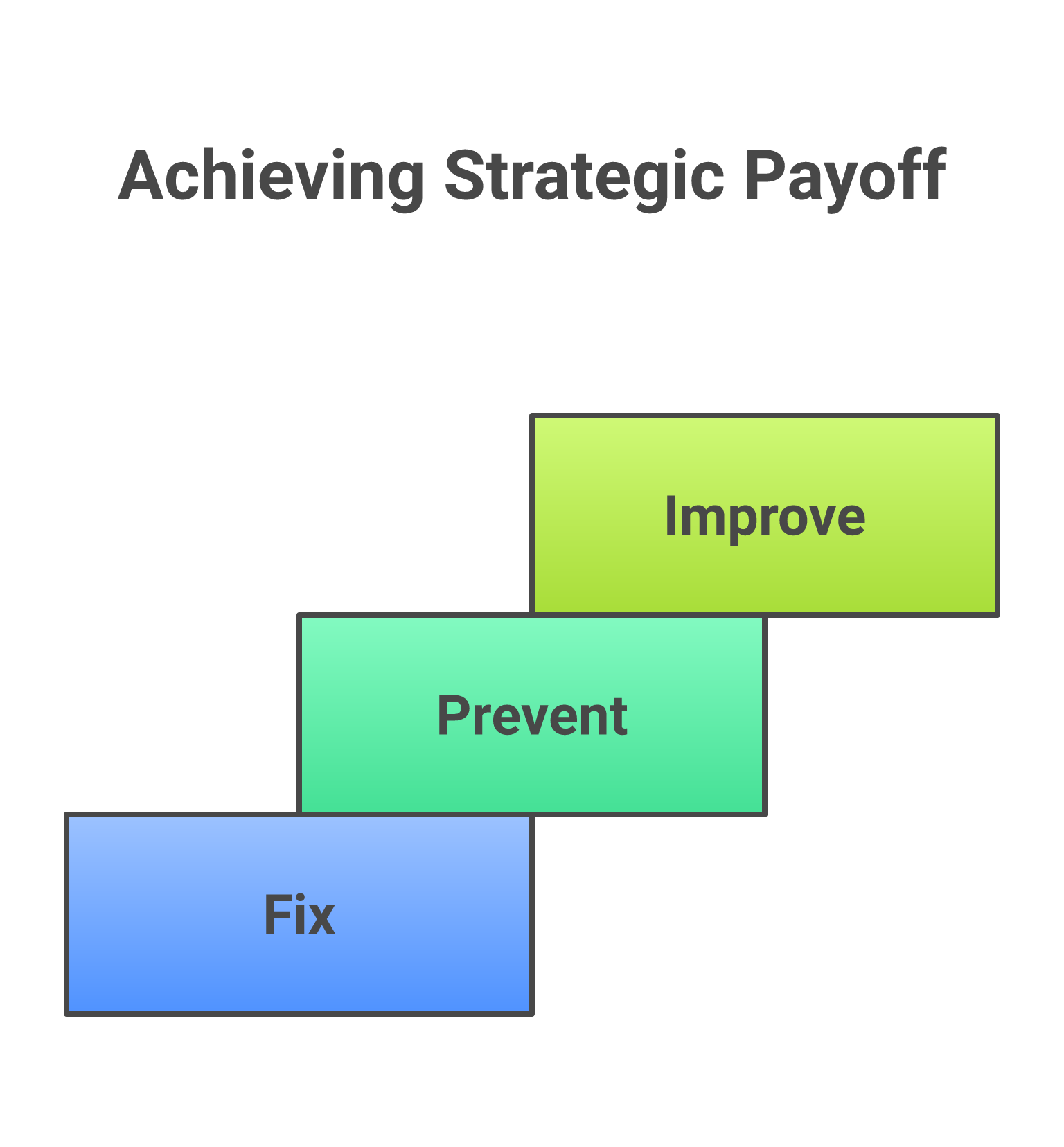
Every co-sell playbook should surface content for all three layers. But the door opener, the thing the AE leads with, is almost always Fix-led.
Fix: the door opener
The Fix layer relieves an immediate pressure for the joint buyer. It solves a real blind spot fast, with no pitch and no demo. Think of a gap map, a maturity score, a cost analysis, or a workflow teardown. Then run the gut-check: if you were the buyer, would you pay five hundred or a thousand dollars for this? If yes, it is a real door opener. If it feels like an intro call, redesign it. A good Fix-layer offer has a high-value output, a sense of scarcity, and an assigned dollar value even when you give it away.
Prevent: the reason to act now
The Prevent layer is the why-now. It names what the buyer loses by waiting: churn, low usage, competitive exposure, vendor lock-in risk, missed revenue. The interview surfaces this when you ask about the cost of doing nothing for ninety days or six months. So Prevent is what moves the buyer off “maybe next quarter.”
Improve: the strategic payoff
The Improve layer is the aspirational one. It ties the combined offer to an executive priority the CEO has already gone on record about: a strategic initiative, a category position, a number on a board slide. Improve is what the joint value proposition unlocks once the buyer is in. It is also the layer that commands premium pricing, because it is about identity and certainty, not a transaction.
What’s in it for the partner is not optional
A co-sell-specific rule: the joint value proposition has to carry the partner’s benefit too. There may be revenue tied to the motion, or there may not be. Either way, name it. Stickiness, goodwill, and access to a buyer they could not reach alone all count. But if there is no clear answer to “what is in it for the partner,” the playbook usually flops. The fastest way to find it is to think through the partner’s challenges first. Do that, and the joint value proposition gets obvious, and you generate revenue for both sides anyway.
The one-page template, and where it lives
Now you can write the one-page artifact, because the interview gave you the substance. The template is the destination, not a substitute for the work.
| Section | Length | What it carries |
|---|---|---|
| Customer outcome | 1 sentence | The measurable result, with a real number |
| Our contribution | 1 to 2 sentences | What your company brings, true on its own |
| Partner contribution | 1 to 2 sentences | What the partner brings, true on its own |
| Combined value | 2 to 3 sentences | What is only true with both, pressure-tested with an AE |
| Proof | 2 specifics | Named outcomes, not “trusted by industry leaders” |
| Call to action | 1 line | The next step, usually the Fix-layer door opener |
Two rules from the field. First, write it with exact text, not bracketed placeholders, because reps need something they can copy and paste, not a template they have to finish. Second, keep it to one page, because an AE will not memorize three.
If you do not have a real customer proof yet, a synthetic proof can hold for the first ninety days. State it as illustrative. After ninety days without a real one, the joint value proposition loses credibility, so treat producing the real proof as part of the motion.
Where the joint value proposition has to live
A joint value proposition that sits in a folder atrophies. So it has to live in three places. First, the joint pitch deck, on slide two, right after the title. Second, the one-page partner brief that travels with the opportunity. Third, the AE’s account-prep, pulled in before every co-sell call and pressure-tested against that specific buyer. If it is not in all three, it is a document, not a partner activation motion.
Frequently asked questions
What is the difference between a value proposition and a joint value proposition?
A value proposition explains why a buyer should buy your product. A joint value proposition explains why a buyer should buy your product and a partner’s product together. Different scope, and a different reader: the joint version is built for the AE running a co-sell motion.
Who should be in the co-sell playbook interview?
The people closest to buyer pain on both sides: solution architects, sales engineers, subject-matter experts, and CSMs. Partner managers can convene it, but they should not be the only voice. Depth of thinking in the room is what makes the output usable.
How long should a joint value proposition be?
One page, or one slide. The artifact has to fit in an AE’s working memory. Two-page joint value propositions are documents, and documents do not get used on calls.
Do you need real customer proofs to build a joint value proposition?
Not on day one. A synthetic proof, clearly labeled as illustrative, can hold for the first ninety days while you produce a real one. After ninety days without a real proof, credibility starts to slip.
How do you make sure the joint value proposition reaches the economic buyer, not just the AE?
Build the Improve layer for the economic buyer. Fix earns the first conversation with a practitioner, while Improve is the language a CFO or CRO repeats upward. So the interview should touch executive priorities on both sides, which keeps that layer grounded rather than guessed.
How often should you refresh the joint value proposition?
Review it quarterly to update proofs and respond to buyer feedback. Then rewrite it once a year to test whether the customer outcome is still the right one. A partner pipeline your AEs actually touch depends on the artifact staying current.
Pick one partnership this week
Do not start by writing. Instead, pick the one partnership where a win matters most this quarter. Book a sixty-minute interview with the people closest to buyer pain, yours and theirs. Run the why-deeper spiral. Then layer what you heard into Fix, Prevent, and Improve, and write the one-pager last. The interview is the work. The template is just where it lands.
Uncover Your Growth Potential
Schedule a Discovery Call