Forecastability: 2026 Framework and Operating Model

Forecastability is the upstream property of a deal or pipeline that lets its outcome be predicted with high confidence inside a known time horizon. It is not the same as forecast accuracy; it is the condition that produces forecast accuracy. Most enterprise pipelines are not forecastable, and the cost is structural.
Most sales organizations treat forecasting as an output problem. The CRO asks for the number; the CRO gets a number; the number is wrong by 15 to 30%; the next quarter the cycle repeats. The diagnosis is usually that “the reps need to forecast better.” The actual problem is upstream: the deals themselves are not in a forecastable state, and no amount of forecasting discipline will turn an unforecastable deal into an accurate forecast.
This piece lays out what forecastability actually is, how it differs from forecast accuracy, the four conditions that produce a forecastable deal, the operating cadence that builds forecastability into the pipeline, and the failure modes that explain why most enterprise pipelines aren’t forecastable. For deeper dives on specific levers, see executive alignment, forecast collaboration, neutral sales comp, and forecast renewals.
What is forecastability?
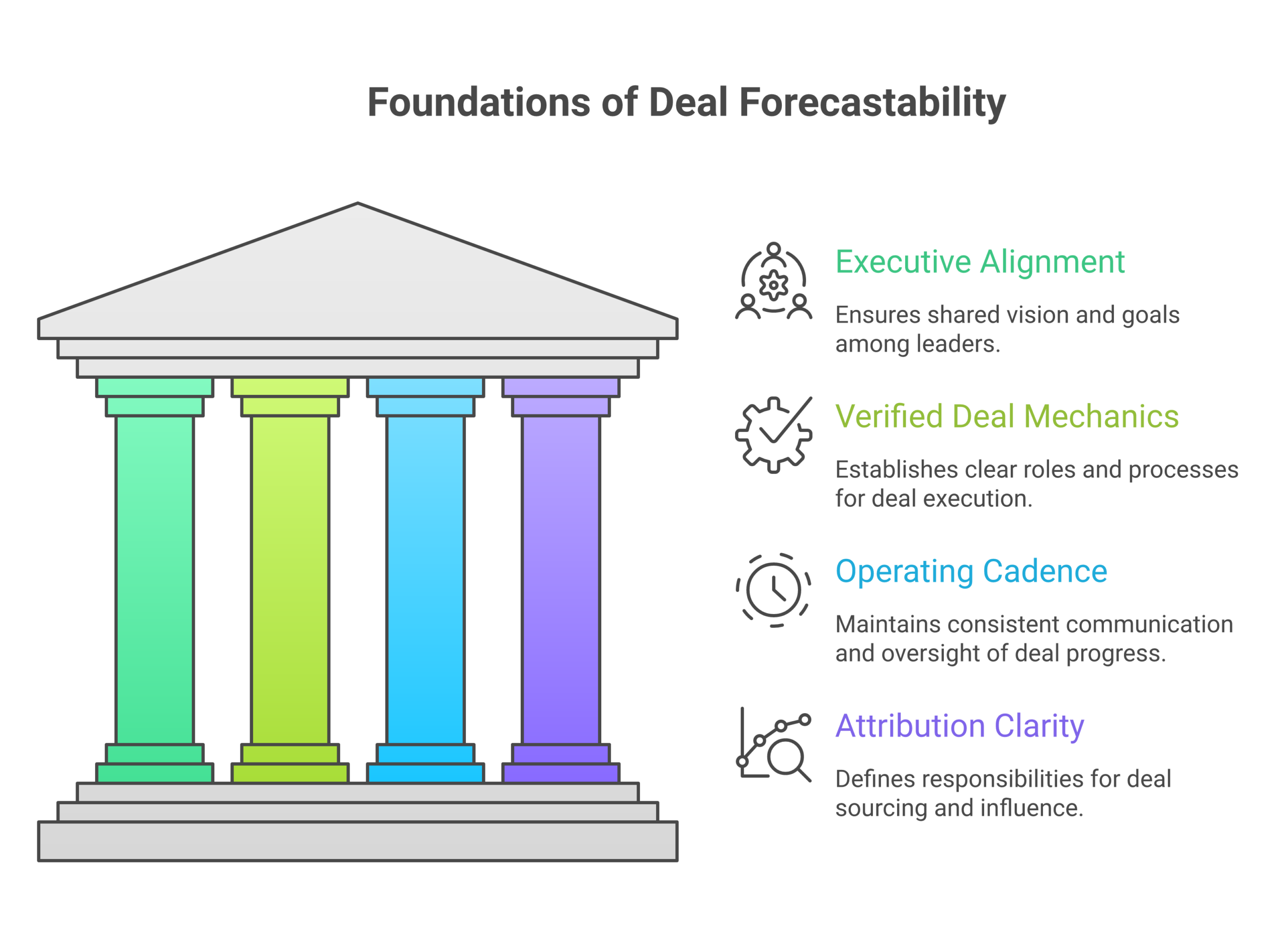
Forecastability is the upstream property of a deal or pipeline that lets its outcome be predicted with high confidence inside a known time horizon. It is the condition produced by clean executive alignment, verified deal mechanics, an operating cadence that surfaces drift early, and an attribution model that everyone agrees on. Forecast accuracy is the downstream metric; forecastability is the operating reality that produces it.
The category is often confused with three adjacent concepts. Forecast accuracy is whether the predicted number matched the actual number; accuracy is the metric, not the cause. Pipeline coverage is whether the pipeline is large enough to produce the target; coverage is necessary but not sufficient for forecastability, an over-covered pipeline of unforecastable deals still misses. Sales rigor is whether the team runs disciplined process; rigor is necessary but does not by itself produce forecastability, you can run rigorous process on deals that are structurally not forecastable.
The unit of forecastability is the deal. A pipeline is forecastable to the extent that the deals inside it are forecastable. A team is forecastable to the extent that the deals it works are forecastable. A business is forecastable to the extent that its pipeline structure produces forecastable deals at the rate the business needs.
There are two practical depths. Deal-level forecastability is whether a specific deal can be predicted, close date, close size, close path, with high confidence inside a quarter or two. Pipeline-level forecastability is whether the aggregate pipeline produces the predicted total inside the predicted period, even when individual deals slip. The two depths are connected but distinct; a pipeline can be forecastable in aggregate while individual deals are not, if the slippage cancels in the aggregate, and a pipeline can be unforecastable in aggregate even when most individual deals close as predicted, if the few that slip are large enough to dominate.
Why forecastability matters
Forecastable pipelines produce predictable revenue, which produces predictable hiring, predictable investment, and predictable strategic decisions. Unforecastable pipelines produce reactive operating models that compound into structural problems, late hiring, panic discounting at quarter-end, and executive-level credibility damage that takes years to repair.
The operating case has three layers. Hiring leverage: companies with forecastable pipelines hire ahead of demand because the demand is predictable; companies without forecastable pipelines hire in panic when the number lands and compound the cost of every hire. Investment leverage: forecastable revenue allows the company to commit to multi-year investments (product roadmap, market expansion, partnership programs) that unforecastable revenue forces into a stop-start cycle. Strategic leverage: forecastable revenue produces operating discipline that compounds, the next-quarter forecast is informed by the last-quarter result, and the cycle gets tighter rather than looser over time.
In practice, the financial case is more durable. Public companies with forecastable revenue trade at higher multiples than companies with the same growth rate and unforecastable revenue, because the market discounts unpredictability. Private companies with forecastable revenue raise capital at better terms, because the LP and VC base discounts unpredictability the same way the public market does. (Public sales research from Gartner and Forrester consistently shows forecast accuracy in the 50-70% band at most enterprise sales orgs; the premium for tighter accuracy is real and measurable.) The premium is structural, not cyclical.
The downside, real and common, is that pursuing forecastability without adjusting the deal mechanics produces forecast theater rather than forecast accuracy. A team that runs a tighter forecast cadence on the same unforecastable deals produces the same wrong number, with more meetings and more pressure on reps. The fix is upstream: build forecastability into the deal mechanics, then run the forecast cadence on top.
How forecastability works: the four conditions
Repeatable forecastability runs on four conditions, all of which must be present for the deal to be forecastable: executive alignment on outcome and success criteria, verified deal mechanics (named buyer, forecast event, next step), an operating cadence that surfaces drift inside the period, and attribution clarity that everyone agrees on. Skip a condition and the deal reverts to a hopeful guess.
The stages
The four conditions, in order:
Why the cadence is the system
The cadence is the system. Most enterprise pipelines that look forecastable on the dashboard have conditions 1 and 2 covered partially and skip 3 and 4. The reviews happen but don’t surface drift; the attribution model is contested. Without 3 and 4, the forecast becomes a number the team produces under pressure rather than a number the operating reality produces.
Common pitfalls in pursuing forecastability
Forecastability efforts fail at predictable points. The five recurring failure modes account for most of the underperformance, and most are operating-model issues rather than tooling issues, which is why forecasting tools alone rarely fix the problem.
The recurring failure modes
The recurring failure modes:
The fix
The fix for most of these is the same: treat forecastability as the work, not as the metric. Companies that get this right see materially tighter forecast accuracy because the deals themselves are forecastable. Companies that don’t run a forecasting motion that performs well in good quarters and breaks under stress.
Tools and platforms for forecastability
Forecastability tooling spans four categories: executive-alignment artifacts (typically a Google Doc or a deal-room platform), deal-mechanics enforcement (CRM with required-fields and stage-gate validation), operating-cadence support (deal review templates, joint pipeline reviews), and attribution and reporting (CRM dashboards, finance-aligned attribution model). The right stack is a function of program maturity.
A pragmatic snapshot of the stack:
| Forecastability stage | Executive alignment | Deal mechanics | Operating cadence | Attribution |
|---|---|---|---|---|
| Early | Google Doc | CRM with required fields | Weekly deal review | Sourced/closed-won |
| Mid | Deal-room or mutual action plan | CRM with stage-gates | Weekly + biweekly partner reviews | Sourced + influenced |
| Mature | Strategic account plan | CRM + forecasting platform | Weekly + monthly executive review | Sourced + influenced + assisted |
| Strategic | Joint executive operating doc | CRM + forecasting + signal platforms | Multi-cadence (deal, partner, exec) | Closed-loop attribution model |
The mistake most companies make is buying mature-stage tooling at early-stage maturity. A forecasting platform at the early stage produces precise wrong numbers because the upstream pipeline isn’t forecastable yet. Match the tooling to the stage; let the tool’s complexity earn itself as the pipeline matures.
Forecastability and the role of partnerships
Partnerships have a structural role in forecastability that most sales organizations underestimate. Partner-touched deals carry richer signal (more buying-committee context, more product validation, more shared accountability) and tend to be more forecastable than direct-only deals at the same size. The condition is that the partner motion is run as a system, not as ad-hoc relationship management.
In practice, the connection is not abstract. Partner-touched deals usually have an additional set of stakeholders engaged early, which surfaces drift earlier; partner-led discovery typically produces a sharper picture of the buyer’s outcome and success criteria; partner-aligned mutual action plans add a second forcing function on the next step. Each of these compounds into forecastability if the partner program is operationally mature. (See Crossbeam’s research on partner-touched deal performance for the underlying ecosystem-data evidence.)
The downside is that partner-touched deals run badly are less forecastable, not more. If the partner motion is theater, friendly relationships without deal mechanics, the additional stakeholders add noise rather than signal, and the deal’s forecastability degrades. The lift is conditional on the partner program being well-run. (See the partnerships overview and the co-sell guide for the underlying operating mechanics.)
Forecastable’s POV
My belief is that forecastability is the most undertheorized property in B2B sales and the most consequential. The industry has spent two decades optimizing forecasting tools and forecasting cadences and has barely moved the needle on actual forecast accuracy at the enterprise level. The reason, as I see it, is that forecasting is a downstream metric. The work is upstream, in the deals themselves, and the upstream work is rarely done.
The pattern that compounds
The pattern I watch compound is forecastability built deal by deal, condition by condition, with the operating cadence designed to surface drift rather than confirm progress. The companies that build this discipline produce forecasting accuracy that compounds: the next-quarter forecast is informed by the last-quarter result, the operating cadence gets tighter rather than looser, and the team’s credibility with finance, with the board, and with the market improves over time.
What I push customers on
Here’s what I push every CRO on: stop optimizing forecasting. Optimize forecastability. The two words look similar; the operating consequences are opposite. Forecasting is an output discipline, asking the rep to predict the number more accurately. Forecastability is an upstream discipline, building the deal mechanics that allow the number to be predicted accurately in the first place. Companies I work with that internalize this redesign their pipeline-review cadence, their deal-mechanic gates, and their attribution model. Companies that don’t keep buying forecasting tools and wondering why the number is still wrong. We named Forecastable around this thesis for a reason.
The other position
The other position I take at Forecastable: most pipelines are over-covered and under-forecastable. The pipeline-coverage doctrine produces a large numerator (pipeline) and unstable denominator (forecastable pipeline), which makes the coverage ratio meaningless. A 1.5x forecastable pipeline outperforms a 4x unforecastable pipeline at materially lower operating cost. Cut the pipeline to the deals that meet the four conditions; run the cadence on those; let the unforecastable deals go to nurture or close-lost rather than crowd the forecast. Depth before breadth produces durable forecastability; breadth before depth produces forecast theater.
Frequently asked questions
What is the difference between forecastability and forecast accuracy?
Forecast accuracy is the downstream metric, whether the predicted number matched the actual number. Forecastability is the upstream condition that produces forecast accuracy. A pipeline of unforecastable deals can never be accurately forecasted; the work to improve accuracy is upstream of the forecast itself.
Is forecastability a sales metric or an operating metric?
Both. At the deal level, forecastability is a property the seller can build. At the pipeline level, forecastability is an operating-model property that depends on management cadence, attribution model, and executive-team discipline. Forecastability programs that treat it as only a sales metric typically underperform.
Can software fix forecastability?
Software can compress the effort once the upstream conditions are in place. Software cannot create the upstream conditions. A forecasting platform run on a noisy pipeline produces a precise wrong number; the same platform run on a forecastable pipeline produces a precise right number. Get the upstream conditions in place first, then layer the software.
How long does it take to make a pipeline forecastable?
For most enterprise sales organizations, building forecastability takes 2 to 4 quarters of disciplined work, redesigning deal-mechanic gates, retraining the field on executive alignment, locking the attribution model, and shifting the pipeline review cadence to surface drift rather than confirm progress. The work is sequenced, not parallel, and rushing produces a partial implementation that often makes accuracy worse before it gets better.
Is forecastability the same as predictable revenue?
Predictable revenue is closer to the outcome (the revenue is predictable). Forecastability is closer to the cause (the deals and pipeline produce predictable outcomes). The two terms are often used interchangeably; in practice, predictable revenue is the result of a forecastable pipeline plus a stable conversion model.
Does forecastability apply to mid-market deals?
The full operating model applies most cleanly at enterprise. At mid-market, a lighter version applies, the four conditions are still relevant, but the artifacts are lighter (mutual action plan rather than executive alignment doc) and the operating cadence is faster. The principles are the same; the implementation is calibrated to the deal size and complexity.
What is the relationship between forecastability and partnerships?
Partner-touched deals carry richer signal and tend to be more forecastable when the partner motion is operationally mature. Partner motions run as theater (friendly relationships without deal mechanics) add noise rather than signal. The lift from partnerships on forecastability is conditional on the partner program being well-run.
Who owns forecastability inside a company?
Forecastability is jointly owned by the CRO, the CFO, and the head of partnerships, with the CRO accountable for the deal-level conditions, the CFO for the attribution and reporting layer, and the head of partnerships for the partner-influenced conditions. Programs that assign forecastability to a single role typically underperform because the operating layers don’t align.
Next step
Forecastability is the most consequential and most undertheorized property in B2B sales. If your team is missing forecast quarter after quarter and the diagnosis keeps coming back to “tighter forecasting,” the gap is upstream. Start by auditing the four conditions on your top 20 deals, executive alignment, deal mechanics, operating cadence, attribution clarity, and rebuild from there.
For deeper dives on the specific levers that build forecastability into the deal motion, see executive alignment, forecast collaboration, neutral sales comp, and forecast renewals.
For the partnership-side mechanics that add forecastability to enterprise deals, see the partnerships overview and the co-sell guide.
Forecastable is an independent third-party professional services company. Our evaluations of other vendors are based on publicly-available information as of May 2026 and our own client experience.
Talk to our team about building forecastability into your pipeline →
By Alex Buckles
Uncover Your Growth Potential
Schedule a Discovery Call