Forecast Renewals: A 2026 Operating Playbook

Forecast renewals are the single most undermanaged line on a SaaS forecast. The new-business pipeline gets weekly review, deal-mechanic gates, and executive scrutiny. The renewal book gets a quarterly health check and a coverage ratio. Renewals deserve the same operating discipline; the math says they outweigh new business in most mature SaaS companies.
Most SaaS organizations forecast renewals the way home owners forecast roof repairs. They assume things are fine until something obvious breaks. The CSM team runs an internal health score, the CFO models a churn assumption, and the CRO reports the number that backs into the board’s growth target. When a logo actually churns, the post-mortem reveals signal that everyone could have seen 90 days earlier if the renewal forecast had been run with the same operating discipline as the new-business pipeline.
This piece covers what forecast renewals actually means as an operating practice, why most SaaS organizations underweight it, the four-stage cadence that makes the renewal forecast as defensible as the new-business one, the failure modes that explain why the renewal book is usually noisy, and the connection to the broader forecastability operating model. For the full operating model, see the forecastability overview. For the connective tissue partnerships add to renewal forecasting, see the partnerships overview and the co-sell guide.
What is renewal forecasting?
Renewal forecasting is the discipline of predicting which existing customer contracts will renew, expand, contract, or churn inside a known time horizon, with the same operating cadence that new-business pipelines receive. The unit of renewal forecastability is the named contract event: a specific customer, a specific contract end date, a specific committed action that the buyer will take.
Renewal forecasting is often confused with renewal reporting. Reporting is what finance and CS produce after the fact: percent retained, percent expanded, NRR, GRR. Forecasting is what the operating team produces forward, often six to twelve months out, identifying which contracts will renew cleanly, which will renegotiate, which will contract, and which are at material risk of churn.
There are three commercial outcomes the renewal forecast has to predict. Net retention is the dollar value retained, measured against the prior contract value. Expansion is incremental ARR added at renewal. Churn is dollars lost. The renewal forecast collapses these into a single forward number that the CFO can defend at board level and that the operating team can act on inside the period.
The unit of forecastability is the named contract event, not the customer. A single customer can have multiple contracts with different end dates, different decision-makers, different success criteria. Forecasting at the customer level (rather than the contract level) hides the operating signal that lets the team intervene before the renewal cycle starts.
Why forecast renewals matter
For most SaaS companies past Series C, the renewal book is two to four times the size of new-business ARR. A 5-point swing in net retention often dwarfs the impact of a record new-business quarter. Companies that forecast renewals with the same rigor as new business compound advantage; companies that don’t accept structural unpredictability in the largest line on their plan.
In practice, the financial case has three layers. Aggregate magnitude: at maturity, the renewal book typically exceeds the new-business book by a wide margin, so a small change in net retention drives a large change in total ARR. Multiple compression: public-market analysis from Bessemer Venture Partners and SaaS-benchmark research from OpenView consistently shows that net retention is one of the strongest predictors of public valuation multiples; companies trading at premium multiples almost always show predictable, high net retention. Capital efficiency: renewals require fundamentally less CAC than new business, so a forecastable renewal book lets the company invest in new-business growth without sacrificing efficiency.
The operating case is more durable. A forecastable renewal book lets CS, sales, and partnerships allocate intervention resources where they actually move the number, instead of running a reactive playbook that addresses churn after the renewal letter goes out. The companies that get this right turn renewal forecasting into a leading indicator of product health, not a lagging one.
The downside, real and structural, is that renewal forecasts run badly produce false confidence. A renewal forecast built on a stale account-health score and a wishful-thinking churn assumption will look defensible until the quarter the model breaks. The fix is operating discipline applied to the contract events, not better dashboards layered over the same data.
How forecast renewals work: the four-stage cadence
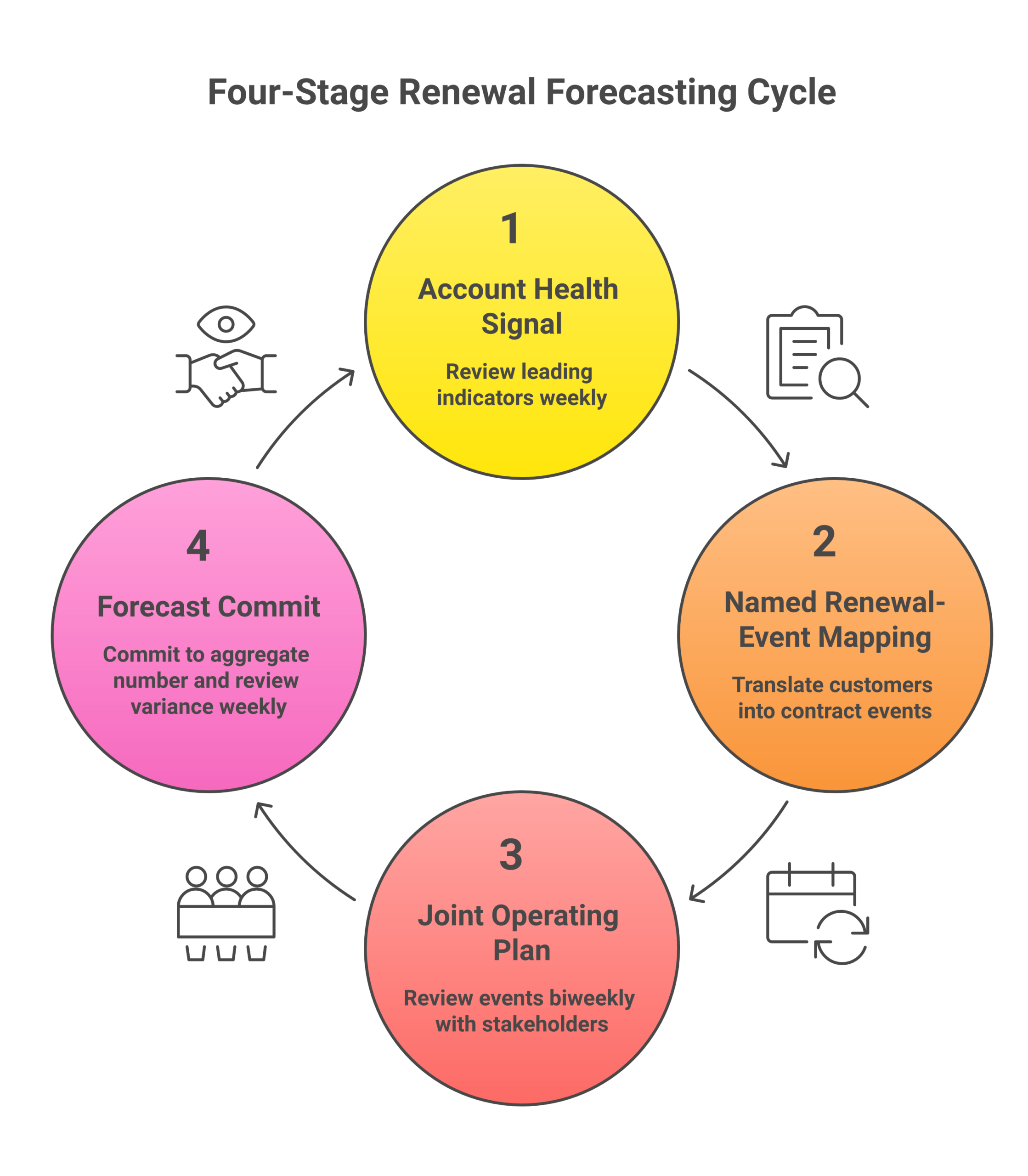
Repeatable renewal forecasting runs on a four-stage cadence: account health signal that surfaces drift, named renewal-event mapping that turns customers into contracts, a joint operating plan that pairs CS with sales and partnerships, and a forecast commit that holds the team accountable to the number. Skip a stage and the renewal forecast reverts to a coverage ratio and a health-score average.
The four stages, in order:
The cadence is the system. Most renewal forecasts that miss have stages 1 and 4 covered (some health score exists, some forecast number gets reported) and skip stages 2 and 3. The contract events aren’t named, the joint plan doesn’t exist, and the forecast becomes an aggregate guess driven by last quarter’s NRR plus a churn assumption.
Common pitfalls in renewal forecasting
Renewal forecasts fail at predictable points. The five recurring failure modes account for most underperformance, and most are operating-model issues that no health-score platform can solve for the customer.
The recurring failure modes
The recurring failure modes:
The fix
The fix for most of these is the same: treat renewal forecasting as the work, not as the report. Companies that get this right see materially tighter forecast accuracy and materially higher net retention at the same product quality. Companies that don’t run a renewal motion that performs in good quarters and breaks under stress.
Tools and platforms for renewal forecasting
Renewal-forecasting tooling spans four categories: account-health platforms (Gainsight, Catalyst, Vitally), contract-data systems (CRM with custom contract objects, or dedicated tools like LinkSquares), forecast and revenue-management platforms (Clari, Boostup), and the joint operating cadence (typically a recurring meeting plus a shared dashboard). The right stack matches the program’s operating maturity, not the analyst’s tier.
A pragmatic snapshot of the stack progression:
| Forecast maturity | Health signal | Contract data | Forecast platform | Operating cadence |
|---|---|---|---|---|
| Early | Manual scorecard | CRM custom fields | Spreadsheet | Quarterly review |
| Mid | Health-score tool | CRM with contract objects | CRM forecasting | Monthly review |
| Mature | Multi-signal model | Dedicated contract data layer | Forecast platform (Clari, etc.) | Weekly joint review |
| Strategic | Predictive-model layer | Closed-loop contract+product data | Forecast + revenue-intelligence | Multi-cadence (CS, sales, exec) |
The mistake most companies make is buying mature-stage tooling at early-stage operating maturity. A predictive-renewal model run on a dirty contract-data layer produces precise wrong numbers. The companies that get the highest leverage out of these tools start with a clean four-signal operating model in a spreadsheet, prove the cadence, then layer the platform.
Forecastable’s POV
My take is that forecast renewals are the single most underweighted line in B2B SaaS operating discipline. The board reviews new-business pipeline weekly. The board reviews the renewal book once a quarter, if that. Yet at scale, the renewal book is the larger number. Companies that flip this operating asymmetry compound advantage for years.
The pattern that compounds
The pattern I watch compound is renewal forecasting run as system-design first, health-scoring second. The system has four parts: a four-signal account-health model reviewed weekly, a contract-event data layer that the operating team owns, a joint plan with CS, sales, and partnerships, and a commit-and-variance discipline that the CFO trusts. Build the system and the renewal forecast becomes a defensible number. Skip it and the forecast is a story the CRO tells the board until the quarter the story breaks.
What I push customers on
Here’s what I tell every CRO and CFO who asks: stop reviewing the renewal book quarterly. Review it weekly, with the same operating cadence you give new business. Most companies that miss net retention by 5 to 10 points in a year miss because the operating cadence on renewals was loose, not because the product underperformed. Companies I see fix this redesign the recurring meeting structure, the contract-event data model, and the comp plan that pays renewal motion behavior. They don’t buy a different health-score tool.
The other position
The other position I push at Forecastable is that partnerships should be in the renewal forecast meeting. Partner-touched accounts behave differently at renewal than direct-only accounts. They expand more frequently, churn less often, and carry richer signal during the renewal cycle. If your partnerships team isn’t in the joint renewal plan, you’re forecasting half the picture. The companies running this cleanly treat the renewal forecast as a three-team meeting (CS, sales, partnerships) and see net retention compound year over year.
Frequently asked questions
What is the difference between renewal forecasting and renewal reporting?
Reporting is backward-looking: percent retained, percent expanded, churn dollars, NRR, GRR for the period that just closed. Forecasting is forward-looking: which contract events will produce which outcomes inside the next two quarters. Most SaaS organizations have strong reporting and weak forecasting, which means they know what happened but cannot predict what will happen.
How far out should you forecast renewals?
The operating cadence works best at a six-to-twelve-month horizon for the named-contract layer, and an eighteen-to-twenty-four-month horizon for the aggregate book. Forecasts shorter than six months are remediation windows, not forecasting; forecasts longer than twenty-four months are too noisy to act on at the contract level.
What is the relationship between net retention and renewal forecasting?
Net retention is the metric the renewal forecast is trying to predict. A forecastable renewal book produces a tight forecast for net retention; an unforecastable book produces a wide variance band. Companies trading at premium SaaS multiples almost always show high and predictable net retention, which is a downstream signal of operating discipline on renewals.
Who owns the renewal forecast inside a company?
Joint ownership across CS, sales, and the CFO produces the best operating outcomes. CS owns the account-health signal and the day-to-day relationship. Sales owns expansion at renewal. The CFO owns the contract-data layer and the commit discipline. Programs that assign renewals to a single role typically underperform because the operating layers don’t align.
How do partnerships affect renewal forecasting?
Partner-touched accounts tend to renew at higher rates and expand more frequently than direct-only accounts at the same segment. The condition is that the partner motion is operationally mature; partner motions run as theater can degrade renewal forecastability rather than improve it. (See Crossbeam’s research on partner-touched account performance for the underlying ecosystem evidence.)
What is the best tool for renewal forecasting?
There is no single best tool; the right stack matches the program’s operating maturity. Early programs run cleanly on a CRM and a spreadsheet. Mature programs benefit from dedicated revenue-intelligence and health-score platforms. The companies that get the most leverage out of any tool are the ones that prove the operating cadence first and layer the platform second.
Can AI improve renewal forecasting?
AI can compress the effort of pattern recognition across a large book of contracts and surface drift signals earlier than human review. AI cannot create the operating discipline. A predictive renewal model running on a noisy contract-data layer produces precise wrong numbers; the same model on a clean data layer produces precise right numbers. Get the upstream conditions in place, then layer AI.
How does renewal forecasting connect to forecastability more broadly?
Renewal forecastability is one application of the broader forecastability operating model: name the events, run the cadence that surfaces drift, lock the attribution, commit to the number. The four conditions that make a new-business deal forecastable apply directly to renewals; the artifacts and stakeholders are different but the operating discipline is the same.
Next step
Renewal forecasting is the highest-leverage and most under-engineered line on the SaaS operating plan. If your team reviews the renewal book quarterly and the new-business pipeline weekly, you’re treating the larger number with less rigor than the smaller one. The fix starts Monday: pick the next two quarters of named contract events, build the four-signal scorecard, and run the joint review on a weekly cadence.
For the broader operating model that wraps renewal forecasting, see the forecastability overview and the executive alignment guide. For the partnership mechanics that lift net retention on partner-touched accounts, see the partnerships overview, the co-sell guide, and the account mapping overview.
Forecastable is an independent third-party professional services company. Our evaluations of other vendors are based on publicly-available information as of May 2026 and our own client experience.
Talk to our team about installing the renewal-forecast cadence →
By Alex Buckles
Uncover Your Growth Potential
Schedule a Discovery Call