Skip to content
  • Home
  • Who We Serve
    • By Category
      • SaaS
      • Professional Services
      • Platforms (Large Ecosystems)
      • Private Equity
    • By Role
      • Chief Revenue Officers (CRO)
      • Chief Financial Officers (CFO)
      • Chief Marketing Officers (CMO)
      • Chief Executive Officers (CEO)
      • Sales Leaders
      • Partnership Professionals
  • Solutions
    • By Partner Program Maturity
      • Partnerships Foundation
      • Partnerships Acceleration
      • Ecosystem-Wide Orchestration
    • Specialized Solutions
      • Net-New Named Account Development
      • Large Ecosystems
      • M&A: Post-Acquisition Internal Cross-Selling
  • Pricing
  • Education
  • Company
    • Our History
    • Security
  • Home
  • Who We Serve
    • By Category
      • SaaS
      • Professional Services
      • Platforms (Large Ecosystems)
      • Private Equity
    • By Role
      • Chief Revenue Officers (CRO)
      • Chief Financial Officers (CFO)
      • Chief Marketing Officers (CMO)
      • Chief Executive Officers (CEO)
      • Sales Leaders
      • Partnership Professionals
  • Solutions
    • By Partner Program Maturity
      • Partnerships Foundation
      • Partnerships Acceleration
      • Ecosystem-Wide Orchestration
    • Specialized Solutions
      • Net-New Named Account Development
      • Large Ecosystems
      • M&A: Post-Acquisition Internal Cross-Selling
  • Pricing
  • Education
  • Company
    • Our History
    • Security
  • Home
  • Who We Serve
    • By Category
      • SaaS
      • Professional Services
      • Platforms (Large Ecosystems)
      • Private Equity
    • By Role
      • Chief Revenue Officers (CRO)
      • Chief Financial Officers (CFO)
      • Chief Marketing Officers (CMO)
      • Chief Executive Officers (CEO)
      • Sales Leaders
      • Partnership Professionals
  • Solutions
    • By Partner Program Maturity
      • Partnerships Foundation
      • Partnerships Acceleration
      • Ecosystem-Wide Orchestration
    • Specialized Solutions
      • Net-New Named Account Development
      • Large Ecosystems
      • M&A: Post-Acquisition Internal Cross-Selling
  • Pricing
  • Education
  • Company
    • Our History
    • Security
Back to all blogs
  • B2B Partnerships Technology
Alex Buckles

Bridge Partners Shipped One Line That Should Reset Every Partnership-AI Vendor Pitch. Here’s the Question Buyers Should Be Asking Instead.

Wood workbench diptych: a cool-lit grid of nine machined steel gears on the left, a single warm-lit hand-tooled brass tuning fork on the right.

Short answer: Almost every partnership-AI vendor in 2026 sells automation while telling buyers they are selling impact. However, automation and orchestration are different categories. Specifically, automation delivers scale and orchestration delivers impact. Therefore, the question every buyer should put to every vendor pitch is one specific line: show me the orchestration outcome your platform produces, not the automation feature it ships.

Richard Albrecht’s post in June 2025 contains a single line that cuts to the seam of the entire 2026 partnership-AI conversation:

Therefore, “Automation delivers scale. Orchestration delivers impact.”

That’s the cleanest articulation of the distinction we have. Read it twice. It should reset every partnership-AI vendor pitch happening in 2026.

It won’t. And the reason it won’t is a structural feature of the AI-vendor unit economics that most buyers haven’t priced in.

Why the line won’t reset the vendor pitches
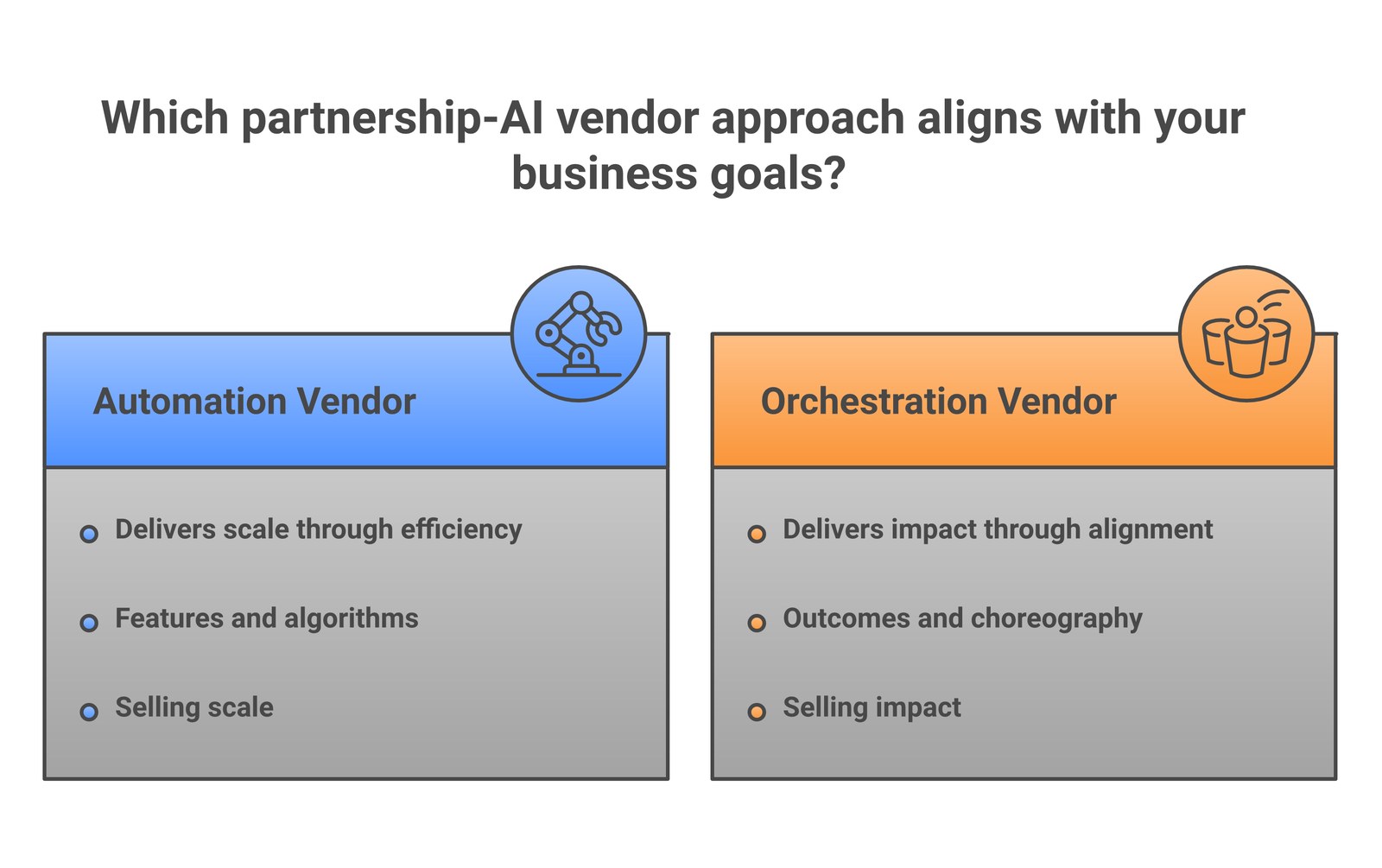
Side-by-side comparison of two partnership-AI vendor approaches โ€” Automation Vendor (delivers scale through efficiency, sells features and algorithms) versus Orchestration Vendor (delivers impact through alignment, sells outcomes and choreography).

Almost every partnership-AI vendor on the market right now is selling automation. Faster matching algorithms. Smarter scoring. Better notifications. Predictive next-best-action. Conversational interfaces over the data. Auto-drafted partner-rep outreach. Auto-summarized partner-meeting notes. AI-generated overlap recommendations. All useful. All automation.

By contrast, almost none of them are selling orchestration. Because orchestration is harder to build, harder to demo, harder to package into a ten-slide vendor pitch, and harder to bill against. Orchestration requires human judgment in the loop, defined cadences across multiple companies, accountability mechanisms that survive reorgs, and context the platform can’t assume. None of that demos cleanly in a 30-minute sales call.

So the vendors compete on the easier side of the distinction, automation, while telling the buyer they’re selling impact. The buyer signs the contract expecting orchestration outcomes from an automation-shaped product. Twelve months later, the platform is producing more dashboards than deals. The buyer concludes AI didn’t work. The platform becomes a cost line. The cycle repeats with the next vendor.

In practice, this is the most common failure pattern in the partnership-AI buying conversation right now. And it is structural, not vendor-specific. Any individual partnership-AI vendor could in principle pivot to selling orchestration; the unit economics of doing so make it commercially difficult, so the category collectively defaults to selling automation and calling it impact.

What automation does well

To be clear about what we are not arguing: automation is genuinely valuable. The matching algorithms that surface overlap. The notification systems that route signal to reps. The auto-summarization features that compress an hour of partner-call review into a five-minute briefing. The chat interfaces that let analysts query partner-activity data without writing SQL. All of these compress time, reduce friction, and enable scale.

Notably, if your existing partnership program has the orchestration layer installed and working, automation will accelerate it materially. The Channelnomics 40%-faster-deal-velocity stat applies here. AI-on-top-of-good-cadence is the use case where the citations work.

The failure mode is not automation per se. The failure mode is the substitution of automation for orchestration in the buyer’s mental model.

What orchestration actually requires

Crucially, orchestration is the layer above automation. It is the cadence design that turns automation outputs into deal motion. Specifically:

  • A shared mental model that every partner-side rep carries, what the joint customer outcome looks like, who owns which moment in the cycle, what “good” looks like for the deal.
  • A better-together story constructed jointly between vendor and partner, that lands at the level of the customer outcome neither party can produce alone.
  • Pipeline choreography sequenced deliberately at the rep-to-rep layer, who opens, who deepens, who lands across multi-partner deals.
  • Mutual action plans that survive between meetings, with named owners across all partner-side counterparts and explicit dates with consequences.
  • Always-on communications cadence between named contacts at every partner producing material pipeline, channel-rotated, brief, value-add, grounded in actual joint pipeline.
  • Production culture in the partnership function that evaluates partner managers on output, not relationship-health metrics.
  • Frontline engagement at the rep-to-rep layer between AE and partner-side AE on a weekly cadence, not via the partner manager.

These are not features. They are operating disciplines that have to be designed, installed, and maintained. The platforms can support them. The platforms cannot, by themselves, produce them.

The question every buyer should put to every vendor pitch from now on

Indeed, what buyers should ask in every partnership-AI vendor pitch from this point forward is one specific question:

Show me the orchestration outcome your platform produces, not the automation feature it ships.

Meanwhile, most demos can’t answer that question because most platforms don’t produce orchestration. The demos that can answer it usually involve a human-in-the-loop role, a Co-Sell Alignment Specialist on the operations side, a Forward-Deployed Engineer on the technical side, that the vendor positions as “implementation services” but is actually the orchestration layer doing the work the platform alone can’t.

That’s a fair admission when the vendor makes it. It also reframes the buying decision. The platform is useful, but the orchestration value comes from the human roles operating against it. The platform spend should be sized to what it actually does (automation at scale). The orchestration spend, which is bigger and more leveraged, should be allocated to the roles and the cadence design that makes the platform produce impact.

Where the orchestration investment should actually live

In fact, the reason most partnership-AI vendors won’t reset their pitch is structural, not strategic. Their unit economics push them toward selling more automation, not toward building orchestration. Which means the buyer has to make the move themselves. Stop buying automation and calling it orchestration. Start sizing the orchestration investment separately from the platform investment. Install the human roles and the cadence design that make the platform actually produce.

That work is exactly what Forecastable does, and orchestration is the category we intend to own.

Most importantly, the 9-accelerator operating system across Strategy, Story, and Selling is the orchestration layer the platforms cannot deliver. The Strategy axis (partner activation, ecosystem leverage, disproportionate advantage) sequences the multi-partner motion. The Story axis (layered value, shared mental model, pipeline choreography) constructs the better-together at the rep-to-rep layer where deals actually close. The Selling axis (production culture, discipline and accountability, frontline engagement) installs the cadence that survives reorgs and hand-offs.

Co-Sell Alignment Specialists run that layer as senior team members embedded in the partnership function. Forward-Deployed Engineers do the same on the technical side, sitting between the platforms and the cadence. Together they are the named owners of the orchestration outputs that no platform alone produces. The platform spend should be sized to what it actually does (automation at scale). The orchestration spend, which is bigger and more leveraged, belongs with the people and the cadence design, not with another seat license.

Then the platform actually produces.

What this means for your team this quarter

Two diagnostics worth running.

Diagnostic one, the platform-vs-cadence audit

However, for your three largest partnership-AI investments (current or planned), score each one as automation-shaped or orchestration-shaped based on what the platform actually does versus what the cadence around it does. Most will score automation-shaped. The orchestration layer underneath each one is what determines whether the investment closes the ROI loop.

Diagnostic two, the role-design audit

For each automation-shaped platform you have or are evaluating, identify the human role that has to exist to extract orchestration value from it. If no such role exists in your org chart today, that’s the missing variable. The platform investment without the role is sized for the wrong outcome.

Therefore, the fix isn’t to stop buying platforms. The fix is to size the platform investment for what it actually does, allocate the orchestration investment separately, install the human roles (Co-Sell Alignment Specialist on operations, Forward-Deployed Engineer on technical, named cadence-owners across each material partner motion), and let the platform accelerate a cadence that’s already producing.

Closing

The BridgeIQ launch named the distinction cleanly. Automation delivers scale. Orchestration delivers impact.

Specifically, the buyer’s response should be the question that flows from it: show me the orchestration outcome, not the automation feature. Vendors that can answer it have done the harder work and earned the spend. Vendors that can’t have built an automation product wrapped in orchestration marketing.

Talk to our team about installing the orchestration layer underneath your partnership-AI investment โ†’

Related reading

  • The data-trust prerequisite layer that has to land first
  • The five-to-eight-partners shift driving multi-partner deals

Sources

  • Bridge partners’ bridgeiq launch
  • The channelnomics 40% stat

Uncover Your Growth Potential

Whether starting with a single sales team or a single partner, any co-sell motion can be live within 30 days.

Schedule a Discovery Call
Latest Insights
Featured image for Forecastable blog post on partner enablement
  • B2B Partnerships Technology
B2B SaaS Co-Sell Head of Sales Partner Ops Partnerships
Alex Buckles

Partner Activation: The Work That Turns Enablement Into Pipeline

Partner activation is the work of getting partner sellers, technical teams, and customer success people to actually run deals alongside the vendor. The industry calls this enablement; the work that produces revenue is activation. Most B2B SaaS partner programs invest heavily in enablement content (training portals, certification badges, recorded courses) and underinvest in activation (motion […]

Read Article
Partner operations admin at dual-monitor workstation using a partner portal interface
  • B2B Partnerships Technology
AI in Partnerships B2B SaaS Partner Ops Partnerships Vendor Comparison
Alex Buckles

What Is PRM Software? The Honest Definition

PRM software is the most overloaded acronym in partnerships. It is one category of four, with specific leaders and specific use cases. Here is the honest definition and what gets confused with it.

Read Article
Rusty bolt embedded in a rough concrete wall, leaning diagonally downward from the masonry surface.
  • B2B Partnerships Technology
Alex Buckles

Channelnomics Says AI in Partner Management Cuts Deal Velocity by 40%. The Companies Hitting It Spent 2026 Reconciling Data, Not Buying Platforms.

Short answer: Channelnomics reports that early adopters of AI in partner management see up to 40% faster deal velocity. However, that outcome is conditional on one prerequisite the citations leave out: data trust. Specifically, partner-attribution data, deal-registration data, partner-activity data, and joint-Slack data have to be reconciled before AI on top of them produces signal […]

Read Article
  • B2B Partnerships Technology
Alex Buckles

Mindmatrix Alternatives: 6 PRM Options for 2026

Mindmatrix is a long-tenured Through-Channel Marketing Automation (TCMA) and PRM platform best fit for vendors with deep channel-marketing needs and a sizable indirect motion. Buyers often shop alternatives when they want a lighter PRM, a more modern UI, a Salesforce-native architecture, or a co-sell-first ecosystem stack. This guide compares six alternatives by program shape, the […]

Read Article

Quick Links

  • Who We Serve
  • Solutions
  • Resources
  • Pricing
  • Our History

Social Media

  • Linkedin

Legal

  • Privacy Policy
  • Terms of Service
Quick Links
  • Who We Serve
  • Solutions
  • Resources
  • Pricing
  • Our History
Social Media
  • Linkedin
Legal
  • Privacy Policy
  • Terms of Service

Stay ahead on ecosystem-led growth

ยฉ 2025 Forecastable. All rights reserved.
Book Your Strategy Call
Request Enrollment Details

[contact-form-7 id=”dfbeed3″ title=”Request Enrollment Details”]

Mollie Bodensteiner

Revops Advisory
  Mollie Bodensteiner is an experienced operations professional with a demonstrated track record of utilizing technology to support operational processes that drive performance and innovation. She currently is the Vice President of Operations at Sound and owns go-to-market agency, MB Solutions. Mollie has previously held operations leadership roles at Deel, Syncari, Corteva and Marketo. She has over 14 years of experience in both B2C and B2B operations and technology. When she is not working, Mollie enjoys spending time with her husband, three small children, and two large dogs. Childhood Career/Dream: Growing up in the age of Disney and Nick@Nite I always wanted to be a child actor (good thing that never was actually pursued ๐Ÿ™‚ Favorite Win: I am not sure I have a specific โ€œwinโ€ but I think I get the most joy and excitement from coaching others and watching them hit major milestones in their career. The first time you get to promote someone on your team or watch them lead a major project – are always career highlights! Personal Fun Facts: Favorite Song: If itโ€™s love, Train Favorite Movie: Good Will Hunting Favorite Meme: Disaster Girl
Forecastable resources: Co-Sell Orchestration Platform · All Use Cases · Live in 30 Days · Co-Sell Playbook

Kelsey Buckles

Director of Operations


My journey from Education to Operations has equipped me with a unique perspective and skill set that perfectly aligns with Forecastable’s mission to help businesses improve sales collaboration through partner co-selling strategies.

At Forecastable, I am passionate about empowering teams and organizations to unlock the full potential of strategic partnerships. By leveraging my expertise in communication, leadership, and operational efficiency, I contribute to creating seamless co-selling processes that align with business goals and deliver exceptional results.

The intersection of my educational foundation and operational experience fuels my dedication to fostering alignment, building trust, and enhancing collaboration between partners. I am driven by the opportunity to contribute to a platform that not only optimizes sales strategies but also strengthens relationships that lead to long-term growth.

Paul Jonhson

Chief Technology Officer (Co-founder)


Paul Johnson has 20+ years of software development and consulting experience for a variety of organizations, ranging from startups to large-enterprise organization with highly-complex needs.

Mr. Johnson has a long track record of successful technology deployments.
This, combined with his deep passion for machine learning and exceptional user experience design, allows him to lead our technical direction from the front with confidence.

Alex Buckles

Product, Partnerships, and Value Engineering (Co-founder)


After serving in The United States Marine Corps, Alex Buckles spent the next two decades as a student of revenue production and an advocate for innovation.

Along the way, he has helped numerous companies achieve double and triple-digit growth by crafting and executing high-performing go-to-market strategies, with co-selling at the center of each.

As a once-advanced technical marketer, an expert sales & partner professional, and a strong customer success advocate, Mr. Buckles understands the impact of these functions aligning not only on revenue production, but on the day-to-day execution of the go-to-market strategy. This concept of revenue-team alignment is what quickly became the foundation of Forecastable back in January of 2018.

In his free time, youโ€™ll find him spending quality time with his children, one of whom is on the autism spectrum. 1 in 36 children in the U.S. are on the spectrum and boys are four times more likely to be diagnosed than girls.

With that in mind, Mr. Buckles plans on dedicating the rest of his life serving those living with autism, through his organization Pathways for Autism. From his perspective, there must be a scalable and financially self-sustaining infrastructure established to put as many individuals with autism as possible on a path towards complete independence as adults.