What Is PRM? Partner Relationship Management Explained

What is PRM?
Short answer: PRM stands for partner relationship management, the discipline and software for recruiting, onboarding, enabling, and measuring the partners who help a company win business. It is the partner-side counterpart to a CRM, holding the partner roster, deal registrations, content, and reporting in one system so a program can be run and reported rather than guessed at.
PRM is both a practice and a product category. The practice is the repeatable motion that turns signed partners into producing ones. A PRM system is the platform that runs that motion, so onboarding, deal registration, and attribution stop living in spreadsheets and inbox threads.
Why PRM matters in 2026
PRM matters in 2026 because partner-influenced revenue is a number leadership expects to see, and a program with no system cannot produce it reliably. Without PRM, nobody can say which partner sourced which deal, and an uncountable program is the easiest one to cut.
The second reason is breadth. A modern ecosystem mixes technology partners, resellers, services firms, and referral sources. PRM gives each of those motions a lane inside one model, so the program scales without turning into four disconnected processes.
How a PRM system actually works
A PRM system runs the program as a sequence, where each stage depends on the one before it. Skipping a stage does not save time, it moves the cost downstream.
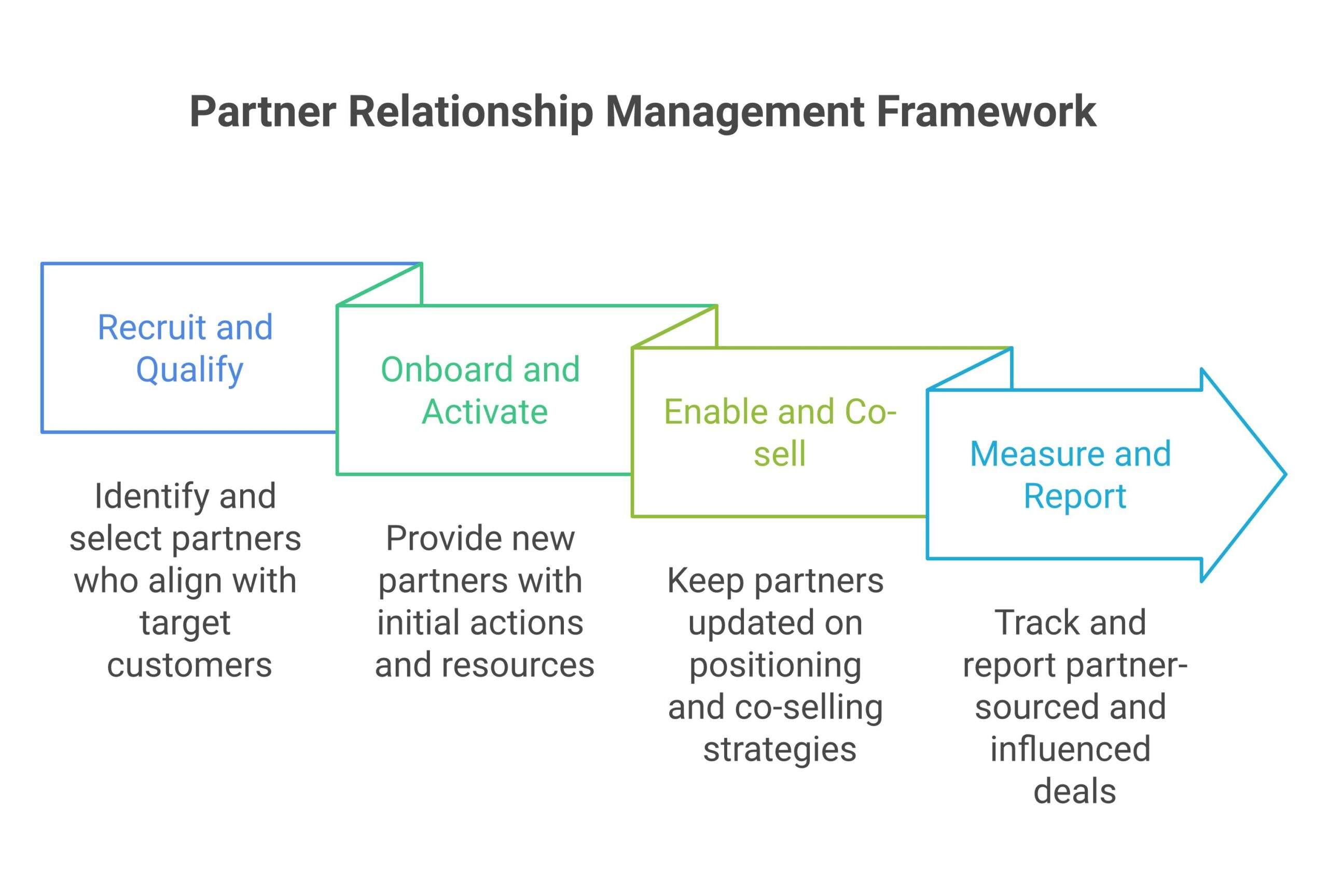
- Recruit and qualify: Bring in partners who already reach the customers you want, deliberately, instead of accepting anyone who will take a badge.
- Onboard and activate: Give each new partner a defined first action, the materials, and a named contact early, so a signature becomes activity.
- Enable and co-sell: Keep partners current on positioning and deal-registration mechanics so they can move real deals with you, continuously rather than once.
- Measure and report: Tag partner-sourced and partner-influenced deals from the first touch and report them beside direct pipeline, so the program defends itself with evidence.
PRM is working when a partner knows their next step and shows up tagged in your pipeline, and failing when you have a roster and no number.
Common pitfalls with PRM
- Buying the system before defining the motion: A PRM system runs whatever program you give it, so an undefined program just gets automated confusion. Define recruit, onboard, enable, and measure first.
- Mistaking a portal for activation: A partner login is not a producing partner. If onboarding ends without a defined first action and a named contact, nothing has started.
- Leaving attribution for later: A program that adds measurement after launch cannot count its first wins, and an uncountable program is the easiest to cut. Turn on attribution from the first touch.
What this looks like in practice
A company outgrowing its spreadsheet could not answer a simple board question: what did partners produce last quarter? They adopted a PRM system, but first they wrote down the motion it would run, who they recruit, what action they want, how they measure it. Deal registrations moved into the system, onboarding became a defined path instead of tribal knowledge, and attribution made the partner number reportable. PRM platforms such as Impartner, Allbound, ZINFI, Introw, and Euler are built to run that motion; the discipline still has to come first.
Forecastable’s POV on PRM
The position we hold is that PRM is a motion you operate before it is a product you buy. The acronym points at software, but the software automates whatever program your habits create, so a strong system on a vague program still produces a roster and no revenue. Define the motion first and the system has something real to run.
The second conviction is that attribution is what makes PRM worth the spend. The reason to put partners on a system is to count what they produce and report it next to direct pipeline. Instrument it from the first touch, and PRM stops being an expense you justify and becomes a number you defend.
Forecastable is a partnerships operating platform; any third-party tools or platforms referenced here are independent third-party products, and naming them is not an endorsement of one deployment over another. Evaluate each against your own motion.
Frequently asked questions
What does PRM stand for?
PRM stands for partner relationship management. It refers to both the discipline of running partners and the software category that supports it.
Is PRM the same as CRM?
No. A CRM runs direct relationships with prospects and customers. PRM runs the indirect motion: the partners who source, influence, and co-sell deals, with mechanics like deal registration that a CRM does not handle.
What is a PRM system used for?
Recruiting, onboarding, and enabling partners, registering and tracking partner deals, hosting enablement content, and reporting partner-sourced and partner-influenced revenue from one place.
Does a small program need PRM software?
Not always at the start. A small program can run on a spreadsheet, but once deal registrations and onboarding outgrow manual tracking, a PRM system pays for itself in reporting alone.
Who uses a PRM system?
Partnerships and channel teams internally, partner operations as the administrators, and the partners themselves through a partner portal for registrations and content.
Next step
If “PRM” is a term you keep hearing but your own partner numbers live in someone’s head, the fix starts with the motion, not the software. Define how you recruit, enable, and measure partners, then choose a system to run it.
Start your growth journey now to stand up PRM as a measurable motion, or get the broader orientation on partner technology and PRM.
Uncover Your Growth Potential
Schedule a Discovery Call