What is ELG?

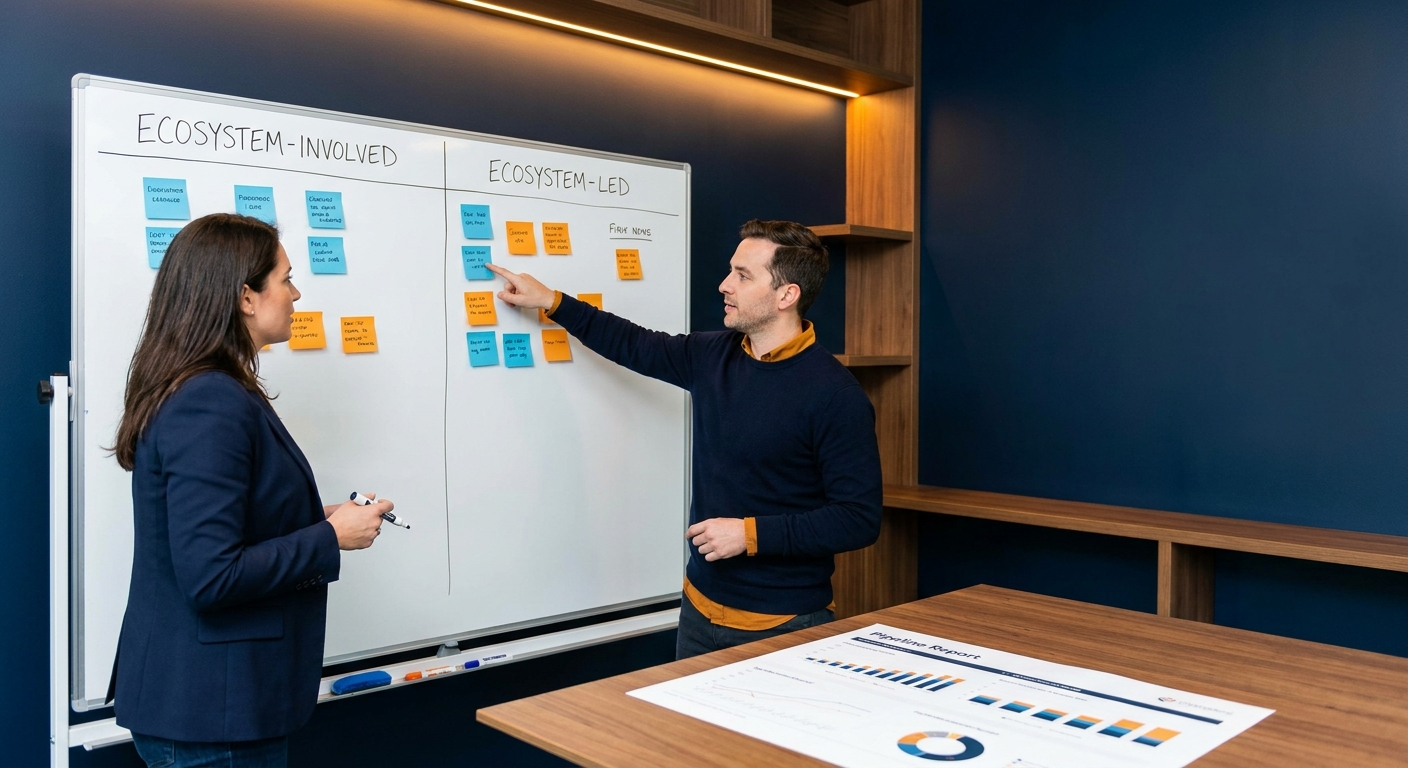
ELG, or ecosystem-led growth, is a go-to-market strategy in which a company’s partner ecosystem becomes the primary source of pipeline, expansion, and retention rather than a sidecar to direct sales and marketing. ELG companies measure ecosystem-influenced revenue as a first-class number, design their CRM and operating cadence around partner overlap data, and treat the partner motion as the organizing GTM thesis rather than as a partnerships function.
The term was popularized by Crossbeam, but the underlying idea, that partner-influenced revenue is the most durable pipeline source available to mid-stage SaaS companies, has been visible in the ecosystem since at least 2018. What makes ELG distinct in 2026 is not the concept; it is the operating discipline of treating the ecosystem as the GTM motion rather than as one of several inputs.
For the broader pillar, start with the ELG overview. For the underlying co-sell motion, see co-sell. For the data layer, see account mapping.
The short answer
ELG is the GTM strategy where partner ecosystem becomes the primary source of pipeline, not a supporting motion. Companies running ELG measure ecosystem-influenced revenue as the headline number, organize their CRM around partner overlap, and run a partner-first operating cadence. The thesis: partner pipeline is harder for competitors to copy, so it compounds longer.
The shortest practical definition: ELG is what happens when partner motion stops being a sidecar and starts being the motion. The change is operating, not strategic, most companies have always agreed that partners matter; ELG companies actually rebuild the operating model around that belief.
The longer answer
The standard B2B GTM motion runs on three engines: outbound sales, paid acquisition, and content marketing. ELG adds a fourth engine, partner ecosystem, and over time lets that engine eat more of the pipeline mix. At maturity, ELG companies often source 30 to 50% of new ARR through the partner ecosystem and run direct sales and marketing as supporting motions rather than primary ones.
The mechanics of ELG break into four pieces:
- Account mapping as the data layer. ELG runs on overlap data, which of your partners are present at which of your customers and prospects. Without that data, the rest of the motion is opinion. Crossbeam, and equivalent platforms produce the overlap layer at machine speed; manual exchanges work at small scale and break above 10 partners.
- Co-sell as the operating motion. ELG turns the overlap data into joint pipeline through a structured co-sell motion, named accounts, joint plans, recurring pipeline reviews, and shared accountability for the deal. (See the co-sell pillar.)
- Partner-influenced revenue as the headline number. ELG companies report partner-sourced and partner-influenced revenue at the same fidelity as direct revenue. The CFO sees the partner-revenue line in the standard board reporting; partner pipeline is in the standard forecast review.
- Operating cadence built around the ecosystem. Sales reps run partner-aware deal cycles. Customer success runs partner-aware QBRs. Product runs partner-aware roadmap reviews. The ecosystem stops being something the partnerships team owns alone and becomes something the company operates.
The thesis underneath ELG is that partner-influenced revenue compounds because it is hard to copy. Direct outbound and paid can be matched by any well-funded competitor. Partner ecosystem cannot, competitors would have to rebuild the relationships, integrations, and operating cadence from scratch. That is the reason ELG has become the dominant late-stage GTM thesis at the SaaS layer in the last 36 months.
What people often get wrong about ELG
Three misconceptions account for most ELG confusion. First, ELG is not the same as partnerships, partnerships is a function, ELG is a GTM thesis. Second, ELG is not about adding partners, it is about restructuring the GTM motion around the partners you already have. Third, ELG is not free pipeline, it requires real operating discipline to convert overlap data into closed revenue.
The misconception list:
- “ELG is just a rebranding of partnerships.” No. Partnerships is the function that owns partner relationships. ELG is the GTM strategy that puts the ecosystem at the center of pipeline. A company can have a strong partnerships function without running ELG; an ELG company necessarily has a strong partnerships function but also has rebuilt sales, marketing, and customer success around the partner motion.
- “ELG means signing more partners.” No. Most companies that under-deliver on ELG have too many partners, not too few. Three to five partners running cleanly produce more ELG revenue than 30 partners running theatrically. Depth before breadth.
- “ELG is plug-and-play once you buy Crossbeam.” No. Crossbeam (or PartnerTap) produces the overlap data; the operating motion that converts overlap into pipeline takes 6 to 9 months to build. Tooling without operating discipline produces shelfware.
Related questions
What is the difference between ELG and nearbound? Nearbound is a closely related term, sometimes used interchangeably with ELG, sometimes used as a sub-set referring specifically to partner-led outbound. The cleanest distinction in 2026: ELG is the GTM strategy; nearbound is one of the tactics inside it (partner-led outbound and account-based selling). See nearbound for the breakdown.
Who runs ELG inside a company? The CRO and the Head of Partnerships co-own the motion. The CRO owns the revenue number; the Head of Partnerships owns the partner-side operating cadence. Without both seats, ELG drifts back into a partnerships function rather than a GTM motion. (See Head of Partnerships.)
How long does it take to build an ELG motion? Twelve to 24 months from kickoff to a stable partner-influenced revenue number. The first six months are data infrastructure and operating cadence design. The next six are execution discipline. The final twelve are when the motion compounds into a defensible pipeline source.
Is ELG just for SaaS? ELG is most visible in mid-to-late-stage SaaS but applies to any B2B category with strong technology partners or services partners, fintech, infrastructure, marketing tech, dev tools. The categories where ELG works less well are those with weak partner economics (commoditized resellers, transactional channels with no joint solution proof).
How is ELG measured? Partner-sourced revenue (deals where the partner brought the lead), partner-influenced revenue (deals where the partner contributed but did not source), and partner-program health (active partner count, joint deal velocity, partner satisfaction). Mature ELG companies report all three at board fidelity.
Next step
If your company is exploring ELG, the highest-leverage next step is to instrument the data layer. Buy account mapping (Crossbeam or PartnerTap) at partner #1, build a clean partner-tagged deal record in your CRM, and run a 90-day pilot co-sell motion with one partner. The pilot is the only reliable way to learn whether the operating cadence will hold inside your company.
Read ecosystem partnerships for the broader strategy context, and co-sell for the operating motion.
By Alex Buckles
Uncover Your Growth Potential
Whether starting with a single sales team or a single partner, any co-sell motion can be live within 30 days.
Schedule a Discovery Call