PartnerStack Alternatives in 2026: A Buyer’s Comparison

PartnerStack is one of the largest PRM platforms in B2B SaaS, with over 600 SaaS customers and 100,000+ partners on its network. The 2026 alternatives that matter most fall into four buckets: AI-native CRM-native PRMs (Introw and Euler are the leading two), enterprise channel PRMs (Impartner is the strongest fit), comprehensive partner operations stacks (ZINFI for 26-module breadth, MindMatrix for Bamboo AI emphasis), and lightweight first-program PRMs (Kiflo for SMB and early-stage teams). Pick the alternative that fits your dominant motion type, affiliate-and-referral programs vs co-sell with technology partners vs traditional enterprise channel, because PartnerStack’s strength (multi-program network breadth) is also exactly the dimension where most alternatives intentionally don’t compete.
I get the “what’s better than PartnerStack” question more often than any other vendor question in B2B SaaS partnerships. The honest framing is that PartnerStack solves a specific problem set well, multi-program partner management with deep affiliate, referral, and reseller automation, and the alternatives mostly solve different problems. Pick on motion type fit, not on feature checklists.
What PartnerStack actually does (so you know what you’re alternative-ing)
PartnerStack positions itself as a multi-program PRM spanning affiliate, referral, reseller, agency, customer-referral, and employee programs on one platform. The 100,000-partner Partner Marketplace is the network-effect differentiator. Key 2025-2026 product moves include Slack-native lead capture, AI email-to-referral extraction, single-portal partner UX across all programs the partner participates in, and the Tackle acquisition that brought cloud GTM capability into the platform. PartnerStack is actively reframing PRM as “Partner Revenue Management” (Mike Head’s language), a system of action, not just a system of record.
Named PartnerStack customers and outcomes include Pipedrive (thousands of affiliates managed via single payment workflow), CallRail (99 percent increase in total partner ecosystem, 4,000+ partners across 5+ programs), Apollo.io (10 percent of total revenue from partner program, 4,000 partners onboarded in under 2 years), Glide (30 percent of revenue through partnerships), Teamwork.com, Katana, HubSpot, Aircall, Slite, and Oyster. The platform crossed $1B in partner-sourced revenue across its network in 2026.
The known PartnerStack weaknesses (from G2 review patterns and field signals): historically positioned as “great for affiliate, weak for enterprise co-sell,” though the 2025-2026 product push (Slack lead capture, single-portal UX, “partner revenue management” reframe) is actively closing that gap. If your motion is enterprise multi-partner co-sell with deep attribution, an alternative typically wins.
The leading PartnerStack alternatives in 2026
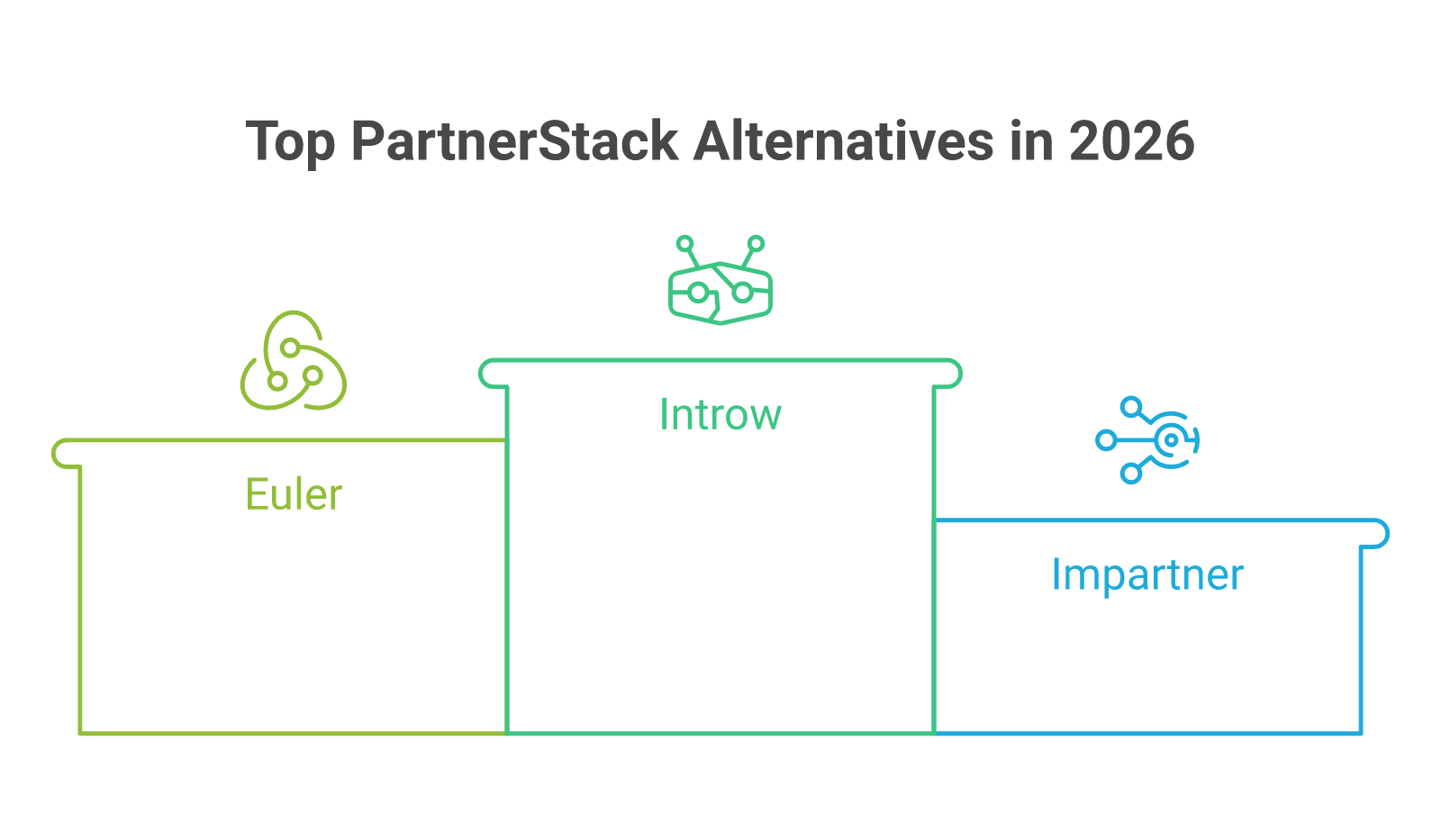
| Alternative | Best fit when PartnerStack is wrong | Key signals |
|---|---|---|
| Introw | Co-sell with technology partners on Salesforce or HubSpot; AI-native team that values feature velocity | 24 consecutive months of product shipping; Claude MCP connector (March 2026); AI Deal Coaching (April 2026); customers Factorial, Xelix, Zenity, QuotaPath, Coder |
| Euler | Mid-market team that wants AI-driven operational automation and clean per-partner ROI; bootstrapped credibility matters | AI Partner Account Manager (24/7 per-partner AI); DealFlow AI (email-to-deal-reg automation); RollWorks customer drove 200%+ agency partner revenue growth, 74% deal size increase, 66% referral volume increase; growing 100% QoQ |
| Impartner | Enterprise channel programs (VARs, distributors, MSPs) needing TCMA, deep partner marketing automation, and analyst-led credibility | Customers include Palo Alto Networks, Visa, Siemens, T-Mobile, Honeywell, Xerox, Ciena, Zebra, Zscaler; TIE Kinetix and Exchange Solutions acquisitions; PMA wedge |
| ZINFI | Complex multi-tier partner programs needing Unified Partner Management with 26+ modules across the partner lifecycle | Founder Sugata Sanyal voice on Ecosystem-Led Growth and PartnerOps; deep TCMA workflows; comprehensive traditional PRM stack |
| MindMatrix | Mid-market to enterprise teams that want AI-infused partner marketing across the existing PRM/PMA stack | Bamboo AI brand across partner marketing, partner activation, asset distribution, MDF, deal reg, co-branded collateral |
| Kiflo | SMB or first-time partner program; “easy to get started” matters more than feature depth | Lightweight UX, transparent pricing, fast onboarding, basic deal registration and referral management |
Introw in depth
Introw (CEO Andreas) positions as the AI-native, CRM-native, “collaborative” PRM. The product surface includes a no-code partner portal (Experience Builder), Salesforce-native and HubSpot-native deep integration, an AI Course Builder with SCORM and conversational quizzes, AI Channel Conflict Resolution (360-degree CRM context), Agentic AI for CRM record creation and update, a Claude MCP connector (March 2026), AI Deal Coaching (April 2026), commission module with invoicing, Product Library with CRM-synced partner-specific pricing, segment-based access control, multi-tenant access, multi-currency, and a 24-month unbroken monthly shipping streak. Named customers: Factorial, Xelix, Zenity, Epiphan Video, Sedai, QuotaPath, Coder, Opus Clip. Pricing is tiered with a Pro plan unlocking custom domain and fonts at 25+ partners. The customer sentiment signal in the corpus is strong positive, “less feature bloat, more customizable” (Xelix). Introw is the right pick when you value modern AI-native architecture, deep CRM integration, and feature velocity over PartnerStack’s network-effect breadth.
Euler in depth
Euler (“when it comes to a PRM, you don’t need features, you need results”) is the AI-native PRM most focused on operational automation and per-partner ROI. The product surface includes the AI Partner Account Manager (24/7 per-partner AI agent), DealFlow AI (email-to-deal-registration automation), AI Communications Hub, POPS AI, partner applications and e-sign contracting, deal registration with CRM sync and attribution, training and certification LMS, commission and spiff payments with no fees, partner directory, affiliate links, and robust reporting. Pricing is unlimited users plus unlimited partners with no hidden costs and demo-required quotes. The flagship customer story is RollWorks (Lizzie Chapman, VP Partnerships), 200 percent agency partner revenue growth, 74 percent deal size increase, 66 percent referral volume increase. Euler is bootstrapped, profitable, growing 100 percent QoQ, and currently hiring across seven roles (AE, Engineering, CS, QA, PM, Design, Onboarding). Euler is the right pick when you want clean per-partner ROI math, an AI agent doing the operational work, and credibility from a bootstrapped, profitable trajectory rather than VC-funded growth-at-all-costs.
Impartner in depth
Impartner is the established enterprise PRM incumbent. The product surface includes Partner Portal / PX, Program Compliance Manager, Channel Insights, Journey Builder, Through-Channel Marketing Automation (TCMA), Partner Marketing Automation (PMA), Workflows, Custom Objects, Partner Locator, Channel Activation, Deal Registration, SSO/LMS integration, and Segmentation. Recent moves include the TIE Kinetix and Exchange Solutions acquisitions, plus 7 new partner integrations announced (Smartsheet, AvePoint, Snyk, Mambu, Finastra, Illumio, Vertiv). Named customers include A10 Networks, Palo Alto Networks, Netskope, Visa, Siemens, BigCommerce, Blackboard, Proofpoint, SentinelOne, AvePoint, Everbridge, Resideo, LogRhythm, Carbon Black, Finastra, T-Mobile, Honeywell, Xerox, Ciena, Illumina, Nintex, Qualtrics, Yamaha, Zebra, Zscaler, BeyondTrust, Lookout, 24+ named enterprise logos. Pricing is enterprise and not publicly disclosed. Impartner is the right pick when you’re running an enterprise channel program with VARs, distributors, MSPs, or affiliates and need deep TCMA plus analyst-aligned credibility.
The decision framework that actually works
Stop comparing feature checklists. Ask three questions in this order.
What’s the dominant motion type for your partner program? Affiliate plus referral plus reseller multi-program with network-effect benefits → PartnerStack stays. Co-sell with technology partners on Salesforce or HubSpot → Introw or Euler. Enterprise channel program with VARs, distributors, MSPs → Impartner. Complex multi-tier program with 20+ modules of need → ZINFI. SMB or first program → Kiflo.
What does your team actually value in a vendor? Network effects and large partner marketplace → PartnerStack stays. AI feature velocity and modern architecture → Introw. Bootstrapped operational ROI credibility → Euler. Analyst alignment and enterprise reference logos → Impartner. Gartner research on revenue technology selection consistently shows team-fit factors predict long-term ROI better than feature comparisons.
Where is your finance team’s pressure point? Per-program ROI clarity → Euler. Per-partner attribution rigor → Impartner or Introw. Total network reach → PartnerStack stays. Forrester research on channel programs shows finance-team alignment is the strongest predictor of multi-year program survival.
The hidden cost analysis nobody runs
PartnerStack alternatives all carry implementation costs that pitch decks understate. Plan for 40 to 120 hours of internal time per platform across IT, security, partnerships ops, and individual partner onboarding. Partner adoption work matters more than buyers expect, every partner you want on the platform has to also adopt it. Workflow gap fill (anything the platform doesn’t do natively becomes a RevOps project) typically adds 0.5 to 1.0 FTE in partnerships ops. Renewal escalations of 15 to 30 percent annually are standard in the category. Run two-year total cost of ownership math, not year-one license comparisons.
How Forecastable fits in the PartnerStack-alternative landscape
Forecastable’s co-sell orchestration platform is not a PRM and not a direct PartnerStack alternative. We sit on top of whatever PRM a customer picks and orchestrate the co-sell motion layer: weekly partner manager and AE rituals, attribution capture, executive reporting in CRO and CFO vocabulary, and the operational discipline that turns partner activity into pipeline the CFO can defend. Customers typically pair Forecastable with Introw, Euler, or Impartner depending on the dominant motion type.
The bigger picture for partnerships leaders
PartnerStack alternatives are not a single category. They are four distinct categories that solve different problems for different motion types. Don’t switch to a generic “PartnerStack alternative”, switch to the platform that fits your dominant partner motion. AI-native co-sell with technology partners points to Introw or Euler. Enterprise channel points to Impartner. Multi-tier complex programs point to ZINFI or MindMatrix. SMB first-program points to Kiflo. And if your motion is genuinely multi-program affiliate plus referral plus reseller, PartnerStack is still the right answer. Pick on motion fit, not on the alternative-of-the-month vendor list.
Frequently Asked Questions
What are the best PartnerStack alternatives in 2026?
The leading alternatives by motion fit: Introw and Euler for AI-native co-sell with technology partners, Impartner for enterprise channel programs, ZINFI for complex multi-tier programs, MindMatrix for AI-infused partner marketing, and Kiflo for SMB or first-time partner programs. Introw and Euler are the AI-native CRM-native leaders most B2B SaaS teams should evaluate first.
Why would I switch from PartnerStack?
The most common reasons: PartnerStack is historically strong on affiliate and referral but weaker on enterprise co-sell (the 2025-2026 product push is closing this gap but hasn’t fully). PartnerStack’s pricing scales with the network. PartnerStack’s “partner revenue management” reframe collides with co-sell-orchestration positioning. If your dominant motion isn’t affiliate or multi-program network breadth, an alternative usually fits better.
What’s the difference between Introw and Euler?
Both are AI-native CRM-native PRMs. Introw (CEO Andreas, customers Factorial/Xelix/Zenity/QuotaPath) leads on feature velocity (24 consecutive months of monthly shipping, Claude MCP connector, AI Deal Coaching). Euler (RollWorks customer drove 200%+ agency revenue growth) leads on operational automation (AI Partner Account Manager, DealFlow AI) and bootstrapped-profitable credibility growing 100% QoQ.
When is Impartner the right PartnerStack alternative?
When you’re running an enterprise channel program with VARs, distributors, MSPs, or affiliates and need deep TCMA, Partner Marketing Automation, and analyst-aligned credibility. Named Impartner customers include Palo Alto Networks, Visa, Siemens, T-Mobile, Honeywell, Xerox, Zebra, and Zscaler.
How much do PartnerStack alternatives cost?
Pricing varies widely. Introw is tiered with Pro plans for advanced features. Euler offers unlimited users plus unlimited partners with demo-required quotes. Impartner is enterprise and not publicly disclosed. Kiflo is the most price-accessible. Mid-market deployments typically run $20,000 to $80,000 per year. Enterprise deployments routinely exceed $100,000. Real total cost of ownership often doubles the sticker price in year one.
How does Forecastable fit in this landscape?
Forecastable is not a PRM and not a direct PartnerStack alternative. We sit on top of whatever PRM you pick and orchestrate the co-sell motion layer: weekly rituals, attribution capture, executive reporting. Customers pair Forecastable with Introw, Euler, or Impartner depending on motion type.
What’s the biggest mistake teams make picking a PartnerStack alternative?
Switching to a generic alternative without identifying the dominant motion. PartnerStack solves multi-program affiliate plus referral plus reseller well. If that’s your motion, no alternative wins. If your motion is co-sell, enterprise channel, or first-program SMB, switching to Introw, Euler, Impartner, or Kiflo respectively delivers more ROI than switching to a generic competitor.
Forecastable is an independent third-party professional services company. Our evaluations of other vendors are based on publicly-available information as of May 2026 and our own client experience.
Forecastable turns scattered partner relationships into predictable, forecastable pipeline. See the platform or start your growth journey.
Uncover Your Growth Potential
Schedule a Discovery Call