Partner Relationship Management Tools: The 2026 Stack

What are partner relationship management tools?
Short answer: Partner relationship management tools are the connected set of systems that run a partner program, the PRM suite at the center, with overlap-data and co-sell layers around it, all syncing to your CRM. They exist so that recruiting, onboarding, deal registration, and attribution operate as one motion instead of as disconnected spreadsheets and portals.
The phrase “tools” is broader than a single platform. A PRM suite handles the lifecycle and deal registration, but most real programs also need account-overlap data to drive co-sell and a co-sell layer to route deals through marketplaces. Thinking in terms of a stack, rather than one tool, is what keeps the pieces from fighting each other.
Why partner relationship management tools matter in 2026
Partner relationship management tools matter in 2026 because the partner motion has too many moving parts to run by hand, and partner-influenced revenue is now a number leadership expects. Deal registrations, onboarding steps, enablement, and attribution each break in a spreadsheet at scale, and the tools exist to hold them reliably.
The second reason is that the motions have multiplied. A program that co-sells with technology partners, resells through channel firms, and takes referrals needs different mechanics for each, plus shared attribution across all of them. The right toolset gives every motion its place while keeping one source of truth.
How partner relationship management tools fit together
Partner relationship management tools work as a connected stack, where each layer does one job and feeds the next. Bolting on a tool that does not connect just creates another silo, so the fit between layers matters as much as any single tool.
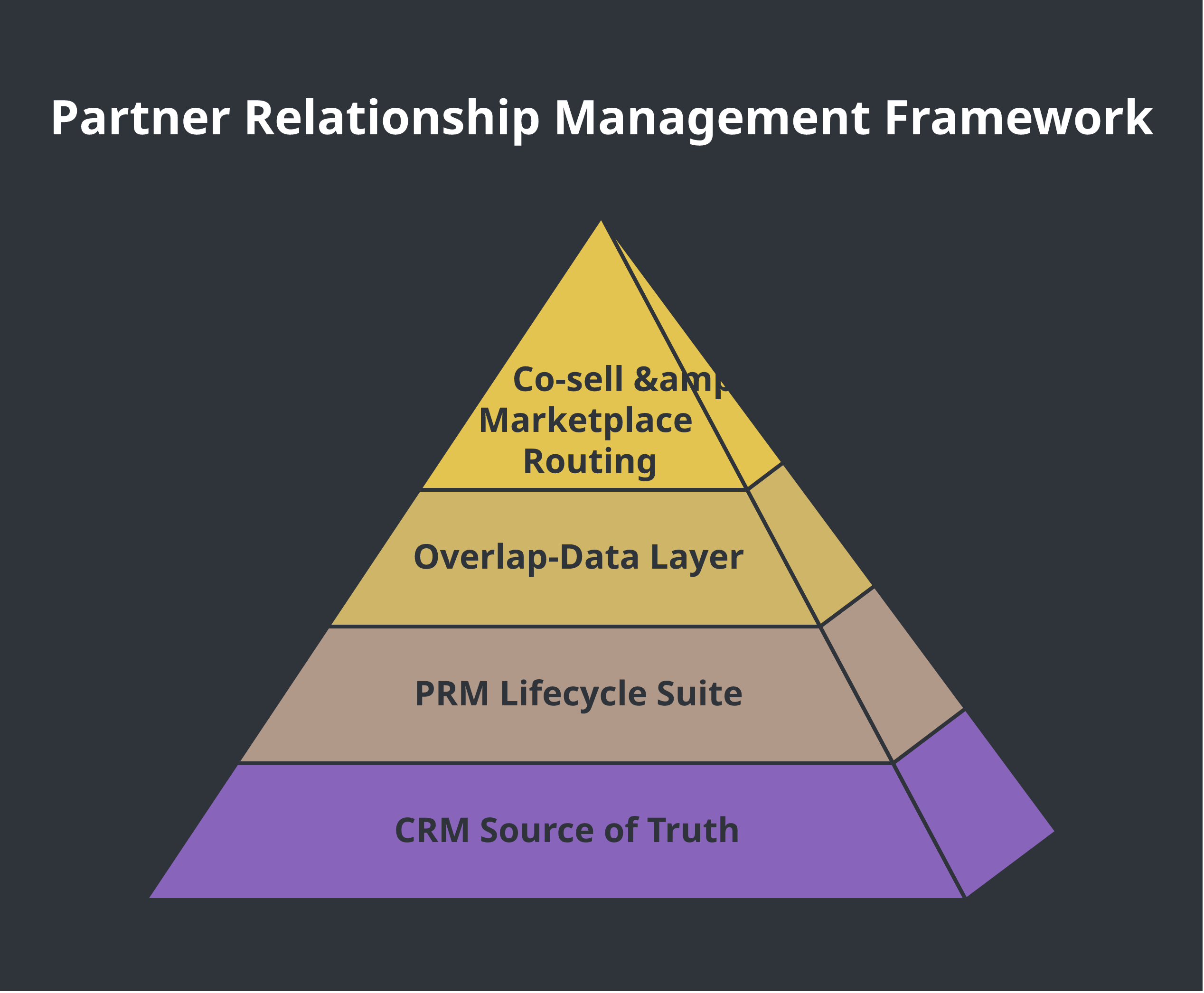
- CRM as the source of truth: Anchor the stack on your CRM so partner data and direct data reconcile rather than compete. Every other tool should sync to it, not around it.
- PRM suite for the lifecycle: Run recruit, onboard, enable, and deal registration in the PRM suite. This is the operational center where the partner roster and registrations live.
- Overlap-data layer for co-sell signals: Add account-mapping and partner-overlap data so co-sell is driven by where you and a partner share accounts, not by guesswork.
- Co-sell and marketplace layer for routing: Route qualified co-sell deals through hyperscaler marketplaces when that is where the budget sits, connecting the motion to the buying channel.
You have the toolset right when each layer feeds the next and everything reconciles to the CRM, and wrong when you own four tools that each hold a different version of the truth.
Common pitfalls when assembling partner relationship management tools
- Buying point tools that do not connect: A best-in-class tool that does not sync to your CRM becomes another silo. Weight connection between layers as heavily as any single feature.
- Starting with the stack instead of the motion: Tools automate a motion; they do not supply one. Define recruit-onboard-enable-measure first, then buy the layers that run it.
- Over-buying for a small program: A young program rarely needs every layer at once. Start with the PRM suite and CRM sync, add overlap data and co-sell layers when the motion calls for them.
- Letting attribution scatter across tools: If each layer reports its own partial number, leadership gets four answers and trusts none. Decide where attribution lives and make every tool feed it.
Tools and examples
The toolset splits into recognizable groups by the job each does. The table frames the groups so you can assemble a stack by function rather than by brand.
| Tool group | Job in the stack | Representative platforms |
|---|---|---|
| Full-suite PRM | Lifecycle, deal registration, enablement, reporting | Impartner, Allbound, ZINFI, Introw, Euler |
| Ecosystem and overlap data | Account mapping and partner-overlap signals | Crossbeam, Pocus, Common Room |
| Cloud co-sell and marketplace | Routing co-sell through hyperscaler marketplaces | Tackle, Labra, Suger, Clazar |
A worked example: a program assembling its partner relationship management tools started by anchoring everything on the CRM it already ran. It added a full-suite PRM for the lifecycle and deal registration, wired an overlap-data tool in so co-sell targeted shared accounts, and connected a co-sell layer for the deals that belonged in a marketplace. The stack worked because each layer had one job and all of them reconciled to the CRM, so the partner-sourced number was one number, not four.
Forecastable’s POV on partner relationship management tools
The position we hold is that you assemble a toolset around a motion, not the other way around. The most common mistake is buying impressive tools and then trying to invent a program that justifies them. Define the motion first and the stack almost designs itself, because each layer maps to a job the motion already needs.
The second conviction is that connection beats best-in-class. A slightly less powerful tool that syncs cleanly to your CRM beats a stronger one that creates a second source of truth. The cost of reconciliation between disconnected tools is paid every week, forever, and it dwarfs the feature gap.
The third point is restraint. A young program does not need every layer on day one. Start with the PRM suite and a clean CRM sync, prove the motion, and add overlap data and co-sell routing when the program is actually running those motions. Buying ahead of the motion is how stacks become shelfware.
Forecastable is a partnerships operating platform; any third-party tools or platforms referenced here are independent third-party products, and naming them is not an endorsement of one deployment over another. Evaluate each against your own motion.
Frequently asked questions
What are partner relationship management tools?
The connected set of systems that run a partner program: the PRM suite for the lifecycle, overlap-data tools for co-sell signals, and co-sell or marketplace layers, all syncing to your CRM.
Do I need more than a PRM platform?
Not always at the start. A PRM suite and a clean CRM sync cover most early programs. Overlap-data and co-sell layers are added when the motion actually needs them.
How do partner relationship management tools connect to a CRM?
The CRM should be the source of truth, with every other tool syncing to it. That keeps partner data and direct data reconciled instead of competing.
What is the difference between a PRM tool and an overlap-data tool?
A PRM tool runs the partner lifecycle and deal registration. An overlap-data tool maps where you and a partner share accounts, feeding co-sell targeting that the PRM tool then operationalizes.
How do I avoid buying tools I do not use?
Define the motion first and buy only the layers it needs now. Add layers as the program starts running new motions, not in anticipation of motions you have not proven.
Which partner relationship management tool should I buy first?
The PRM suite, with a clean CRM sync. It is the operational center that runs the lifecycle and deal registration, and most early programs need nothing more until co-sell volume grows.
Where should attribution live across the tools?
In one place, with every other layer feeding it, reconciled to the CRM. If each tool reports its own partial number, leadership gets several answers and trusts none of them.
Next step
If your partner tools each hold a different version of the truth, the fix is not another tool, it is a stack designed around one motion and reconciled to your CRM. Map the layers you actually need before you buy the next one.
Start your growth journey now to design the motion your toolset should run, or get the broader orientation on partner technology and PRM.
Uncover Your Growth Potential
Schedule a Discovery Call