Partner Engagement: What It Is and How to Build It

What is partner engagement?
Short answer: Partner engagement is the degree to which a partner is actively working deals, sharing accounts, and taking joint actions with you, not just present on your roster. It is the difference between a partner who logs into your portal and a partner who is in a live opportunity with your sellers this quarter.
Most programs measure the wrong thing. They count logins, training completions, and portal visits, and call that engagement, when none of those activities moves a deal.
A partner is engaged when they are doing the work of selling with you. Real engagement shows up as conversations with your team, accounts shared, and opportunities in the CRM, not as a green dot on an activity dashboard.
Why partner engagement matters in 2026
Partner engagement matters because a signed partner produces nothing until they are actually working with you, and most rosters are full of partners who signed and went quiet. The gap between a roster and a producing roster is engagement, and it is where most programs quietly lose the value they expected from partnerships.
In 2026, more revenue moves through partners, and the cost of a disengaged roster is higher than it used to be. Every partner you recruited, onboarded, and enabled represents sunk cost, and that cost only pays back when the partner engages. A program that drives real engagement turns its roster into pipeline. A program that mistakes activity for engagement keeps reporting healthy portal numbers while the forecast stays flat.
There is also an attention problem. Partner teams are small, and their time is the scarcest resource in the program. Spending that time on partners who log in but never sell, instead of on partners who are ready to work deals, is how good programs stall. Engagement is how you decide where the attention goes.
How partner engagement actually works
Partner engagement works as a loop tied to real selling: read the signals that show a partner is willing to work, run a cadence built around live deals rather than check-ins, do joint activity that moves opportunities, measure engagement against pipeline, and re-engage or retire the partners who stay quiet. Each part feeds the next, so the program spends its time on partners who are actually moving revenue. The components below are what a working engagement motion includes.
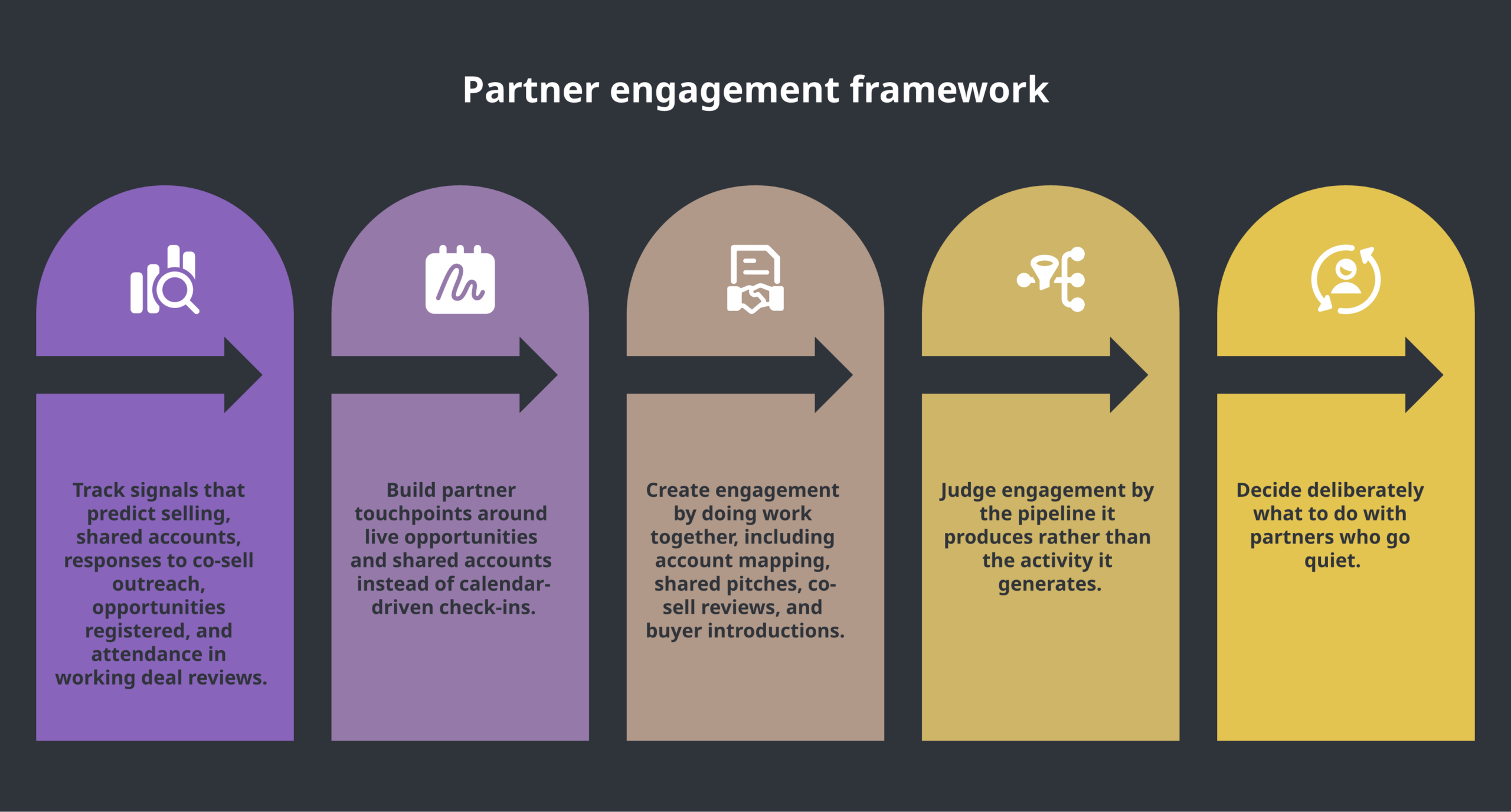
- Read the engagement signals that matter: Track the signals that predict selling, shared accounts, responses to co-sell outreach, opportunities registered, and attendance in working deal reviews, not vanity metrics like portal logins or course completions. A partner who overlaps your accounts and answers your reps is engaged; a partner who logs in weekly and does nothing is not.
- Run a cadence tied to real deals: Build your partner touchpoints around live opportunities and shared accounts, not calendar-driven check-ins. A monthly call with no deal on the table is theater. A working session on two accounts you both touch is engagement, and it gives the partner a reason to show up.
- Do joint activity, not check-ins: Engagement is created by doing the work together, joint account mapping, a shared pitch to a mutual customer, a co-sell deal review, an introduction to a live buyer. Activity that produces a next step in a real deal builds engagement; a status update does not.
- Measure engagement against pipeline: Judge engagement by the pipeline it produces, not by the activity it generates. A partner is engaged if their conversations and actions are showing up as sourced or influenced opportunities in your CRM. If the activity is high and the pipeline is zero, the partner is busy, not engaged.
- Re-engage or retire quiet partners: Decide deliberately what to do with partners who go quiet. Some can be re-engaged with a specific deal or account; others were never a fit and should be retired so their share of the team’s attention goes to partners who produce. A roster you never prune fills with names that consume support and return nothing.
Common pitfalls in partner engagement
- Mistaking portal logins for engagement: A partner who logs in, completes training, and visits the portal can look highly engaged on a dashboard and still never work a single deal. Activity in a system is not engagement in a pipeline.
- A cadence built on check-ins: Recurring calls with no deal on the table teach the partner that meeting with you produces nothing, and engagement drops accordingly. Tie the cadence to real accounts or expect it to be ignored.
- Measuring effort instead of outcomes: Reporting how many touchpoints, emails, or events a partner attended tells you the team was busy, not that the partner is producing. Measure the pipeline, not the motion.
- Treating every partner the same: Spreading the same engagement cadence evenly across the whole roster wastes attention on partners who will never sell and starves the ones who are ready to. Engagement effort should follow signal.
- Never retiring quiet partners: Keeping every signed partner on the roster forever inflates the headcount and dilutes the attention that should go to producers. A partner who has been quiet for a year is a decision you have not made.
What this looks like in practice
A worked example: a software vendor reported strong partner engagement to its board every quarter, citing portal adoption, training completion, and a high rate of monthly partner calls. Partner-sourced pipeline told a different story, flat for three quarters despite the healthy engagement numbers. When they looked closely, the engagement they were measuring was all activity in the portal and on the calendar, and none of it touched a live deal. Partners logged in, completed certifications, and joined monthly check-ins that never got past status updates. The vendor changed what engagement meant. They tied every partner touchpoint to a shared account, tracked conversations and actions forward into the CRM, and started measuring engagement by sourced and influenced pipeline rather than logins and attendance. Partners who had looked engaged but produced nothing were re-engaged around specific deals or retired. Within two quarters, a smaller set of genuinely engaged partners was producing real pipeline, and the engagement number on the board deck finally meant something. The lesson was that engagement you cannot trace to a deal is not engagement, it is activity wearing its clothes.
Forecastable’s POV on partner engagement
Our position is that partner engagement is only real when it shows up as conversations and actions that move CRM pipeline. Everything else, portal logins, training completions, calendar check-ins, is activity that feels like engagement and produces nothing. The programs that confuse the two keep reporting healthy engagement while the forecast stays flat, because they are measuring motion instead of outcomes.
We think the honest test of engagement is simple. Can you trace this partner’s activity forward into a specific opportunity in your CRM? If yes, they are engaged. If the activity is high but the trail goes cold before it reaches a deal, the partner is busy, and busy is not the same as producing.
Forecastable is a partnerships operating platform focused on connecting partner conversations and actions to CRM pipeline and revenue, the flywheel from conversations to actions to pipeline to revenue. We do not run your partner calls or send your co-sell outreach. We make it visible which partners are actually engaged in the way that matters, whose conversations and actions are turning into pipeline, so the team can spend its attention on real engagement and stop rewarding activity that never reaches a deal.
Forecastable is a partnerships operating platform and a category authority, complementary to PRM administration rather than a replacement, and not a PRM vendor. Any third-party tools or firms referenced in this space are independent third-party products, and mentioning them is not an endorsement. Evaluate any engagement approach against your own partner mix, motion, and CRM.
Frequently asked questions
What is partner engagement?
The degree to which a partner is actively working deals, sharing accounts, and taking joint actions with you, as opposed to simply being signed and present on your roster. Real engagement shows up as pipeline, not portal activity.
How do you measure partner engagement?
Measure it against pipeline. Track whether a partner’s conversations and actions are turning into sourced or influenced opportunities in your CRM, rather than counting logins, training completions, or meetings attended. If the activity does not reach a deal, it does not count as engagement.
Is a portal login a sign of engagement?
No. A login shows a partner visited a system, not that they are working a deal with you. Portal activity is easy to measure and easy to mistake for engagement, which is exactly why so many programs over-report it.
How do you re-engage a quiet partner?
Give them a specific reason to work with you, usually a shared account or a live deal, rather than another check-in. If a concrete opportunity does not restart the relationship, the partner may not be a fit, and retiring them is a legitimate outcome.
What is the right cadence for partner engagement?
A cadence built around real deals and shared accounts, not the calendar. The frequency matters less than whether each touchpoint moves a live opportunity forward. A working session beats a standing check-in every time.
Why do partners disengage?
Usually because working with you stopped producing anything for them, or never did. Check-ins with no deal, generic enablement, and a program that measures their logins instead of their pipeline all teach a partner that engagement is not worth their time.
Does more partner activity mean more engagement?
No. High activity with no pipeline means a partner is busy, not engaged. Engagement is judged by the outcome it produces, not the volume of motion it generates.
Next step
If your engagement numbers look healthy but your partner-sourced pipeline is flat, you are measuring activity, not engagement. Tie every partner touchpoint to a real account, and measure engagement by the pipeline it produces. Start your growth journey now to make partner engagement visible as conversations and actions that move CRM pipeline. The partner program hub frames how partner engagement connects to recruitment, onboarding, enablement, and co-selling.
Uncover Your Growth Potential
Schedule a Discovery Call