Head of Partnerships Ecommerce Role Category Guide

What is the head of partnerships ecommerce role category?
Short answer: The head of partnerships ecommerce role category is a growth and go-to-market function, sitting alongside marketing and commercial leadership rather than inside operations or merchandising. It owns the revenue a brand generates through other companies, including affiliate and influencer partners, marketplaces, technology integrations, and retail or channel relationships.
The category question comes up in ecommerce because “partnerships” there can mean several different things, from affiliate marketing to marketplace management to brand collaborations. For a head of partnerships who owns partner-driven revenue, the role belongs in the growth side of the business.
Why the ecommerce role category matters in 2026
The category placement matters because in ecommerce it decides whether partnerships is treated as a revenue channel or a side project. Placed in growth and go-to-market, the role is measured on partner-attributed revenue beside paid, organic, and direct. Placed in operations or merchandising, it gets measured on deals signed and integrations shipped, and the revenue it drives stays invisible in the channel reporting that leadership actually watches.
In 2026 this matters more because ecommerce acquisition economics have tightened and partner channels, affiliate, marketplace, and embedded technology, have become a way to grow without buying every customer through paid media. A brand that categorizes partnerships as a growth channel can manage it like one, with attribution and a target. A brand that files it elsewhere cannot see what it is producing and tends to underinvest in the channel that could lower blended acquisition cost.
The ecommerce ecosystem is also unusually broad, which is part of why the category gets muddled. The same leader might own an affiliate program, a presence on a marketplace, a set of technology integrations, and a few brand collaborations, each with different mechanics. The role category has to be wide enough to hold all of them under one growth-oriented accountability.
How to place the head of partnerships in an ecommerce org
Placing the role is a matter of sorting it by output and motion, where each step rules out a wrong home and confirms the right one. Walk the steps once and the category is settled.
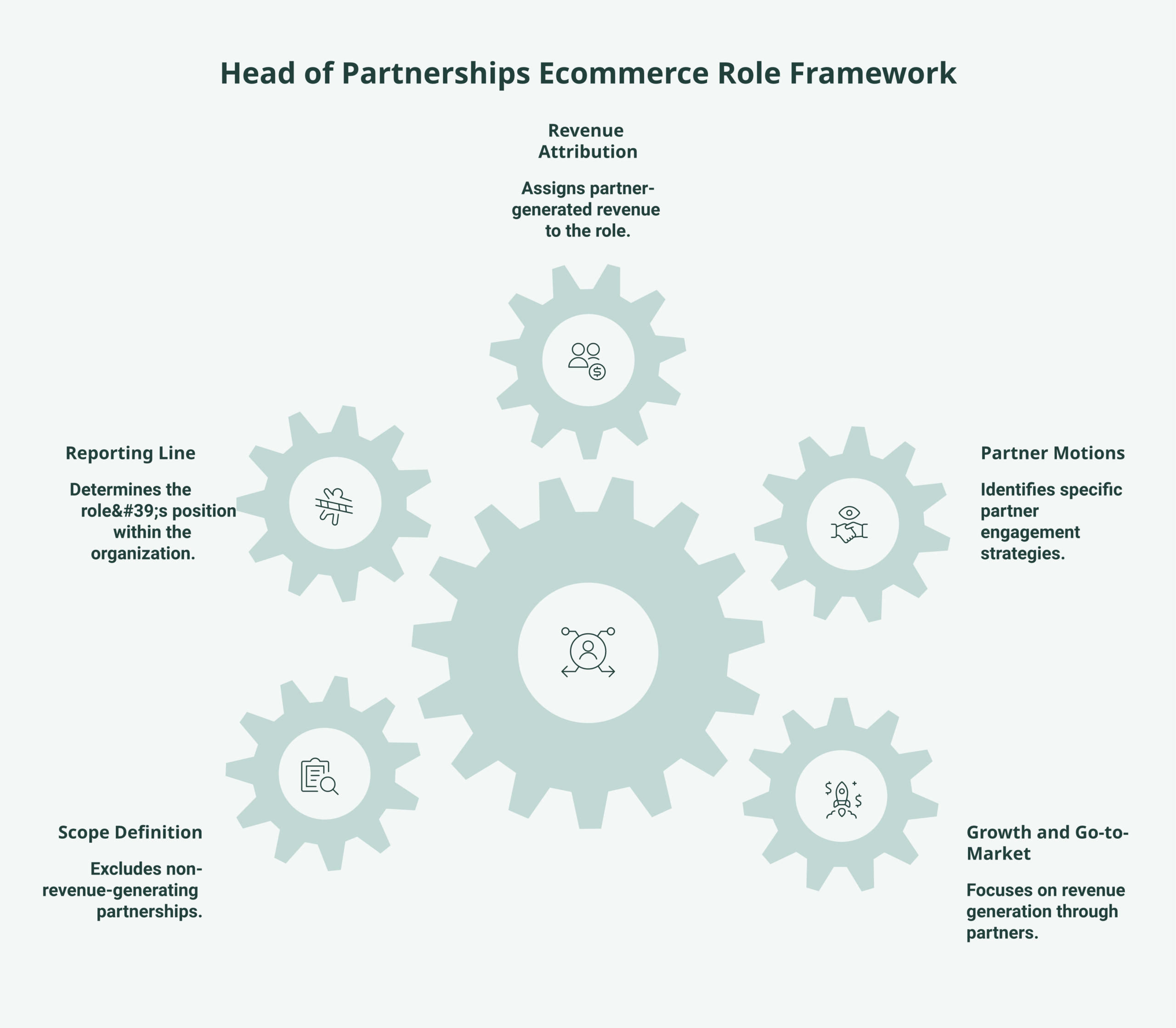
- Sort by primary output: If the role exists to drive revenue through partners, it is a growth and go-to-market function. If it exists to manage logistics or vendor contracts, that is a different operations role wearing the same word.
- Map the partner motions: Identify which motions the role runs, affiliate and influencer, marketplace, technology integrations, and channel or retail, so the scope is explicit rather than assumed.
- Attach a revenue line: Give the role partner-attributed revenue as its number, so it sits in channel reporting next to paid, organic, and direct rather than outside it.
- Confirm the reporting line: A growth-oriented partnerships role reports to a CRO, CMO, or head of growth, not to a merchandising or supply-chain leader. The reporting line confirms the category.
- Separate the lookalikes: Strip out vendor management, logistics partnerships, and one-off brand collaborations that carry no revenue accountability. They share the word but belong to other categories.
The placement is right when the role sits where partner revenue can be seen and managed as a channel, and wrong when it is filed by the label “partnerships” into a function that never reports a revenue number.
The partner motions inside ecommerce partnerships
What makes the ecommerce role category distinctive is the mix of motions it covers. Affiliate and influencer partnerships drive revenue through publishers and creators who send qualified traffic and earn on performance. Marketplace partnerships govern the brand’s presence and economics on third-party platforms where a large share of discovery and purchase now happens. Technology partnerships cover the apps and integrations that extend the storefront and the stack. Channel and retail partnerships manage relationships with resellers and physical or digital retail that carry the brand to new buyers.
Each motion has its own mechanics, but they share a category because they all produce revenue through another company rather than through the brand’s own paid and owned channels. A head of partnerships in ecommerce owns the portfolio of these motions and decides where to invest, which is why the role belongs in growth rather than scattered across operations.
How the role differs from adjacent ecommerce functions
The ecommerce role category gets blurred by several adjacent functions that use overlapping language. Merchandising owns product assortment and margin, not partner revenue. Vendor and supply-chain management owns the relationships that get product made and delivered, which is operations, not go-to-market. Affiliate management can be a sub-function the head of partnerships owns, but it is not the whole category. Brand and marketing partnerships, the co-branded campaigns, sometimes sit in marketing and sometimes under partnerships, depending on whether they carry a revenue line.
The clean test is whether the relationship is accountable for revenue the company can attribute. If yes, it belongs in the growth-oriented partnerships category; if no, it likely belongs to operations, merchandising, or brand. Drawing that line keeps the head of partnerships role focused on the motions that move the number and prevents it from becoming a catch-all for every external relationship in the business.
Common pitfalls in categorizing this role
- Filing it under operations: Putting partnerships in operations because some partner work looks like vendor management strips the role of revenue accountability and hides the channel it drives.
- Treating affiliate as the whole job: Affiliate is one motion. A role categorized only as affiliate management misses the marketplace, technology, and channel partnerships the category should hold.
- No revenue line: Without partner-attributed revenue as a number, the role floats outside channel reporting and gets underinvested relative to paid and organic.
- Confusing brand collaborations with the function: Co-branded campaigns without a revenue line are marketing, not the partnerships category. Including them dilutes the role’s focus on motions that produce attributable revenue.
- Reporting into the wrong leader: A partnerships role reporting to merchandising or supply chain is mis-categorized. Growth-oriented partnerships reports to a CRO, CMO, or head of growth.
What this looks like in practice
A direct-to-consumer brand had its partnerships lead reporting into operations, where the role had landed because the first partner work was a logistics integration. The leader actually ran an affiliate program, a marketplace presence, and a set of app integrations, but none of that revenue showed up in the brand’s channel dashboard, so leadership treated partnerships as overhead. Re-categorizing the role into growth changed the picture: partner-attributed revenue moved into the same dashboard as paid and organic, the leader got a target, and the brand could finally compare the blended acquisition cost of partnerships against its other channels. The motions did not change; the category change is what made the channel visible and fundable.
Forecastable’s POV on the ecommerce role category
Our position is that in ecommerce you categorize partnerships as a growth channel or you lose the channel. The motions, affiliate, marketplace, technology, and retail, all produce revenue through other companies, which makes them a channel to be managed with attribution and a target, exactly like paid and organic. File the role anywhere that does not report a revenue number and the channel becomes invisible, which is how brands end up underinvesting in the one channel that could lower their acquisition cost.
The second conviction is that the role category has to be wide enough to hold the whole portfolio. Ecommerce partnerships span several motions with different mechanics, and splitting them across operations, marketing, and merchandising guarantees that no one owns the channel’s number. One growth-oriented owner with a portfolio view can move investment to the motions that produce and defend the channel in planning. That ownership is what turns a scattered set of external relationships into a managed growth channel.
The third conviction is that attribution is the dividing line for what belongs in the category at all. If a relationship is accountable for attributable revenue, it is partnerships; if it is not, it is operations, brand, or merchandising. Holding that line keeps the role focused on the motions that move the number and keeps the category from becoming a dumping ground for every external relationship the business has.
Forecastable is a partnerships operating platform; any third-party motions, platforms, or frameworks referenced here are independent and naming them is not an endorsement of one structure over another. Categorize the role against your own ecommerce model.
Frequently asked questions
What department does a head of partnerships sit in at an ecommerce company?
Growth or go-to-market, reporting to a CRO, CMO, or head of growth. The role owns partner-attributed revenue and belongs in channel reporting beside paid, organic, and direct.
Is ecommerce partnerships a marketing role?
It overlaps with marketing, especially on affiliate and influencer motions, but it is broader. It also covers marketplace, technology, and channel partnerships, so it sits in growth rather than purely in marketing.
What motions does an ecommerce head of partnerships own?
Typically affiliate and influencer, marketplace presence and economics, technology integrations, and channel or retail relationships, all unified by driving revenue through other companies.
Is affiliate management the same as head of partnerships?
No. Affiliate is one motion the role may own. A head of partnerships owns the full portfolio of partner motions, of which affiliate is a part.
How is the ecommerce partnerships role measured?
On partner-attributed revenue and its contribution to blended acquisition cost, supported by leading indicators like active partners and new partner-driven traffic.
Does this role belong in operations?
Not when it owns revenue. Operations partnerships, such as logistics and vendor management, are a different function. Revenue-owning partnerships sits in growth.
How does it differ from merchandising?
Merchandising owns assortment and margin; partnerships owns revenue driven through external partners. They are separate functions that occasionally collaborate.
Next step
If your ecommerce partnerships role is filed outside growth, give it a revenue line and move it where the channel can be seen. Forecastable helps leaders define the partner motions and attribution that make partnerships a managed growth channel. Start your growth journey now to put the role where its revenue lives. The partner program hub frames how the function coordinates across go-to-market, and the related head of partnerships responsibilities detail what the role owns once it is placed.
Uncover Your Growth Potential
Schedule a Discovery Call