GTM Partnerships: What They Are and How to Run Them

What are GTM partnerships?
Short answer: GTM partnerships are alliances where two companies align their go-to-market efforts, marketing, selling, and sometimes product, to reach a shared market together rather than separately. They go beyond a referral arrangement to coordinate how both companies find, win, and grow customers, so the combined motion produces more than either could alone.
GTM stands for go-to-market, the full motion of how a company brings an offering to buyers. A GTM partnership is two of those motions deliberately overlapped, which is what separates it from a loose relationship where two companies are merely friendly.
Why GTM partnerships matter in 2026
GTM partnerships matter because no single company owns the whole buyer relationship anymore. Buyers assemble solutions from multiple vendors, and the companies that show up together, with an aligned story and a coordinated motion, win against those that show up alone. A GTM partnership lets two companies meet the buyer where they already are, inside a relationship the buyer already trusts, rather than each fighting for attention separately.
In 2026 they matter more because acquisition is getting harder and more expensive across every channel. Cold outbound is less effective, paid channels are crowded, and buyers are more skeptical of vendors selling to them directly. A GTM partnership offers a warmer path, the partner’s existing relationships and credibility, which converts better than the channels that are getting saturated. The companies leaning into partner-led motions are doing so because the alternatives are losing efficiency.
There is also a compounding effect when GTM partnerships are run well. Two companies that align on a target segment, a joint offer, and a shared pipeline can build a motion that gets stronger with each deal, as references accumulate and the teams learn to sell together. A company running GTM partnerships as a series of one-off favors gets none of that compounding, which is why the discipline of running them as a real motion matters as much as having the partnerships at all.
How GTM partnerships actually work
GTM partnerships run on alignment across several dimensions, not just goodwill between two companies. The components below are what turn a friendly relationship into a motion that produces pipeline.
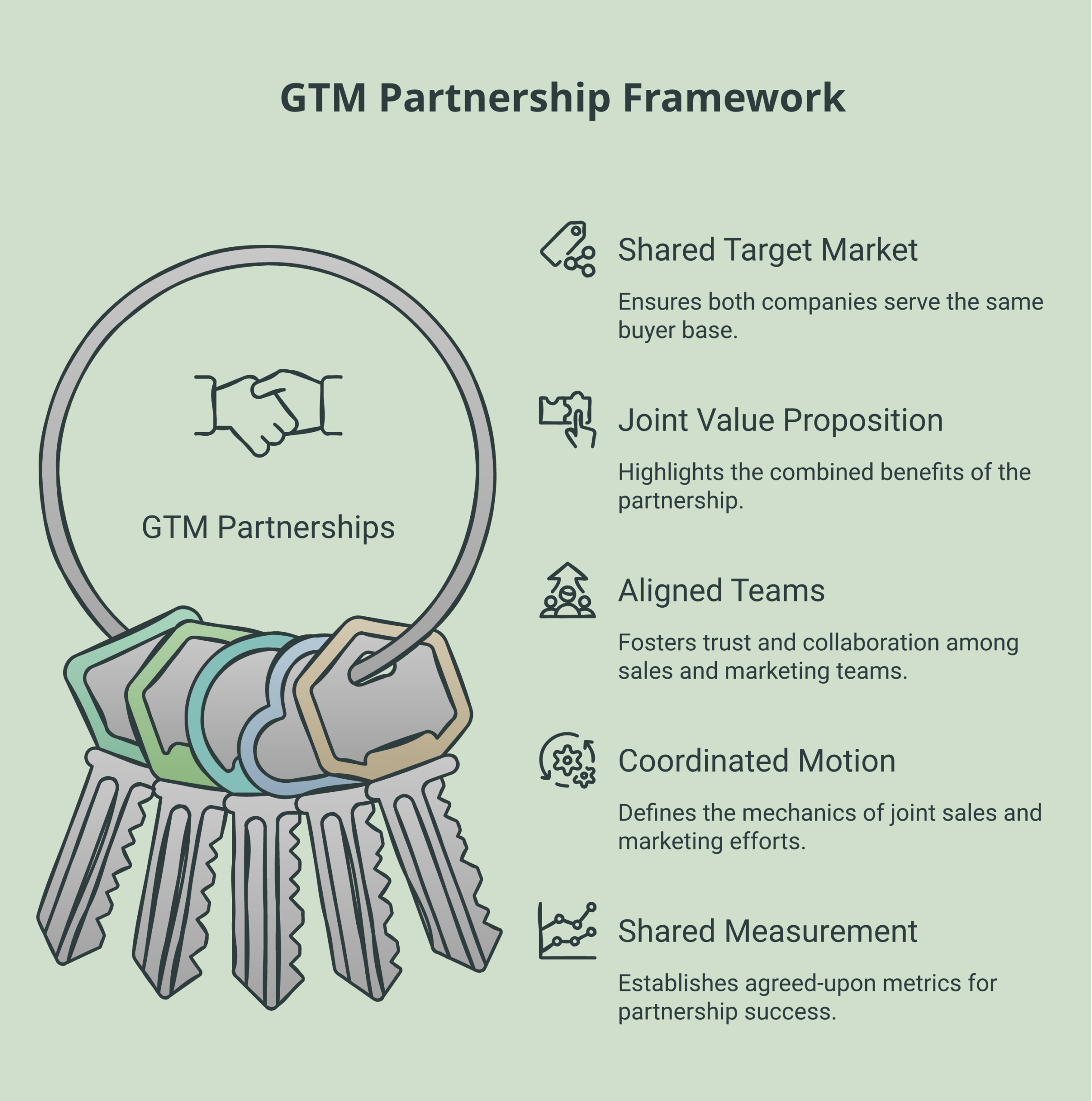
- Shared target market: The partnership only works where both companies serve, or want to serve, the same buyers. Aligning on the specific segment and accounts where you overlap is the foundation, and partnerships that skip it produce activity in markets only one side cares about.
- Joint value proposition: A reason the two offerings are better together, expressed in a way a seller can actually say to a buyer. Without a crisp joint story, the partnership is two products in the same room rather than a combined offer.
- Aligned teams: The sales, marketing, and partnership people on both sides have to know each other, trust each other, and have reasons to work together. GTM partnerships fail at the rep level far more than at the executive level, because the deals happen between front-line people.
- A coordinated motion: The actual mechanics of working together, joint campaigns, account mapping, co-selling, shared events, defined so both sides know how a deal moves. A motion that is improvised every time never becomes efficient.
- Shared measurement: A way to see the pipeline and revenue the partnership produces, agreed by both sides. Without it, neither company can tell whether the partnership is working, and support for it erodes the moment budgets tighten.
Common pitfalls in GTM partnerships
- Executive handshake, no field execution: The most common failure. Two leaders announce a partnership, and nothing happens, because the reps were never aligned and given a reason to work together. The deals live at the field level, and that is where the partnership has to be built.
- No shared target: When the two companies have not agreed on the specific market and accounts where they overlap, effort scatters into segments only one side cares about. A vague shared market produces vague results.
- A weak joint value proposition: If sellers cannot say in a sentence why the two products are better together, buyers hear two pitches, not one offer. The joint story has to be sharp enough for a rep to use unprompted.
- No measurement: A GTM partnership that no one can quantify becomes the first thing cut when budgets tighten, regardless of whether it was working. Shared measurement is what lets a partnership defend its own existence.
- Treating it as a series of favors: Running each joint deal as a one-off favor rather than a repeatable motion means the partnership never compounds. The learning and references that make later deals easier only accumulate if the motion is deliberate.
What this looks like in practice
Two companies with complementary products announced a GTM partnership at the leadership level, complete with a press release and a joint webinar. Six months later there was almost no pipeline to show for it. The executives were aligned and enthusiastic, but the field teams had never met, there was no agreed target segment, and the reps on both sides had no idea how the other company’s product fit a deal or why they should bring it up. The partnership existed on paper and nowhere else.
The teams rebuilt it from the field up. They agreed on a specific segment where both served the same buyers, wrote a joint value proposition a rep could say in one breath, mapped overlapping accounts together, and paired sales people from both sides on the first set of opportunities. They put a shared pipeline view in place so both companies could see what the partnership was producing. The deals started moving once the reps had a reason and a way to work together, and because the motion was now repeatable, each deal made the next one easier. The partnership that had been a handshake became a motion that compounded.
Forecastable’s POV on GTM partnerships
Our position is that GTM partnerships are won or lost at the field level, and the executive handshake is the least important part. Leaders aligning is necessary, but it is the easy part, and far too many partnerships stop there. The deals happen between reps who need to know each other, trust each other, and have a clear reason and a clear way to work together. A partnership that is not built at the field level is a press release, not a motion.
We also believe the joint value proposition does more work than any other single element. If a seller cannot say in one sentence why the two products are better together, the buyer experiences two separate pitches and the partnership adds nothing. Getting that story sharp, and getting it into the reps’ hands in a form they will actually use, is what turns two companies in the same room into one combined offer. It is unglamorous work and it is the work that matters.
Finally, a GTM partnership that cannot be measured cannot be defended or improved. Both sides need a shared view of the pipeline and revenue the partnership produces, because that visibility is what justifies continued investment and what reveals where the motion is breaking. Connecting partner activity and joint deals back to CRM pipeline turns a GTM partnership from an act of faith into a motion you can see, manage, and prove, which is the difference between one that survives the next budget cycle and one that does not.
Forecastable is a partnerships operating platform. Any third-party tools or methods named here are independent third-party products, and naming them is not an endorsement. Decide how GTM partnerships should fit your own market, teams, and offer.
Frequently asked questions
What are GTM partnerships?
They are alliances where two companies align their go-to-market efforts, marketing, selling, and sometimes product, to reach a shared market together. They coordinate how both companies find, win, and grow customers rather than acting separately.
What does GTM stand for?
Go-to-market, the full motion of how a company brings an offering to buyers. A GTM partnership is two of those motions deliberately overlapped to reach a shared market.
How are GTM partnerships different from referral partnerships?
A referral partnership passes leads. A GTM partnership coordinates the whole motion, target market, joint offer, aligned teams, and shared measurement, so the two companies sell together rather than just handing each other names.
Why do GTM partnerships fail?
Most often because they stop at the executive handshake and never reach the field, where the deals actually happen. Other common causes are no shared target market, a weak joint value proposition, and no measurement.
How do you measure a GTM partnership?
Through a shared view of the pipeline and revenue it produces, agreed by both companies. Connecting joint deals to CRM pipeline lets both sides see whether the partnership is working and defend continued investment in it.
What makes a GTM partnership compound?
Running it as a repeatable motion rather than a series of one-off favors. When the target, the joint story, and the way deals move are deliberate, references and learning accumulate and each deal makes the next one easier.
Next step
If a GTM partnership of yours looks good at the leadership level but produces little pipeline, the gap is almost always field execution and measurement. Forecastable helps partnerships teams build joint motions at the rep level and connect them to CRM pipeline, so GTM partnerships produce visible, forecastable revenue rather than press releases. Start your growth journey now to run GTM partnerships as a real motion. The partner program hub frames the wider program, and the co-sell hub covers the joint selling motion in depth.
Uncover Your Growth Potential
Schedule a Discovery Call