Ecosystem Partnerships: What They Are, How They Work

Ecosystem partnerships are the network of technology, services, and channel partners whose combined presence at the same customer accounts produces co-sell, co-build, and customer-expansion opportunities. The operating model is different from one-to-one channel partnerships, ecosystem partnerships compound through overlap, integration density, and shared customer success rather than through bilateral commercial agreements. Run them well and they become the most defensible pipeline source a company has.
Most companies have a list of partners. Few have an ecosystem. The difference is the operating model, a list is a static rolodex; an ecosystem is a working set of overlapping relationships that produce joint pipeline, joint product, and joint customer outcomes. This post explains what ecosystem partnerships actually are in 2026, how they differ from traditional channel and tech partnerships, the operating cadence that makes them work, and the failure modes that explain why most ecosystem-partnership programs underperform.
For the broader pillar, see ELG and nearbound. For the operating motion that converts ecosystem partnerships into revenue, see co-sell. For the data layer, see account mapping.
What are ecosystem partnerships?
Ecosystem partnerships are the working set of technology, services, and channel partners that share customer accounts with you and produce joint pipeline, joint product, or joint customer success through that overlap. Unlike traditional channel partnerships, which run on bilateral commercial agreements, ecosystem partnerships compound through network density, the more partners share customers with you, the more joint plays become available.
Three types of partners typically populate an ecosystem:
- Technology partners are software vendors whose products integrate with or sit alongside yours at the same customer. The joint motion centers on integration depth, joint product roadmap, and co-sell into shared accounts. Examples: HubSpot’s integration ecosystem, Salesforce’s ISV ecosystem, the Snowflake data ecosystem.
- Services partners are consultancies, agencies, and SI firms that implement, customize, or operate your product on behalf of customers. The joint motion centers on implementation quality, customer expansion, and renewal protection. Examples: HubSpot agency partners, Salesforce SIs, the broader RevOps consulting ecosystem.
- Channel partners are resellers, MSPs, and distributors that sell your product alongside theirs. The joint motion centers on transactional volume and channel-led pipeline. In ecosystem partnerships, channel sits inside the broader network rather than as the sole partner channel.
What makes the partnership “ecosystem” rather than just “channel” is the overlap pattern. In a traditional channel motion, each partner is sold to and managed bilaterally; in an ecosystem motion, partners are managed as a network where overlap density at named accounts is the operating signal. The data layer that exposes the overlap pattern (account mapping platforms like Crossbeam or PartnerTap) is what makes ecosystem partnerships operationally distinct from one-to-one channel.
How ecosystem partnerships differ from traditional partnerships
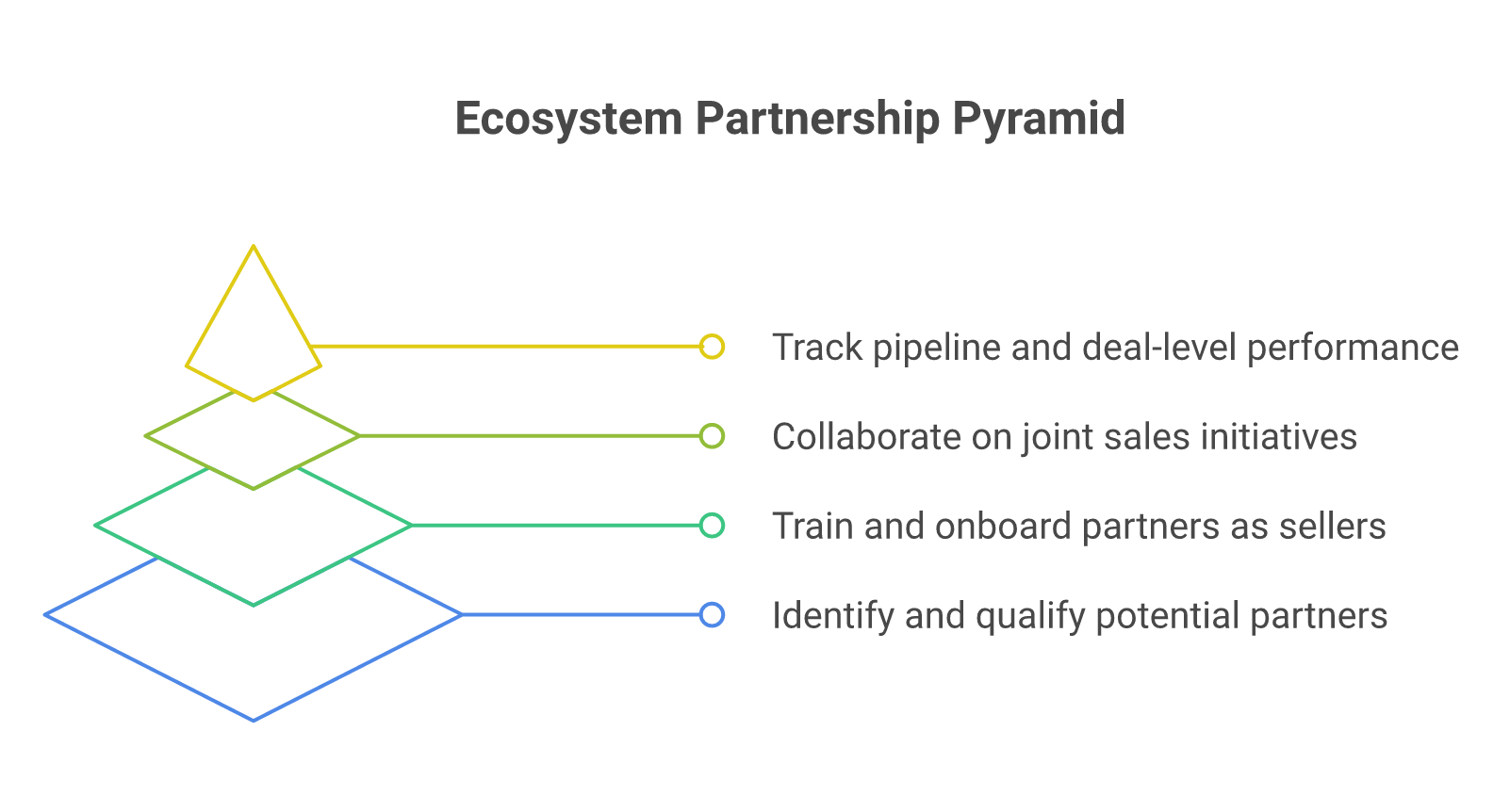
Traditional partnerships run bilaterally, your relationship with one partner is independent of your relationship with another. Ecosystem partnerships run as a network, the value comes from overlap density across the partner set, not from any single partnership in isolation. The implication is that the operating model has to optimize for network outcomes, not for bilateral outcomes.
The four operating differences:
- Unit of analysis. Traditional: the partner. Ecosystem: the named account where multiple partners overlap. Joint plans are made at the account level, with multiple partners in scope, not at the partner level with one logo at a time.
- Data layer. Traditional: bilateral exchanges of customer/prospect lists. Ecosystem: shared account-mapping platform with continuous overlap data across the partner set. The platform layer is what makes the operating model network-shaped rather than bilateral.
- Operating cadence. Traditional: per-partner business reviews. Ecosystem: account-level pipeline reviews with the partners co-present at the account, plus per-partner reviews on the relationship. The named-account-level cadence is what compounds; the per-partner cadence is the supporting layer.
- Pipeline measurement. Traditional: partner-sourced and partner-influenced revenue per partner. Ecosystem: ecosystem-influenced revenue across the network, plus per-partner attribution as a secondary view. The headline number is the network number.
The companies that compound treat the partner ecosystem as a system of overlapping relationships, not a collection of bilateral relationships. The companies that don’t compound usually have the right partner list but the wrong operating model, they manage 30 partners bilaterally and never produce the network effects that make the ecosystem worth the cost. (See the broader partnerships overview for the role context.)
The four operating layers of ecosystem partnerships
Repeatable ecosystem partnerships run on four layers: the data layer (account mapping), the relationship layer (per-partner management), the deal layer (co-sell on named accounts), and the program layer (governance, attribution, and exec sponsorship). Skip any layer and the ecosystem reverts to a partner list.
The four layers, in order:
- Data layer (account mapping). The shared overlap data between your customer/prospect base and each partner’s. Without it, the ecosystem operates blind. Crossbeam, and equivalent platforms produce the layer at scale; manual exchanges work below 10 partners and break above. (See account mapping software.)
- Relationship layer (per-partner management). The ongoing per-partner relationship, partner managers, partner-side enablement, partner-side QBRs, partner satisfaction. The relationship layer is necessary but not sufficient; without the deal layer above it, relationships do not produce revenue.
- Deal layer (named-account co-sell). The joint motion on specific named accounts where multiple partners are co-present. This is where ecosystem revenue is actually produced. The deal layer runs on the four-stage co-sell cadence: account mapping, joint planning, named-deal execution, and pipeline review. (See co-sell.)
- Program layer (governance, attribution, exec sponsorship). The cross-functional governance that holds the motion together, attribution model, comp alignment with sales, executive sponsorship at the CRO and CEO level, partner-influenced revenue reporting in the standard board pack. Without the program layer, the motion gets defunded the first time the quarterly forecast misses.
The error most companies make is to over-invest in the relationship layer (partner managers, partner enablement, partner events) and under-invest in the deal layer (named-account co-sell, joint pipeline reviews) and the program layer (attribution, comp). The relationship layer is the most visible, it produces partner satisfaction surveys and event photos, but it does not produce revenue without the deal and program layers underneath it.
Common pitfalls in ecosystem partnerships
Five recurring failure modes account for most ecosystem-partnership underperformance. They are mostly fixable inside one planning cycle if the executive team is willing to recut the operating model.
The recurring patterns:
- Partner list, not partner ecosystem. Companies sign 30 partner agreements, generate 30 partner pages on the website, and then run none of them deeply. The ecosystem is the working set of partners producing joint pipeline this quarter, typically 5 to 10 partners, not the rolodex. Cut the rolodex; deepen the working set.
- Bilateral operating model on a network problem. Per-partner QBRs and per-partner business plans are necessary but insufficient. The named-account-level joint pipeline review is where the network effects are realized. Add it explicitly to the operating cadence.
- No attribution model. Sales reps stop sending overlap data to the partner once they realize their comp doesn’t recognize partner-influenced deals. Lock the attribution model and the comp alignment before launching the ecosystem motion. (See partner attribution.)
- Ecosystem owned solely by partnerships. When sales, marketing, and customer success do not run partner-aware processes, the partnerships team becomes the only group operating the ecosystem and the network effects never materialize. The CRO has to own the revenue number and the operating discipline has to extend across the GTM team.
- Tooling before motion. Buying Crossbeam, a PRM, and a co-sell workflow tool before the operating cadence is proven is the most expensive ecosystem mistake. Run the motion manually for a quarter to prove the cadence, then buy the platform that fits the proven workflow. (See partner ecosystem platforms.)
Where ecosystem partnerships are heading in 2026
Three shifts are visible in the ecosystem partnerships category in 2026: AI-driven co-sell recommendation, marketplace-first ecosystem motions, and cross-vendor data sharing at higher fidelity. None of these change the operating fundamentals, the core motion is still account mapping, joint planning, named-deal execution, and pipeline review, but they change the speed at which a well-run ecosystem can compound.
The three shifts:
- AI-driven co-sell recommendation. Account mapping platforms are starting to recommend the highest-probability joint plays from overlap data, not just expose the data. The promise is faster joint-plan creation; the risk is recommendation theater that surfaces obvious plays the partner reps already know about. Expect real value at the next-account-suggestion layer rather than at the joint-plan-creation layer for the next 18 months.
- Marketplace-first ecosystem motions. Hyperscaler marketplaces (AWS, Azure, GCP, Salesforce AppExchange) are becoming a primary distribution channel for ecosystem-driven revenue. Companies running ELG in 2026 typically have a marketplace co-sell motion alongside direct co-sell, and the operating cadence has to include marketplace-tied pipeline reviews.
- Higher-fidelity cross-vendor data. The next generation of account mapping platforms is exposing more than just overlap booleans, opportunity stage, deal owner, last activity. The fidelity gain reduces the manual reconciliation work the partner-ops team has historically absorbed and shortens time-to-joint-deal materially.
Forecastable’s POV
Most companies treat the ecosystem like a list. The companies that compound treat it like a system. The system has four layers, runs on overlap data, produces revenue at the named-account level, and is governed by the CRO and the Head of Partnerships together. Build that system and the ecosystem becomes the most defensible pipeline source the company has. Skip any layer and the ecosystem reverts to slide-deck theater.
The pattern that compounds is depth before breadth. Five partners running cleanly in a network model produce more revenue than 30 partners running bilaterally. Most growth-stage SaaS companies have too many partners and too little operating cadence; the highest-leverage move in 2026 is usually to cut the partner list, deepen the working set, and add the named-account-level pipeline review to the operating calendar.
The Forecastable view: stop treating ecosystem partnerships as a function. Treat them as a GTM motion. Run the four-layer operating model. Hold the CRO accountable for the partner-influenced revenue number. Defund the partner list outside the working set. Companies that do this build durable ecosystems that compound for years; companies that don’t keep relaunching the partnership program every 18 months and wonder why the partner motion never stabilizes.
Frequently asked questions
What is the difference between ecosystem partnerships and channel partnerships? Channel partnerships are bilateral commercial agreements, typically with resellers or distributors. Ecosystem partnerships are network-shaped, the value comes from overlap density across technology, services, and channel partners co-present at the same customer accounts. Channel sits inside the broader ecosystem in 2026.
How many partners should an ecosystem have? Working set of 5 to 10 partners running the deal-layer cadence cleanly. The broader ecosystem can include 30 to 100 partners, but most of that breadth runs on the relationship layer only. Trying to run named-account co-sell with all of them produces neither relationships nor revenue.
Who owns ecosystem partnerships? The CRO and the Head of Partnerships co-own. The CRO owns the revenue number; the Head of Partnerships owns the operating cadence. CMO and Customer Success own supporting layers (co-marketing, joint customer success). Without CRO ownership, the motion never gets the comp and reporting alignment it needs to produce revenue.
How is ecosystem partnership success measured? Three metrics: ecosystem-influenced revenue (network-level), per-partner sourced and influenced revenue (partner-level), and ecosystem health (active partner count, joint deal velocity, partner-side satisfaction). The headline number is the network number; the partner-level numbers are the supporting view.
Can a company run ELG without ecosystem partnerships? No. ELG is the GTM thesis; ecosystem partnerships are the operating model that delivers ELG. A company with ELG ambition but no ecosystem operating model usually has a partnerships function that produces partner-sourced pipeline at small scale, not an ELG motion that compounds.
What’s the first step toward building an ecosystem partnership program? Pick one named partner, set up the data layer (account mapping), and run the four-stage co-sell cadence on 8 to 15 named accounts for a quarter. The pilot is the cheapest way to learn whether the operating cadence will hold inside your company. Add partners only after the cadence proves itself.
Next step
Audit the partner list against the working-set test: for each partner, can you name 8 to 15 specific accounts you are pursuing jointly this quarter? The partners who pass are your real ecosystem. The partners who fail are your rolodex. Cut the rolodex; deepen the working set; add the named-account pipeline review to the calendar.
Read co-sell for the operating motion, account mapping for the data layer, and partner ecosystem platforms for the tooling.
By Alex Buckles
Uncover Your Growth Potential
Schedule a Discovery Call