Skip to content
  • Home
  • Who We Serve
    • By Category
      • SaaS
      • Professional Services
      • Platforms (Large Ecosystems)
      • Private Equity
    • By Role
      • Chief Revenue Officers (CRO)
      • Chief Financial Officers (CFO)
      • Chief Marketing Officers (CMO)
      • Chief Executive Officers (CEO)
      • Sales Leaders
      • Partnership Professionals
  • Solutions
    • By Partner Program Maturity
      • Partnerships Foundation
      • Partnerships Acceleration
      • Ecosystem-Wide Orchestration
    • Specialized Solutions
      • Net-New Named Account Development
      • Large Ecosystems
      • M&A: Post-Acquisition Internal Cross-Selling
  • Pricing
  • Education
  • Company
    • Our History
    • Security
  • Home
  • Who We Serve
    • By Category
      • SaaS
      • Professional Services
      • Platforms (Large Ecosystems)
      • Private Equity
    • By Role
      • Chief Revenue Officers (CRO)
      • Chief Financial Officers (CFO)
      • Chief Marketing Officers (CMO)
      • Chief Executive Officers (CEO)
      • Sales Leaders
      • Partnership Professionals
  • Solutions
    • By Partner Program Maturity
      • Partnerships Foundation
      • Partnerships Acceleration
      • Ecosystem-Wide Orchestration
    • Specialized Solutions
      • Net-New Named Account Development
      • Large Ecosystems
      • M&A: Post-Acquisition Internal Cross-Selling
  • Pricing
  • Education
  • Company
    • Our History
    • Security
  • Home
  • Who We Serve
    • By Category
      • SaaS
      • Professional Services
      • Platforms (Large Ecosystems)
      • Private Equity
    • By Role
      • Chief Revenue Officers (CRO)
      • Chief Financial Officers (CFO)
      • Chief Marketing Officers (CMO)
      • Chief Executive Officers (CEO)
      • Sales Leaders
      • Partnership Professionals
  • Solutions
    • By Partner Program Maturity
      • Partnerships Foundation
      • Partnerships Acceleration
      • Ecosystem-Wide Orchestration
    • Specialized Solutions
      • Net-New Named Account Development
      • Large Ecosystems
      • M&A: Post-Acquisition Internal Cross-Selling
  • Pricing
  • Education
  • Company
    • Our History
    • Security
Back to all blogs
  • Sales Management
  • Sales Reps
Frontline Sales Managers
Alex Buckles

The Differences Between Decision *Process and Paper Process in B2B Sales*

Person wearing black shoes stands at a fork in the road, arrows pointing left and right ahead of them.”

Many sales organizations leverage the MEDDPIC sales qualification methodology. For those that don’t, it’s:

Metrics

Economic Buyer

Decision Criteria

Decision Process

Paper Process

Identify Pain

Champion

The two areas we’re focusing on are Decision Process & Paper Process.


Decision Process:

Before walking through all of the contracting paperwork, someone within the buying organization must first decide whether or not to purchase your product or service. If it’s a competitive situation, they not only have to decide to buy something to solve their challenges, but then have to decide on which solution is the best solution for them (deciding on whether or not to buy from YOU).

First Point of Decision Process Qualification – Category Purchase: As the seller, ask yourself the question, “Has the buyer already decided they are absolutely going to purchase something in this category to solve the problem(s) they’re looking to solve?” Most of the time, this is a yes, unless they just happened to have stumbled across your offering and made an impulsive and premature decision to reach out, when there’s no formal initiative or documented pain they need to solve. If the latter is the case, you’ve got some more qualifying to do for sure and you can bet the cycle will likely be much longer.

Second Point of Process Qualification – Vendor Selection Process: Once you’ve validated they’re going to make a purchase in your category, it’s time for the real work to begin around systematically identifying what you need to do to get them to make a decision in your favor. That all begins by poking & prodding around a few key questions:

Direct asks:

  • Who will be the ultimate and final decision maker for this purchase?
  • As you go through this evaluation with us, I’d imagine your decision maker is going to rely on various team members for their input and opinions. Which folks do you think he/she will rely on?


Questions you should be asking yourself?

Who else or what roles would a purchase like this impact? Don’t solely rely on who they name as being involved. If there are other stakeholders that “should” be involved, and it’ll help make your case, it’s good to find out who those people are and get them involved in some capacity.

What level of authority or influence does each stakeholder have? Samples: 

  • Economic Buyer
  • Influencer
  • Coach
  • Champion
  • Business/Functional Evaluator
  • Technical Evaluator
  • Decision Maker

What should I be aware of socially or politically within the organization?

  • Who’s friendly with whom?
  • Where are people not so friendly with each other?
  • Look for little, but important, nuances like if you find out that a low-level functional evaluator was hired on the recommendation of the decision maker, then that person’s opinion may have more influence than others’ feedback, given their history. Details matter.

Determining Preference, by Stakeholder:

  • Once you know who’s who in the zoo, it’s time to get much more granular to either convert each stakeholder to a supporter of your solution or somehow neutralize those you’re unable to convert.


At the end of this effort, in general, if you have the right stakeholders or the right number of stakeholders as supporters, you’ll likely be selected as the vendor of choice. Let’s just hope you weren’t forecasting that close date for tomorrow though because now that you’re the vendor of choice, it’s time to go through the contracting or paperwork process.

FYI – It’s More Complex in Co-Sell Motions

Learn More

Paper Process:

The paper process is the contracting process each buyer must follow in order to approve/accept and contract with a vendor, once they’ve made the decision to purchase. This process could include information security reviews, audits, insurance requirements, contract redlining, committee approvals for spend above a certain dollar amount, etc. — There are so many items that could be involved, which is why the paper process can be as quick as just a few days or as long as six months. 

If you’ve achieved vendor of choice and have yet to ask them questions about their paper process, you’re likely in for a slipped deal, which is defined as a deal that will close beyond the close date you’ve committed. It’s not the end of the world, but if that was a key deal for you or your team in forecast, it will make a lot of people unhappy.

To avoid timing surprises at the end of your cycle, it’s important to understand their paper process as early as possible. It’s likely something you’ll figure out over time as you get opportunities to ask questions.

The most basic question to start all of this is, “Have you made a purchase of this size before?” 

  • If you’re dealing with a decision maker that has not, then you want to put that bug in their head early → “Assuming all the stars align and we’re chosen as your vendor, what would the contracting process look like? I’m sure all of the vendors you’re evaluating will want this so they can estimate a project kick-off date for your team.”
  • If they have made this kind of purchase before, you can casually say something like, “That’s great. Real quickly, since you’ve been through this before, what was the contracting process like once you made the decision to move forward? Some folks have wild processes and some are really simple, so I’m just trying to get a feel for yours.” — Almost everyone will answer this question directly and honestly.
    • After they answer, prod a little bit more with something like, “Okay, so probably about a month-long process?” —  See if they correct you, confidently agree with you, or hesitantly agree with you. 


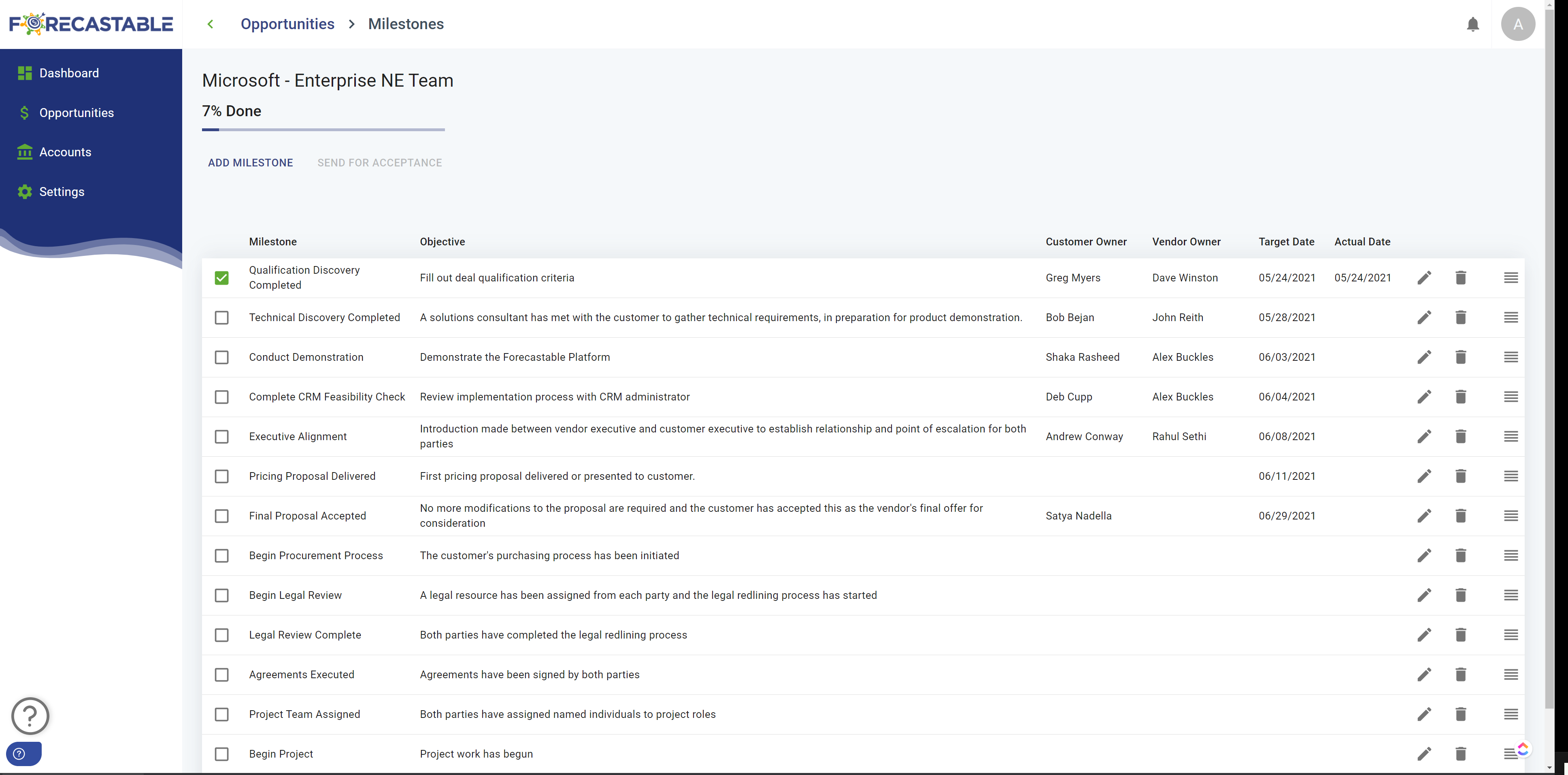
Once you have some semblance of what the process looks like, be sure to document that in the evaluation plan and ensure the close date you’re forecasting seems reasonable and achievable. Continue to pay close attention to your dates because if one of those milestones in your plan is delayed for a meaningful amount of time, you may want to check your close date again. This could be a great opportunity to involve and collaborate with your prospect as well. 

Example Question while showing evaluation plan: “We’re running 2 weeks late on this one milestone, which looks like it’ll put the kickoff date of 8/1 at risk, unless we can make up some time over here in these next milestones. What do you think?” — Make it about them and their kickoff date; not about you and your close date.
FYI – It’s More Complex in Co-Sell Motions

Learn More

Uncover Your Growth Potential

Whether starting with a single sales team or a single partner, any co-sell motion can be live within 30 days.

Schedule a Discovery Call

Latest Insights
A diverse group of coworkers collaborating around a table, reviewing documents and a laptop with smiles and engagement.
  • B2B Partnerships Strategy
  • Partner Co-Selling
  • Sales Management
Co-Sell Frontline Sales Managers
Alex Buckles

*Sales Managers:* Winning Partner-Involved Deals Through Situational Tag Teaming

Knowing how to leverage partners to win deals opens the door to endless opportunities. As a sales manager, fine-tuning the tag-teaming approach – strategically choosing which partners to bring in and why – can significantly impact your sales cycle. Being on the front lines lets you see how wins happen across the organization, build relationships […]

Read Article
Group of diverse professionals in a boardroom, discussing with laptops and documents on the table.
  • B2B Partnerships Strategy
  • Partner Co-Selling
  • Sales Management
Co-Sell Frontline Sales Managers
Alex Buckles

*Tactics* for Turning Fluffy Partner Meetings Into Revenue-Focused Conversations

Fluffy conversations, or as our CEO at Forecastable calls them, “squishy” discussions, lack what’s needed to push the needle forward and drive results in partner relationships. These conversations often hover around general inquiries about progress, with responses like “things are going well.” The partner managers then make broad assumptions about what ‘going well’ means. However, […]

Read Article
Two professionals shake hands over a table with printed charts and a tablet nearby.
  • B2B Partnerships Strategy
  • Partner Co-Selling
  • Sales Management
Co-Sell Frontline Sales Managers Partnerships
Alex Buckles

*Frontline Sales Managers:* How to Know Which Partners Can Help or Hurt Your Team’s Deals

As a frontline sales manager, your team’s success can hinge on your ability to identify partners who can make or break your deals. The best way to gain this insight is through the experiences and observations of your sales reps. They know which partners stand out as valuable assets and which pose barriers to closing […]

Read Article
Four professionals in business attire shake hands and smile in a modern office lobby. 2 men and 2 women present, one holds a tablet.
  • B2B Partnerships Strategy
  • Partner Co-Selling
  • Sales Reps
B2B Sales Rep Co-Sell Partnerships
Alex Buckles

*B2B Sales Reps:* A Guide to Keeping Partners from Wrecking Your Deals

The fear of a partner “screwing up your deal” is a common one for sales reps. While partners can bring expertise, resources, and reach to your efforts, a mistake can quickly unravel all your hard work. This concern is valid. Bringing any new human – partner or not – into a deal adds risk. For […]

Read Article

Quick Links

  • Who We Serve
  • Solutions
  • Resources
  • Pricing
  • Our History

Social Media

  • Linkedin

Legal

  • Privacy Policy
  • Terms of Service
Quick Links
  • Who We Serve
  • Solutions
  • Resources
  • Pricing
  • Our History
Social Media
  • Linkedin
Legal
  • Privacy Policy
  • Terms of Service

Stay ahead on ecosystem-led growth

© 2025 Forecastable. All rights reserved.
Book Your Strategy Call
Request Enrollment Details

[contact-form-7 id=”dfbeed3″ title=”Request Enrollment Details”]

Mollie Bodensteiner

Revops Advisory
  Mollie Bodensteiner is an experienced operations professional with a demonstrated track record of utilizing technology to support operational processes that drive performance and innovation. She currently is the Vice President of Operations at Sound and owns go-to-market agency, MB Solutions. Mollie has previously held operations leadership roles at Deel, Syncari, Corteva and Marketo. She has over 14 years of experience in both B2C and B2B operations and technology. When she is not working, Mollie enjoys spending time with her husband, three small children, and two large dogs. Childhood Career/Dream: Growing up in the age of Disney and Nick@Nite I always wanted to be a child actor (good thing that never was actually pursued 🙂 Favorite Win: I am not sure I have a specific “win” but I think I get the most joy and excitement from coaching others and watching them hit major milestones in their career. The first time you get to promote someone on your team or watch them lead a major project – are always career highlights! Personal Fun Facts: Favorite Song: If it’s love, Train Favorite Movie: Good Will Hunting Favorite Meme: Disaster Girl
Forecastable resources: Co-Sell Orchestration Platform · All Use Cases · Live in 30 Days · Co-Sell Playbook

Kelsey Buckles

Director of Operations


My journey from Education to Operations has equipped me with a unique perspective and skill set that perfectly aligns with Forecastable’s mission to help businesses improve sales collaboration through partner co-selling strategies.

At Forecastable, I am passionate about empowering teams and organizations to unlock the full potential of strategic partnerships. By leveraging my expertise in communication, leadership, and operational efficiency, I contribute to creating seamless co-selling processes that align with business goals and deliver exceptional results.

The intersection of my educational foundation and operational experience fuels my dedication to fostering alignment, building trust, and enhancing collaboration between partners. I am driven by the opportunity to contribute to a platform that not only optimizes sales strategies but also strengthens relationships that lead to long-term growth.

Paul Jonhson

Chief Technology Officer (Co-founder)


Paul Johnson has 20+ years of software development and consulting experience for a variety of organizations, ranging from startups to large-enterprise organization with highly-complex needs.

Mr. Johnson has a long track record of successful technology deployments.
This, combined with his deep passion for machine learning and exceptional user experience design, allows him to lead our technical direction from the front with confidence.

Alex Buckles

Product, Partnerships, and Value Engineering (Co-founder)


After serving in The United States Marine Corps, Alex Buckles spent the next two decades as a student of revenue production and an advocate for innovation.

Along the way, he has helped numerous companies achieve double and triple-digit growth by crafting and executing high-performing go-to-market strategies, with co-selling at the center of each.

As a once-advanced technical marketer, an expert sales & partner professional, and a strong customer success advocate, Mr. Buckles understands the impact of these functions aligning not only on revenue production, but on the day-to-day execution of the go-to-market strategy. This concept of revenue-team alignment is what quickly became the foundation of Forecastable back in January of 2018.

In his free time, you’ll find him spending quality time with his children, one of whom is on the autism spectrum. 1 in 36 children in the U.S. are on the spectrum and boys are four times more likely to be diagnosed than girls.

With that in mind, Mr. Buckles plans on dedicating the rest of his life serving those living with autism, through his organization Pathways for Autism. From his perspective, there must be a scalable and financially self-sustaining infrastructure established to put as many individuals with autism as possible on a path towards complete independence as adults.