Crossbeam Overlap Automation: How It Works

What is Crossbeam overlap automation?
Short answer: Crossbeam overlap automation is the automatic detection of shared accounts and prospects between you and your partners, replacing the manual spreadsheet swaps that account mapping used to require. It connects each side’s CRM data and surfaces the intersections, so overlap is a live signal rather than a quarterly exercise.
The value is not the data itself; it is removing the friction. When overlap has to be assembled by hand, it happens rarely and goes stale fast. When it is automated, it becomes something a seller can act on this week.
Why Crossbeam overlap automation matters in 2026
Crossbeam overlap automation matters because manual account mapping does not scale past a handful of partners. Swapping account lists in spreadsheets is slow, error-prone, and instantly outdated, so by the time a team finishes a mapping exercise the data no longer reflects the pipeline. Automating overlap turns a periodic chore into a continuous signal, which is the only form of overlap a busy seller will actually use.
In 2026, with partner-sourced revenue under real scrutiny, the speed of overlap is part of its value. A warm path into an account is worth the most while the deal is open, and a quarterly mapping exercise misses that window by months. Automated overlap surfaces the intersection while it still matters, which is what lets a seller turn a shared account into a partner introduction in time to affect the deal.
There is also a trust and security dimension. Partners are sharing customer data to find overlap, and they will only do it through a process that controls what each side sees. Automation done well means each partner shares the minimum needed to find intersections, without exposing their full customer list, which is what makes partners willing to participate at all. Manual swaps, by contrast, usually mean oversharing or not sharing, and neither is sustainable.
How Crossbeam overlap automation actually works
Overlap automation runs as a connected pipeline from data sync to actioned intersection. The components below are the parts that have to function for automated overlap to be trustworthy and useful.
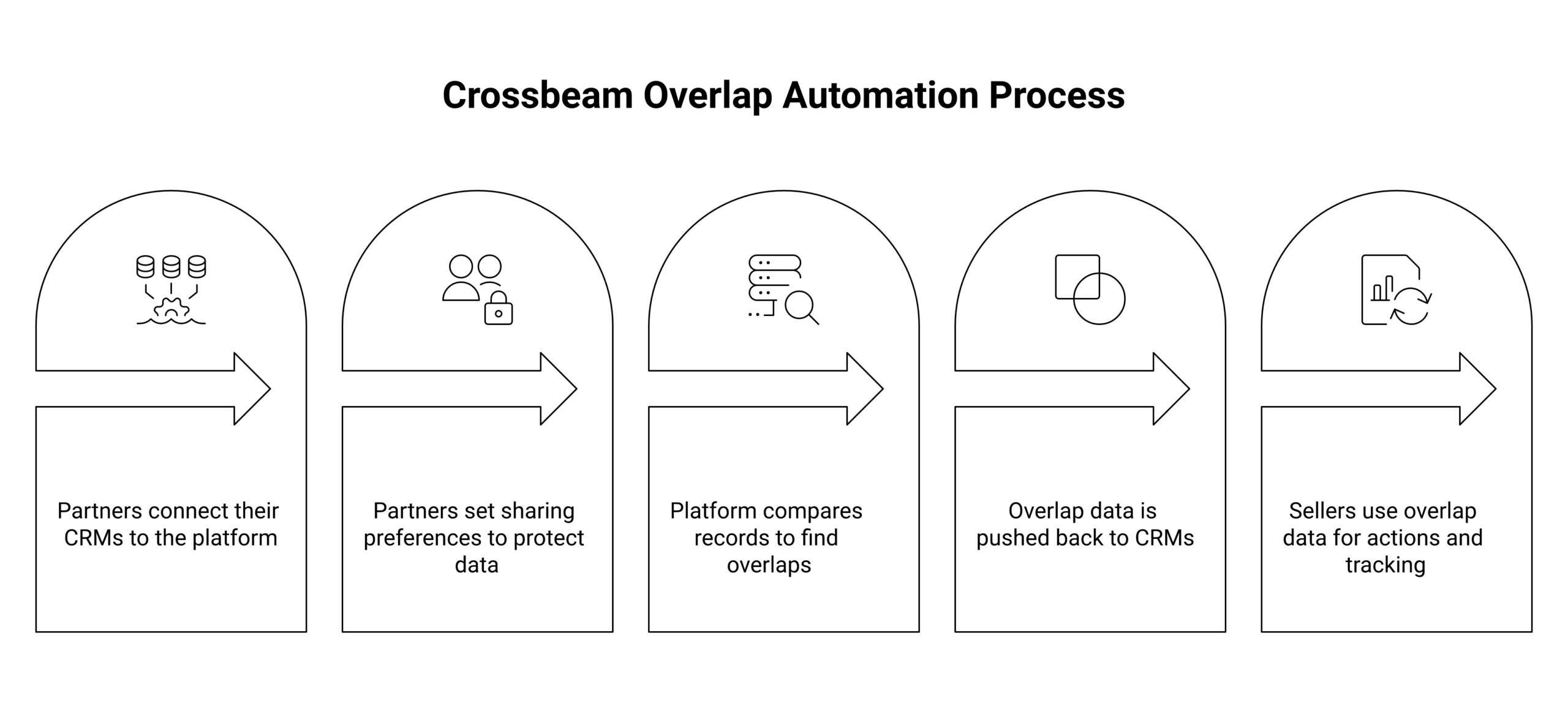
- Data connection: Each partner connects their CRM so the platform can read account and prospect records. Automation starts with a live connection, not a one-time export, which is what keeps overlap current.
- Controlled sharing: Each side sets what is shared and at what level, so overlap can be found without either partner exposing their full customer list. This permissioning is what makes partners comfortable participating.
- Match detection: The platform compares records across partners and surfaces the intersections, such as shared customers, shared prospects, and accounts one partner has that the other is pursuing. This is the core automation that replaces the manual swap.
- CRM surfacing: The matched overlap is pushed back to where sellers work, landing on the account records they actually open. Overlap that stays in a separate dashboard rarely changes a deal.
- Action and tracking: A seller uses an intersection to request a partner introduction or coordinate on an account, and the resulting partner involvement is logged. Automation that stops at detection leaves the value on the table.
Common pitfalls in overlap automation
- Automating detection but not action: Surfacing overlap and stopping there produces a dashboard, not pipeline. The value appears only when an intersection becomes a partner introduction a seller acts on.
- Overlap that never reaches the seller: If matched accounts live in a partner tool the AE never opens, the automation might as well not run. Overlap has to land on the records sellers actually use.
- Weak sharing controls: Partners will not connect if they fear exposing their full customer list. Sharing controls that are too blunt suppress participation and starve the overlap of data.
- Stale connections: An automation built on a one-time import drifts out of date as pipelines change. Live CRM connections are what keep overlap current enough to act on.
- No logging of the resulting action: When a seller acts on an overlap and forgets to record the partner’s role, attribution disappears and the program cannot prove the value the automation created.
Tools and examples
Overlap automation is offered both by dedicated ecosystem-data platforms and by partner relationship platforms that include native overlap. The table maps the main options to the job each is best suited to.
| Tool | What it is | Best for |
|---|---|---|
| Crossbeam | Partner ecosystem and account-overlap platform | Teams wanting a large partner network for overlap detection |
| Pocus | Signal and ecosystem data platform | Teams combining partner overlap with product and prospect signals |
| Common Room | Ecosystem and community signal platform | Teams centered on community and engagement data alongside overlap |
| Introw | Partner relationship platform with native overlap | Teams wanting overlap connected to registration and co-sell |
| Euler | Partner relationship platform with native overlap | Teams wanting account mapping inside a fuller partner workflow |
A team ran account mapping by exchanging spreadsheets with their top partners once a quarter. The data was stale before it was useful, and most overlaps surfaced after the relevant deals had already closed. They moved to automated overlap, connecting CRMs with controlled sharing, and pushed matched accounts back into the seller’s CRM view, whether the overlap engine was Crossbeam, Pocus, or a partner platform with native overlap such as Introw or Euler. Sellers began requesting partner introductions on shared accounts while deals were still open, and because each resulting partner action was logged, the program could finally show the pipeline its overlap created.
Forecastable’s POV on Crossbeam overlap automation
Our position is that overlap automation is only as valuable as the action it triggers. Most teams treat detection as the finish line, so they buy a tool, connect their data, admire the matched accounts, and never turn a single intersection into a partner introduction. The automation worth paying for is the kind that ends in a seller acting on a shared account, not the kind that ends in a dashboard.
We also think the surfacing step is where most value leaks. Overlap that lives in a partner-team tool the AE never opens is invisible to the person who could use it, so the intersection sits unused while the rep works the account blind. Whatever platform detects your overlap, the test is whether the matched account shows up where the seller already works. If it does not, the automation is running for an audience of one.
Finally, log the action or lose the proof. Every time a seller acts on an overlap and the partner’s role goes unrecorded, the program loses the evidence that the automation paid off. Connect the resulting partner involvement to CRM, and overlap automation stops being a cost you justify on faith and becomes a source of attributable, forecastable pipeline.
Forecastable is a partnerships operating platform. Any third-party tools named here are independent third-party products, and naming them is not an endorsement of one over another. Decide how overlap automation should fit your own partners, stack, and motion.
Frequently asked questions
What is Crossbeam overlap automation?
It is the automatic detection of shared accounts and prospects between you and your partners, replacing manual spreadsheet swaps. Connected CRM data surfaces the intersections continuously, so overlap is a live signal rather than a quarterly exercise.
How does overlap automation work?
Each partner connects their CRM with controlled sharing, the platform detects matching accounts, and the overlap is pushed back into the seller’s CRM view so it can be acted on. Done well, it ends in a partner introduction, not just a match.
Why automate account mapping instead of doing it manually?
Manual list swaps are slow, error-prone, and stale by the time they are finished. Automation keeps overlap current enough that a seller can turn a shared account into a partner introduction while the deal is still open.
Is overlap automation secure for partner data?
It can be, when sharing controls let each side expose only the minimum needed to find intersections rather than their full customer list. Strong permissioning is what makes partners willing to participate.
What tools offer overlap automation?
Dedicated ecosystem platforms such as Crossbeam, Pocus, and Common Room, and partner relationship platforms with native overlap such as Introw and Euler. The choice depends on whether you want overlap standalone or inside a fuller partner workflow.
How do you measure the value of overlap automation?
Track how many intersections become partner introductions and log the resulting partner involvement in CRM. The pipeline created from acted-on overlap is the measure, not the count of matched accounts.
Next step
If your account mapping is a quarterly spreadsheet exercise, the overlaps you find are stale before a seller can use them. Forecastable helps partnerships teams turn overlap into acted-on partner introductions and connect the resulting involvement to CRM pipeline. Start your growth journey now to make overlap a live signal your sellers act on. The PRM and partner tech hub frames how overlap automation fits the wider stack.
Uncover Your Growth Potential
Schedule a Discovery Call