B2B Partner Marketing: What It Is and How to Run

What is B2B partner marketing?
Short answer: B2B partner marketing is marketing done with and through partners to reach buyers a vendor could not reach alone, spanning co-branded campaigns, joint events, referrals, and shared demand generation. It treats partners as a marketing channel, not just a sales one. Done well, it borrows a partner’s trust and audience to put a vendor in front of buyers already inclined to listen.
The discipline covers two motions that often get confused. Marketing to partners is about enabling them to sell you; marketing with partners is about reaching their customers together. B2B partner marketing usually means the second, though a healthy program does both.
Why B2B partner marketing matters in 2026
B2B partner marketing matters because buyers increasingly start from a trusted recommendation rather than a vendor’s own ad, and a partner is often the source of that trust. When a prospect asks their agency, their existing platform, or a peer what to use, a vendor with strong partner marketing is in that conversation and a vendor without it is invisible. That shift makes the partner channel a demand source, not just a fulfillment path.
In 2026, with acquisition costs high and attention scarce, borrowing a partner’s audience is one of the more efficient ways to generate pipeline. A co-branded webinar to a partner’s list reaches qualified buyers at a fraction of the cost of building that audience from scratch. That efficiency is why partner marketing budgets hold even as broad-reach spend gets scrutinized.
The other driver is proof. Marketing leaders are asked which channels actually source pipeline, and partner marketing has historically been the fuzziest to measure. The programs that survive are the ones that made partner-influenced pipeline a real number rather than a feel-good story.
How B2B partner marketing actually works
B2B partner marketing works by combining two audiences and two brands into campaigns neither party could run alone, then tracking what they produce. The components below are what a working practice includes.
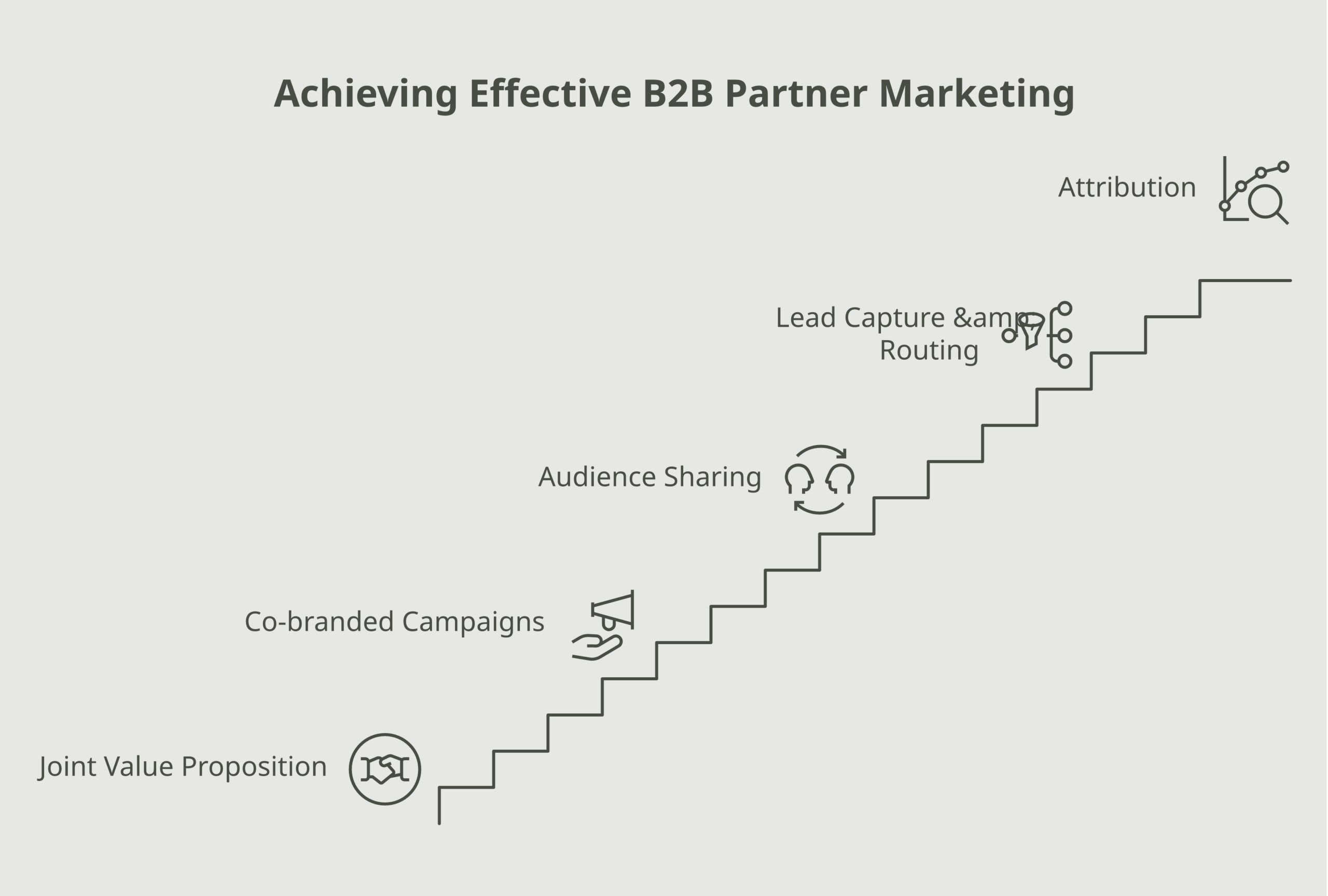
- Joint value proposition: A clear reason the two products are better together, because a co-branded campaign with no shared story is just two logos on a slide.
- Co-branded campaigns: Webinars, content, and events built and promoted by both sides, so each brings its audience and its credibility to the same offer.
- Audience sharing: The deliberate exchange of reach, where each partner markets to its own list on behalf of the pair, which is where the efficiency actually comes from.
- Lead capture and routing: The plumbing that collects who responded and routes them to the right team, so joint marketing produces trackable pipeline rather than a vague glow.
- Attribution: Connecting partner-influenced responses to CRM pipeline and revenue, so the program’s contribution is a defensible number and keeps its budget.
Common pitfalls in B2B partner marketing
- Two logos, no story: Running a co-branded campaign without a real joint value proposition produces polite attendance and no pipeline. The shared reason to buy is the whole point.
- One-sided audience sharing: A campaign where only one partner actually promotes to its list is a favor, not a partnership, and it will not be repeated. The reach has to be mutual.
- No lead routing: Generating interest with no agreement on who follows up and how it is tracked wastes the effort and creates friction between the teams.
- Measuring activity, not pipeline: Reporting webinar registrations instead of influenced pipeline lets partner marketing look busy while proving nothing. Attendance is not attribution.
- Marketing with partners who cannot sell you: Co-marketing to an audience the partner cannot actually serve produces leads that go nowhere. Align the marketing motion with a real joint sales motion.
What this looks like in practice
A worked example: two complementary B2B software vendors had run occasional co-branded webinars that drew polite crowds and produced nothing traceable. They rebuilt the motion around a real joint value proposition, agreed that both would promote each campaign to their own lists, and wired registration and follow-up to a shared routing rule with CRM attribution. Over two quarters the co-marketing produced a measurable slice of influenced pipeline, concentrated in accounts where both products fit. The campaigns were not fancier; they were mutual and measured. The lesson was that B2B partner marketing works when both sides bring audience and the results land in a forecast, not a recap deck.
Forecastable’s POV on B2B partner marketing
Our position is that partner marketing fails most often on mutuality, not creativity. The campaigns that work are the ones where both partners actually spend their audience, and the ones that die are the ones where a vendor builds the whole thing and the partner forwards one email. Before investing in production, confirm the partner is genuinely committed to promoting, because a one-sided campaign is a cost, not a channel.
We also think partner marketing has to graduate from activity reporting to pipeline attribution or it will keep losing budget fights. Registrations and impressions are easy to produce and easy to dismiss; partner-influenced pipeline in the CRM is hard to argue with. The programs that earn recurring investment are the ones that made their contribution a number leadership recognizes in the forecast.
Forecastable is a partnerships operating platform focused on connecting partner conversations and actions to CRM pipeline and revenue. We do not run campaigns, but we make the partner-influenced pipeline those campaigns produce visible and measured, so partner marketing stops being the fuzziest line in the plan. The marketing borrows the audience; we help you prove what the borrowing returned.
Forecastable is a partnerships operating platform and a category authority, not a PRM vendor. Any third-party tools or firms referenced in this space are independent third-party products, and mentioning them is not an endorsement. Evaluate any partner marketing approach against your own partner mix, motion, and CRM.
Frequently asked questions
What is B2B partner marketing?
It is marketing done with and through partners to reach buyers a vendor could not reach alone, spanning co-branded campaigns, joint events, referrals, and shared demand generation.
What is the difference between marketing to partners and marketing with partners?
Marketing to partners enables them to sell you, through training and assets. Marketing with partners reaches their customers together, through co-branded campaigns. B2B partner marketing usually means the second.
How is B2B partner marketing measured?
By partner-influenced and partner-sourced pipeline tied to CRM, not by campaign activity like registrations or impressions, which look busy but prove little.
What makes a co-branded campaign work?
A real joint value proposition and mutual audience sharing, where both partners promote to their own lists. A campaign only one side promotes rarely produces anything.
Does B2B partner marketing require special software?
Not to start. A committed pair can run co-marketing with existing tools. As the number of partner campaigns grows, channel marketing software helps run them at scale and track results.
How does partner marketing connect to partner sales?
The marketing should map to a real joint sales motion. Co-marketing to an audience the partner cannot serve produces leads that stall, so align the marketing with where the two products actually sell together.
Next step
If your partner marketing produces attendance but no pipeline, the issue is usually mutuality and measurement, not creativity. The fix is to confirm both sides will spend their audience and to route what the campaigns produce into the forecast leadership already watches. Forecastable helps partnerships teams connect partner marketing activity to measured CRM pipeline, so the co-marketing you fund is co-marketing you can prove. Start your growth journey now to make partner-influenced pipeline visible. The partner program hub frames how B2B partner marketing fits alongside enablement and attribution.
Uncover Your Growth Potential
Schedule a Discovery Call