MSP Channel Partner: What It Is and How It Works

Short answer
Short answer: An MSP channel partner is a managed service provider that adopts your product and runs it on behalf of its own clients as part of an ongoing service, rather than reselling it and walking away. The relationship is different from a standard reseller because the MSP embeds your product into a recurring service, which means stickier revenue but a higher bar to get adopted in the first place.
Here is the position. MSPs are the most valuable channel partner type to win and the hardest to activate. They will not touch your product unless it makes their service better or their margins healthier, and no amount of program administration changes that.
What is an MSP channel partner?
An MSP channel partner is a managed service provider, a firm that manages IT, software, or infrastructure for clients on an ongoing basis, that has adopted your product as part of what it delivers. Instead of the end customer buying and running your software, the MSP buys it, operates it, and bundles it into the managed service the client already pays for monthly.
This changes the economics for everyone. The MSP folds your product into a recurring service and earns margin plus services revenue over the life of the client relationship. You get revenue that renews as long as the MSP keeps the client, which is often years. The end customer gets your product without having to run it themselves. That is why MSP revenue, once won, is some of the stickiest in any channel.
Define it plainly, because “MSP” gets used loosely. An MSP is distinct from a reseller that transacts a one-time sale and a systems integrator that builds and hands off a solution. The MSP keeps running the solution indefinitely. That ongoing operational role is the defining feature and the reason the MSP motion works differently from every other channel type.
Why an MSP channel partner matters in 2026
An MSP channel partner matters because managed services are how a large and growing share of small and mid-market companies consume technology. Rather than staff their own IT and software operations, these companies outsource to an MSP, which means the MSP, not the end customer, is often the real buyer and decision-maker for products like yours. If MSPs do not adopt you, you are locked out of every account they serve.
The second reason is revenue quality. Because the MSP embeds your product in a recurring service, the revenue renews with the service and does not depend on a fresh sales cycle each year. In a market that prizes net revenue retention, a healthy MSP channel is one of the most durable revenue sources a vendor can build.
The catch is that MSPs are ruthlessly practical about what they adopt. An MSP produces when your product clearly improves its service or its margins and is easy to deploy across its client base, and it ignores you when adopting you adds cost or complexity without a clear payoff. Winning an MSP channel is about proving that payoff, not about tiers and portals.
How an MSP channel partner actually works
An MSP channel partner program runs on a five-part model. Skip any part and MSPs sign up and never deploy.
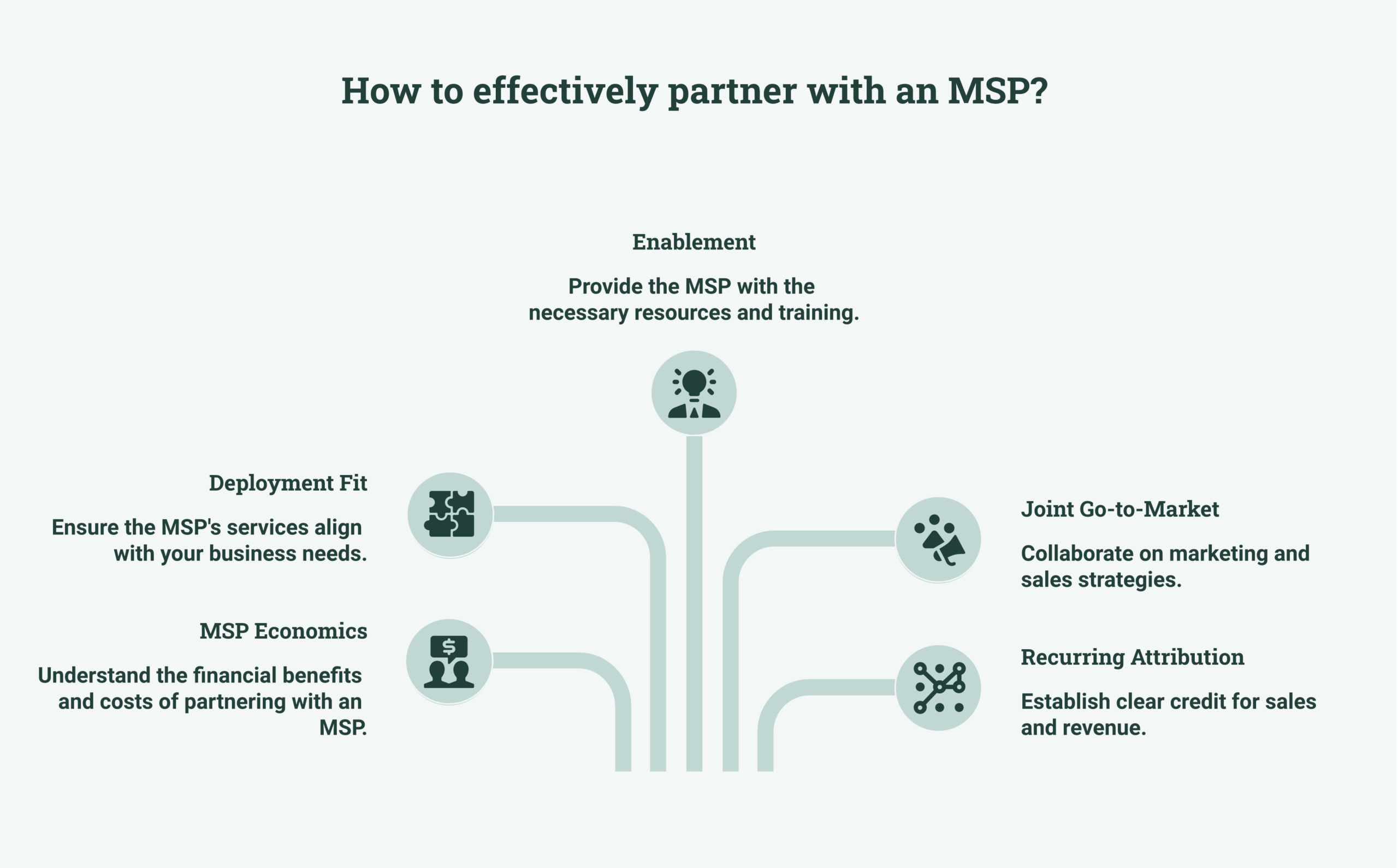
- MSP economics: structure pricing and margin so adopting your product improves the MSP’s service profitability, through recurring margin, multi-tenant pricing, or per-seat economics that fit a managed model. An MSP will not adopt a product that squeezes its margins to serve its clients.
- Deployment fit: make the product easy to deploy and manage across many client tenants at once, because an MSP serving fifty clients cannot hand-configure your product fifty times. Multi-tenancy and central management are often the difference between adoption and rejection.
- Enablement: train the MSP’s technical and account teams so they can deploy, run, and support your product without leaning on you, because an MSP’s whole value is operating things for clients. Enablement that stops at a sales deck fails; MSPs need to run the product.
- Joint go-to-market: help the MSP position and sell your product into its client base, with co-branded material and a clear story for why the client benefits, rather than leaving the MSP to figure out the pitch. The MSP owns the client relationship; you help them use it.
- Recurring attribution: track adoption and recurring revenue by MSP and client, so you can see which MSPs are actually deploying and defend the channel’s contribution. MSP revenue is recurring, so the attribution has to track renewals, not just initial deals.
The through-line is that an MSP channel is an operational adoption motion, not a resale transaction. The program that treats MSPs like resellers, hands them a margin and a portal, and waits for orders, misunderstands the model. MSPs produce when your product becomes part of how they run their clients.
Common pitfalls
- Treating MSPs like resellers: giving an MSP the same margin, portal, and one-time-sale expectations as a reseller, ignoring that the MSP needs to operate your product, not just sell it.
- Ignoring deployment friction: shipping a product that is painful to deploy across many tenants, so MSPs sign the agreement and never roll it out.
- Enablement that stops at sales: training the MSP to pitch but not to deploy and support, so the MSP cannot actually deliver your product as a service.
- Margin that does not work: pricing in a way that hurts the MSP’s service profitability, which guarantees non-adoption no matter how good the product is.
- No recurring attribution: tracking only initial deals and missing renewals, so the channel’s true recurring contribution is invisible and undefendable.
What this looks like in practice
A worked example shows the difference between an MSP roster and an MSP channel. In my work with partnerships teams, the MSP channel that underperforms almost always has the same story: MSPs were recruited like resellers, given a margin and a portal, and expected to sell. Most signed and never deployed, because no one made adopting the product easy or clearly profitable for the way an MSP runs.
The fix starts with the MSP’s business, not the vendor’s program. We identify the few MSPs whose client base fits, work with them to make deployment across their tenants painless, and prove the product improves their service and margins on a first set of clients before scaling. That is deliberate: the program does not drive MSP adoption, a product that fits how the MSP operates and a motion that helps them roll it out does. The first MSPs that actually deploy and renew become the reference that convinces the next set.
The lesson is that an MSP channel partner adopts you into how they run their clients, or they do not adopt you at all. Win the operational fit first, and the recurring revenue follows.
Forecastable’s POV
An MSP channel fails for a boring reason: the vendor runs it like a reseller channel when the MSP motion is an operational adoption problem. Margins and portals get set up, MSPs sign, and then nothing deploys because adopting the product does not obviously make the MSP’s service better or more profitable. Leadership sees a roster of MSP logos and no recurring revenue and cannot explain the gap.
The fix is to treat the MSP channel as an adoption motion: get the economics and deployment right so adopting you helps the MSP’s service, enable the MSP to actually run the product, and help them take it to their clients. Prove operational fit and recurring revenue with a few well-fit MSPs before scaling recruiting. Order of operations matters: a deploying, renewing MSP first, a big MSP roster second.
At Forecastable we operate at that activation layer. We are a partnerships operating platform focused on connecting partner conversations and actions to CRM pipeline and revenue, the flywheel from conversations to actions to pipeline to revenue. Your partner tech can hold the tiers and margins. Our Co-Sell Alignment Specialist is delivered as part of the service and uses the platform to run the motion that gets MSPs deploying and to attribute the recurring revenue they generate.
My bet: the vendors that win the MSP channel make adoption easy and profitable for how MSPs actually operate, and the ones that keep recruiting MSPs like resellers keep wondering why the logos never turned into recurring revenue.
Forecastable is an independent third-party. Any tools, vendors, or third-party figures referenced here are described from public information for the reader’s own evaluation, not as paid placements.
Frequently asked questions
What is an MSP channel partner? An MSP channel partner is a managed service provider that adopts a vendor’s product and runs it on behalf of its own clients as part of an ongoing managed service. Rather than reselling the product once, the MSP embeds it in a recurring service, producing stickier revenue for the vendor.
How is an MSP channel partner different from a reseller? A reseller transacts a one-time sale and carries margin. An MSP operates the product for its clients indefinitely as part of a managed service, so the revenue recurs with the service. The MSP is the operator, not just the seller, which changes the economics, the enablement, and the attribution.
Why are MSP channel partners valuable? Because they embed your product in a recurring service, MSP revenue renews with the client relationship and does not depend on a fresh sale each year. MSPs are also often the real buyer for the small and mid-market clients they serve, so their adoption unlocks accounts a direct team could not reach.
Why do MSPs sign up but never deploy? Usually because adopting the product is not clearly profitable or easy across their client base. If deployment is painful across many tenants, or the margin hurts the MSP’s service economics, the MSP signs and never rolls out. Adoption depends on operational fit, not on tiers and portals.
How do you make an MSP channel produce? Get the economics and deployment right so adopting the product helps the MSP’s service, enable the MSP to run and support it, help them take it to their clients, and track adoption and recurring revenue by MSP. Prove operational fit with a few well-fit MSPs before scaling recruiting.
Next step
Look at your MSP channel and ask how many signed MSPs have actually deployed your product to their clients. If most have not, the problem is not the MSPs; it is that adopting you was never made easy or clearly profitable for how they operate.
If you want the motion that gets MSPs deploying and renewing, that is what we do. Start your growth journey with Forecastable and we will run it on top of your program. Our partner program guide covers how the partner types fit together, and the channel partner guide and channel partner management guide go deeper on running the channel.
Uncover Your Growth Potential
Schedule a Discovery Call