Through-Channel Marketing: What It Is and How It Works

Short answer
Short answer: Through channel marketing is demand generation a vendor runs through its partners, supplying campaigns, content, and funds so partners market to their own customers under their own brand. It matters because partners own trusted relationships a vendor cannot reach directly, but most of these programs underperform because they push vendor material partners never use.
The core mistake is confusing distribution with adoption. Handing partners a campaign is not the same as partners running it. The whole discipline lives in the gap between what you supply and what partners actually send.
What is through-channel marketing?
Through channel marketing is the practice of marketing to end customers by way of your partners rather than directly. The vendor builds campaigns, content, and creative, funds some of the activity, and equips partners to take it to their own audiences. Because the message reaches the customer through the partner’s brand and relationship, it carries a trust the vendor’s own outreach usually lacks.
The category has a tooling layer, through-channel marketing automation, or TCMA, which is software that distributes vendor campaigns to partners and lets them localize and send. The tooling is not the discipline. The discipline is getting partners, who are busy and marketing several vendors at once, to actually run your material instead of letting it sit in a portal.
The distinction worth holding is between to-partner, through-partner, and with-partner marketing. To-partner marketing recruits and educates the partner. Through-partner marketing, the subject here, arms the partner to market to their customers. With-partner, or co-marketing, is a joint campaign both brands run together. They are different motions, and calling all of them the same thing is how programs end up measuring the wrong activity.
Why through-channel marketing matters in 2026
Through channel marketing matters because partners sit closest to customers a vendor cannot reach. A reseller or services firm has trust, context, and a standing relationship with accounts that would ignore a vendor’s cold campaign. Marketing through that partner borrows the trust, which is why a partner-sent message often outperforms the same message sent direct.
The strategic pull is reach at the partner’s credibility rather than the vendor’s. Analyst Jay McBain has long argued that the majority of the customer journey now happens through partners and influencers rather than the vendor’s own channels, which makes the partner’s marketing surface one of the few ways to be present where buyers actually decide. Ceding that surface means being absent from the conversation.
The recurring failure is supply without adoption. Vendors build large content libraries, load them into a portal, and count the assets as a program, while partners run almost none of it because it does not fit their brand, their voice, or their customers. I see the same pattern repeatedly: the material is generic vendor messaging, and the partner’s audience can smell it. What actually travels is a fuller story told to a persona, not an isolated vendor pitch.
How through-channel marketing actually works
Through channel marketing that produces runs on five components. The content is only the start, and adoption is where most programs break.
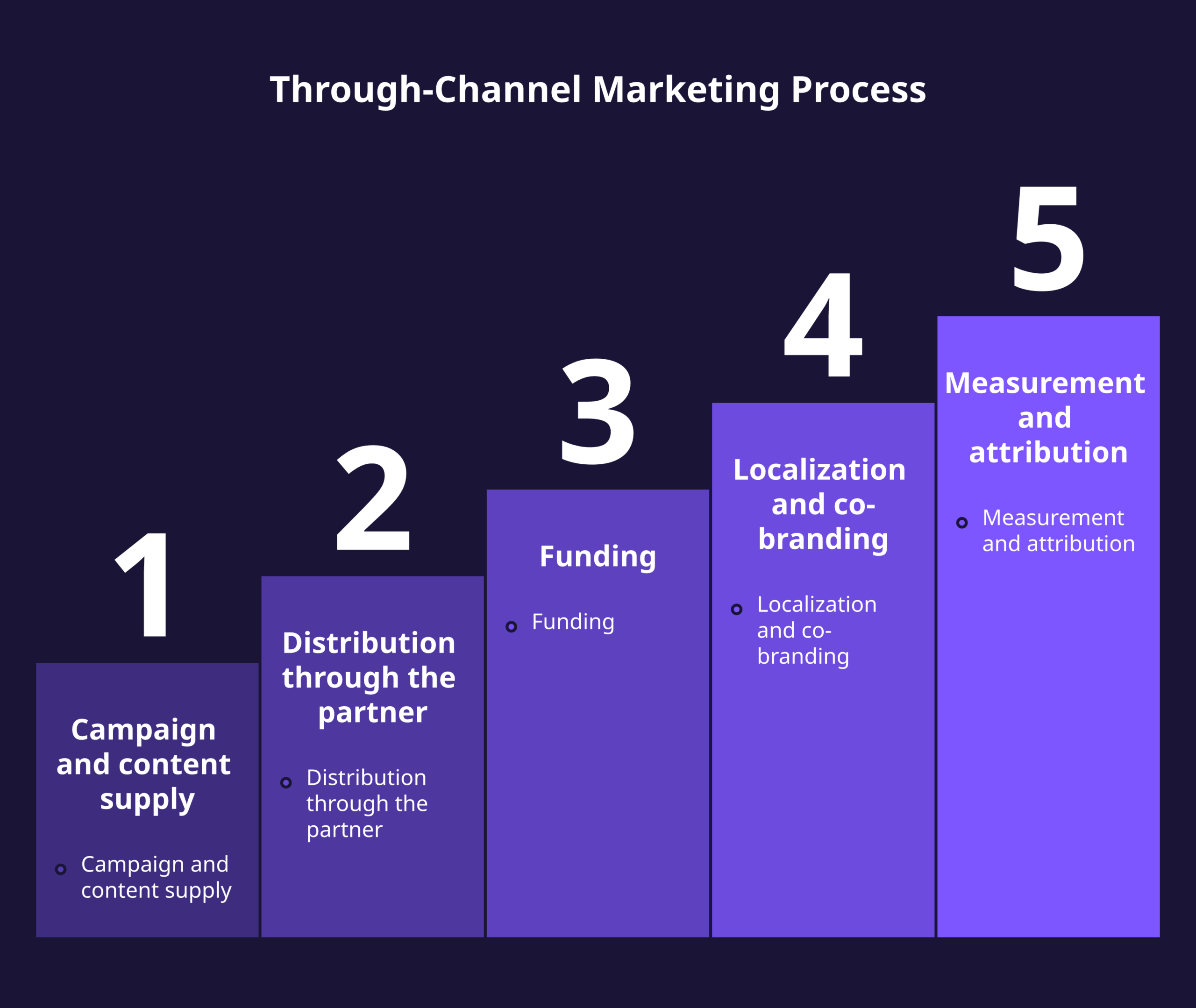
- Campaign and content supply: the vendor builds the campaigns, assets, and creative partners can take to market. The bar is not volume, it is whether a partner can pick it up and send it without rebuilding it.
- Distribution through the partner: the material goes out under the partner’s brand and voice to the partner’s audience. This is the point of the whole motion, and it only works if the partner genuinely runs it rather than storing it.
- Funding: market development or co-op funds pay for the partner’s activity, an event, a campaign, an ad spend. Money without a defined activity funds nothing; funding tied to a specific motion moves it.
- Localization and co-branding: partners adapt the material to their brand, their market, and often their language, so it reads as theirs rather than as forwarded vendor content. Adoption rises sharply when partners can make it their own.
- Measurement and attribution: track what partners actually ran and what pipeline it produced, tied back to the vendor’s system. Counting assets published is vanity; counting campaigns sent and leads sourced is the real signal.
The through-line is that supply is easy and adoption is hard. Vendors optimize the part they control, building more content, and neglect the part that decides the outcome, whether partners run it. The programs that produce make the material trivially easy to adopt and worth adopting, then measure what traveled.
Common pitfalls
- Supply mistaken for a program: filling a portal with assets and counting them as marketing. Content no partner runs generates nothing, no matter how much of it there is.
- Generic vendor messaging: shipping material in the vendor’s voice that partners cannot make their own. Customers recognize forwarded vendor content and discount it.
- Funding with no defined activity: handing out co-op dollars without tying them to a specific campaign or event. Undirected funds get spent without producing motion.
- Isolated pitches instead of a full picture: pushing a single-vendor message when the persona needs the combined story. A fuller narrative told to a buyer beats a narrow product pitch.
- No adoption measurement: tracking what was published rather than what partners ran and sourced. Without adoption data, you cannot tell a live program from a full library.
What this looks like in practice
The version that works tells a fuller story than one vendor can. Take a finance-software motion I would model this on: rather than each vendor pushing its own isolated message, the vendors marketed the combined picture to a shared persona, one covering planning, another covering compensation, another covering close and consolidation, so the buyer saw a complete financial operations stack rather than three disconnected pitches. The combined narrative was stronger than any single-vendor version, and each partner’s audience got something worth their attention instead of an ad.
That reframing is the lesson. Partner marketing works when it is about telling the full picture to a persona, not broadcasting isolated vendor messages. The partner runs the material because it makes their own customers smarter, not because the vendor asked. Funding followed a defined joint activity, an event and a campaign, rather than being sprinkled across the channel with no motion attached.
The contrast is the vendor that measures a portal. It publishes hundreds of assets, reports the library size as reach, and never checks whether a single partner sent anything. The assets sit, the partners market their other lines, and the vendor mistakes a full content shelf for a working program. The pattern repeats: the constraint is adoption, and the teams that win make the material easy to run, worth running, and measured on what actually ran.
Forecastable’s POV
Through channel marketing is where vendors do the most work for the least return, because they pour effort into supply and almost none into adoption. A portal full of unused campaigns is not a marketing program, it is a storage cost. The number that matters is not how much you produced, it is how much partners actually ran and what it sourced.
At Forecastable we treat partner marketing as an execution problem, not a content problem. We are a partnerships operating platform focused on connecting partner conversations and actions to CRM pipeline and revenue, the flywheel that runs from conversations to actions to pipeline to revenue. Supplying a campaign is administration. The work we deliver as part of the service is making sure the partner actually runs it and tying what they ran to sourced pipeline, using the Forecastable platform to see it. Publishing is not marketing until a partner sends it.
My bet: the programs that win will measure through-channel marketing by partner adoption and sourced pipeline, and will build fewer, sharper, more adoptable campaigns told to real personas. The teams counting published assets are measuring their own effort, not the market’s response.
Forecastable is an independent third-party. Any tools or vendors named here are described from public information for the reader’s own evaluation, not as paid placements, and Forecastable does not resell them.
Frequently asked questions
What is through channel marketing? Through channel marketing is demand generation a vendor runs through its partners, supplying campaigns, content, and funding so partners market to their own customers under their own brand. The message reaches the customer through the partner’s relationship rather than the vendor’s direct outreach.
What is the difference between through-channel and to-channel marketing? To-channel, or to-partner, marketing targets the partners themselves, recruiting and educating them. Through-channel, or through-partner, marketing arms partners to market to their end customers. One markets to the partner; the other markets through the partner to the market.
What is TCMA? TCMA stands for through-channel marketing automation, the software category that distributes vendor campaigns to partners and lets them localize and send. It is the tooling layer under through channel marketing. The software helps distribution; it does not solve whether partners actually adopt and run the material.
What are market development funds in through channel marketing? Market development funds, or MDF, are vendor dollars that pay for a partner’s marketing activity, such as an event or campaign. In through channel marketing they fund the partner’s execution, and they work best when tied to a specific, defined activity rather than handed out with no motion attached.
Why does through channel marketing underperform? Usually because vendors optimize supply and ignore adoption. They fill a portal with generic content partners never run, fund activity with no defined motion, and measure assets published instead of campaigns sent. The material has to be easy to adopt, worth adopting, and measured on what traveled.
How do you measure through channel marketing? Track what partners actually ran, not what you published, and tie it to sourced pipeline in your system. Adoption rate and partner-sourced leads are the real signals. Library size and assets available measure vendor effort, not market impact.
Next step
Pull your through-channel program and check one number: what share of the content you supplied did partners actually run last quarter. If it is small, your problem is adoption, and building more assets will not fix it.
If you want partner marketing measured on what partners run and what it sources, that is the operating work we do. Start your growth journey with Forecastable and we will connect partner activity to pipeline you can defend. Our partner program guide covers how partner marketing fits the wider motion.
Uncover Your Growth Potential
Schedule a Discovery Call