Partnership Marketing: What It Is and How to Run It

Short answer
Short answer: Partnership marketing is joint marketing between two companies that combine audiences, content, and channels to generate demand for a shared value proposition. It matters because a co-branded campaign borrows the trust and reach of both brands at once, which is why a partner webinar or joint guide usually outperforms the same effort run solo.
The failure mode is treating it as an event calendar. A webinar with no follow-up motion is an afternoon of registrations, not pipeline. The marketing only pays off when it is wired to a selling motion behind it.
What is partnership marketing?
Partnership marketing, often called partner marketing or co-marketing, is any marketing activity two companies run together to reach an audience neither could reach as efficiently alone. The classic shapes are a joint webinar, a co-branded report, a shared event presence, a swapped email promotion, or an integration launch that both companies announce to their bases.
It helps to place it against the neighbors. Co-selling is two sales teams working a shared deal. Channel or through-channel marketing is a vendor equipping many partners to market on its behalf, often with funds and templated campaigns. Partnership marketing, in the sense most people mean, is the one-to-one version: two specific companies building a campaign around a shared story. All three can run at once, and the terms blur, so it is worth being explicit about which one you are doing.
The defining feature is the shared value proposition. A partnership marketing campaign that does not answer “why should this audience care that these two companies are working together” is just two logos on a landing page. The message has to be about the combined value, not about the partnership itself, because customers care about their problem, not your org chart.
Why partnership marketing matters in 2026
Partnership marketing matters because paid and cold channels keep getting more expensive and less trusted, while a warm introduction through a partner’s audience still converts. When a partner puts your joint webinar in front of their list, you inherit the permission and credibility they have already built with those people. That is a fundamentally cheaper and higher-trust form of reach than buying attention from strangers.
It also compounds with the rest of the partner motion. A co-marketing campaign that generates a shared lead is the front end of a co-sell: the lead is warm, both companies have a reason to work it, and the follow-up is a joint one. Run well, partnership marketing is not a standalone tactic but the demand-generation layer of a broader partner relationship, feeding the pipeline that account mapping and co-selling then convert.
The honest limit is that partnership marketing is easy to do badly and hard to do in a way that produces revenue. Most co-marketing I see stops at the event. The registrations come in, the webinar happens, everyone shares the recording, and no one owns the follow-up. The activity was real and the pipeline was zero, because the marketing was never connected to a selling motion or a measurement.
How partnership marketing actually works
Partnership marketing that produces pipeline runs on five connected pieces. The campaign is the visible part; the four pieces around it decide whether it converts.
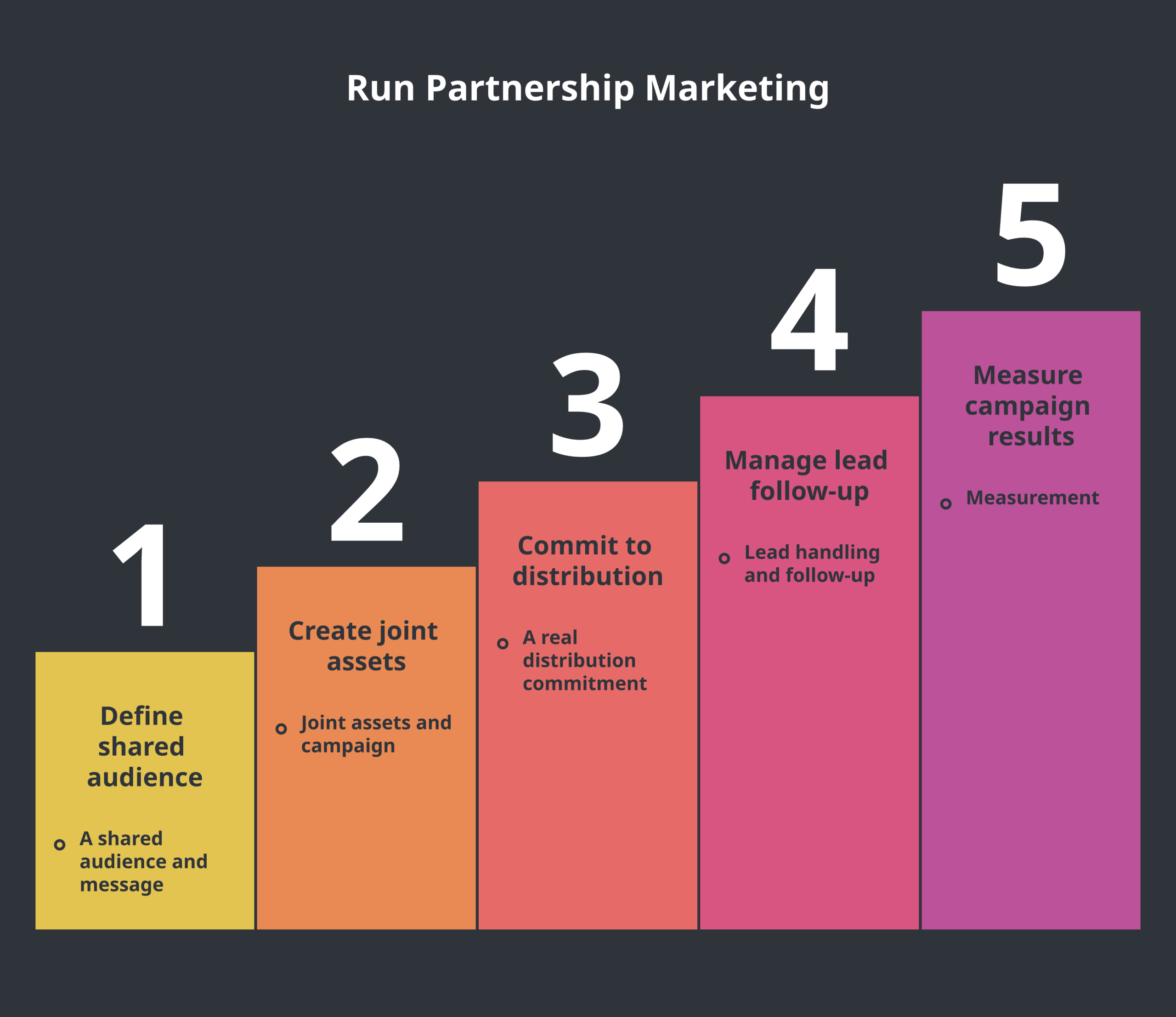
- A shared audience and message: agree who you are jointly reaching and the one combined value proposition you are reaching them with. If the two teams cannot state the shared story in a sentence, the campaign will be two half-messages stapled together.
- Joint assets and campaign: build the actual co-branded thing, a webinar, a report, an event, an email swap, with both brands and a clear call to action. This is the part everyone does.
- A real distribution commitment: each side commits to specific promotion, to which list, on which dates. The most common way these fail is one company promotes hard and the other forgets, so the reach is half of what was planned.
- Lead handling and follow-up: decide up front how leads are captured, shared, and worked, and set an attribution window so a lead that closes weeks later still counts. A campaign with no follow-up owner is where the pipeline dies.
- Measurement: track sourced and influenced pipeline per campaign and per partner, not just registrations. Without it, partnership marketing is judged on attendance and cut when budgets tighten.
The pattern is that partnership marketing is a demand motion, not an event. The webinar is the moment; the shared message, the mutual promotion, the follow-up, and the measurement are what turn the moment into revenue.
Common pitfalls
- Co-marketing with no co-selling: the webinar runs, the recording goes out, and nobody owns the follow-up. The leads cool and the campaign scores zero pipeline despite good attendance.
- Hiring before the workflow exists: adding a partner-marketing headcount before you have a repeatable campaign process is premature. Establish the workflow and prove one or two campaigns first, then scale the team to it.
- A one-sided distribution deal: one company promotes the campaign to its full list and the other posts once and moves on. The reach collapses and the partner who did the work feels used.
- Vanity metrics: measuring registrations and impressions instead of sourced pipeline makes a campaign look successful while producing nothing the revenue team can use.
- One-off campaigns with no rhythm: a single big webinar a quarter, with long gaps and no standing cadence, never builds the compounding pipeline that a repeatable partner-marketing motion does.
What this looks like in practice
The version that works is boring and repeatable. Two companies pick a shared audience and a single combined message, then build one strong asset around it, say a webinar on a problem both products touch. Both sides commit in writing to specific promotion: this many emails to these segments, these dates, these social posts. Leads are captured to one place, split by agreement, and every lead gets a follow-up owner with a two-week window. A 60-day attribution window is set, so a registrant who becomes an opportunity six weeks later is still credited to the campaign. At the end, the two teams look at sourced pipeline by partner and decide what to run next.
I am careful with teams about the sequencing here, because the instinct when partner marketing starts working is to hire for it immediately. My advice is the reverse: get the workflow repeatable and prove it with one or two partners before you add a partner-marketing hire, or you will hire a person into a process that does not exist and ask them to invent it under quota. Establish the motion, then staff it.
The contrast is the event-calendar version, where partner marketing is a list of webinars with no follow-up and no measurement. It generates activity that looks like progress and produces no defensible pipeline. The difference is never the quality of the webinar. It is whether anyone owned the message, the promotion, the follow-up, and the number.
Forecastable’s POV
Partnership marketing is one of the highest-trust demand channels available and one of the most wasted, because most teams execute the campaign and skip the operating layer around it. The webinar is easy. The shared message, the mutual promotion commitment, the follow-up ownership, and the attribution are the hard parts, and they are the parts that decide whether the campaign is pipeline or theater.
At Forecastable we treat partner marketing as the front end of a measured motion, not a standalone activity. We are a partnerships operating platform focused on connecting partner conversations and actions to CRM pipeline and revenue, the flywheel that runs from conversations to actions to pipeline to revenue. The campaign creates the shared lead; the work we deliver as part of the service is making sure that lead becomes an owned, worked, tracked opportunity, on the Forecastable platform. The webinar answers “did people show up.” We answer “did it turn into pipeline, and which partner sourced it.”
My bet: as partner programs get held to a revenue standard, partnership marketing stops being reported on attendance and starts being reported on sourced pipeline like every other demand channel. The teams that build the follow-up and measurement now will be the ones whose co-marketing survives the next budget cut.
Forecastable is an independent third-party. Any tools or vendors named here are described from public information for the reader’s own evaluation, not as paid placements, and Forecastable does not resell them.
Frequently asked questions
What is partnership marketing? It is joint marketing between two companies that combine audiences, content, and channels to generate demand for a shared value proposition. Common formats include co-branded webinars, joint reports, shared events, and email promotions built around a combined message.
What is the difference between partnership marketing and co-selling? Partnership marketing generates demand through joint campaigns. Co-selling is two sales teams working a shared deal. In a healthy motion they connect: a co-marketing campaign produces a shared lead that a co-sell then converts.
How is partnership marketing different from through-channel marketing? Through-channel marketing is a vendor equipping many partners to market on its behalf, often with funds and templates. Partnership marketing, as most people use the term, is the one-to-one version: two specific companies building a campaign around their shared story.
How do you measure partnership marketing? Track sourced and influenced pipeline per campaign and per partner, using an attribution window so leads that convert later still count. Registrations and impressions are activity metrics, not outcomes, and judging campaigns on them hides whether they produced revenue.
When should you hire a dedicated partner marketer? After you have a repeatable campaign workflow and one or two partners producing predictably, not before. Hiring ahead of the process asks a new person to invent the motion under quota, which usually stalls.
Why do partnership marketing campaigns fail? Most fail at the follow-up. The campaign runs, leads come in, and nobody owns working them, so the pipeline never materializes. The activity is real and the revenue is zero because the marketing was never wired to a selling motion.
Next step
Look at your last partner webinar and ask two questions: who owned the follow-up, and how much sourced pipeline can you attribute to it. If neither has a clear answer, the campaign was activity, not a motion, and the fix is ownership and measurement, not a bigger next event.
If you want to turn partner campaigns into tracked pipeline, that is exactly what we do. Start your growth journey with Forecastable and we will wire the follow-up and attribution with you. Our partner program guide covers how partner marketing feeds the rest of the motion.
Uncover Your Growth Potential
Schedule a Discovery Call