


The Partner Data Flywheel: How It Compounds

Short answer: the partner data flywheel
The partner data flywheel is the compounding loop, developed at Forecastable, that turns partner conversations into actions, actions into pipeline, and pipeline into revenue, then feeds what it learns back into the next cycle. It exists because most partner programs treat data as a report to read once, when the value is in a loop that gets smarter every turn.
What is the partner data flywheel?
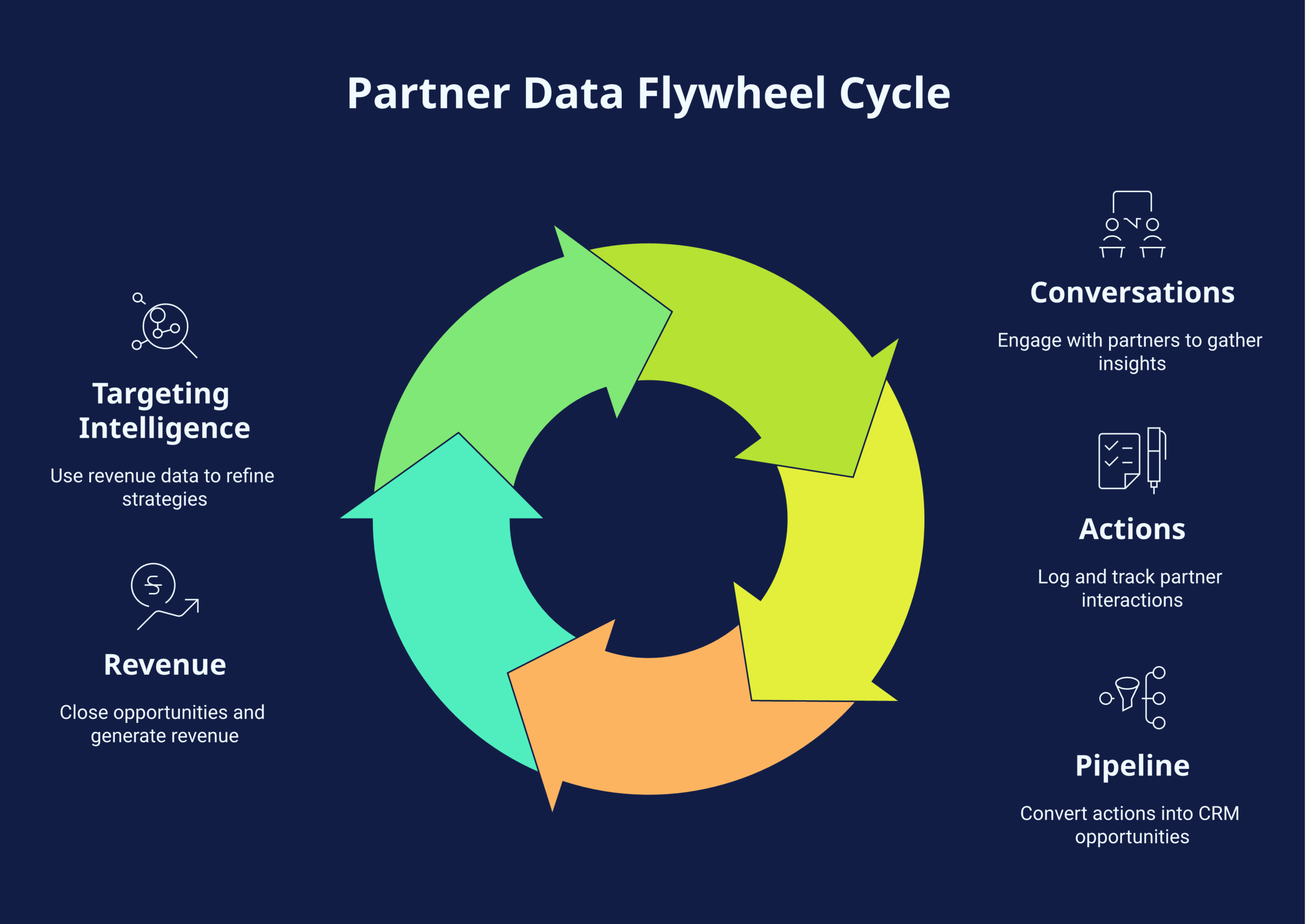
The partner data flywheel is a model for how a partner program compounds: each stage produces the input to the next, and the whole loop learns from its own output. The four stages are Conversations, Actions, Pipeline, and Revenue. Conversations with a partner’s frontline generate actions, actions generate pipeline, pipeline converts to revenue, and the record of what worked feeds back to sharpen the next set of conversations.
We named it a flywheel at Forecastable on purpose. A flywheel is not a funnel you run once; it is a wheel that spins faster the more you turn it, because each rotation adds momentum. A partner program that captures every conversation, action, and outcome gets better at predicting which partners and which plays will produce, and that prediction makes the next cycle more efficient. A program that lets the data evaporate after each deal starts every cycle cold.
Why the partner data flywheel matters in 2026
The partner data flywheel matters because partner data is usually collected and then wasted. Overlap exports, call notes, and deal outcomes pile up in three different tools and never inform each other, so the program relearns the same lessons every quarter. The flywheel matters because it is the discipline that stops the leak and turns scattered data into compounding advantage.
The compounding is where the economics live. Crossbeam and HubSpot data show partner-involved deals produce roughly 3x the pipeline and 40% higher win rates, and those numbers get better, not worse, as a program learns which partners and plays produce. A flywheel that feeds outcomes back into targeting means the program spends its next cycle on the accounts most likely to close. With Omdia and Jay McBain estimating about 96% of tech deals are partner-surrounded, a program that compounds its partner learning is compounding on most of its addressable market.
How the partner data flywheel actually works
The flywheel runs in four stages, and the connective tissue is that every stage writes its record back so the next turn is sharper. Momentum builds when nothing between stages is dropped.
-
Conversations, the frontline input. The loop starts with conversations between your team and the partner’s frontline: their account executives, customer success managers, and account owners. Conversations come first because nearly all partner pipeline originates there, not with the partner’s partnerships team.
-
Actions, the logged motion. Every conversation produces a next action, and every action is logged: a meeting booked, an overlap worked, a play sent, a follow-up owned. Actions are the stage most programs skip recording, which is why their flywheel never builds momentum.
-
Pipeline, the tracked opportunity. Logged actions convert into CRM opportunities that carry a partner attribution, so the program can see which conversations and actions actually produced pipeline. Pipeline is where the loop becomes measurable rather than anecdotal.
-
Revenue, the closed outcome that teaches. Pipeline converts to revenue, and the record of what closed (which partner, which play, which account type) feeds back to the Conversations stage as targeting intelligence. Revenue is not the end of the loop; it is the input to the next, sharper turn.
Common pitfalls
-
Treating data as a report, not a loop. A program that pulls an overlap export, reads it, and moves on gets a snapshot, not a flywheel. The value is in feeding each stage’s output into the next, every cycle.
-
Dropping the Actions stage. Conversations and outcomes get recorded, but the actions between them do not, so the program cannot tell which motion produced the deal. The unlogged action is where most flywheels stall.
-
Splitting the loop across disconnected tools. When conversations live in one system, overlaps in another, and pipeline in the CRM with no connection, the loop never closes and the learning never compounds. The stages have to write back to a shared record.
-
Talking to the wrong people. A flywheel fed by conversations with partner managers instead of the frontline spins on the wrong input. The first stage has to be the partner’s actual sellers.
-
Never feeding revenue back to targeting. Programs celebrate a closed deal and forget to ask what it teaches. Without the feedback from Revenue to Conversations, the wheel turns once and stops instead of accelerating.
What this looks like in practice
The flywheel shows up as a program that gets more efficient every quarter without adding headcount, because it stops relearning what it already knew. Each closed deal sharpens the next round of targeting.
A worked example: a program that had been running partner plays by instinct started logging every stage, whose conversation, which action, which opportunity, which close. After two quarters the pattern was obvious: a specific partner type and a specific play were producing most of the revenue, while a broad set of well-liked partners produced almost none. The program shifted its conversations toward the productive pattern, and the same team produced more pipeline the next quarter without working more accounts. Nothing about the effort changed. The flywheel simply pointed the effort at what the data already knew would close, which is the entire point of feeding revenue back into targeting.
Forecastable’s POV
Partner data is the most wasted asset in most programs. Teams collect overlaps, notes, and outcomes and then let each one evaporate, so they start every quarter cold and relearn the same lesson about which partners produce. The flywheel is the fix, and it is a discipline before it is a tool: capture every stage, and make each stage feed the next.
The stage everyone skips is Actions. Programs record the conversation and eventually record the closed deal, but the motion in between, the booked meeting, the worked overlap, the sent play, goes unlogged, and without it the program cannot connect a conversation to a close. That missing link is why so many flywheels never build momentum. Log the actions and the loop starts to spin.
I keep the language exact. We run the partner motion as part of the service and use the Forecastable platform to connect partner conversations and actions to CRM pipeline and revenue, which is the flywheel made operational. The platform is what closes the loop between stages; the service is the team that turns each cycle’s learning into the next set of conversations. Neither works if the data stops writing back.
Forecastable is an independent third-party professional services company. Our observations are based on our own client work and publicly available research as of August 2026. We run the partner motion as part of the service and use the Forecastable platform to connect partner conversations and actions to CRM pipeline and revenue.
How this differs from a sales funnel
The partner data flywheel is often pictured as a partner version of the sales funnel, and the shapes are opposites. A funnel is linear and one-directional: leads enter the top, most fall out, and a few convert at the bottom, then the funnel resets and starts over with nothing carried forward. The flywheel is circular and compounding: revenue at the far side feeds targeting at the near side, so each turn starts smarter than the last. A funnel measures conversion through a single cycle. The flywheel measures whether the program is getting more efficient across cycles. Use funnel thinking to understand one deal’s path. Use flywheel thinking to understand why a program that captures its own data pulls away from one that does not.
Frequently asked questions
What is the partner data flywheel?
It is a compounding loop, developed at Forecastable, that turns partner conversations into actions, actions into pipeline, and pipeline into revenue, then feeds what closed back into the next round of targeting so the loop gets sharper each cycle.
What are the four stages?
Conversations (with the partner’s frontline), Actions (the logged motion), Pipeline (attributed CRM opportunities), and Revenue (closed outcomes that feed targeting). Each stage produces the input to the next.
Why is it a flywheel and not a funnel?
A funnel is linear and resets each cycle. A flywheel is circular and compounds, because revenue feeds back into targeting, so every turn starts smarter than the last.
Which stage do programs most often skip?
Actions. Teams record conversations and closed deals but not the motion in between, so they cannot connect a conversation to a close and the loop never builds momentum.
What does the flywheel need to compound?
Every stage has to write its record back to a shared source, and the loop has to start with the partner’s frontline. Split the stages across disconnected tools and the learning never accumulates.
How does this affect forecasting?
A flywheel that feeds revenue back into targeting learns which partners and plays produce, which makes the next cycle’s pipeline more predictable and the partner-sourced forecast more defensible.
Next step
Map your own partner motion against the four stages and find the one that is not writing its record back. If Actions are unlogged or Revenue never informs targeting, your loop is a funnel that resets, not a flywheel that compounds.
Start your growth journey now and we will connect your partner conversations and actions to CRM pipeline so the loop actually compounds. You can also see how this fits our wider forecastability work.
Uncover Your Growth Potential
Schedule a Discovery Call


