Deal Registration: How It Works and Why It Matters

What is deal registration?
Short answer: Deal registration is the process where a partner formally submits a prospect or opportunity to the vendor and, once approved, earns a defined period of protection and usually a better margin on that account. It exists to reward the partner who sources or influences a deal and to stop two partners from fighting over the same logo.
The mechanism is simple, but it carries most of the trust in a channel program. A partner is asking the vendor to commit, in writing, that the work they put into a prospect will be honored. How a vendor handles that request tells partners more about the program than any pitch deck.
Why deal registration matters in 2026
Deal registration matters because it is the single clearest signal of whether a partner program is fair. A partner invests time, relationships, and credibility into a prospect before there is any revenue. Without registration, that investment is exposed: a direct rep or a second partner can walk into the same account and take the deal. Registration converts effort into a protected claim, which is what makes partners willing to invest in the first place.
In 2026 the stakes are higher because buying groups are larger and sales cycles are longer, so a partner may carry a deal for months before it closes. The longer that gap, the more important it is that the claim holds. Programs that approve registrations quickly and honor them consistently get more deals submitted, because partners learn the system is real. Programs that sit on approvals, reject claims on technicalities, or quietly let direct reps override registered deals teach partners to stop bringing their best opportunities.
There is also a measurement angle. A clean registration process is the cleanest source of partner-sourced pipeline you will ever have, because the partner is telling you, deal by deal, what they brought. That data feeds attribution, forecasting, and the case for investing more in the channel. A messy process produces messy data and a partner program that cannot prove its own contribution.
How deal registration actually works
Deal registration runs as a short, repeatable workflow. The components below are the parts that have to function for the process to be trustworthy, and the failure of any one of them is what partners actually complain about.
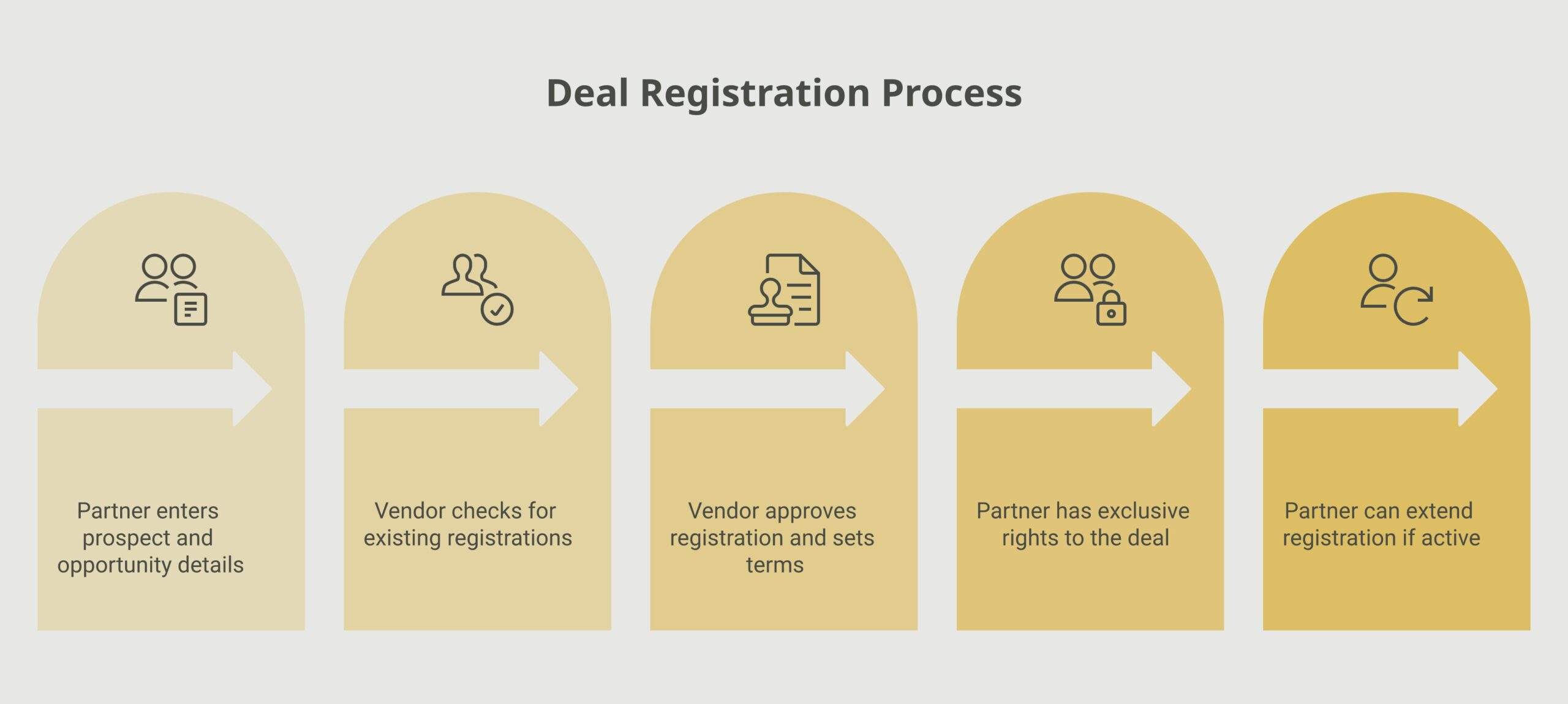
- Submission: The partner enters the prospect, the opportunity details, and the work done so far. The form should be short enough to fill in minutes, because a long form depresses registration volume and you lose visibility into deals partners simply did not bother to log.
- Review and deduplication: The vendor checks the submission against existing pipeline and other registrations. This is the moment that decides fairness. The reviewer confirms the account is not already claimed and that the partner genuinely has standing in it, then makes a fast yes or no call.
- Approval and terms: An approved registration grants a protection window, often 60 to 120 days, and a specific benefit, usually a margin uplift or a referral fee. The terms must be explicit so there is nothing to argue about at close.
- Protection: During the window, the deal is the partner’s to work. Direct reps and other partners are held off the account. If the vendor cannot enforce this internally, the registration is worthless no matter how clean the form was.
- Renewal or expiry: If the deal is still active when the window ends, the partner can extend it by showing progress. If it has gone cold, it expires and the account reopens. This keeps registrations tied to real activity rather than letting partners park logos indefinitely.
Common pitfalls in deal registration
- Slow approvals: A registration that takes a week to approve leaves the partner exposed during the exact period they most need cover. Slow review is the fastest way to kill registration volume, because partners stop trusting that the claim will be there when it matters.
- Approving everything: The opposite failure. Rubber-stamping every submission, including ones where the partner has no real standing, lets partners park accounts they are not working and creates conflict when a partner who is actually selling runs into a stale registration.
- No internal enforcement: The most damaging pattern. The program approves a registration, then a direct rep closes the same account anyway and the partner is told to take it up with someone. One unenforced registration, talked about across a partner community, costs more trust than a dozen approvals earn.
- Terms that are vague at close: If the margin uplift or fee was never written down precisely, the argument happens at the worst possible moment, when money is on the table. Define the benefit at approval, not at payout.
- A form nobody fills in: If submitting a deal is slow or the value of doing it is unclear, partners skip it and you lose your best pipeline signal. Treat low registration volume as a process problem, not a partner-effort problem.
What this looks like in practice
A program had a deal registration form that took twenty minutes to complete and a review queue that ran four to seven days. Partners registered only the deals they were nervous about, which meant the vendor had almost no visibility into the rest of the channel pipeline. Worse, two of the slow approvals lapsed into conflict when direct reps engaged the same accounts, and the partners involved told their peers.
The fix was mechanical. The form was cut to the few fields review actually needed, approvals were committed to a 24-hour turnaround with a named owner, and the protection terms were stated on the approval itself. Registrations are logged in the program’s partner system, whether that is a relationship management platform like Introw, Euler, Impartner, or Allbound, or the vendor’s own workflow, so review and enforcement run against one record rather than scattered emails. Within a quarter, registration volume climbed because partners trusted the turnaround, and the vendor could finally view partner-sourced pipeline as a clean, deal-by-deal number it could forecast against.
Forecastable’s POV on deal registration
Our position is that deal registration is not paperwork, it is the contract of trust between a vendor and its partners, and it should be run with that seriousness. The form, the queue, and the terms are the visible parts, but the thing partners are really testing is whether you will honor a claim when it costs you something. Every design decision should be made to make that honoring obvious and fast.
We also think most programs measure the wrong thing. They watch approval rates and rejection reasons when they should watch turnaround time and enforcement consistency, because those are what drive registration volume. The lever that gets partners to bring you more deals is not a richer margin uplift, it is a process they have learned to trust. A fast, fair, enforced registration is worth more to a partner than a generous one that arrives late or gets overridden.
Finally, treat the registration record as a measurement asset, not just an approval gate. Each approved deal is the partner telling you exactly what they sourced, which is the foundation of honest partner attribution and a partner pipeline you can actually forecast. Connect that record to your CRM and you turn a fairness mechanism into the spine of your partner-led growth reporting.
Forecastable is a partnerships operating platform. Any third-party tools named here are independent third-party products, and naming them is not an endorsement of one over another. Decide how deal registration should run inside your own program, partners, and sales motion.
Frequently asked questions
What is deal registration in a partner program? It is the process where a partner submits a prospect to the vendor and, once approved, earns a protection window and usually a better margin on that account. It rewards the partner who sources the deal and prevents two parties from chasing the same logo.
How long does deal registration protection last? Most programs grant 60 to 120 days, often renewable if the partner can show the deal is still progressing. The window should be long enough to cover a realistic sales cycle without letting partners park accounts they are not working.
What is the difference between deal registration and a lead referral? A referral is handing the vendor a name to pursue. Deal registration is a partner claiming an opportunity they are actively working and asking for protection and margin on it. Referrals are lighter; registrations carry more commitment on both sides.
Why do partners stop registering deals? Usually because approvals are slow, terms are vague, or a registration was once overridden by a direct rep. Partners register when they trust the claim will hold; they stop the moment the process feels unfair.
How does deal registration help with forecasting? Each approved registration is a partner telling you, deal by deal, what they sourced. That is the cleanest partner-sourced pipeline signal available, and it feeds attribution and revenue forecasting directly.
Should deal registration live in a PRM or the CRM? Either can hold the form, but the record has to connect to your CRM pipeline so review, enforcement, and reporting run against one source of truth rather than scattered emails.
Next step
If your registration volume is low or your partners do not trust the process, the fix is almost always turnaround time and enforcement, not richer terms. Forecastable helps partnerships teams connect registered deals to CRM pipeline so claims are honored, conflict is avoided, and partner-sourced revenue is something you can prove and forecast. Start your growth journey now to make deal registration a trust engine rather than a form. The partner program hub frames how the wider program fits together, and the co-sell hub goes deeper on running joint deals once a registration is approved.
Uncover Your Growth Potential
Schedule a Discovery Call