What Is Deal Registration? A Plain Answer

What is deal registration?
Short answer: Deal registration is the process by which a partner tells a vendor about an opportunity they are working so the vendor protects that deal for them, usually with margin, support, or exclusivity. It is how a channel rewards the partner who found the deal rather than the one who showed up last. Without it, partners have no reason to bring their best opportunities to you.
At its core, deal registration answers a simple question: who gets credit and protection for this deal? It gives the sourcing partner a claim the vendor honors.
Why deal registration matters in 2026
Deal registration matters because partners invest in the deals they will be paid for, and they walk away from the ones they might lose to a competing partner or the vendor’s own team. Registration is the promise that makes a partner comfortable sharing pipeline. Take it away and partners hide their best deals or sell something else.
In 2026, with more selling running through partners, channel conflict is a real cost. A vendor whose partners fear losing deals to each other, or to direct, gets less pipeline and more friction. A clear deal registration process is the mechanism that keeps partners bringing opportunities forward, because they trust the vendor to protect what they source.
How deal registration actually works
Deal registration works as a claim-and-approval flow: the partner submits the deal, the vendor reviews it, and an approved registration carries defined protections. The components below are what a working process includes.
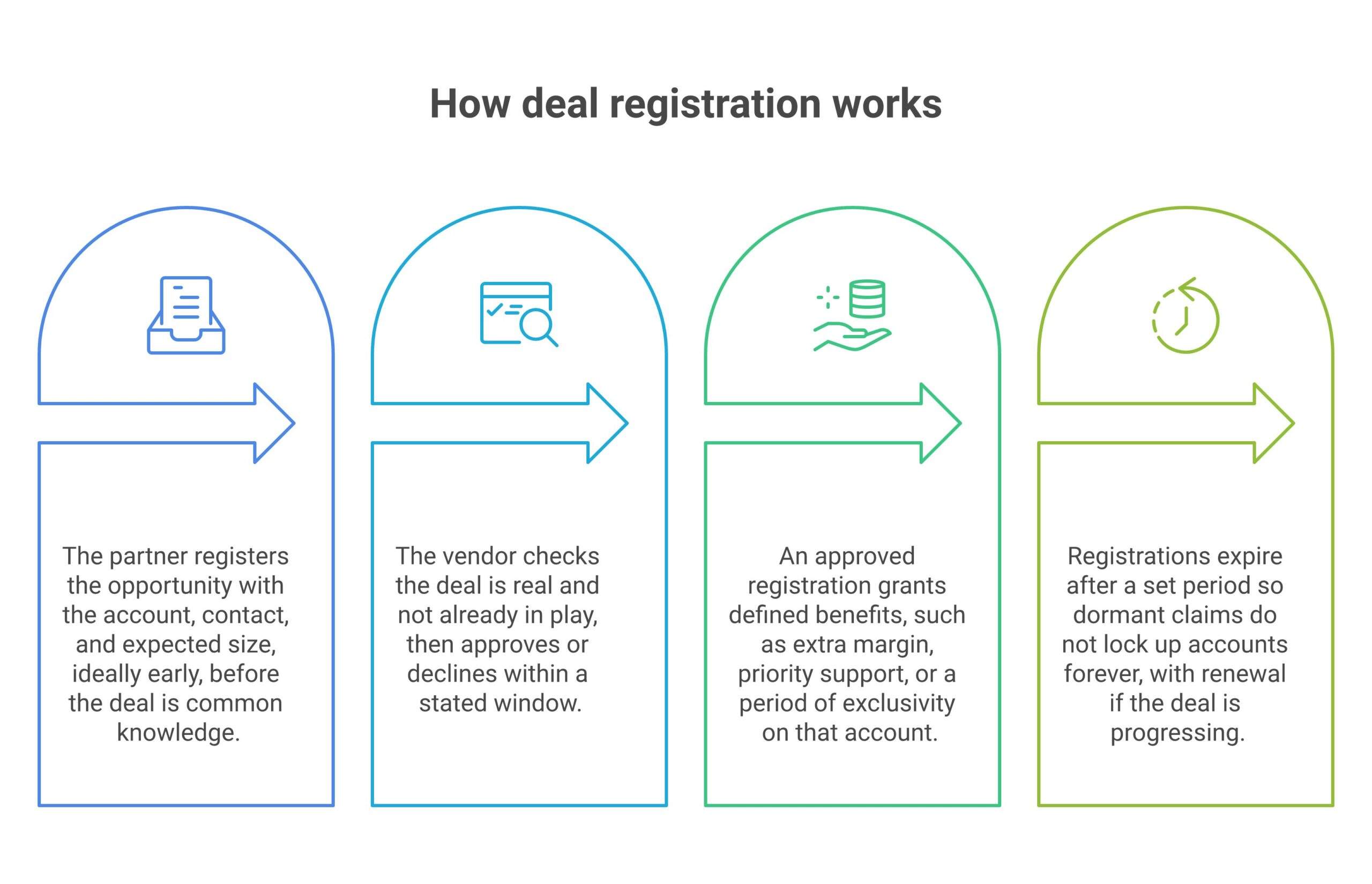
- Submission: The partner registers the opportunity with the account, contact, and expected size, ideally early, before the deal is common knowledge.
- Review and approval: The vendor checks the deal is real and not already in play, then approves or declines within a stated window, so partners are not left waiting.
- Protection terms: An approved registration grants defined benefits, such as extra margin, priority support, or a period of exclusivity on that account.
- Expiration and renewal: Registrations expire after a set period so dormant claims do not lock up accounts forever, with renewal if the deal is progressing.
Common pitfalls in deal registration
- Slow or opaque approvals: A process that takes weeks or gives no reason for a decline teaches partners not to bother registering. Approve fast and explain declines.
- Protections that do not hold: Granting a registration and then letting another partner or direct take the deal destroys trust permanently. The claim must be honored.
- Registration without early submission: Allowing partners to register deals that are already obvious rewards no one and creates conflict. Reward early, genuine sourcing.
- No expiration: Registrations that never lapse let partners hoard accounts they are not working, blocking others from a live opportunity.
What this looks like in practice
A worked example: a vendor found partners were sandbagging their best deals because two partners had both claimed the same account the prior year and the vendor sided with the larger one, burning the smaller partner. Partners learned that registration did not protect them, so they stopped surfacing early pipeline. The vendor rebuilt the process: registrations were approved within two business days, first genuine submission won, protections were written down and honored without exception, and claims expired after ninety days if the deal stalled. Partners started registering deals early again because the promise was now real. The lesson was that deal registration is only as valuable as the vendor’s willingness to honor it, and a process partners trust is worth more than a generous one they do not.
Forecastable’s POV on deal registration
Our position is that deal registration is a trust instrument, not a paperwork step, and vendors who treat it as paperwork lose the pipeline it was meant to protect. The mechanics are easy; the discipline of honoring every approved registration, even when it is inconvenient, is what actually makes partners bring you deals. Break the promise once and partners remember for years.
We also think registration data is a signal most vendors waste. Every registered deal is a partner telling you where real pipeline is forming, early. Tracked in CRM alongside partner-sourced revenue, registrations become a leading indicator of channel health, not just a claims ledger. The vendors who read that signal know which partners are actually selling long before the revenue lands.
Forecastable is a partnerships operating platform focused on connecting partner conversations and actions to CRM pipeline and revenue. We do not run your registration workflow; we make partner-sourced pipeline and the deals behind it visible in the forecast, so the sourcing you protect shows up as measured revenue. Registration protects the deal; visibility proves the partner earned it.
Forecastable is a partnerships operating platform and a category authority, not a PRM vendor. Any third-party tools or firms referenced in this space are independent third-party products, and mentioning them is not an endorsement. Evaluate any registration approach against your own partner mix, motion, and CRM.
Frequently asked questions
What is deal registration?
Deal registration is the process by which a partner tells a vendor about an opportunity they are working so the vendor protects that deal for them, usually with margin, support, or exclusivity.
Why do vendors offer deal registration?
To reward the partner who sources a deal, reduce channel conflict, and get partners to surface their best pipeline early instead of hiding it.
What protections does a registered deal get?
Commonly extra margin, priority support, or a period of exclusivity on the account, defined by the vendor’s program terms.
How long does a deal registration last?
Usually a set period, often thirty to ninety days, after which it expires unless the deal is progressing and the partner renews it.
What is the difference between deal registration and a lead?
A lead is an unqualified contact; a registered deal is a specific opportunity a partner is actively working and has claimed for protection.
Why do partners stop registering deals?
Usually because approvals are slow or protections were not honored. Partners register when they trust the vendor to protect what they source.
Next step
If partners are hiding their best deals, the issue is trust in your registration process, not partner effort. Approve fast, honor every protection, expire dormant claims, and track registered pipeline in CRM. Start your growth journey now to make partner-sourced pipeline visible in the forecast. The partner program hub frames how deal registration connects to co-selling, enablement, and attribution.
Uncover Your Growth Potential
Schedule a Discovery Call