Head of Partnerships Responsibilities: The Full List

What are head of partnerships responsibilities?
Short answer: Head of partnerships responsibilities are the duties of the person who owns the partner revenue program end to end, covering strategy, partner recruiting, onboarding and enablement, co-sell execution, internal alignment, and attribution. They add up to one accountability: turning a roster of partners into reported, defensible pipeline.
The list reads long because the role sits between several teams, but it resolves into a single throughline. Everything the head of partnerships does either brings the right partners in, gets them producing, or proves what they produced.
Why head of partnerships responsibilities matter in 2026
These responsibilities matter because an unscoped partnerships leader becomes a relationship manager by default, busy with logos and signed agreements that never turn into revenue. Writing the responsibilities down forces the role toward outcomes: not how many partners were signed, but how much pipeline they sourced and influenced. The scope is what separates a program that produces from one that merely exists.
In 2026 the stakes are higher because partner-influenced revenue is now a number leadership expects on the forecast. A head of partnerships whose responsibilities stop at recruiting and “relationship building” cannot produce that number, while one whose responsibilities explicitly include attribution and co-sell execution can. The difference between the two job descriptions is the difference between a defensible program and the first line cut in a downturn.
The role also has to absorb a broader ecosystem than it did a few years ago. Technology partners, resellers, services firms, and referral sources each behave differently, so the responsibilities now include designing distinct motions for distinct partner types rather than treating every partner the same. The leader who owns this breadth has to think in systems, not relationships.
How head of partnerships responsibilities actually work
The responsibilities organize into five areas that run in sequence, where each one depends on the area before it. Skipping an area does not remove its work; it pushes the cost downstream where it is harder to fix.
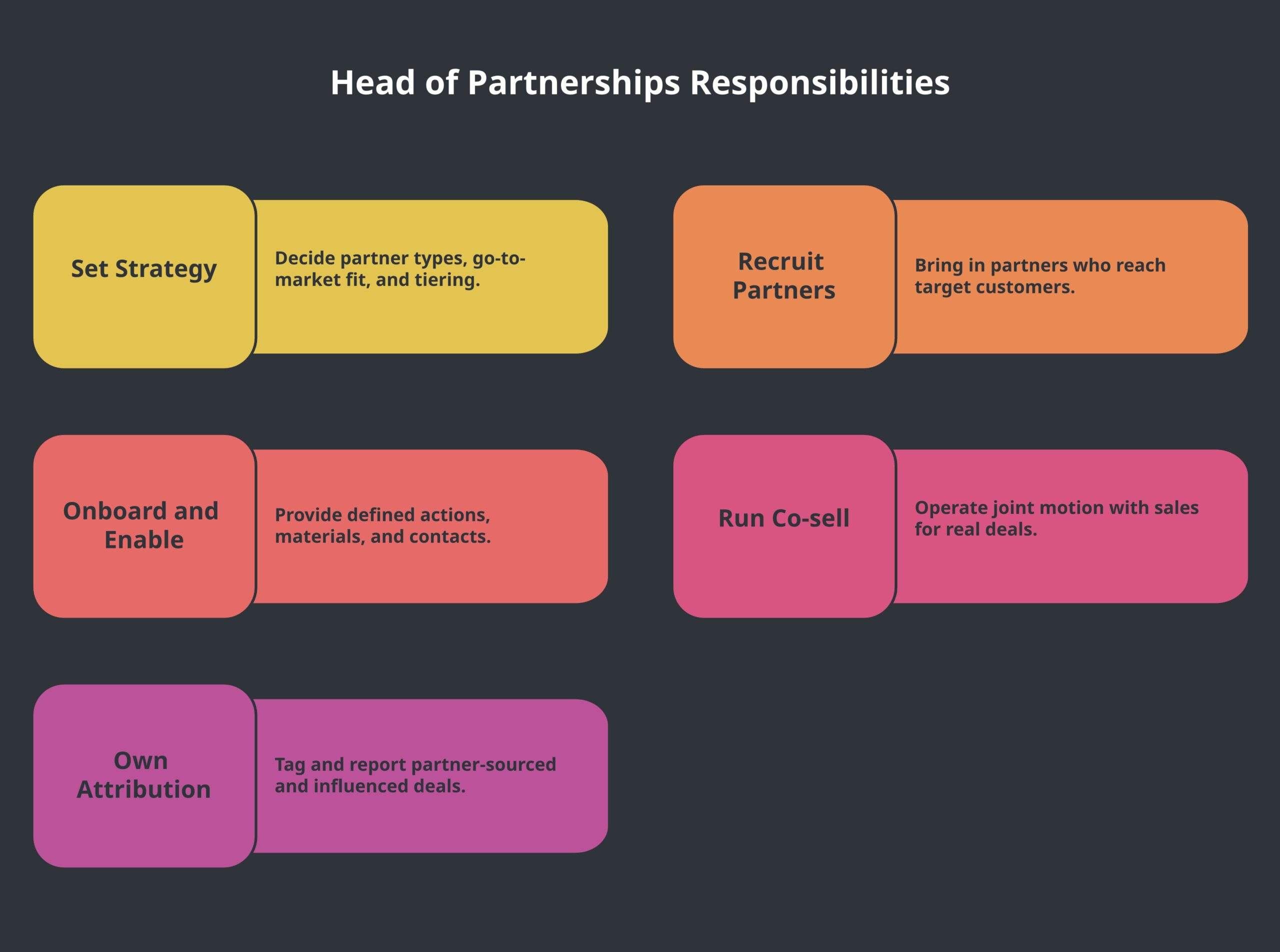
- Set strategy and tiering: Decide which partner types the program will pursue, why they fit the go-to-market, and how partners are tiered by potential. This is where the program gets a thesis instead of a list, and where every later responsibility gets its priorities.
- Recruit and qualify partners: Bring in partners who already reach the customers the company wants, deliberately, rather than accepting anyone willing to take a badge. Qualification against the tiering criteria keeps the roster aligned to the strategy.
- Onboard and enable: Give each new partner a defined first action, the materials, and a named contact early, so a signed agreement becomes activity. Ongoing enablement keeps partners current on positioning and deal-registration mechanics.
- Run co-sell execution: Operate the joint motion with sales, so partners and account executives work real deals together. This is where the program meets the revenue org and where most partner pipeline is actually created.
- Own attribution and reporting: Tag partner-sourced and partner-influenced deals from the first touch and report them beside direct pipeline. This responsibility is what makes the entire program countable and defensible.
The responsibilities are working when partners know their next step and show up tagged in the pipeline, and failing when the leader can describe great relationships but cannot produce a number to defend them.
The strategic responsibilities in detail
The first group of responsibilities is strategic and easy to skip under pressure, which is why programs drift. The head of partnerships owns the partnering thesis: which partner types matter, what each is expected to produce, and how the program is sequenced over the year. They own tiering, the criteria that separate a strategic partner from a long-tail one, so attention and budget flow to where the return is. They also own the internal business case, the argument that wins program budget and cross-functional cooperation in planning meetings.
Strategy here is not a deck written once. It is a living set of decisions the leader revisits as the ecosystem and the company change, and it is the responsibility that gives every operational task its priority. Without it, recruiting becomes opportunistic and enablement becomes generic.
The operating responsibilities in detail
The second group is operational and is where most of the week goes. Recruiting and qualification mean building a deliberate pipeline of partners and screening them against the tiering criteria. Onboarding means designing a path from signature to first action, not just issuing a portal login. Enablement means keeping partners and the internal sales team fluent in the joint value proposition and the mechanics of registering and working deals together.
Co-sell execution is the operating responsibility that touches revenue most directly. The head of partnerships sets the rules of engagement between partners and account executives, runs the deal reviews where joint opportunities get worked, and removes the friction that stalls partner deals. This is cross-functional work: it only succeeds when sales leadership treats partner deals as real pipeline, which loops back to the strategic responsibility of internal selling.
The measurement responsibilities in detail
The final group is measurement, and it is the responsibility most often left for later and most often regretted. The head of partnerships owns the attribution model: how partner-sourced and partner-influenced deals are defined, tagged, and reported. They own the program’s metrics, the small set of numbers that say whether the motion is working, and they own the reporting cadence that puts partner pipeline in front of leadership beside direct.
Measurement is not a year-end exercise. Instrumented from the first partner touch, it lets the program show its first wins, defend its budget, and improve its motion based on evidence rather than anecdote. A head of partnerships who treats attribution as core, not clerical, is the one whose program survives the next planning cycle.
Common pitfalls with these responsibilities
- Letting relationships replace outcomes: A leader who measures success in partner meetings and signed agreements, rather than sourced and influenced pipeline, has scoped the role as account management. Anchor every responsibility to a number.
- Skipping the strategy responsibility: Without a tiering thesis, recruiting becomes opportunistic and enablement becomes generic. The strategic group is the easiest to drop and the most expensive to lose.
- Treating onboarding as a portal login: Issuing access and calling a partner activated is the most common false finish. Onboarding is a defined first action with a named contact, or it has not happened.
- Deferring attribution: A program that adds measurement after launch cannot count its early wins, and an uncountable program is the easiest to cut. Instrument from the first touch.
- Owning everything alone: A head of partnerships who refuses to build process and team stays a one-person bottleneck. Part of the role is making the motion repeatable by others.
What this looks like in practice
A head of partnerships joining a thirty-person revenue team inherited forty signed partners and no pipeline number. Rather than chasing more logos, she rewrote her own responsibilities around the sequence: first a tiering thesis that cut the active roster to the twelve partners who reached the right buyers, then an onboarding path that gave each a defined first co-sell action, then a weekly deal review with sales where joint opportunities got worked, and finally an attribution model that tagged partner-influenced deals from first touch. Two quarters later the program reported its first defensible partner-influenced number in the forecast. Nothing exotic happened; she just took ownership of the full list of responsibilities in order, instead of staying busy at the recruiting end.
Forecastable’s POV on head of partnerships responsibilities
Our position is that the responsibilities only matter if they end in a number. It is easy to write a job description full of relationship-building and ecosystem-development language that sounds complete and produces nothing measurable. The responsibilities that count are the ones that move pipeline: a tiering thesis that focuses effort, an onboarding path that creates activity, a co-sell motion that works deals, and an attribution model that proves it. Write the list to end in reported revenue, and the role has a spine.
The second conviction is that attribution is a primary responsibility, not an afterthought handed to operations. The reason the program exists is to produce partner-sourced and partner-influenced revenue, and a number nobody owns is a number nobody defends. When the head of partnerships owns measurement directly and instruments it from the first touch, the program stops being a cost to justify and becomes a line to protect. Every other responsibility on the list serves that one.
The third conviction is that internal selling belongs on the list as explicitly as external work. A partner motion lives or dies on whether the sales org treats partner deals as real pipeline, and that cooperation does not happen by goodwill. The head of partnerships is responsible for earning it, with evidence and a seat in the forecast conversation, which is why the role has to sit high enough in go-to-market to be in that room.
Forecastable is a partnerships operating platform; any third-party frameworks or tools referenced here are independent and naming them is not an endorsement of one approach over another. Scope these responsibilities against your own program and motion.
Frequently asked questions
What does a head of partnerships do day to day?
They move between strategy and execution: reviewing partner-sourced pipeline, running co-sell deal reviews with sales, unblocking active partner deals, enabling partners and internal reps, and reporting on partner-influenced revenue.
What are the most important head of partnerships responsibilities?
Setting strategy and tiering, recruiting the right partners, enabling them and the sales team, running co-sell execution, and owning attribution. Attribution is the one that makes all the others defensible.
Is a head of partnerships responsible for revenue?
Yes, increasingly so. The modern version of the role carries accountability for partner-sourced and partner-influenced pipeline, not just relationship management or partner counts.
How is a head of partnerships measured?
On the partner-sourced and partner-influenced pipeline and revenue the program produces, supported by leading indicators like activated partners and co-sell deals in motion, not on signed-agreement counts alone.
Does the head of partnerships manage a team?
Often, but not always. At larger companies they manage partner managers and partner operations; at earlier-stage companies they may own the full list of responsibilities as an individual contributor before building a team.
How do head of partnerships responsibilities differ from a partner manager’s?
The head of partnerships owns the whole program, strategy through attribution, while a partner manager executes within it on a defined set of partner relationships.
Where do these responsibilities sit in the org?
In go-to-market, usually reporting to the CRO or CEO, so the role has the cross-functional pull and the forecast seat the responsibilities require.
Next step
If your head of partnerships role is scoped around relationships instead of revenue, rewrite the responsibilities to end in a number. Forecastable helps leaders turn the full list, strategy through attribution, into a motion that reports defensible partner pipeline. Start your growth journey now to scope the role around outcomes. The partner program hub connects these responsibilities to the wider operating model, and the related head of partnerships job description turns this list into a hiring document.
Uncover Your Growth Potential
Schedule a Discovery Call