Partner Relationship Management Software: A Buyer’s Guide

What is partner relationship management software?
Short answer: Partner relationship management software is the system of record for running a partner program, recruiting, onboarding, enabling, registering deals, and reporting partner-sourced revenue in one place. It does for the indirect motion what a CRM does for direct sales, so partner work stops scattering across spreadsheets and inbox threads.
Partner relationship management software is not a portal with a login and a content folder. It is the operational backbone that holds the partner roster, governs deal registration, serves enablement, and produces the attribution numbers leadership asks for. The buying decision is less about features on a slide and more about which motion you need the system to run.
Why partner relationship management software matters in 2026
Partner relationship management software matters in 2026 because partner-influenced revenue is now reported to the board, and you cannot report a number a spreadsheet cannot hold. Once deal registrations and onboarding steps pass a certain volume, manual tracking breaks, attribution gets reconstructed by hand, and the program loses the evidence it needs to defend its budget.
The second reason is that ecosystems have layered. Programs run technology partners, resellers, services firms, and referral sources at once, each with different mechanics. Software that handles only one motion forces the others back into spreadsheets, so the evaluation question is whether a platform runs the full set of motions you actually have.
How to evaluate partner relationship management software
Evaluating partner relationship management software works when you score it against the motion you need to run, not against a feature checklist that every vendor can tick. The criteria below are the ones that separate a system that produces from a portal that just stores.
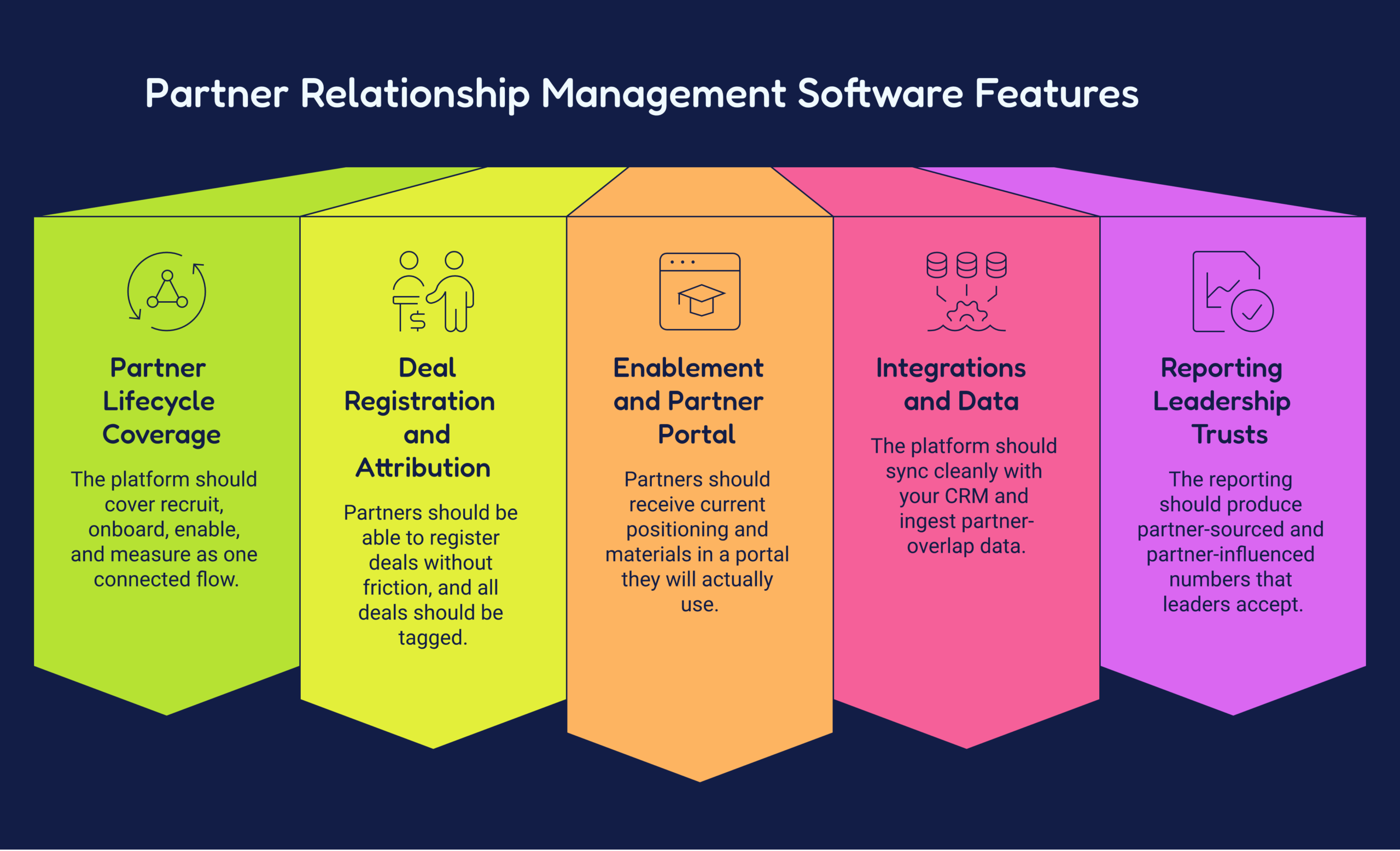
- Partner lifecycle coverage: Check that the platform handles recruit, onboard, enable, and measure as one connected flow, not as separate bolt-ons. A system that onboards but cannot attribute leaves you back in the spreadsheet for the part that matters most.
- Deal registration and attribution: Confirm partners can register a deal without friction and that every partner-sourced and partner-influenced deal is tagged from the first touch. Attribution is the reason the program gets funded, so it cannot be an afterthought.
- Enablement and partner portal: Look at whether partners get current positioning and materials in a portal they will actually use. Enablement that is hard to reach goes stale, and stale enablement loses deals quietly.
- Integrations and data: Verify the platform syncs cleanly with your CRM and can ingest partner-overlap or account-mapping data, so the system reflects reality rather than a parallel truth.
- Reporting leadership trusts: Make sure the reporting produces partner-sourced and partner-influenced numbers in a form your finance and revenue leaders accept, next to direct pipeline. Reporting nobody trusts is reporting nobody uses.
You are evaluating well when each criterion maps to a motion you actually run, and badly when you are comparing feature counts between vendors whose strengths you have not tied to your own program.
Common pitfalls when buying partner relationship management software
- Buying before the motion is defined: Software automates whatever process you hand it, so an undefined program just gets automated confusion. Write the recruit-onboard-enable-measure motion down before the demos start.
- Optimizing for the portal, not the attribution: A pretty partner portal is easy to demo and easy to over-weight. The part that earns budget is attribution, so weight the evaluation toward it.
- Ignoring CRM integration depth: A PRM platform that only loosely syncs with your CRM creates a second source of truth and constant reconciliation. Test the integration on real records, not a sandbox.
- Sizing for today only: Buying for the one partner motion you run now, with no path to the others you will add, means a rebuy in a year. Size for the motions you can anticipate.
Tools and examples
The market splits into recognizable groups, and the right purchase depends on which motions you run and how deep your data needs go. The table frames the groups rather than ranking individual products.
| Tool group | What it is built for | Representative platforms |
|---|---|---|
| Full-suite PRM | Recruit, onboard, enable, deal-reg, and reporting end to end | Impartner, Allbound, ZINFI, Introw, Euler |
| Ecosystem and overlap data | Account mapping and partner overlap that feeds co-sell | Crossbeam, Pocus, Common Room |
| Cloud co-sell and marketplace | Routing co-sell through hyperscaler marketplaces | Tackle, Labra, Suger, Clazar |
A worked example: a company evaluating partner relationship management software wrote its five criteria first, then ran three demos scored against them. The flashiest portal lost because its attribution was thin and its CRM sync created duplicate records. The platform they chose was middle of the pack on portal polish but strong on deal registration, attribution, and CRM depth, the three things their motion actually depended on. The lesson was that the right software is the one that fits the motion, not the one that demos best.
Forecastable’s POV on partner relationship management software
The position we hold is that you buy software to run a motion you have already defined, never to discover one. Teams that shop first and design later end up with an expensive system that automates a vague program. Teams that define recruit, onboard, enable, and measure on paper, then score vendors against it, buy the right thing the first time.
The second conviction is that attribution outranks the portal in every honest evaluation. The portal is what partners see, but the partner-sourced number is what keeps the program funded. Weight the decision toward the system that produces a number your finance team will accept, because that is the part of the purchase that pays for itself.
The third point is about integration honesty. A PRM platform lives or dies on how well it syncs with your CRM, and that is the hardest thing to judge from a demo. Test it on real records before you sign, because a second source of truth costs more in reconciliation than the license ever saves.
Forecastable is a partnerships operating platform; any third-party tools or platforms referenced here are independent third-party products, and naming them is not an endorsement of one deployment over another. Evaluate each against your own motion.
Frequently asked questions
What does partner relationship management software do?
It runs the partner program end to end: recruiting, onboarding, enablement, deal registration, and reporting of partner-sourced and partner-influenced revenue, all in one system of record.
How is PRM software different from a CRM?
A CRM manages direct prospects and customers. PRM software manages the indirect motion, including partner-specific mechanics like deal registration and margin claims that a CRM was not built to handle.
What should I evaluate PRM software on?
Lifecycle coverage, deal registration and attribution, enablement and portal usability, CRM and data integration, and reporting your leadership trusts. Score each against the motion you actually run.
How much does partner relationship management software cost?
Pricing varies widely by partner count, motions covered, and depth, so the useful comparison is cost against the partner-sourced revenue the system helps you report and grow, not license price alone.
When is a spreadsheet no longer enough?
When deal registrations, onboarding, and reporting can no longer be tracked reliably by hand, and you cannot answer which partner sourced which deal without reconstructing it manually.
Does partner relationship management software replace a CRM?
No. The CRM stays the source of truth for direct pipeline, and the PRM software runs the partner-specific motion and reconciles back to it. The two work together rather than overlapping.
How long does PRM software take to implement?
It depends on integration depth and how much you configure at launch. Teams that scope the motion first and configure only what they run now go live faster than teams that customize everything before launch.
Next step
If you are about to book PRM software demos, write your five evaluation criteria first and score every vendor against the motion you run. The flashiest demo and the right purchase are rarely the same system.
Start your growth journey now to define the motion before you buy, or get the broader orientation on partner technology and PRM.
Uncover Your Growth Potential
Schedule a Discovery Call