Partner Relationship Management Platform: What to Know

What is a partner relationship management platform?
Short answer: A partner relationship management platform is the configurable system that runs an entire partner motion, recruiting, onboarding, enablement, deal registration, and reporting, and connects to the rest of your go-to-market stack. It is more than a portal: it is the place you operationalize the partner program and wire it into your CRM and data so the motion runs without manual glue.
A partner relationship management platform differs from a single-purpose tool in that it is built to be configured and integrated. The value is not only the features it ships with but how well it adapts to your motion and connects to your CRM, overlap data, and marketplaces. A platform you cannot shape to your program is just a portal with a longer feature list.
Why a partner relationship management platform matters in 2026
A partner relationship management platform matters in 2026 because partner motions have grown too varied to run on rigid tooling. A program might register reseller deals, co-sell with technology partners, and route some deals through a marketplace, and a platform that bends to all three beats three tools that each handle one.
The second reason is integration. Partner-influenced revenue only becomes a trusted number when the platform reconciles with the CRM and ingests the data that drives co-sell. A platform that automates the motion and keeps one source of truth is what turns partner activity into a figure leadership accepts, rather than a parallel record nobody believes.
How a partner relationship management platform actually works
A partner relationship management platform works by combining a configurable core with the integrations that connect it to your stack. The capabilities below are what separate a true platform from a fixed portal.
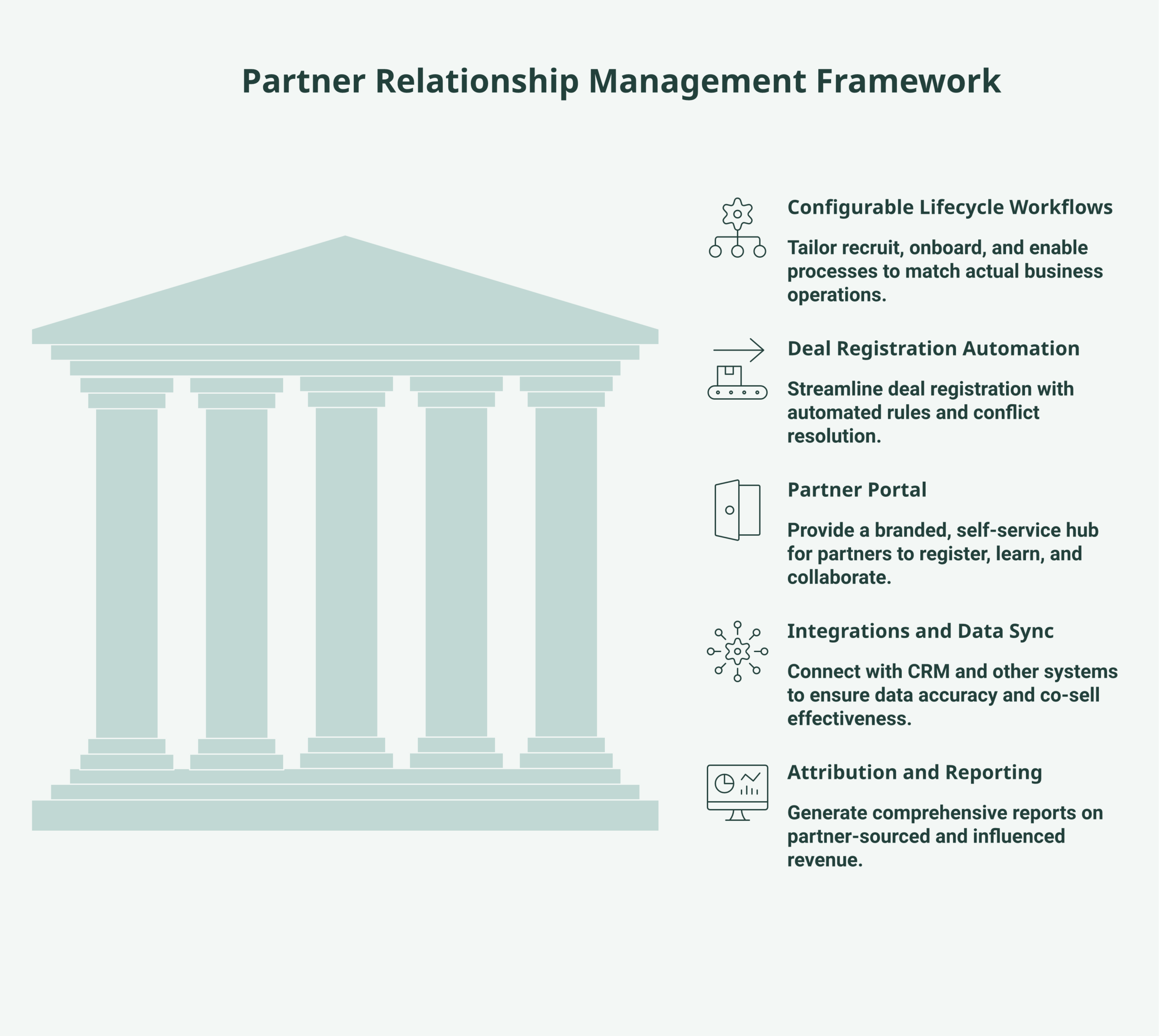
- Configurable lifecycle workflows: Shape recruit, onboard, and enable steps to your actual motion rather than accepting a fixed template. A platform that bends to your program is the point of buying a platform at all.
- Deal-registration automation: Automate registration rules, conflict handling, and routing so attribution starts at first touch without manual policing. Automation here is what keeps the registration data clean enough to trust.
- Partner portal: Give partners one configurable place to register, learn, and self-serve, branded and shaped to how your partners actually work.
- Integrations and data sync: Connect to the CRM as source of truth and ingest overlap or account-mapping data, so the platform reflects reality and co-sell is driven by real signals.
- Attribution and reporting: Produce partner-sourced and partner-influenced numbers that reconcile with direct pipeline, configurable to the way your leadership reads revenue.
The platform is working when your specific motion runs inside it with automation handling the routine, and underused when you have adapted your program to fit the tool instead of the reverse.
Common pitfalls when choosing a partner relationship management platform
- Buying a portal and calling it a platform: A fixed portal with a feature list is not a platform you can shape. Test configurability against your real motion, not the vendor’s default template.
- Underrating integration depth: A platform that only loosely syncs with your CRM creates a second source of truth. Integration depth is the hardest thing to judge from a demo and the most expensive to get wrong.
- Over-configuring on day one: A configurable platform invites endless customization that delays launch. Configure for the motion you run now, and extend as the program grows.
- Ignoring automation quality: Manual deal-registration policing does not scale. If the platform cannot automate registration rules and routing cleanly, the data degrades and attribution with it.
Tools and examples
Platforms fall into recognizable groups by the motion they best support. The table frames the groups so you can match a platform to your program.
| Tool group | Platform strength | Representative platforms |
|---|---|---|
| Full-suite PRM | Configurable lifecycle, deal-reg automation, reporting | Impartner, Allbound, ZINFI, Introw, Euler |
| Ecosystem and overlap data | Account-mapping data that feeds co-sell | Crossbeam, Pocus, Common Room |
| Cloud co-sell and marketplace | Routing co-sell through hyperscaler marketplaces | Tackle, Labra, Suger, Clazar |
A worked example: a team chose a partner relationship management platform specifically because their motion did not fit a template. They configured the onboarding flow to their two partner types, automated deal-registration routing so conflicts resolved without a human, and wired the platform to their CRM and an overlap-data source. The platform earned its cost not through any single feature but because it bent to a motion that a fixed portal would have forced them to abandon.
Forecastable’s POV on a partner relationship management platform
The position we hold is that the word platform should mean configurable and connected, and if it does not, you are buying a portal. The reason to choose a platform over a point tool is that your motion is specific, so the test is whether it adapts to your program and integrates with your stack, not how long its feature list runs.
The second conviction is that integration depth is the quiet deciding factor. Two platforms can look identical in a demo and differ entirely in production because one keeps a clean CRM sync and the other spawns a second source of truth. Prove the integration on real records before you commit.
The third point is restraint in configuration. A platform that can do anything tempts teams to configure everything, which delays launch and complicates support. Configure for the motion you run today, launch, and extend as the program actually grows into new motions.
Forecastable is a partnerships operating platform; any third-party tools or platforms referenced here are independent third-party products, and naming them is not an endorsement of one deployment over another. Evaluate each against your own motion.
Frequently asked questions
What is a partner relationship management platform?
A configurable system that runs an entire partner motion, recruiting, onboarding, enablement, deal registration, and reporting, and connects to your CRM and data stack.
How is a PRM platform different from a PRM tool or portal?
A portal mainly gives partners a login and content. A platform runs the full motion, can be configured to your program, and integrates with your stack, so it adapts rather than forcing your program to fit it.
What should I evaluate in a PRM platform?
Configurability against your motion, deal-registration automation, portal usability, CRM and data integration depth, and attribution that reconciles with direct pipeline.
Does a PRM platform integrate with a CRM?
A good one does, with the CRM as source of truth. Integration depth is the most production-critical and least demo-friendly criterion, so test it on real records.
Is a PRM platform worth it for a small program?
If the motion is simple, a lighter tool may be enough. A platform pays off when the motion is specific or varied enough that configurability and integration matter.
How do I test configurability in a demo?
Bring your real motion and ask the vendor to configure it live: your partner types, your onboarding steps, your deal-registration rules. A platform that can only show its default template is a portal in disguise.
What slows down a PRM platform rollout?
Over-configuration before launch and a CRM integration that was never tested on real records. Configure for the motion you run now, prove the sync early, and extend once the program is live.
Next step
If a vendor calls its product a platform, make it prove the word by configuring your real motion in the demo and syncing real CRM records. A platform that cannot bend to your program is a portal with a price tag.
Start your growth journey now to define the motion your platform has to run, or get the broader orientation on partner technology and PRM.
Uncover Your Growth Potential
Schedule a Discovery Call