Skip to content
Logo โ€” Itโ€™s All AboutThe Team
  • Home
  • Who We Serve
    • By Category
      • SaaS
      • Professional Services
      • Platforms (Large Ecosystems)
      • Private Equity
    • By Role
      • Chief Revenue Officers (CRO)
      • Chief Financial Officers (CFO)
      • Chief Marketing Officers (CMO)
      • Chief Executive Officers (CEO)
      • Sales Leaders
      • Partnership Professionals
  • Solutions
    • By Partner Program Maturity
      • Partnerships Foundation
      • Partnerships Acceleration
      • Ecosystem-Wide Orchestration
    • Specialized Solutions
      • Net-New Named Account Development
      • Large Ecosystems
      • M&A: Post-Acquisition Internal Cross-Selling
  • Pricing
  • Education
  • Company
    • Our History
    • Security
  • Login
Logo โ€” Itโ€™s All AboutThe Team
  • Home
  • Who We Serve
    • By Category
      • SaaS
      • Professional Services
      • Platforms (Large Ecosystems)
      • Private Equity
    • By Role
      • Chief Revenue Officers (CRO)
      • Chief Financial Officers (CFO)
      • Chief Marketing Officers (CMO)
      • Chief Executive Officers (CEO)
      • Sales Leaders
      • Partnership Professionals
  • Solutions
    • By Partner Program Maturity
      • Partnerships Foundation
      • Partnerships Acceleration
      • Ecosystem-Wide Orchestration
    • Specialized Solutions
      • Net-New Named Account Development
      • Large Ecosystems
      • M&A: Post-Acquisition Internal Cross-Selling
  • Pricing
  • Education
  • Company
    • Our History
    • Security
  • Login
  • Home
  • Who We Serve
    • By Category
      • SaaS
      • Professional Services
      • Platforms (Large Ecosystems)
      • Private Equity
    • By Role
      • Chief Revenue Officers (CRO)
      • Chief Financial Officers (CFO)
      • Chief Marketing Officers (CMO)
      • Chief Executive Officers (CEO)
      • Sales Leaders
      • Partnership Professionals
  • Solutions
    • By Partner Program Maturity
      • Partnerships Foundation
      • Partnerships Acceleration
      • Ecosystem-Wide Orchestration
    • Specialized Solutions
      • Net-New Named Account Development
      • Large Ecosystems
      • M&A: Post-Acquisition Internal Cross-Selling
  • Pricing
  • Education
  • Company
    • Our History
    • Security
  • Login
Back to all blogs
  • Partnerships Strategy & Leadership
Alex Buckles

Partner Battle Card: Building One AEs Actually Use

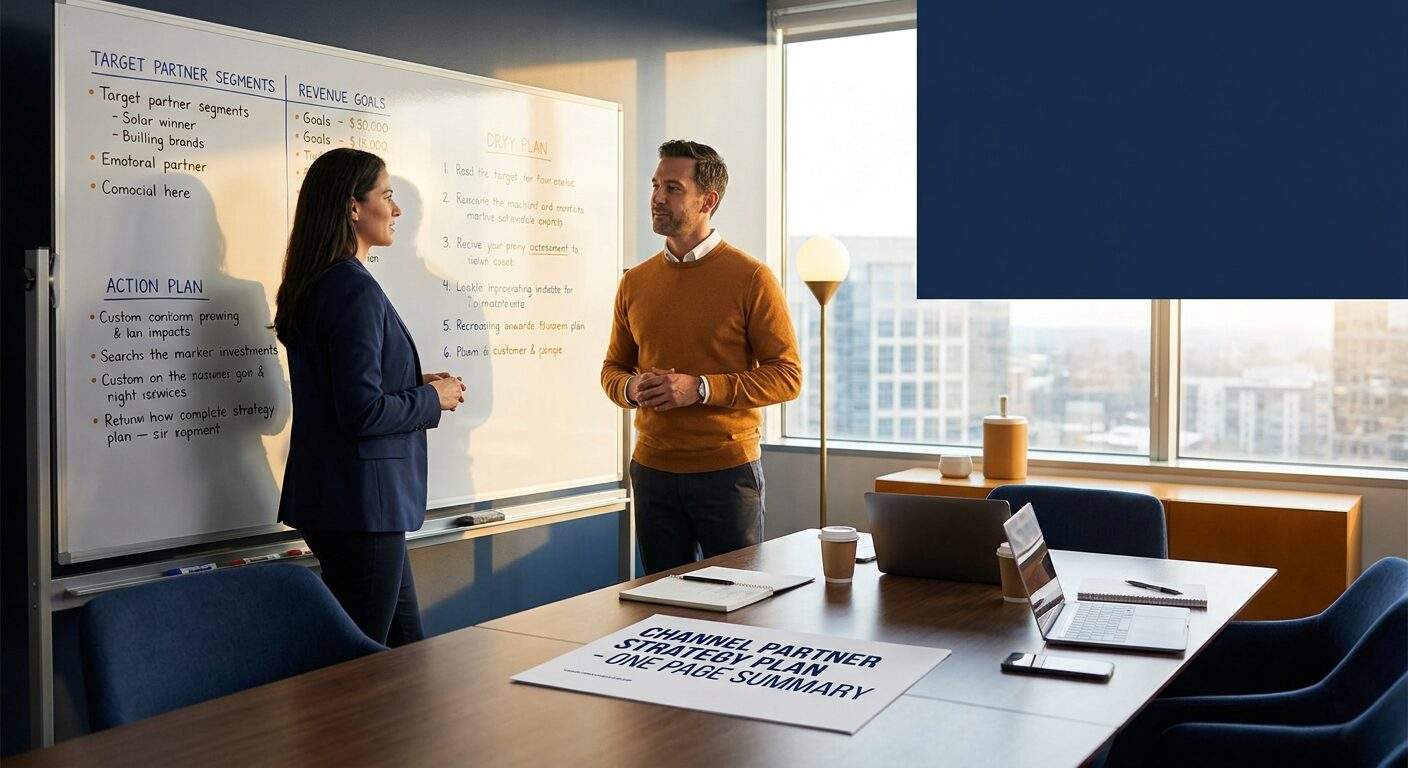
A partner manager and an account executive at a desk reviewing a printed partner battle card with co-sell talking points and a competitive landscape table while a laptop shows a joint pitch deck and an account list, deep navy and warm amber palette

What is a partner battle card?

Short answer: A partner battle card is the one-to-two page AE-facing enablement asset that names the joint value, the named buying personas, the co-sell motion, and the head-to-head competitive position when a host product and a partner product are sold together. It exists because AEs cannot remember the joint story across ten partners, and the partner side cannot remember the host story across fifty co-sell motions. The card is the operating artifact that compresses the joint pitch into something the AE can read on the way to the meeting.

The shortcut is to treat the partner battle card as a sales tool, not a marketing asset. The card has to answer the AE’s three questions before the meeting (who is the buyer, what is the joint pitch, what is the next move) in under three minutes.

Why partner battle cards matter in 2026

Three forces have made the partner battle card central to co-sell execution. First, co-sell motions have stratified across more partners than AEs can carry in their heads; a typical mid-market AE works between three and seven active partner motions and cannot keep them straight without a written reference. Second, the buying committees on co-sell deals have grown, and the AE needs the joint persona map at the meeting, not in a deck back at the office. Third, the partner-side seller is asking for the same card from the host side, and the absence of a working card is a leading indicator of a partner-led motion that will not scale.

A working partner battle card is read in three minutes, lives in the CRM or the PRM, and gets updated quarterly. The teams that produce cards that no AE reads have built marketing assets; the teams that produce cards AEs actually use have built a sales tool.

The shortcut is to write the card with the AE in the room, not for the AE. Co-author the first version with the host AE who has actually run the joint pitch, and iterate against three more AEs before the card ships.

How a partner battle card actually works

A working partner battle card runs on six components. Each component is short, named, and built for AE retention.
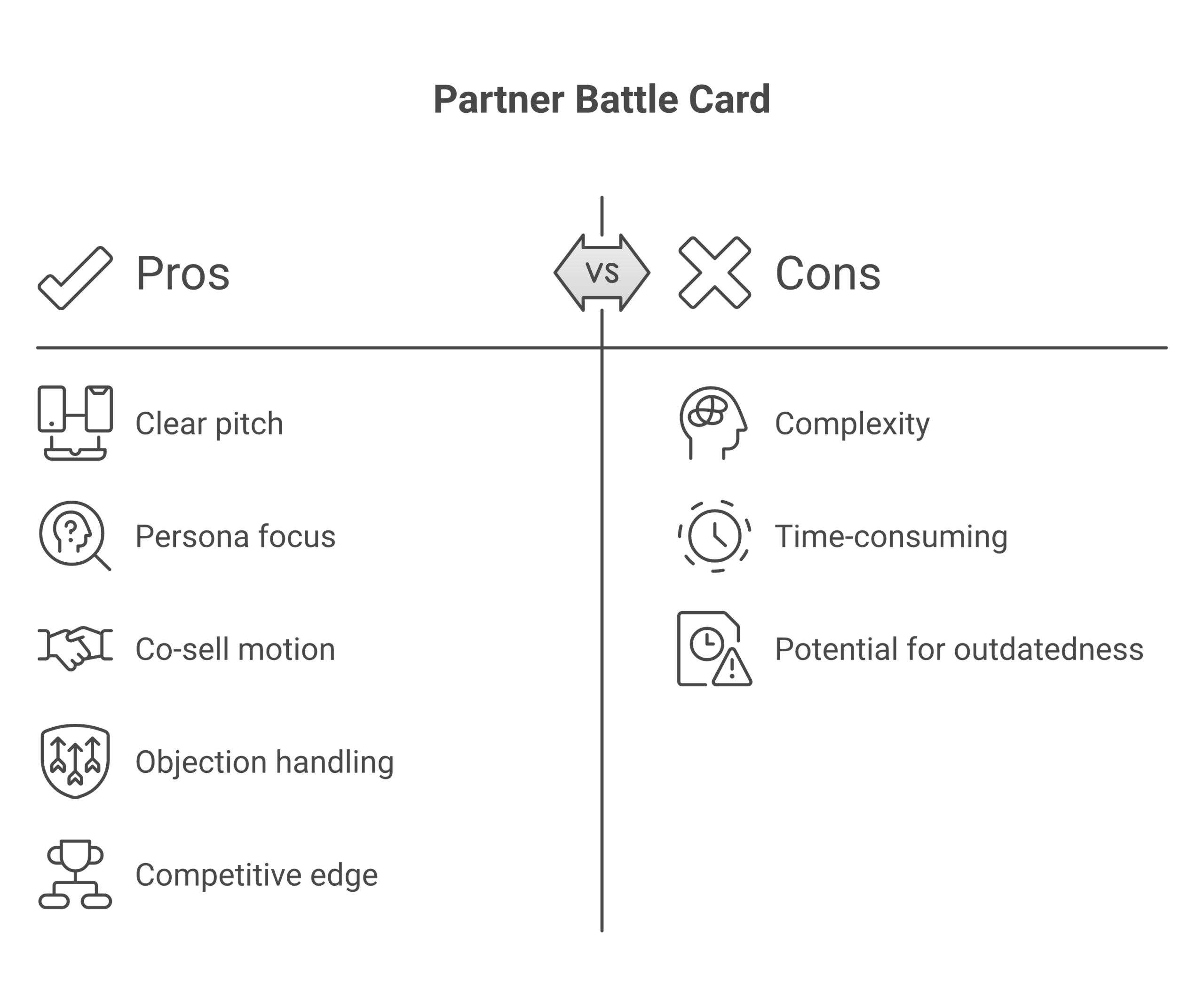
Six-component working format for an AE-facing partner battle card from joint pitch to next move.

  1. The joint pitch in two sentences: Not the product pitch, not the partner pitch. The specific outcome the customer gets when the two products are deployed together, in the language the buyer uses.
  2. The named buying personas: One to three buyer titles (CRO, head of revenue ops, head of finance) with the named pain each persona owns and the joint move that addresses it. Personas are not generic; they are the specific roles the AE will meet.
  3. The co-sell motion: A two-step play. Step one names the partner-side counterpart the AE calls before the customer meeting. Step two names the joint move (joint discovery, technical pre-brief, exec intro, joint pitch deck). The card lists the partner-side rep, the slack channel, and the response SLA.
  4. The objection bank: The three objections that come up on co-sell deals (pricing, integration, support model) with a one-sentence response and the named asset to send. Objection bank lives at the bottom of the card so the AE can scroll to it during a call.
  5. The competitive position: Where the joint pitch lands against the named competitive alternative the buyer is also evaluating. The position has to be defensible and short; a long competitive section is a leading indicator that the card will not get read.
  6. The next move: The action the AE takes after the customer meeting. Usually a joint follow-up, a partner-side technical brief, or a registration in the PRM (Introw, Euler, Impartner, PartnerStack, or Channelscaler).

A card with all six runs at one to two pages, fits on one screen, and reads in under three minutes.

Common pitfalls in building a partner battle card

  • Writing the card in marketing voice instead of AE voice: A card written by product marketing reads like a brochure; a card written with an AE in the room reads like a sales tool. AEs ignore brochures.
  • Three pages of joint value and one paragraph of co-sell motion: The joint value is the headline, but the co-sell motion is the operating instruction. Most cards over-invest in the headline and under-invest in the named move; the card has to flip the ratio.
  • Skipping the named partner-side counterpart: A card that says “engage your partner contact” without naming the rep, the slack channel, and the response SLA produces nothing. The named counterpart is what turns the card into a motion.
  • No quarterly refresh: Partner products change, joint pricing changes, partner roster changes. A stale card is worse than no card; the AE reads it, runs the old motion, and the partner side is annoyed. Update quarterly.
  • One card per partner with no host-product spine: AEs cannot hold ten different partner narratives in their head. The card has to slot into the AE’s existing product narrative; the partner-specific moves are the variant, not the spine.

What this looks like in practice

A growth-stage B2B SaaS team had thirteen Tier 1 partners and seven Tier 2 partners; AEs were carrying the joint pitches in their heads and the win rate on co-sell deals was inconsistent. The head of partnerships ran a card-building workshop with three AEs in the room, an established Tier 1 SI as the first partner, and the joint customer outcome as the anchor. The first card came in at one and a half pages: two-sentence joint pitch, three buying personas with named pain, a two-step co-sell motion with the SI’s regional MD named, three objections with one-sentence responses, a one-paragraph competitive position against the named alternative, and a next-move section that pointed at the Introw deal registration. The card lived on the partner record in Introw and opened from the opportunity in Salesforce when the partner tag was applied. Within six weeks, AEs were reading the card before partner meetings, the partner-side response SLA had tightened from three days to one, and the win rate on co-sell deals with the SI had moved from forty-six percent to sixty-one percent. Twelve more cards were built over the next quarter on the same template.

Forecastable’s POV on partner battle cards

The partner battle card is the operating artifact that connects the joint pitch to the AE workflow. The teams that produce cards AEs actually use treat the card as a sales tool, build it with an AE in the room, and update it quarterly. The teams that produce cards that sit in a SharePoint folder have built a marketing asset and called it a battle card.

The deeper read is that the card is the most teachable partner enablement artifact a partnerships team can ship in its first year. The unit of work is small (one to two pages per partner), the iteration loop is short (build, test on three AEs, refine, ship), and the impact is measurable in win rate on the partner-tagged opportunities. A team that ships ten working cards in a quarter has installed an AE-side co-sell motion the rest of the program can build on.

The candor on the partner-side card question is that the host has to build the host-side card and the partner has to build the partner-side card, and the two have to align on the joint pitch and the co-sell motion. A one-sided card produces a one-sided motion; the joint planning has to include the partner-side counterpart.

The candor on tooling is that the card lives where the AE works. If AEs live in the CRM, the card lives in the CRM. If AEs live in the PRM, the card lives in the PRM. Putting the card in a wiki or a slide deck that AEs do not open is a leading indicator that the card will not get read.

Forecastable is a partnerships operating platform; the tools above (Crossbeam, Pocus, Common Room, Tackle, Labra, Suger, Clazar, Introw, Euler, Impartner, PartnerStack, Channelscaler) are independent third-party platforms, and naming them is not an endorsement of any specific deployment over another. Evaluate each on your own motion.

Frequently asked questions

What is the right length for a partner battle card?
One to two pages, readable in under three minutes. Longer cards do not get read; shorter cards leave the co-sell motion ambiguous.

Who owns the partner battle card?
The partner manager owns the card; the partner-side counterpart contributes the partner narrative; an AE who has run the joint pitch is the third author. Marketing supports the asset hygiene but does not own the content.

How often should a partner battle card be updated?
Quarterly. Stale cards run stale motions; a partner roster or pricing change without a card update is a leading indicator of a missed quarter on the partner motion.

Where does the partner battle card live?
In the PRM (Introw, Euler, Impartner, PartnerStack, or Channelscaler) on the partner record, with a link from the CRM opportunity when the partner tag is applied. The card opens from the place the AE works.

Should we build one card per partner or one card per joint motion?
One card per partner is the default; if the partner runs multiple distinct joint motions (different products, different segments, different geos), one card per motion. The test is whether the AE would need different content at the meeting.

Should we include pricing on the partner battle card?
Indicative pricing for the joint pitch, not list pricing. The card has to give the AE enough to qualify the deal at the meeting; full pricing lives in the deal record.

How does a partner battle card relate to a joint value proposition?
The joint value proposition is the message; the partner battle card is the operating artifact that carries the message into the AE workflow. The two are different; the card is downstream of the JVP and operationalizes it.

Next step

If a partner battle card is open this quarter, the move this week is to run a card-building workshop with three AEs and the named partner counterpart, anchor the card on a real joint customer outcome, and ship the first version on one partner before scaling.

Start your growth journey now to install a working partner battle card motion in your specific environment, or read the orientation on the partner program for the broader operating model.

Uncover Your Growth Potential

Whether starting with a single sales team or a single partner, any co-sell motion can be live within 30 days.

Schedule a Discovery Call
Latest Insights
Three businessmen seated at a wooden table review a document during a meeting in a modern office, with graphs displayed on a monitor in the background.
  • Partnerships Strategy & Leadership
Alex Buckles

MEDDIC Partnerships: Qualifying Co-Sell Deals That Close

What is MEDDIC for partnerships? Short answer: MEDDIC partnerships is the application of the classic sales qualification frame (Metrics, Economic buyer, Decision criteria, Decision process, Identify pain, Champion) to co-sell and partner-sourced deals, with a partner-side mirror on every letter so the host AE and the partner counterpart qualify the same opportunity on the same […]

Read Article
Two B2B executives across a conference table reviewing a printed OEM contract draft alongside a reseller agreement, with discount tier annotations visible, deep navy and amber palette
  • Partnerships Strategy & Leadership
Alex Buckles

OEM vs Reseller: A 2026 Comparison for Programs

What is the difference between OEM and reseller? Short answer: OEM vs reseller is the decision between embedding your product inside a partner’s offering (OEM) versus letting a partner sell your product as-is alongside theirs (reseller). The two motions look adjacent and produce opposite operating models. The economics, the legal posture, the support model, and […]

Read Article
Partner manager walking a head of sales through a CRM-grade partner pipeline on a wall monitor with named deals visible at the stage level, deep navy and amber palette
  • Partnerships Strategy & Leadership
Alex Buckles

Partner Manager Skills: A 2026 Operating Profile

What partner manager skills predict performance in 2026? Short answer: partner manager skills are the operational competencies a partner manager needs to produce partner-sourced and partner-influenced pipeline at scale, hunter orientation, pipeline discipline, partner-manager execution, internal selling, and ecosystem fluency. In 2026, these five competencies determine whether a partner manager produces deals or produces meetings, […]

Read Article
Two sellers from different B2B companies presenting a joint value proposition to a customer in a calm modern conference room with a printed seller script visible on the table, deep navy and amber palette
  • Partnerships Strategy & Leadership
Alex Buckles

Partner Messaging: A 2026 Framework for Co-Sell

What is partner messaging? Short answer: partner messaging is the joint narrative two partner companies use to position a combined offering to a shared customer, covering the joint value proposition, the buyer-fit segmentation, the proof points, and the specific scripts both sales teams use in the room. In 2026, it is the single most undervalued […]

Read Article
Logo โ€” Itโ€™s All AboutThe Team

Quick Links

  • Who We Serve
  • Solutions
  • Resources
  • Pricing
  • Our History

Social Media

  • Linkedin

Legal

  • Privacy Policy
  • Terms of Service
Quick Links
  • Who We Serve
  • Solutions
  • Resources
  • Pricing
  • Our History
Social Media
  • Linkedin
Legal
  • Privacy Policy
  • Terms of Service

Stay ahead on ecosystem-led growth

Logo โ€” Itโ€™s All AboutThe Team
ยฉ 2025 Forecastable. All rights reserved.
Book Your Strategy Call
Request Enrollment Details

[contact-form-7 id=”dfbeed3″ title=”Request Enrollment Details”]

Mollie Bodensteiner

Revops Advisory
  Mollie Bodensteiner is an experienced operations professional with a demonstrated track record of utilizing technology to support operational processes that drive performance and innovation. She currently is the Vice President of Operations at Sound and owns go-to-market agency, MB Solutions. Mollie has previously held operations leadership roles at Deel, Syncari, Corteva and Marketo. She has over 14 years of experience in both B2C and B2B operations and technology. When she is not working, Mollie enjoys spending time with her husband, three small children, and two large dogs. Childhood Career/Dream: Growing up in the age of Disney and Nick@Nite I always wanted to be a child actor (good thing that never was actually pursued ๐Ÿ™‚ Favorite Win: I am not sure I have a specific โ€œwinโ€ but I think I get the most joy and excitement from coaching others and watching them hit major milestones in their career. The first time you get to promote someone on your team or watch them lead a major project – are always career highlights! Personal Fun Facts: Favorite Song: If itโ€™s love, Train Favorite Movie: Good Will Hunting Favorite Meme: Disaster Girl
Forecastable resources: Co-Sell Orchestration Platform · All Use Cases · Live in 30 Days · Co-Sell Playbook

Kelsey Buckles

Director of Operations


My journey from Education to Operations has equipped me with a unique perspective and skill set that perfectly aligns with Forecastable’s mission to help businesses improve sales collaboration through partner co-selling strategies.

At Forecastable, I am passionate about empowering teams and organizations to unlock the full potential of strategic partnerships. By leveraging my expertise in communication, leadership, and operational efficiency, I contribute to creating seamless co-selling processes that align with business goals and deliver exceptional results.

The intersection of my educational foundation and operational experience fuels my dedication to fostering alignment, building trust, and enhancing collaboration between partners. I am driven by the opportunity to contribute to a platform that not only optimizes sales strategies but also strengthens relationships that lead to long-term growth.

Paul Jonhson

Chief Technology Officer (Co-founder)


Paul Johnson has 20+ years of software development and consulting experience for a variety of organizations, ranging from startups to large-enterprise organization with highly-complex needs.

Mr. Johnson has a long track record of successful technology deployments.
This, combined with his deep passion for machine learning and exceptional user experience design, allows him to lead our technical direction from the front with confidence.

Alex Buckles

Product, Partnerships, and Value Engineering (Co-founder)


After serving in The United States Marine Corps, Alex Buckles spent the next two decades as a student of revenue production and an advocate for innovation.

Along the way, he has helped numerous companies achieve double and triple-digit growth by crafting and executing high-performing go-to-market strategies, with co-selling at the center of each.

As a once-advanced technical marketer, an expert sales & partner professional, and a strong customer success advocate, Mr. Buckles understands the impact of these functions aligning not only on revenue production, but on the day-to-day execution of the go-to-market strategy. This concept of revenue-team alignment is what quickly became the foundation of Forecastable back in January of 2018.

In his free time, youโ€™ll find him spending quality time with his children, one of whom is on the autism spectrum. 1 in 36 children in the U.S. are on the spectrum and boys are four times more likely to be diagnosed than girls.

With that in mind, Mr. Buckles plans on dedicating the rest of his life serving those living with autism, through his organization Pathways for Autism. From his perspective, there must be a scalable and financially self-sustaining infrastructure established to put as many individuals with autism as possible on a path towards complete independence as adults.