MEDDIC Partnerships: Qualifying Co-Sell Deals That Close

What is MEDDIC for partnerships?
Short answer: MEDDIC partnerships is the application of the classic sales qualification frame (Metrics, Economic buyer, Decision criteria, Decision process, Identify pain, Champion) to co-sell and partner-sourced deals, with a partner-side mirror on every letter so the host AE and the partner counterpart qualify the same opportunity on the same evidence. It exists because partner deals fail at qualification more often than they fail at close, and the failure is usually the partner side missing the champion or the economic buyer.
The shortcut is not to invent a new frame for partner deals; it is to run MEDDIC on the host side and run MEDDIC on the partner side and reconcile the two reads in the deal review. The disagreements between the two reads are where the deal lives.
Why MEDDIC partnerships matters in 2026
Co-sell deals carry a structural risk that direct deals do not. The partner-side seller often has different incentives, a different visibility into the buying committee, and a different definition of qualification than the host AE. The two sides agree the deal is real, push it to forecast, and one of them learns at the end of the quarter that the other side never had the economic buyer.
Three forces have made the MEDDIC partnerships question more important in the last two years. First, partner sourcing now produces a meaningful share of pipeline at programs that have matured past the recruiting stage, and the finance side is asking for a fundable forecast on those opportunities. Second, the partner-side compensation structures have stratified (partner-sourced commission, partner-influenced bonus, co-sell SPIFs), and the qualification standard has to be the same regardless of who gets paid. Third, the buying committees on co-sell deals are larger and more cross-functional than direct deals, and the champion and the economic buyer are not always on the same side of the table.
A working MEDDIC partnerships motion installs the same scoring on the host and partner side, runs the reconciliation in a recurring deal review, and treats the disagreements as the actual qualification work.
How MEDDIC partnerships actually works
A working motion runs on five steps. Each step has a named artifact and a named owner on both sides of the deal.
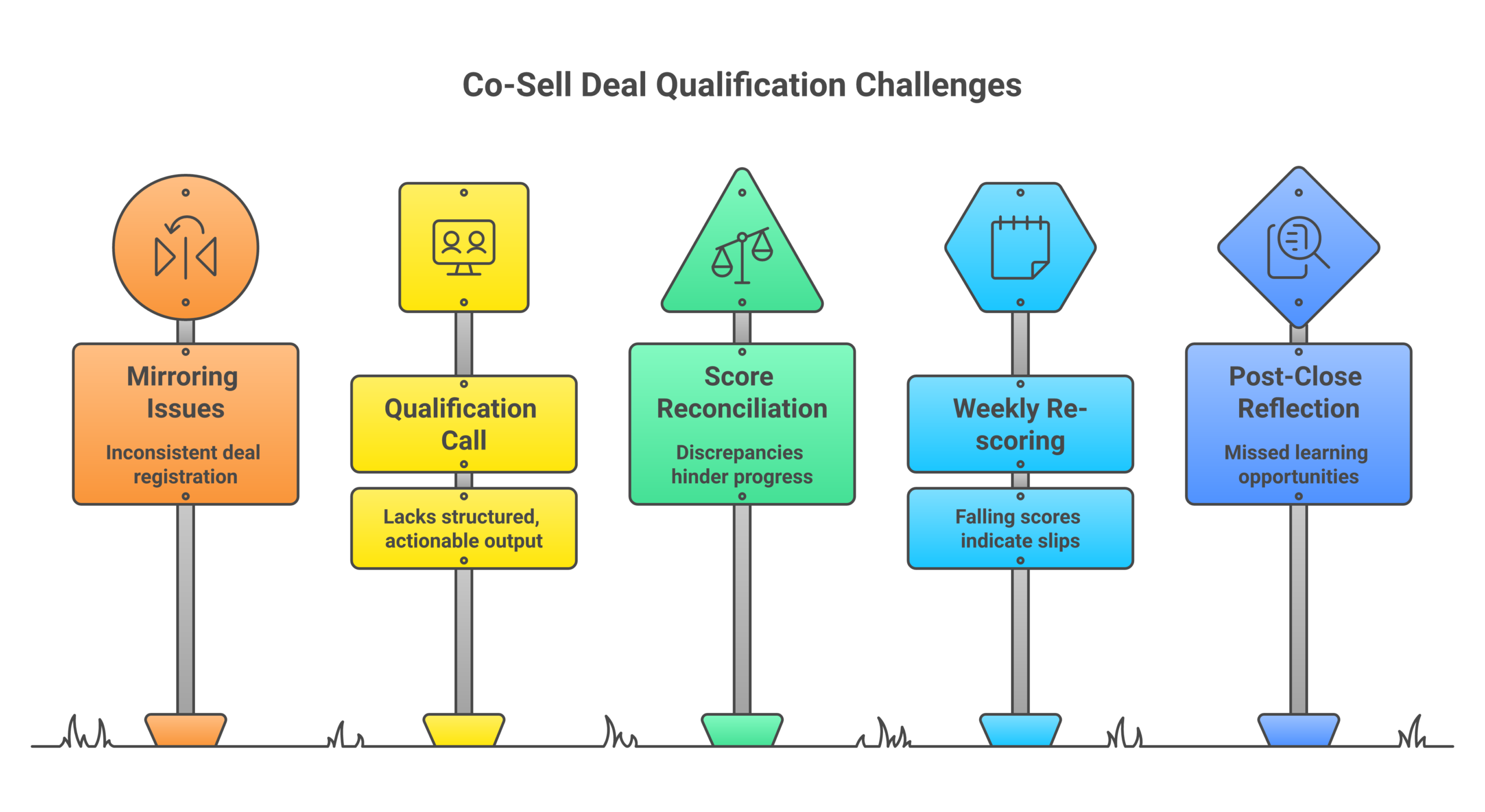
- Establish the partner-side mirror at deal registration: When the deal registers in the PRM (Introw, Euler, Impartner, PartnerStack, or Channelscaler), the registration form captures the partner-side read on metrics, economic buyer, champion, and decision process. Empty fields are the first qualification flag.
- Run a joint qualification call in the first week: The host AE and the partner-side seller jointly walk MEDDIC with the prospect, with the partner side leading the relationship moves and the host side leading the product and pricing moves. The call produces a one-page scorecard.
- Score the deal on both sides and reconcile in the deal review: Each side scores M, E, D, D, I, C on a 0 to 2 scale. The reconciliation surfaces every disagreement; the partner manager owns the resolution.
- Re-score weekly through the close plan: MEDDIC scoring is a state, not a stamp. The score moves up and down as the close plan executes, and a falling score on E or C is the leading indicator of a slipping deal.
- Run the post-close MEDDIC reflection on every closed-won and closed-lost: The two sides debrief on which letter actually moved the deal and which letter was inflated at qualification. The reflection compounds across the next ten deals.
The motion runs on a weekly thirty-minute deal review and a monthly partner business review.
Common pitfalls in running MEDDIC partnerships
- Treating the partner-side read as the same as the host-side read: The partner-side seller usually has the relationship moves but not the buying-committee map. The host AE usually has the buying-committee map but not the relationship trust. Running one MEDDIC score across both sides loses the disagreement that produces the qualification work.
- Inflating C (Champion) on the strength of one friendly meeting: A real champion has explicit influence on the decision criteria and the economic buyer’s evaluation. One friendly meeting with a sponsor who likes the product is not a champion; the score should stay at 0 or 1 until the influence is demonstrated.
- Skipping E (Economic buyer) on enterprise deals because the partner side does not know who it is: The most common slipped-deal pattern. If the partner-side seller cannot name the economic buyer, the deal does not have one yet, and the close date is wrong. Push the qualification call to find the EB before the deal is forecast.
- Scoring once at deal registration and never re-scoring: MEDDIC is a state, not a stamp. The buying process moves, the committee shifts, the criteria change. Re-score weekly; the trend matters more than the snapshot.
- No post-close MEDDIC reflection: The compounding gain is in the reflection, not the score. A team that debriefs ten deals and finds the same letter inflated each time has surfaced a systemic qualification gap; without the reflection, the gap re-creates itself.
What this looks like in practice
A mid-market B2B software vendor co-sells with a Tier 1 SI partner into a regional bank prospect. The deal registers in Introw with the partner-side read on champion at score 2 (the SI’s regional MD knows the bank’s CIO) and the host-side read on champion at score 0 (no host-side relationship yet). The joint qualification call surfaces that the EB is not the CIO but the CFO, that the decision criteria are anchored on a six-week pilot, and that the SI’s relationship is real but does not extend to the CFO. The two sides reconcile: champion stays at 1 until the CFO is named and met, the EB scoring drops to 1 from 2, and the close plan now includes a CFO-introduction move owned by the SI’s regional MD with a host-side technical pre-brief. The deal closes six weeks later at forecasted ACV; the post-close reflection notes that the partner-side champion score was overestimated at registration and the EB-finding move added three weeks to the cycle, which gets baked into the close plan template for the next ten deals.
Forecastable’s POV on MEDDIC partnerships
MEDDIC partnerships is not a new frame; it is the same MEDDIC, run on both sides of a co-sell deal, with the reconciliation surfaced as the qualification work. The teams that treat it as a fancier qualification checklist will get the same results they got before, because the gain is in the disagreement between the host side and the partner side, not in the letters themselves.
The deeper read is that the partner-side seller and the host AE almost always disagree on E and C, and the disagreement is the leading indicator of whether the deal will close. A program that runs the host-side score, runs the partner-side score, and surfaces the gaps in a weekly deal review will catch slipped deals four to six weeks earlier than a program that lets the partner side own the qualification or the host side own it.
The candor on the qualification frame question is that MEDDIC is one of several frames that work; BANT and the Sandler pain funnel work too, and the choice matters less than the discipline of running the same frame on both sides. Pick one, run it on both sides, and reconcile the reads. The frame does not produce the deal; the reconciliation does.
The candor on tooling is that the PRM has to support structured qualification fields and a joint scorecard workflow, or the qualification work happens in shared docs and falls off when reps are busy. Introw and Euler both support the workflow natively; Impartner, PartnerStack, and Channelscaler can be configured to support it.
Forecastable is a partnerships operating platform; the tools above (Crossbeam, Pocus, Common Room, Tackle, Labra, Suger, Clazar, Introw, Euler, Impartner, PartnerStack, Channelscaler) are independent third-party platforms, and naming them is not an endorsement of any specific deployment over another. Evaluate each on your own motion.
Frequently asked questions
Is MEDDIC the only qualification frame that works for partner deals?
No. BANT, Sandler, and the Force Management Command of the Message frames all work; the discipline matters more than the frame. The host and partner sides have to run the same frame and reconcile the reads in the deal review.
Who owns the MEDDIC scorecard for a co-sell deal?
The partner manager owns the reconciliation between the host AE and the partner-side seller. Each side owns their own scoring; the partner manager owns the conversation when the scores disagree.
How often should the MEDDIC score be updated?
Weekly through the close plan and on every material event (new buying-committee member identified, criteria shift, EB change). The trend matters more than the snapshot.
What is the right scale for scoring MEDDIC?
A 0 to 2 scale works well: 0 is unknown or unconfirmed, 1 is identified, 2 is verified and operational. A 0 to 5 scale invites false precision and slows the reconciliation conversation.
Should the partner-side seller see the host-side MEDDIC score?
Yes. The reconciliation only works when both sides see both reads. Hiding scores defeats the purpose of running the frame.
Does MEDDIC work for marketplace co-sell deals?
Yes, with a small adjustment: the E (economic buyer) often lives behind a hyperscaler procurement gate, and the partner-side mirror has to capture the procurement step. Tackle, Labra, Suger, or Clazar give visibility into where the deal sits in marketplace flow.
How does MEDDIC tie into the PRM?
The PRM (Introw, Euler, Impartner, PartnerStack, or Channelscaler) hosts the structured qualification fields, the joint scorecard, and the deal registration. The deal review reconciliation happens in a recurring meeting; the PRM is the system of record.
Next step
If a co-sell deal is at risk this quarter, the move this week is to score it on both sides against MEDDIC, surface the disagreements with the partner manager, and rebuild the close plan around the lowest-scoring letter.
Start your growth journey now to install a working MEDDIC partnerships motion in your specific environment, or read the orientation on the partner program for the broader operating model.
Uncover Your Growth Potential
Schedule a Discovery Call