Crossbeam Reviews: An Honest 2026 Assessment

What do Crossbeam reviews tell you?
Short answer: Crossbeam reviews consistently rate the account-overlap data highly and rate the surrounding operating model less clearly, because most reviewers are scoring the tool and not the motion it feeds. They tell you the data is reliable and easy to connect, and they rarely tell you whether a buyer turned that data into co-sell revenue.
Crossbeam is an ecosystem-data platform. It compares your accounts against a partner’s accounts and returns the overlap: shared customers, shared prospects, shared open opportunities. Public reviews on sites like G2 reflect that core function, and on it the verdict is broadly positive.
The gap in most reviews is that they evaluate a data product as if data were the outcome. The outcome is co-sell revenue, and whether a company gets there depends far more on its motion than on the platform. This assessment reads the reviews and then adds the part the reviews leave out.
Why Crossbeam reviews matter in 2026
Reviews matter because the ecosystem-data category is now a real budget line, and buyers are choosing between credible options rather than deciding whether to spend at all. A review that scores the data without scoring the operating reality can lead a buyer to a tool that works and a program that still does not.
There is also a category-history reason to read 2026 reviews carefully. The ecosystem-data space consolidated, and older reviews reference products and competitive framings that no longer hold. A 2026 read on Crossbeam should be grounded in the current product and the current alternatives, not in a market snapshot two years stale.
The reality for most buyers is that they read reviews to answer “will this tool work” when the question that decides their outcome is “will we run a motion on it.” Reviews answer the first question well and the second one barely.
How to actually read Crossbeam reviews
A useful read of Crossbeam reviews separates four things most reviews blend together.
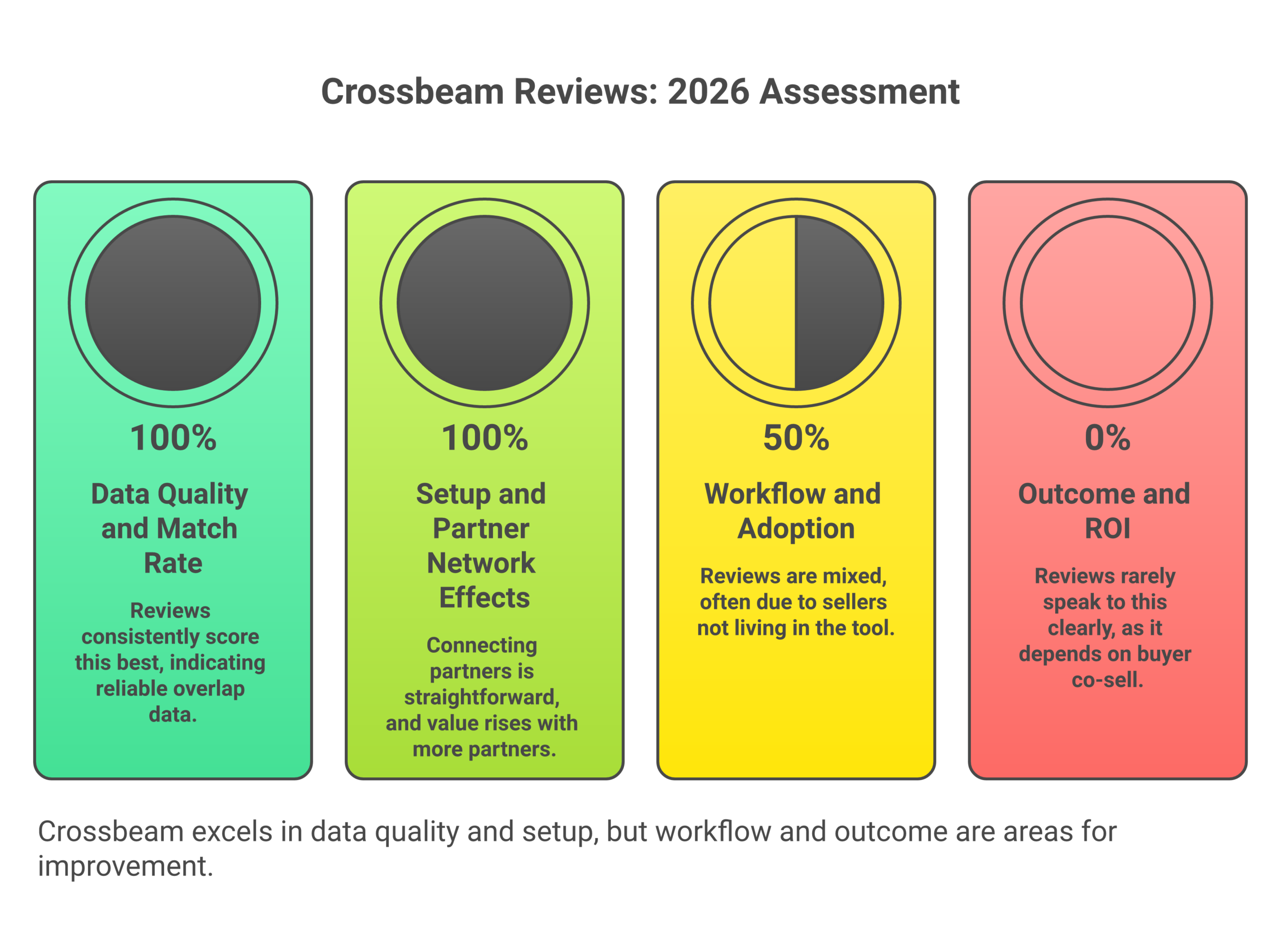
- Data quality and match rate: This is what reviews score best. The consistent signal is that the overlap data is accurate and the account matching is dependable. Treat this part of the reviews as reliable.
- Setup and partner network effects: Reviews note that connecting partners is straightforward and that value rises as more of your partners are also on the platform. The platform is worth more when your ecosystem is present on it, which is a real and fair point.
- Workflow and adoption: Here reviews get mixed, and the mixed signal is usually not a product complaint. Sellers do not live in a partner tool, so overlap that stays inside the platform goes unused. This is a motion problem reviews often record as a tool problem.
- Outcome and ROI: Reviews rarely speak to this clearly, because outcome depends on the buyer’s co-sell motion. A high review score and zero co-sell revenue can coexist, and that combination is the single most important thing reviews fail to surface.
The point is that Crossbeam reviews are trustworthy on data and setup, ambiguous on workflow, and mostly silent on outcome. Read them for the first two and supply the rest yourself. Crossbeam works. It’s proven. What’s ambiguous is how you will specifically leverage the data. When leveraged properly, it’ll unlock more pipeline than you can imagine.
Common pitfalls in evaluating Crossbeam
Buyers misread Crossbeam reviews in consistent ways.
- Reading a high data score as an ROI promise: Accurate overlap is necessary and not sufficient. The reviews confirm the data; they cannot confirm your motion.
- Ignoring adoption signals: When reviews mention sellers not using the data, buyers dismiss it as a minor complaint. It is the central risk, and it is a motion risk and not a tooling risk (Crossbeam works).
- Comparing against a stale market: Older reviews reference a competitive set that has changed. Anchor on a current 2026 comparison.
- Skipping the integration question: Overlap data has to reach the CRM and the seller workflow. Reviews praising the data say little about whether a buyer wired it into where deals are worked.
- Treating the platform as the program: The most common and most expensive misread. Crossbeam is a data layer, not a co-sell program.
Tools and examples
Crossbeam sits in the ecosystem-data layer. A fair evaluation also weighs the layers around it, because a buyer is assembling a stack, not buying one tool.
| Layer | Role | Examples |
|---|---|---|
| Ecosystem data | Account overlap and shared-opportunity signals | Crossbeam |
| Partner program operations | Onboarding, deal registration, attribution | Impartner, PartnerStack, Channelscaler, Introw, Euler |
| Marketplace co-sell ops | Hyperscaler co-sell transactions and attribution | Tackle, Labra, Suger, Clazar |
A worked example. A company reads strong Crossbeam reviews, buys it, connects fifteen partners, and sees accurate overlap immediately. Six months later co-sell revenue is flat. The reviews were right and the outcome is still poor, because the company never built a deal-review cadence or a joint pitch. The fix is not a different tool; it is the motion the data was always waiting on.
Forecastable’s POV
Crossbeam reviews are broadly accurate about Crossbeam. The data is good, the setup is reasonable, and the network effect is real. If a buyer needs reliable account overlap, the reviews point in a defensible direction.
What reviews cannot do is tell a buyer whether they will get co-sell revenue, because that is not a property of the platform. We have seen companies with excellent overlap data and no co-sell motion, and companies with modest tooling and a disciplined motion that outproduces them. The platform is a multiplier on a motion. Multiplying a motion that does not exist returns zero.
The contrarian read on Crossbeam reviews is that a perfect score should not close a buying decision. The decision should turn on one question the reviews do not ask: do you have, or will you build, a co-sell motion to run on this data. If yes, Crossbeam is a strong choice and the reviews are a fair guide. If no, the tool will be one more accurate report nobody acts on, and no review score changes that.
Forecastable is an independent third-party professional services company. Our evaluations of Crossbeam and partner tooling are based on publicly-available information and published reviews as of May 2026 and our own client experience.
Frequently asked questions
Are Crossbeam reviews positive?
Broadly yes, especially on data quality, account match rate, and ease of connecting partners. Reviews are more mixed on seller adoption.
What do Crossbeam reviews get right?
They score the core data product accurately. The overlap data is reliable and the setup is straightforward, and the reviews reflect that.
What do Crossbeam reviews miss?
Outcome. Reviews rarely show whether a buyer turned overlap data into co-sell revenue, because that depends on the buyer’s motion, not the tool.
Is Crossbeam worth it based on reviews?
It is worth it if you have a co-sell motion to run on the data. If you do not, a high review score will not produce revenue on its own.
What are the alternatives to Crossbeam?
In the ecosystem-data layer, Common Room and Pocus are the main alternatives buyers weigh in 2026.
Should I trust older Crossbeam reviews?
Read them with caution. The ecosystem-data market consolidated, so older reviews reference a competitive set that has changed.
Next step
If you are reading Crossbeam reviews to make a buying decision, ask the question the reviews skip: do you have a co-sell motion to run on the data. The tool is a multiplier, and it multiplies a motion. Decide the motion first, then the platform.
Talk to our team about evaluating your partner-tech stack →
The PRM and partner tech hub holds the broader operating context, and the crossbeam overlap automation write-up covers how to get overlap data into the workflow where deals are worked.
Uncover Your Growth Potential
Schedule a Discovery Call