Skip to content
Logo — It’s All AboutThe Team
  • Home
  • Who We Serve
    • By Category
      • SaaS
      • Professional Services
      • Platforms (Large Ecosystems)
      • Private Equity
    • By Role
      • Chief Revenue Officers (CRO)
      • Chief Financial Officers (CFO)
      • Chief Marketing Officers (CMO)
      • Chief Executive Officers (CEO)
      • Sales Leaders
      • Partnership Professionals
  • Solutions
    • By Partner Program Maturity
      • Partnerships Foundation
      • Partnerships Acceleration
      • Ecosystem-Wide Orchestration
    • Specialized Solutions
      • Net-New Named Account Development
      • Large Ecosystems
      • M&A: Post-Acquisition Internal Cross-Selling
  • Education
  • Company
    • Our History
    • Security
  • Login
Logo — It’s All AboutThe Team
  • Home
  • Who We Serve
    • By Category
      • SaaS
      • Professional Services
      • Platforms (Large Ecosystems)
      • Private Equity
    • By Role
      • Chief Revenue Officers (CRO)
      • Chief Financial Officers (CFO)
      • Chief Marketing Officers (CMO)
      • Chief Executive Officers (CEO)
      • Sales Leaders
      • Partnership Professionals
  • Solutions
    • By Partner Program Maturity
      • Partnerships Foundation
      • Partnerships Acceleration
      • Ecosystem-Wide Orchestration
    • Specialized Solutions
      • Net-New Named Account Development
      • Large Ecosystems
      • M&A: Post-Acquisition Internal Cross-Selling
  • Education
  • Company
    • Our History
    • Security
  • Login
  • Home
  • Who We Serve
    • By Category
      • SaaS
      • Professional Services
      • Platforms (Large Ecosystems)
      • Private Equity
    • By Role
      • Chief Revenue Officers (CRO)
      • Chief Financial Officers (CFO)
      • Chief Marketing Officers (CMO)
      • Chief Executive Officers (CEO)
      • Sales Leaders
      • Partnership Professionals
  • Solutions
    • By Partner Program Maturity
      • Partnerships Foundation
      • Partnerships Acceleration
      • Ecosystem-Wide Orchestration
    • Specialized Solutions
      • Net-New Named Account Development
      • Large Ecosystems
      • M&A: Post-Acquisition Internal Cross-Selling
  • Education
  • Company
    • Our History
    • Security
  • Login
Back to all blogs
  • Co-Selling
Alex Buckles

Co-Sell Metrics: Leading and Lagging Signals

A co-sell alignment specialist and a RevOps analyst reviewing a leading-and-lagging metrics dashboard on two monitors at a desk, deep navy and warm amber palette

What are co-sell metrics?

Short answer: Co-sell metrics are the full set of measurements that show whether a joint selling motion is healthy, spanning leading signals that predict outcomes and lagging signals that confirm them. They are the instrument panel for a co-sell program, the layer beneath the headline scorecard.

Co-sell metrics and co-sell KPIs are often used interchangeably, and that conflation causes real damage. KPIs are the four or five headline numbers a leader commits to. Metrics are the wider system that explains those numbers. A leader reports KPIs; a leader diagnoses with metrics.

The distinction is the difference between knowing the program missed and knowing why. Partner-sourced pipeline came in low: that is a KPI telling you the outcome. Cadence adherence dropped, overlap data went stale, and first-deal-review time slipped: those are metrics telling you the cause.

This post covers the full measurement system, how leading and lagging metrics divide the work, and how to wire the instrumentation so the metrics are trustworthy rather than decorative.

Why co-sell metrics matter in 2026

Three forces have made a real metrics system worth building. Co-sell is now a primary pipeline source, so a program that can only see lagging outcomes is flying a quarter behind. Co-sell programs have grown to manage more partners each, so a leader cannot diagnose by gut and needs instrumentation. And finance scrutiny means the program must not only report results but explain them, which requires metrics, not just KPIs.

The case for a layered metrics system has three layers of its own. At the strategy layer, leading metrics give a program the chance to correct a motion before the quarter is lost, which a lagging-only view never allows. At the operating layer, metrics tell a co-sell alignment specialist exactly which partnership is drifting and why, so attention goes where it pays. At the financial layer, a program that can explain a miss with a clear causal metric keeps credibility with finance; a program that can only report the miss loses it.

The reality most programs live is a metrics setup that is all lagging and all late. They see sourced pipeline and closed revenue, both of which arrive after the period they describe. By the time the number is bad, the quarter that produced it is over.

How co-sell metrics actually work

A working co-sell metrics system splits into leading and lagging signals, with attribution as the spine that connects them. Five components carry the system.
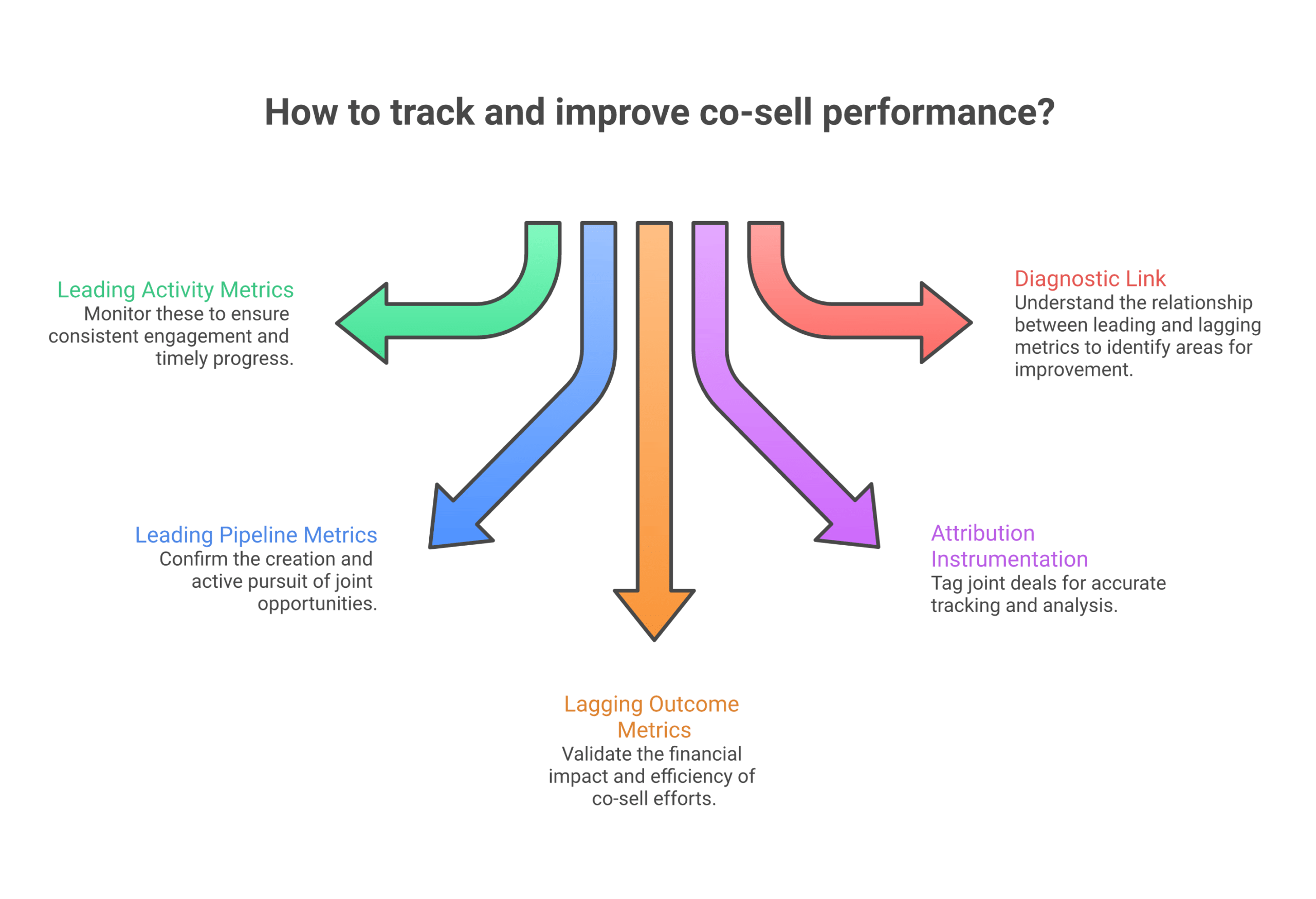
Framework diagram of the co-sell metrics system: leading activity metrics, leading pipeline metrics, lagging outcome metrics, attribution instrumentation, and the diagnostic link.

  1. Leading activity metrics: Cadence adherence, deal-review attendance, first-deal-review time after signature, and overlap-data freshness. These move first and predict whether the motion will produce. A drop here shows up in pipeline two months later.
  2. Leading pipeline metrics: Joint opportunities created, overlap accounts moved to active pursuit, and partner-engaged accounts. These confirm the activity is turning into deals while there is still time to act.
  3. Lagging outcome metrics: Partner-sourced pipeline value, partner-influenced revenue, co-sell win rate, and joint-deal cycle time. These confirm the result and feed the KPI scorecard.
  4. Attribution instrumentation: The CRM fields, deal-registration data, and marketplace records that tag every joint deal as sourced or influenced. Without clean attribution, every other metric is an estimate.
  5. The diagnostic link: The defined relationships between leading and lagging metrics, so when a lagging number misses, the program can trace it to a specific leading metric. A metrics system with no diagnostic link is just two disconnected reports.

The closing point is that the value of the system is the diagnostic link. Leading metrics without lagging ones cannot prove the program produces revenue. Lagging metrics without leading ones cannot be corrected in time. The link between them, the explicit statement that cadence adherence predicts sourced pipeline, is what makes the system a management tool rather than a dashboard.

Common pitfalls

Co-sell metrics systems fail in consistent ways, and most failures are structural rather than a matter of effort.

  • Lagging-only measurement: The program tracks sourced pipeline and revenue and nothing that precedes them. Every problem is visible only after the quarter that caused it has closed.
  • Leading metrics with no link to outcomes: Activity is tracked but never tied to whether it produced pipeline. The program measures motion and cannot tell if the motion matters.
  • Broken attribution: Joint deals close untagged or tagged inconsistently. Every downstream metric is then an estimate nobody fully trusts.
  • Dashboard sprawl: Forty metrics on a screen nobody reads. A metrics system that is not curated becomes wallpaper.
  • Vanity disguised as a metric: Total partner emails sent, portal logins, asset downloads. They are measurable and meaningless, and they crowd out the metrics that predict revenue.

What this looks like in practice

Co-sell metrics are produced across the standard stack. The instrumentation matters more than the dashboard; a clean attribution layer is what makes every metric trustworthy.
of the diagnostic link in use. A co-sell program reports a lagging metric miss: partner-sourced pipeline is 30% below target for the quarter. With a leading-and-lagging system wired, the alignment specialist traces it. Cadence adherence had dropped from 85% to 50% in weeks four through eight, first-deal-review time had slipped from ten days to over a month on the newest partnerships, and overlap data had not been refreshed in six weeks. The miss is explained, the cause is specific, and the fix is operational: reinstate the cadence and refresh the data.

The contrast is a program with lagging-only metrics. It reports the same 30% miss and has nothing to say about why. The conversation with finance becomes a guess, and the fix is a guess too.

Forecastable’s POV

The core mistake in co-sell measurement is building the system from the outcomes backward and stopping there. Sourced pipeline and revenue are the numbers everyone wants, so those are the numbers programs instrument first and often only. The problem is that both are lagging. A program that can only see lagging metrics is permanently a quarter late, reacting to misses it could not see coming.

Across our client base, the programs that run well instrument the leading metrics with as much care as the lagging ones, and they make the diagnostic link explicit. They can say, on the record, that cadence adherence below 70% predicts a sourced-pipeline miss two months out. That single stated relationship turns a dashboard into a steering wheel. The programs that struggle have plenty of metrics and no link between them, so they can describe their situation but never get ahead of it.

The contrarian point is that the most valuable co-sell metric is the least glamorous one: cadence adherence. It is a simple attendance number, it sounds administrative, and it is the earliest reliable predictor of whether the program will produce. A program that watches cadence adherence weekly knows its next quarter before the quarter starts. A program that watches only revenue learns its quarter after it ends.

If you are building co-sell metrics, instrument the leading signals first, fix attribution before anything else, and write down the diagnostic links between leading and lagging numbers.

Forecastable is an independent third-party professional services company. Our evaluations of co-sell measurement and tooling are based on publicly-available information as of May 2026 and our own client experience.

Frequently asked questions

What is the difference between co-sell metrics and co-sell KPIs?
KPIs are the four or five headline numbers a leader commits to. Metrics are the full measurement system that explains those numbers, including the leading signals KPIs usually leave out.

What are leading co-sell metrics?
Signals that move before outcomes: cadence adherence, deal-review attendance, first-deal-review time, overlap-data freshness, and joint opportunities created. They predict the lagging results.

What are lagging co-sell metrics?
Signals that confirm outcomes after the fact: partner-sourced pipeline, partner-influenced revenue, co-sell win rate, and joint-deal cycle time.

Which co-sell metric predicts results earliest?
Cadence adherence. A drop in deal-review attendance shows up in sourced pipeline roughly two months later, so it is the earliest reliable warning.

Why is attribution called the spine of the system?
Because every pipeline and revenue metric depends on joint deals being tagged correctly. Broken attribution turns every downstream metric into an estimate.

How many co-sell metrics should a program track?
Enough to cover leading activity, leading pipeline, and lagging outcomes, roughly ten to fifteen, curated. Sprawl past that and the system becomes wallpaper.

Next step

If your co-sell measurement is all lagging, you are managing a quarter behind. Instrument the leading signals, fix attribution first, and write down which leading metric predicts which outcome so a miss can always be diagnosed.

Talk to our team about your co-sell measurement →

The co-sell hub holds the broader operating context, and the co-sell KPIs write-up covers the headline scorecard this metrics system feeds.

Uncover Your Growth Potential

Whether starting with a single sales team or a single partner, any co-sell motion can be live within 30 days.

Schedule a Discovery Call
Latest Insights
Two professionals review charts and documents at a conference table as a presentation screen shows a business strategy slide on the wall.
  • Co-Selling
Alex Buckles

Co-Sell Strategy: Building a Motion That Produces

What is a co-sell strategy? Short answer: A co-sell strategy is the set of decisions about which partners you sell with, which accounts you go after together, and how the joint motion runs. It chooses where co-sell effort goes so the company produces partner pipeline by design rather than by lucky overlap. It is not […]

Read Article
A partner enablement lead running a co-sell training session with three account executives around a table, a printed joint pitch one-pager and a deal-registration workflow on the screen behind them, deep navy and warm amber palette
  • Co-Selling
Alex Buckles

Co-Sell Training: Teaching Reps to Sell With Partners

What is co-sell training? Short answer: Co-sell training is how a company teaches its reps to run joint deals with partners, the pitch, the workflow, and the handoffs that a co-sell motion requires. It exists to turn a co-sell strategy into rep behavior, so the motion runs in the field rather than living in a […]

Read Article
An account executive and a partner rep running a joint customer call, a shared screen showing the customer's account and a printed joint pitch on the desk, deep navy and warm amber palette
  • Co-Selling
Alex Buckles

How to Co-Sell: A Step-by-Step Guide for Reps

What is co-selling? Short answer: How to co-sell comes down to four steps: find the accounts you and a partner both have reason to work, agree who does what, run the joint deal, and settle credit before close. It is two companies working one account together so the combined motion closes faster than either would […]

Read Article
A sales leader and a partnerships lead at a sales floor reviewing a per-rep account list with a recommended partner per account, a printed spiff and registration workflow on the screen behind them, deep navy and warm amber palette
  • Co-Selling
Alex Buckles

How to Get Sales Team to Co-Sell, Step by Step

What does getting a sales team to co-sell mean? Short answer: How to get sales team to co-sell reduces to one rule: make the partner the easy path on accounts reps already work. They adopt a partner when it shortens their next close, not when they are told partners matter, so engineer that on real […]

Read Article
Logo — It’s All AboutThe Team

Quick Links

  • Who We Serve
  • Solutions
  • Resources
  • Pricing
  • Our History

Social Media

  • Linkedin

Legal

  • Privacy Policy
  • Terms of Service
Quick Links
  • Who We Serve
  • Solutions
  • Resources
  • Pricing
  • Our History
Social Media
  • Linkedin
Legal
  • Privacy Policy
  • Terms of Service

Stay ahead on ecosystem-led growth

Logo — It’s All AboutThe Team
© 2025 Forecastable. All rights reserved.
Book Your Strategy Call
Request Enrollment Details

[contact-form-7 id=”dfbeed3″ title=”Request Enrollment Details”]

Mollie Bodensteiner

Revops Advisory
  Mollie Bodensteiner is an experienced operations professional with a demonstrated track record of utilizing technology to support operational processes that drive performance and innovation. She currently is the Vice President of Operations at Sound and owns go-to-market agency, MB Solutions. Mollie has previously held operations leadership roles at Deel, Syncari, Corteva and Marketo. She has over 14 years of experience in both B2C and B2B operations and technology. When she is not working, Mollie enjoys spending time with her husband, three small children, and two large dogs. Childhood Career/Dream: Growing up in the age of Disney and Nick@Nite I always wanted to be a child actor (good thing that never was actually pursued 🙂 Favorite Win: I am not sure I have a specific “win” but I think I get the most joy and excitement from coaching others and watching them hit major milestones in their career. The first time you get to promote someone on your team or watch them lead a major project – are always career highlights! Personal Fun Facts: Favorite Song: If it’s love, Train Favorite Movie: Good Will Hunting Favorite Meme: Disaster Girl
Forecastable resources: Co-Sell Orchestration Platform · All Use Cases · Live in 30 Days · Co-Sell Playbook

Kelsey Buckles

Director of Operations


My journey from Education to Operations has equipped me with a unique perspective and skill set that perfectly aligns with Forecastable’s mission to help businesses improve sales collaboration through partner co-selling strategies.

At Forecastable, I am passionate about empowering teams and organizations to unlock the full potential of strategic partnerships. By leveraging my expertise in communication, leadership, and operational efficiency, I contribute to creating seamless co-selling processes that align with business goals and deliver exceptional results.

The intersection of my educational foundation and operational experience fuels my dedication to fostering alignment, building trust, and enhancing collaboration between partners. I am driven by the opportunity to contribute to a platform that not only optimizes sales strategies but also strengthens relationships that lead to long-term growth.

Paul Jonhson

Chief Technology Officer (Co-founder)


Paul Johnson has 20+ years of software development and consulting experience for a variety of organizations, ranging from startups to large-enterprise organization with highly-complex needs.

Mr. Johnson has a long track record of successful technology deployments.
This, combined with his deep passion for machine learning and exceptional user experience design, allows him to lead our technical direction from the front with confidence.

Alex Buckles

Product, Partnerships, and Value Engineering (Co-founder)


After serving in The United States Marine Corps, Alex Buckles spent the next two decades as a student of revenue production and an advocate for innovation.

Along the way, he has helped numerous companies achieve double and triple-digit growth by crafting and executing high-performing go-to-market strategies, with co-selling at the center of each.

As a once-advanced technical marketer, an expert sales & partner professional, and a strong customer success advocate, Mr. Buckles understands the impact of these functions aligning not only on revenue production, but on the day-to-day execution of the go-to-market strategy. This concept of revenue-team alignment is what quickly became the foundation of Forecastable back in January of 2018.

In his free time, you’ll find him spending quality time with his children, one of whom is on the autism spectrum. 1 in 36 children in the U.S. are on the spectrum and boys are four times more likely to be diagnosed than girls.

With that in mind, Mr. Buckles plans on dedicating the rest of his life serving those living with autism, through his organization Pathways for Autism. From his perspective, there must be a scalable and financially self-sustaining infrastructure established to put as many individuals with autism as possible on a path towards complete independence as adults.