Co-Sell KPIs: The Scorecard That Defends Budget

What are co-sell KPIs?
Short answer: Co-sell KPIs are the small set of headline numbers a partnerships leader commits to and is reviewed against: producing-partner rate, partner-sourced pipeline, partner-influenced revenue, and joint-deal cycle time. They are the scorecard, not the instrument panel, and they exist to answer one question from finance: is co-sell worth the spend?
A KPI is not the same as a metric, and the difference matters. A metric is anything you can measure about co-sell. A KPI is a metric you have chosen as a commitment, given a target, and agreed to be judged on. A program can track fifty metrics. It should carry four or five KPIs.
The discipline is in the selection. The temptation is to elevate every number to KPI status, which produces a scorecard nobody can act on and a leader accountable for everything and therefore nothing. A good KPI set is short, owned, and tied to outcomes a CFO recognizes as revenue.
This post covers which numbers belong on the co-sell scorecard, which ones look important but are not, and how to set targets that survive a budget review.
Why co-sell KPIs matter in 2026
Three forces have made the co-sell scorecard a high-stakes artifact. Co-sell now drives a material share of pipeline, so it is large enough to draw finance scrutiny. Budget cycles have tightened across B2B, and any spend that cannot show a number gets cut first. And partner-influenced revenue is now expected to be reported with the same rigor as direct, so a co-sell program that cannot produce a credible scorecard is a program that cannot defend itself.
The case for a disciplined KPI set has three layers. At the strategy layer, the KPIs are what align the partnerships team, sales, and finance on what co-sell is for; a vague scorecard means three teams optimizing three different things. At the operating layer, a short KPI set tells a partnerships leader where to spend attention this quarter. At the financial layer, the scorecard is the program’s budget defense, and a defense built on activity counts rather than revenue outcomes does not hold.
The reality most programs live is a scorecard full of vanity. Partners signed, meetings held, assets shipped. Every number goes up and to the right, and none of them answers whether co-sell produced revenue. When the budget review comes, the program has data and no case.
How co-sell KPIs actually work
A defensible co-sell scorecard carries four or five KPIs. Each one has a target, an owner, and a direct line to revenue.
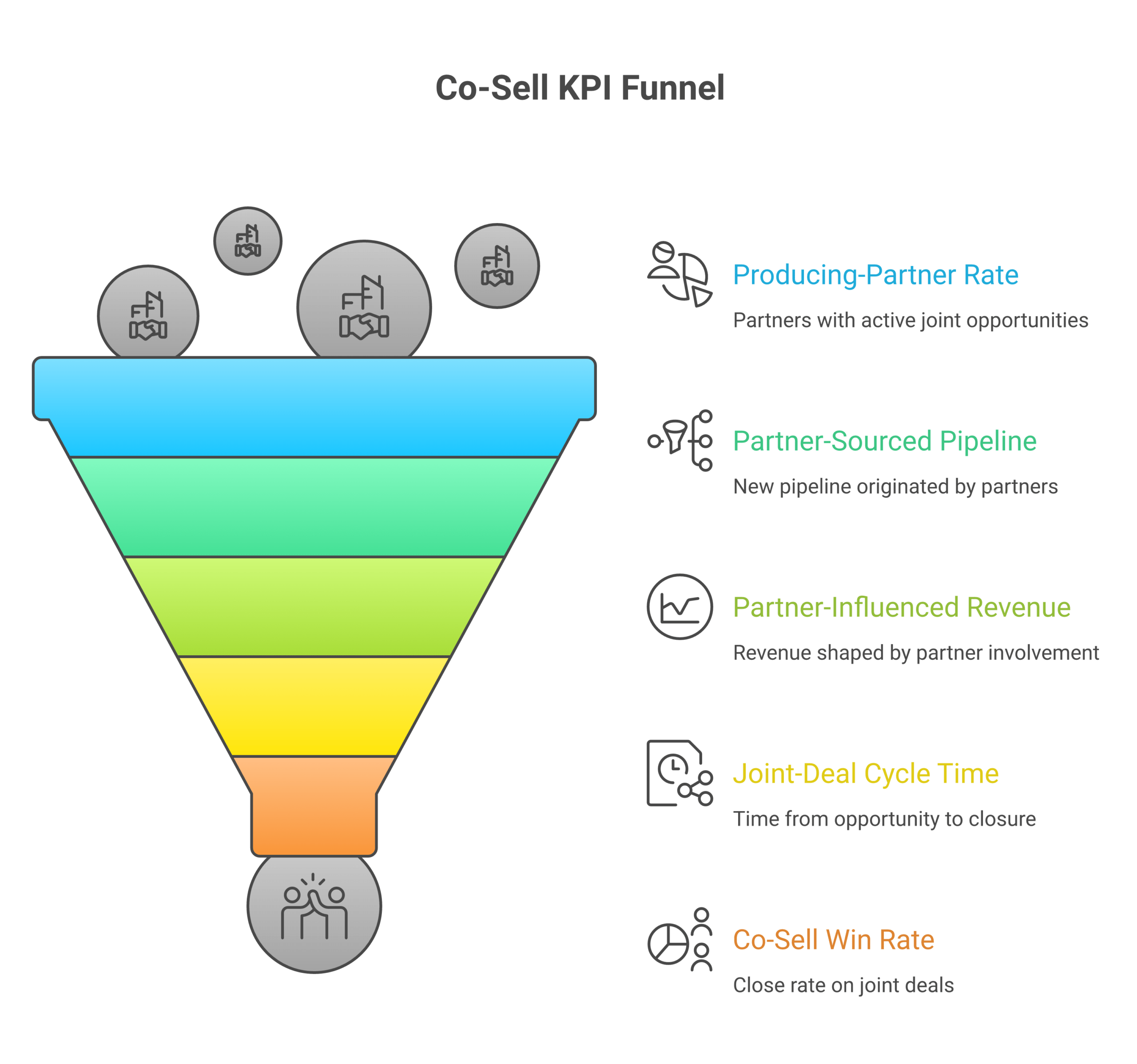
- Producing-partner rate: The share of signed co-sell partners with at least one live joint opportunity in the period. This is the truest health number in co-sell, because it exposes the gap between partners signed and partners working. A program signing partners with a low producing rate is leaking.
- Partner-sourced pipeline: The dollar value of new pipeline where the partner originated the opportunity. This is the KPI finance recognizes fastest, because sourced pipeline is unambiguous: without the partner, the deal would not exist.
- Partner-influenced revenue: Closed-won revenue where a partner materially shaped a deal the vendor also worked. It is harder to attribute than sourced pipeline and needs a clear, agreed definition, but it captures the larger share of co-sell value.
- Joint-deal cycle time: The average time from joint-opportunity creation to closed-won, compared against the direct-sales baseline. Co-sell should compress cycle time; if it does not, the motion needs inspection.
- Co-sell win rate: The close rate on joint opportunities versus comparable direct deals. A higher joint win rate is one of the strongest arguments for the motion, and one of the easiest for finance to grasp.
The closing point is that every KPI on this list ties to revenue or to a revenue-relevant efficiency. Producing-partner rate predicts future pipeline, sourced pipeline and influenced revenue are revenue, and cycle time and win rate are efficiency gains a CFO can value. A number that does not connect to one of those does not belong on the scorecard.
Common pitfalls
Co-sell KPI sets fail in consistent ways, and most failures trace to selecting the wrong numbers or too many.
- Vanity KPIs: Partners signed, meetings held, assets shipped, treated as headline numbers. They go up regardless of whether co-sell produced revenue, so they defend nothing.
- Too many KPIs: A scorecard of fifteen numbers. The leader is accountable for everything, can prioritize nothing, and the review loses focus.
- No target: A KPI tracked but never given a number to hit. Without a target it is a metric, not a commitment, and it cannot be passed or missed.
- Influenced revenue with no agreed definition: Partner-influenced revenue counted differently by partnerships, sales, and finance. The number then gets argued instead of trusted.
- No owner on the KPI: A scorecard number nobody is personally accountable for. Unowned KPIs drift and decay.
What this looks like in practice
Co-sell KPIs are produced from the same stack that runs the motion. The tools do not generate the KPIs; they supply the underlying data the scorecard rolls up.
A partnerships leader rebuilds the co-sell scorecard before a budget review. The old version had eleven numbers, mostly activity counts. The new version has five KPIs: producing-partner rate with a target of 60%, partner-sourced pipeline with a quarterly dollar target, partner-influenced revenue on a definition agreed in writing with finance, joint-deal cycle time benchmarked against direct, and co-sell win rate. Each KPI has a named owner. At the budget review, the leader shows producing-partner rate up from 35% to 58%, sourced pipeline above target, and a joint win rate eight points higher than direct. The program keeps its budget and adds a headcount.
The contrast is the leader who walks into the same review with eleven activity numbers all trending up. Finance asks one question, how much revenue, and the scorecard cannot answer it. The program holds flat at best.
Forecastable’s POV
The co-sell scorecard fails most often not because the numbers are bad but because there are too many of them and they measure the wrong layer. Partnerships leaders elevate activity to KPI status because activity is easy to grow and feels like progress. Partners signed always goes up. Meetings held always goes up. A scorecard built on those numbers is a scorecard that cannot be missed, which means it also cannot be trusted.
Across our client base, the leaders who win budget reviews carry four or five KPIs that all map to revenue, and they put producing-partner rate at the top. That number is the honest one. It does not let a program hide behind a big signed-partner count, because it asks how many of those partners actually have a live deal. A leader who can move producing-partner rate has a real story; a leader who only grows the signed count has a vanity chart.
The contrarian point is that the co-sell scorecard should be built with finance, not shown to finance. The partner-influenced revenue definition in particular needs to be agreed in writing before the number is ever reported, because a number finance helped define is a number finance defends, and a number finance sees for the first time in a review is a number finance discounts.
If you are rebuilding your co-sell KPIs, cut to five, give every one a target and an owner, and write the influenced-revenue definition down with your CFO.
Forecastable is an independent third-party professional services company. Our evaluations of co-sell measurement and tooling are based on publicly-available information as of May 2026 and our own client experience.
Frequently asked questions
How many co-sell KPIs should a program have?
Four or five. Producing-partner rate, partner-sourced pipeline, partner-influenced revenue, joint-deal cycle time, and co-sell win rate cover the program without overloading the review.
What is the single most important co-sell KPI?
Producing-partner rate. It exposes the gap between partners signed and partners actually working a deal, which is where most co-sell programs leak.
What is the difference between co-sell KPIs and co-sell metrics?
KPIs are the small set of numbers a leader commits to and is judged on. Metrics are the broader set of everything measured. Every KPI is a metric; most metrics are not KPIs.
Why are activity counts bad KPIs?
Partners signed, meetings held, and assets shipped grow regardless of whether co-sell produced revenue. They cannot be missed, so they cannot defend a budget.
How do you set co-sell KPI targets?
Benchmark against the program’s own prior periods and against the direct-sales baseline for cycle time and win rate. Set targets with finance so they are credible in a review.
How is partner-influenced revenue defined?
With a written definition agreed by partnerships, sales, and finance before it is reported, since the three teams will otherwise count it differently and the number will be argued.
Next step
If your co-sell scorecard is a long list of activity numbers, it will not survive the next budget review. Cut to five revenue-linked KPIs, lead with producing-partner rate, and agree the influenced-revenue definition with finance in writing.
Talk to our team about your co-sell scorecard →
The co-sell hub holds the broader operating context, and the co-sell metrics write-up covers the fuller measurement system the KPIs sit on top of.
Uncover Your Growth Potential
Schedule a Discovery Call