Co-Sell Advisor: When to Hire One and What They Actually Do

What is a co-sell advisor?
Short answer: A co-sell advisor is an external advisor, fractional partnerships leader, or consultant on retainer who helps a partnerships org design and run its co-sell motion. They sit alongside the in-house team, diagnose what is actually broken, design the operating model, and coach the team through the first cycles of execution.
They are not a recruiter and not a tooling vendor. The job is to put a working operating model in place and transfer the muscle to the in-house team. The best advisors leave behind a partnerships org that no longer needs them.
Three properties define a working co-sell advisor. First, they have personally run a partnerships program at scale, not just consulted on one. Second, they bring a named operating model with named roles, named cadences, and named artifacts, not a framework deck (although, frameworks are still important). Third, they get hands-on inside partner-facing conversations during the first cycles, not just inside internal strategy sessions.
Adjacent terms get conflated. A fractional CPO is an interim executive who sits in a chair on the org chart. A consultant produces a scoped deliverable and exits. A co-sell agency runs the motion on behalf of the vendor. A co-sell advisor sits across all three, but the core job is design plus coaching, not execution-on-behalf-of.
Why a co-sell advisor matters in 2026
Three forces have made the advisor role more valuable than it was even two years ago. The partnerships function has professionalized faster than the talent market has kept up, which means most companies signing their first tier-1 partners have nobody on staff who has done this before. Buying committees have grown to seven or more stakeholders, and the design of a co-sell motion now has to coordinate across product marketing, RevOps, and field sales in a way it did not need to in 2022. And the cost of getting the operating model wrong, in terms of partner trust burned, is permanent in a way that fixing a broken outbound motion is not.
The operating case is three layers. At the strategy layer, the operating model decisions you make in the first 90 days set the trajectory for the next two years. At the operating layer, an experienced advisor compresses six months of trial-and-error into 90 days of working motion. At the financial layer, the cost of a fractional advisor for one to two quarters is roughly one tenth the cost of hiring, ramping, and losing a wrong-fit VP of Partnerships.
The operating reality is that most companies hire a co-sell advisor too late. The advisor walks into a program that has already failed, partner trust has eroded, and the first 90 days of work is recovery rather than design. The right time to bring in a co-sell advisor is before the program is launched or before a major partner cohort is signed. For broader industry context, see Partnership Leaders’ fractional and advisor cohorts.
How a co-sell advisor actually works
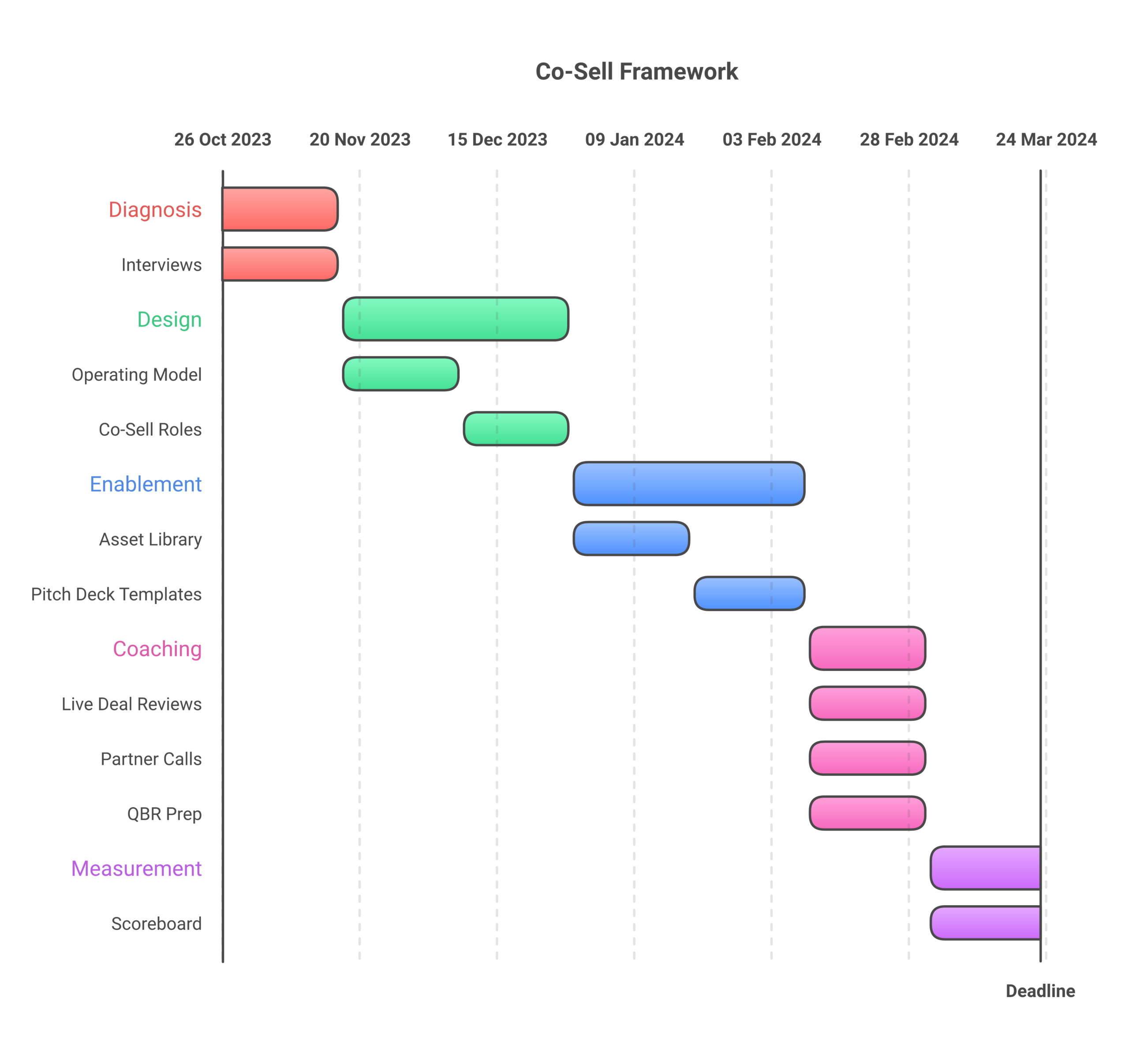
A working co-sell advisor engagement runs across five sequenced mechanics, typically over 90 to 180 days. The advisor is not in the chair full-time, but they are deeply embedded in design and coaching during this window. The mechanics are diagnosis, design, enablement, coaching, and measurement.
- Diagnosis: Two to three weeks of structured interviews with the partnerships team, the field sales leaders, RevOps, product marketing, and a sample of existing partners. The output is a written diagnosis of where the motion is actually broken, separated from where the team thinks it is broken. These two are rarely the same.
- Design: Four to six weeks of operating-model work. Named co-sell roles on both vendor and partner sides. Cadences with specific frequencies. Tiering criteria with specific thresholds. Account-mapping mechanics. Attribution plumbing. The output is a documented operating model the in-house team can run without the advisor in the room.
- Enablement: Asset library, joint pitch deck templates, deal-review playbooks, partner manager training. This is not a content marathon. It is the minimum set of artifacts the operating model needs to function: a joint pitch deck, a customer-facing one-pager, a deal-review playbook, and a partner-manager runbook.
- Coaching: Live deal reviews, live partner-side calls, live internal QBR prep. The advisor is in the room for the first three to six weeks of cadence execution, observing and coaching. This is the mechanic that transfers the muscle.
- Measurement: The right scoreboard. Leading indicators (cadence attendance, account-mapping coverage, first opportunity inside 60 days) and lagging indicators (partner-sourced pipeline, partner-influenced revenue, partner-attached deal size). Most partnerships orgs measure only lagging indicators and have no early warning system.
The closing point is that a co-sell advisor who skips the coaching mechanic is a consultant who delivered a deck. The transfer happens in the room, on real deals, with real partners. Everything before that is preparation.
Common pitfalls
Most co-sell advisor engagements fail for one of five reasons, and four of them are inside the buying company’s control.
- Hiring too late: The most common failure mode. The advisor walks into a failed program, eroded partner trust, and 90 days of recovery work before design can begin. The right time is pre-launch or pre-cohort.
- Hiring a framework consultant: An advisor who has never personally run a partnerships org at scale brings a framework deck, not an operating model. The framework looks great in slide form and does not survive contact with a real partner cadence.
- Skipping the coaching mechanic: The engagement ends at the design phase. The in-house team has a beautiful operating model document and no one has ever run the cadences with the advisor in the room. The model collapses on first contact.
- No in-house owner: The advisor has nobody on the in-house team to transfer to. The engagement extends indefinitely and the org becomes dependent on the advisor. This is the advisor’s fault as much as the company’s.
- Treating the advisor as a recruiter: The advisor is hired to find a VP of Partnerships rather than to design the operating model. The wrong VP gets hired into an undefined role and fails inside two quarters.
What this looks like in practice
The co-sell advisor market sorts into four buckets, each with a different scope, a different price point, and a different fit pattern. The right choice depends on stage, partner cohort size, and whether the in-house team has any prior partnerships experience.
A Series B SaaS company is preparing to sign its first cohort of five tier-1 partners. They bring in a co-sell advisor 60 days pre-launch. The advisor runs diagnosis, designs the operating model, ships the three core enablement assets, and is in the room for the first six weeks of deal-review cadences. By day 90, the company has a working motion. By day 180, three of the five partners have produced first opportunities. The advisor steps out at day 120 and stays on a light-touch retainer.
Now the contrast. A Series C SaaS company hires a co-sell advisor 18 months in, after their first 10 tier-1 partners have gone quiet. The advisor spends the first 90 days on partner-side recovery conversations before design can begin. Three of the original 10 partners are unsalvageable. The total engagement runs nine months and costs roughly three times the pre-launch case to produce a comparable result. Same advisor, same operating model, same client maturity. The only variable is timing.
Forecastable’s POV
Most companies hire a co-sell advisor too late, after the motion has already failed and trust has eroded with partners. The right time is before the program is launched or before a major partner cohort is signed. Design the motion first, run partner-side cadences second.
The reason most fractional co-sell advisors fail is not that they are bad at design. It is that they show up after the org has already committed to a broken operating model, signed a cohort of partners under bad terms, and burned through the partner-side patience that a new motion requires. Design is the easy part. Recovery is brutal and often impossible.
The contrarian point is that the cheapest, fastest, highest-leverage moment to bring in a co-sell advisor is before you have a partnerships problem to solve. Companies that bring in an advisor pre-launch typically ship a working motion in 90 days at a fraction of the cost of recovery. Companies that wait until the program is visibly broken typically spend six months and three times the budget to get to the same place, and they lose two to three partners they cannot get back.
If you are reading this and you have already launched a partner program that is not producing, the advice does not change. Bring in an advisor now, not in another quarter. Every month the broken model continues compounds the recovery cost.
Forecastable is an independent third-party professional services company. Our evaluations of the co-sell advisor market are based on publicly-available information as of May 2026 and our own client experience.
Frequently asked questions
When is the right time to hire a co-sell advisor?
Pre-launch or pre-cohort. The cheapest, highest-leverage moment is before you have a problem. Post-failure engagements work but cost three times as much and take three times as long.
What is the typical engagement length?
Ninety to one hundred eighty days of active engagement, followed by a light-touch retainer. Engagements that run beyond six months without a defined transition to in-house ownership are usually a sign the advisor has not done the coaching transfer correctly.
How much does a co-sell advisor cost?
Fractional engagements run roughly $10K to $30K per month depending on scope and seniority. Scope-of-work engagements are typically fixed-fee in the $40K to $150K range for a full design and coaching cycle. A wrong-fit VP of Partnerships hire costs roughly 10x more once you factor in salary, equity, ramp, and the cost of replacing them.
Should we hire an advisor or a VP of Partnerships first?
Advisor first if you have not run partnerships before, because the advisor helps you write the role the VP will fill. Hiring the VP first usually produces a wrong-fit hire into an undefined role.
What is the difference between a co-sell advisor and a co-sell agency?
The advisor designs the motion and coaches the in-house team. The agency runs the motion on behalf of the vendor. Different jobs, different fit patterns. We cover the agency model separately in our co-sell agency post.
Can a community membership replace a co-sell advisor?
No. Pavilion and Partnership Leaders are excellent for executive coaching and peer learning. They do not produce a documented operating model for your specific company or coach you through live deal reviews with your specific partners.
How do we know if the engagement is working?
Three leading indicators inside 90 days. A documented operating model with named roles. Live cadences running with at least one named tier-1 partner. The in-house partnerships leader running deal reviews without the advisor in the room by day 75.
Next step
If you are pre-launch or pre-cohort, the highest-leverage move you can make right now is to talk to a co-sell advisor before you sign the next tier-1 partner. If you are already post-failure, the advice is the same and the urgency is higher.
Talk to our team about co-sell advisor work →
The co-sell hub holds the broader context on how an advisor fits inside the full co-sell operating model.
Uncover Your Growth Potential
Schedule a Discovery Call