Co-Sell Activation: 8-Week Cadence That Builds Pipeline

What is co-sell activation?
Short answer: Co-sell activation is the structured process of taking a partner from signed to actively producing co-sell pipeline. It is the difference between a paper partnership and a producing one, and it lives or dies on a recurring deal-review cadence run for the first six to eight weeks after signature.
Most partnerships teams treat activation as a slack message and a shared folder. That is not activation. That is hope. A working activation has named roles on both sides, a fixed cadence, and a specific set of artifacts shipped on a specific schedule.
Three properties separate a working co-sell activation from a checklist. First, it has a named owner on both the vendor and the partner side, with calendars blocked. Second, it has a recurring deal-review meeting that does not get rescheduled in the first eight weeks. Third, it has attribution plumbing in the CRM before the first joint conversation, not after.
Adjacent terms get conflated here. Partner onboarding is the contractual and administrative process: paperwork, portal access, deal-registration mechanics. Partner enablement is the asset and training layer: pitch decks, playbooks, certifications. Co-sell activation sits on top of both and is the only one that actually generates revenue.
Why co-sell activation matters in 2026
Three forces have made activation the single highest-leverage motion in a partnerships org. Ecosystem-led growth is now the dominant pipeline source for mid-market and enterprise SaaS, which means partner sourced and partner influenced revenue is no longer a side bet. Buying committees have grown to seven or more named stakeholders, and most of those stakeholders trust their existing vendors more than they trust your AE on a first call. And the cost of acquiring a logo through outbound has roughly doubled since 2022, while partner-sourced CAC has stayed flat or improved.
The operating case is three layers. At the strategy layer, your tier-1 partners are a finite resource and every one you sign and fail to activate is a future competitor’s win. At the operating layer, the first eight weeks after signature are when partner-side attention is highest and the marginal cost of getting on calendars is lowest. At the financial layer, the gap between a partner that produces a first joint opportunity in 60 days and one that takes 180 days or never is roughly one full quarter of pipeline per partner per year.
The operating reality is harsher than the case. Most signed partners never produce pipeline. Industry-wide, fewer than one in three signed tier-1 partners produces a sourced opportunity in their first six months. That is not a partner-quality problem. That is an activation problem. For broader industry context, see Crossbeam’s co-sell mechanics writing.
How co-sell activation actually works
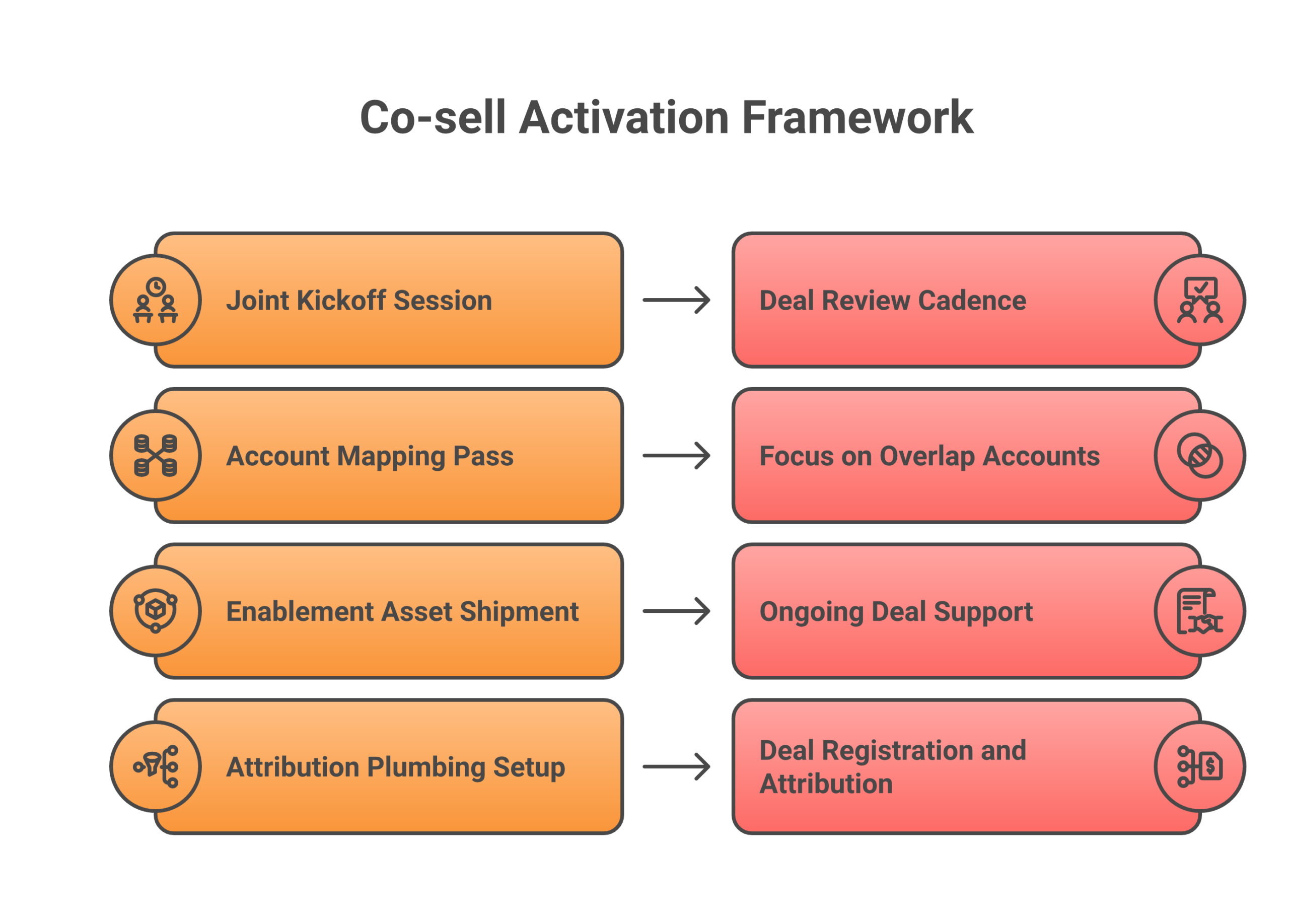
Co-sell activation is a sequenced five-part process executed in the first eight weeks after signature. Each part has a specific owner, a specific artifact, and a specific time window. Skip one and the motion does not produce. Run all five and the partner is producing inside 60 days.
- Joint kickoff with named co-sell roles: A 90-minute working session inside the first 10 days post-signature with named vendor and partner counterparts. Outputs are a documented operating model, named partner manager on each side, and a calendar of cadences for the next eight weeks.
- Account-mapping pass to surface overlap: A Crossbeam, or Common Room overlap run in week one, segmented by partner-customers we both sell to, partner-prospects we are both pursuing, and customer-overlap where we already share logos. This is the data spine for every subsequent deal review.
- First deal-review cadence (weekly for 6-8 weeks): A 30-minute weekly meeting between the two named partner managers, focused on the top 10 overlap accounts. Same time slot every week, no reschedules in the first eight weeks. This is the single mechanism that turns a paper partnership into a producing one.
- Enablement asset shipment: A joint pitch deck, a customer-facing one-pager, and a joint pursuit playbook delivered by week three. Not a content marathon. Three artifacts, shipped, used in the deal-review cadence by week four.
- Attribution plumbing: CRM tags, partner-attribution fields, and deal-registration mechanics (if applicable) set up before the first joint conversation. Tackle, Labra, Suger, or Clazar for hyperscaler co-sell. Native CRM fields for everything else. If you cannot tag a deal as partner-sourced or partner-influenced on day one, you will spend the next two quarters arguing about who gets credit.
The closing point is that none of these are optional and none of them substitute for each other. You cannot skip the deal-review cadence because you shipped a great pitch deck. You cannot skip the account mapping because the partner says they know their book. Each mechanic does a job no other mechanic does.
Common pitfalls
Most activation failures look the same in retrospect, and they all trace to skipping the cadence in favor of something that feels productive but is not.
- Treating activation as a checklist: Teams ship the kickoff, ship the assets, and call it activated. There is no recurring deal-review cadence, so within a quarter the partnership reverts to inactivity.
- Rescheduling the weekly deal review: The first time the deal-review meeting gets pushed because of a quarter-end fire is the moment activation dies. Once it slips, it does not come back.
- Account mapping in isolation: The overlap report gets pulled, lives in a shared drive, and never feeds a conversation. Account mapping without a deal-review cadence is a data exercise, not an activation mechanic.
- Asset overproduction: Twelve enablement assets shipped by week eight, none of which the partner-side AE ever opens. Three assets, used in the cadence, beat twelve assets sitting in a portal.
- Attribution debt: Deals close in month four with no partner-attribution tag because the CRM fields were a phase-two item. Now the program has no scoreboard and no budget defense.
What this looks like in practice
Co-sell activation runs on a three-layer stack. The data layer surfaces overlap. The execution layer runs the cadence and ships assets. The attribution layer captures credit. The stack does not have to be expensive, but it has to be complete.
A Series C SaaS signs a tier-1 systems-integrator partner in January. The partnerships team runs the full eight-week activation cadence: kickoff in week one, overlap pulled in week one, weekly deal review starting week two, three enablement assets shipped by week three, attribution fields live before any joint conversation. First joint-sourced opportunity registered in week eight. First closed-won partner-sourced deal in month five. By end of year one, the SI partner is sourcing roughly $1.2M in annual pipeline.
The same company signs a comparable tier-1 partner in March and skips the weekly deal-review cadence. Same kickoff. Same assets. Same overlap data. No recurring deal review. First joint-sourced opportunity in month seven. By end of year one, the second partner has sourced $180K. Same partner quality, same vendor, same assets. The only variable is the cadence.
Forecastable’s POV
Most co-sell programs treat activation as a checklist and skip the deal-review cadence. That is the single decision that determines whether a partnership produces. I have run the math on more than a hundred partner activations across our client base, and the pattern is unambiguous. Teams that hold the weekly deal review for six to eight weeks produce first opportunity inside 60 days roughly 70% of the time. Teams that skip the cadence average 180 days or never.
The cadence is not magic. It is the only mechanism that forces two organizations with different priorities, different account books, and different incentive structures to actually look at the same deals on the same day. Without it, the partnership reverts to inactivity within a quarter. Every other artifact (the deck, the playbook, the one-pager) is downstream of the cadence and useless without it.
The contrarian point is that activation is not a content problem or an enablement problem. It is a calendar problem. The partnerships leaders who win are the ones who treat the deal-review cadence as non-negotiable for the first eight weeks, even when quarter-end fires are burning. The ones who let it slip are running paper partnerships that will not show up on a board deck two quarters from now.
If you remember one thing from this post, remember the eight-week rule. The cadence is the program. Everything else is supporting evidence.
Forecastable is an independent third-party professional services company. Our evaluations of co-sell activation are based on publicly-available information as of May 2026 and our own client experience.
Frequently asked questions
How long should the activation cadence run?
Six to eight weeks of weekly deal reviews, then transition to bi-weekly for the next quarter. The first eight weeks set the operating rhythm. After that, the cadence can step down if both sides are producing.
What is the right size for a joint kickoff?
Four to six people total. The vendor partner manager, the partner-side partner manager, one AE from each side, and optionally one RevOps or marketing counterpart. Larger kickoffs become demo sessions and produce nothing.
Do we need a PRM to run activation?
No, but you need somewhere to track partner records and deal-registration. A Salesforce or HubSpot record with partner-attribution fields is enough for the first 10 partners. Beyond that, a PRM like Impartner, PartnerStack, Channelscaler, Introw, or Euler starts paying back.
What if the partner will not commit to weekly deal reviews?
That is a qualification signal. A tier-1 partner that will not block 30 minutes a week for the first eight weeks is not a tier-1 partner. Either downgrade their tier or do not sign them.
How do we measure activation success?
Three leading indicators. First joint-sourced opportunity inside 60 days. Cadence attendance rate above 80% in the first eight weeks. At least three overlap accounts moved to active pursuit by week six. If all three hit, the partner will produce.
What about non-overlap partners?
Run the same cadence on prospect-overlap instead of customer-overlap. The mechanics do not change. The data input does.
How does this differ from partner onboarding?
Onboarding is paperwork and portal access. Activation is the operating motion that produces pipeline. Onboarding ends at signature. Activation starts at signature.
Next step
If you are signing tier-1 partners and not running an eight-week activation cadence, you are leaving roughly one quarter of pipeline per partner per year on the table. The fix is mechanical, not philosophical. Block the calendar, name the roles, ship the three assets, run the cadence.
Talk to our team about co-sell activation →
The co-sell hub holds the broader context on how activation fits inside a full co-sell operating model.
Uncover Your Growth Potential
Schedule a Discovery Call